By a Biometrica staffer
On Monday, Dec. 6, the Federal Bureau of Investigation (FBI) published data on nearly 8.9 million criminal offenses reported via the National Incident-Based Reporting System (NIBRS) in 2020. Of the total 8,879,728 offenses reported in 7,560,867 incidents, 60.5% fell under the crimes against property criminal offense category; 25.2% were crimes against persons; and 14.3% were crimes against society.
NIBRS data cannot be compared on an apples to apples basis from one year to another. But, for general understanding, the distribution of criminal offenses by category were very similar even per 2019 statistics. In 2019, the FBI published data on nearly 7.7 million criminal offenses in 6,572,870 incidents. Of those, 59.6% were crimes against property; 24.6% were crimes against persons; and 15.8% were crimes against society.
When it comes to crimes against persons, assault offenses made up the largest category of both incidents and offenses, followed in descending order by sex offenses, kidnapping/abduction, homicide offenses and, finally, human trafficking. Under crimes against property, larceny/theft offenses made up the most reported sub-category among the top five sub-categories, followed by destruction/damage/vandalism of property, fraud offenses, burglary/breaking & entering, and motor vehicle theft.
Within the broader crimes against society category, drug/narcotic offenses accounted for an overwhelming majority, followed by weapon law violations, pornography/obscene material related offenses, animal cruelty, prostitution offenses, and gambling offenses.
Per the NIBRS report, some incidents were counted two or more times when there were two or more offense types within the incident. While referring to victims, the figures represent the number associated with each offense type. The term known offender does not imply that the identity of the suspect is known, but only that an attribute of the suspect has been identified which distinguishes him/her from an unknown offender.
In this piece, we delve further into the data contained in the FBI Uniform Crime Reporting (UCR) Program’s latest report, NIBRS, 2020.
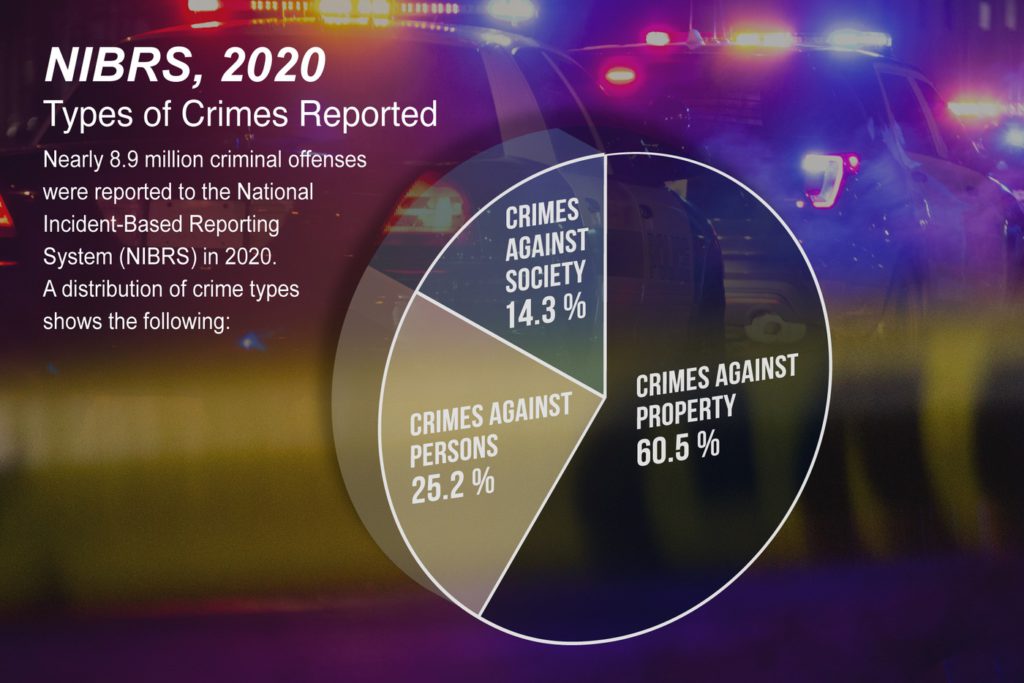
We begin by looking at some of the key highlights of the NIBRS 2020 report.
Participation — In 2020, 9,880 law enforcement agencies, whose jurisdictions covered more than 177.5 million U.S. inhabitants, submitted NIBRS data to the UCR Program. These agencies accounted for 62.1% of the 15,901 law enforcement agencies that submitted data to the UCR Program in 2020. In 2019, 8,497 law enforcement agencies, whose jurisdictions covered more than 146.5 million U.S. inhabitants, submitted NIBRS data to the UCR Program. These agencies accounted for 51.3% of the 16,551 law enforcement agencies that submitted data to the UCR Program in 2019.
Victims — The 9,362,709 victims reported via NIBRS include individuals, businesses, institutions, or society as a whole. For 2020, the data regarding the 6,597,394 victims who were individuals showed:
Known Offenders — In 2020, law enforcement reported information about 7,173,072 known offenders, meaning some aspect of the suspect — such as age, gender, or race — was known.
Arrestees — Law enforcement agencies submitted data to the UCR Program through incident reports and arrest reports for 3,621,299 arrestees.
By a Biometrica staffer Drug related offenses accounted for almost one-third of all cases reported...
Read articleBy a Biometrica staffer London in the late 17th and 18th centuries was a rather...
Read articleBy a Biometrica staffer Anyone can, potentially, help in the battle against human trafficking. How?...
Read article