By a Biometrica staffer
This time last week, we established that yes, terror groups were very much active during 2020, even when much of the world was closed due to the Covid-19 pandemic, as the Europol Terrorism Situation and Trend Report 2021 showed. In the second part of the series, we go into details about the biggest terror threat to the European Union in 2020: jihadist terrorism.
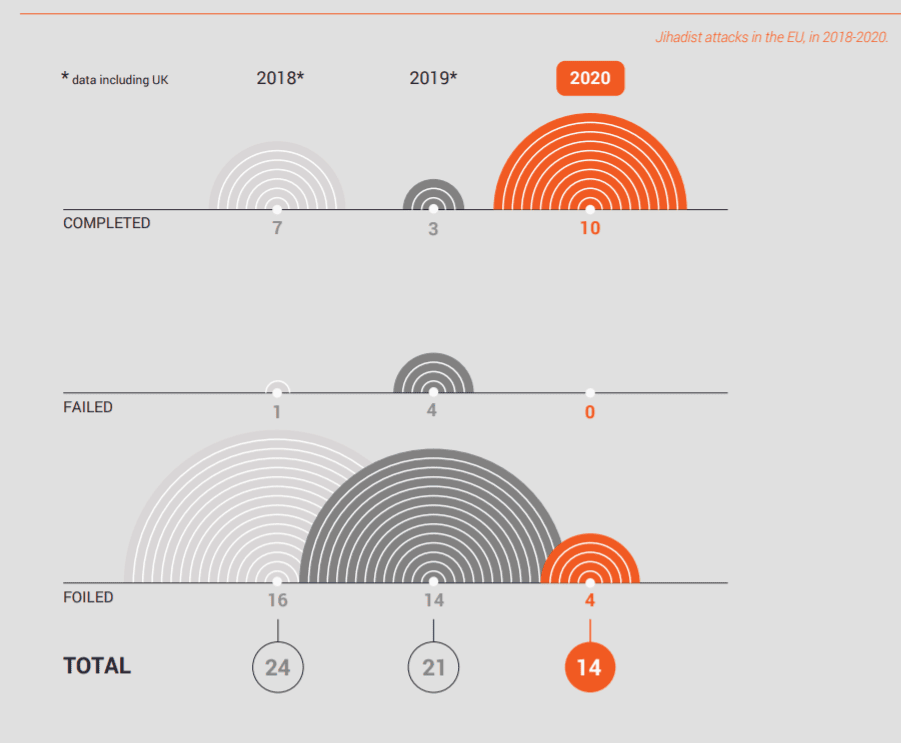
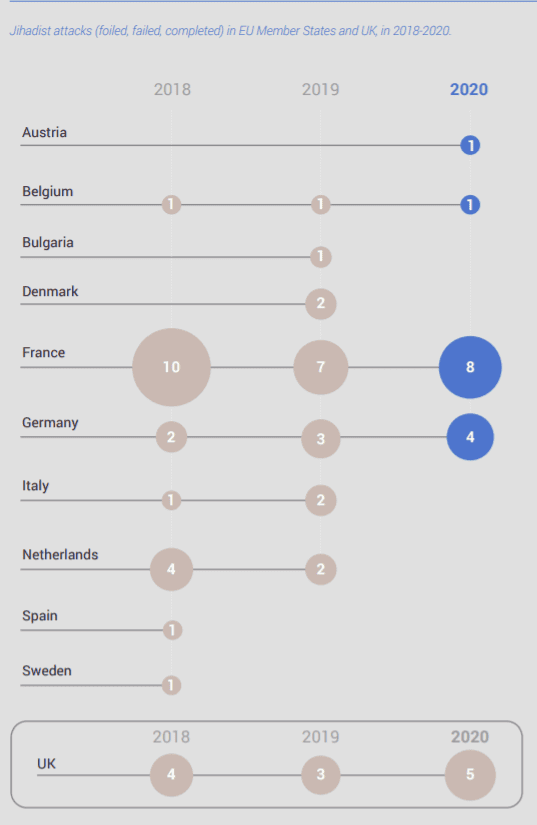
In 2020, there were 10 completed jihadist terrorist attacks in the EU, which killed 12 people in Austria, France, and Germany. More than 47 people were injured. Four jihadist attacks were foiled in Belgium, France, and Germany. The UK reported three jihadist terrorist attacks, one that led to three people being killed and two plots that were thwarted. In addition, Switzerland reported two attacks in which jihadist motivation probably played a role.
As we said in our piece last week, the number of completed jihadist attacks in Europe (EU, Switzerland, and the UK) in 2020 more than doubled in comparison with the number in the EU (including the UK) in 2019. However, it’s not immediately clear if that jump is linked to the effects of the pandemic, the report said.
In today’s piece, we delve into the definition of jihadist terrorism, its status in the EU, and give you a quick brief of each of the 10 completed jihadist terror attacks in the region during 2020. We will be examining other kinds of terror attacks, including right-wing and left-wing related extremism and terrorism in the next part of this series.
What Is Jihadist Terrorism?
The Europol’s report says it uses a narrow definition of the term “jihadism” to define jihadist terrorism. Jihadism, it says, is “a violent sub-current of Salafism, a revivalist Sunni Muslim movement that rejects democracy and elected parliaments, arguing that human legislation is at variance with God’s status as the sole lawgiver. Jihadists aim to create an Islamic state governed exclusively by Islamic law (shari’a), as interpreted by them. Major representatives of jihadist groups are the al-Qaeda network and the self-proclaimed Islamic State (IS) terrorist group.” Other Salafist currents are mostly quietist.
The term “jihad” in classic Islamic doctrine actually means “striving” or “exertion,” the report clarifies. But in Islamic law it is treated as religiously sanctioned warfare and draws historical comparisons with the Christian crusades of the Middle Ages to describe the current situation, i.e., that Sunni Islam is believed to be under attack from a global non-Muslim alliance comprising Christians, Jews, people of other religions such as Buddhists and Hindus, and secularists as well. Some jihadists even include Shi’is, Sufis, and other Muslims in their spectrum of perceived enemies.
Jihadist Modi Operandi
We also pointed out last week that all completed jihadist terrorist attacks were carried out by lone actors, while disrupted plots mainly involved multiple suspects. There were several other factors identified by the EU report as part of the modi operandi of jihadist attacks in 2020. Here’s a look at some of those based on excerpts from the report:
The 10 Completed Jihadist Attacks Of 2020
There were ten completed jihadist attacks in 2020, as we mentioned earlier. Here’s a quick look at them, per the report:
On Jan. 3, a 22-year-old French male convert to Islam stabbed one person to death and injured two others in a park in Villejuif (Val-de-Marne, France). The attacker was shot and killed by police. He had a history of severe mental illness. A letter found in a bag nearby contained an identity card and a letter in which the alleged perpetrator talked about God and asked for forgiveness.
On April 4, a 33-year-old Sudanese male refugee stabbed and killed two people and injured five others in Romans-sur-Isère (Drôme, France). The perpetrator first went to a tobacco shop and stabbed the owner and his wife, then to a butcher’s shop where he seized a knife and attacked people waiting outside a bakery, killing two people, before being arrested. He had entered France in 2016 and reportedly was unknown to French police and intelligence services. Documents were found at his home, probably handwritten by the attacker, in which he described France as a land of “unbelief.”
On April 27, a 29-year-old French male seriously injured two police officers on motorbikes who were checking a vehicle in Colombes (Hauts-de-Seine, France), northwest of Paris, when he rammed them with his vehicle. A pledge of allegiance to IS and a knife were found in his car. The attacker was arrested and admitted having acted intentionally.
In April/May, a 25-year-old German male, born in Bavaria to Turkish-Kurdish parents, perpetrated a series of attacks on Turkish-owned commercial establishments in Waldkraiburg (Bavaria, Germany). In an arson attack on a fruit and vegetable store on 27 April, a total of six people living in the building were injured. In 2018, he had attempted unsuccessfully to join IS in Syria.
On Aug. 18, a 30-year-old Iraqi male asylum seeker caused several car crashes and injured six people on a highway in Berlin (Germany). The perpetrator was arrested. The attack was not claimed by any terrorist organization. Statements by the attacker after his arrest suggested a religious motivation. There were also indications of psychological instability.
On Sept. 25, a 25-year-old male of Pakistani origin injured two people when attacking them with a meat cleaver in front of the building that was the scene of the 2015 attack on the satirical magazine Charlie Hebdo. The attacker was unaware that the Charlie Hebdo office had moved to a different location.
On Oct. 4, a knife attack was committed against two male tourists in Dresden (Saxony, Germany). Both victims suffered serious injuries. One of the victims died in hospital a short time later. The perpetrator, a 20-year-old Syrian national, was identified and arrested on Oct. 20. The attack had a radical Islamist motivation. The perpetrator selected his victims, a gay couple, for being symbols of a liberal and “unbelieving” society.
On Oct. 16, an 18-year-old male killed and decapitated a French school teacher in Conflans-Sainte-Honorine near Paris (France). The perpetrator, who was born in Moscow (Russia) to Chechen parents and brought to France as a young child when they applied for asylum, posted an image of the severed head on Twitter, threatening anyone perceived to have insulted the Prophet Muhammad. The teacher is said to have been targeted for showing cartoons of the Prophet Muhammad to his students. The perpetrator was killed by police near the scene of the attack. IS praised the attacker in its weekly Arabic language newsletter al-Naba’ (“The News”), but did not claim responsibility. An al-Qaeda publication eulogized him and compared him to the perpetrators of the 2015 attack on Charlie Hebdo.
On Oct. 29, a 21-year-old Tunisian male, who had entered the EU as an irregular migrant approximately a month earlier, killed three people inside Notre Dame cathedral in Nice (France) with a knife and injured a fourth one approaching the main entrance. The attacker was shot and injured by police and arrested.
On Nov. 2, shortly before a Covid-19 lockdown was to come into effect, a 20-year-old male of Austrian and North Macedonian nationality started a shooting spree near a synagogue in central Vienna. The perpetrator was carrying an AK47 assault rifle, a Tokarev pistol, a machete, and a fake explosives belt. He randomly targeted people in the street and nearby restaurants, killing two women and two men. One police officer and 16 guests in restaurants were injured by gunshots, and 10 additional individuals were injured during their attempt to escape. Nine minutes into the attack, the attacker was killed by police. Responsibility for the Vienna attack was claimed by IS, and its A’maq News outlet released a video of the attacker pledging allegiance to the IS leader, the first such release since 2018.
Given the comprehensive nature of the Europol report, this is the second in a series of pieces we will be doing based on its findings.
A face search can do its job perfectly and still put the wrong person in...
Read articleIn the space of three days this month, two local governments walked away from the...
Read articleA stop or an arrest that starts from an identity match fails in one of...
Read article