By a Biometrica staffer
A total of 1,864 suspects in matters involving violations of federal hate crime statutes were investigated by U.S. attorneys during the fiscal years 2005 to 2019, the Bureau of Justice Statistics (BJS) said in a report published last week on federal hate crime prosecutions. The number of hate crime matters investigated during 2015–19 fell 8% to 597 (or 119 per year), from 647 during 2005–09 (or 129 per year), the report said. However, the conviction rate rose during the same comparable periods to 94% from 83%.
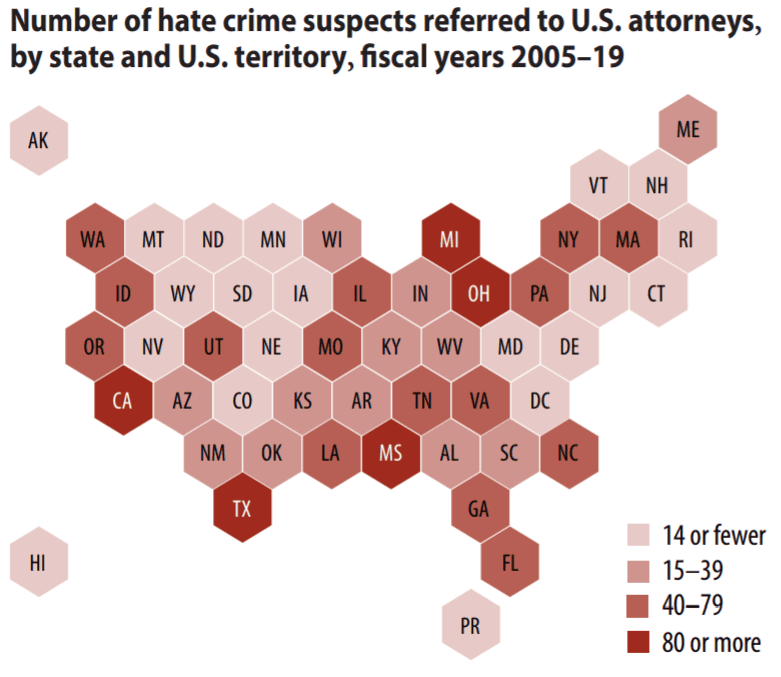
Nearly half of the 597 suspects investigated for a hate crime during the years 2015-19, the most recent period for which data is available, were referred to U.S. attorneys for violating the Hate Crimes Prevention Act (HCPA). Of the 284 hate crime convictions during the entire 15 year period (i.e., 2005-19), 40% occurred in federal judicial districts in just six states: New York (30), California (26), Texas (19), Arkansas (15), Tennessee (13), and Pennsylvania (12).
In today’s piece, we give you a broad overview of the most important statistics from the report, and examine the report’s definitions of hate crimes and the laws around it.
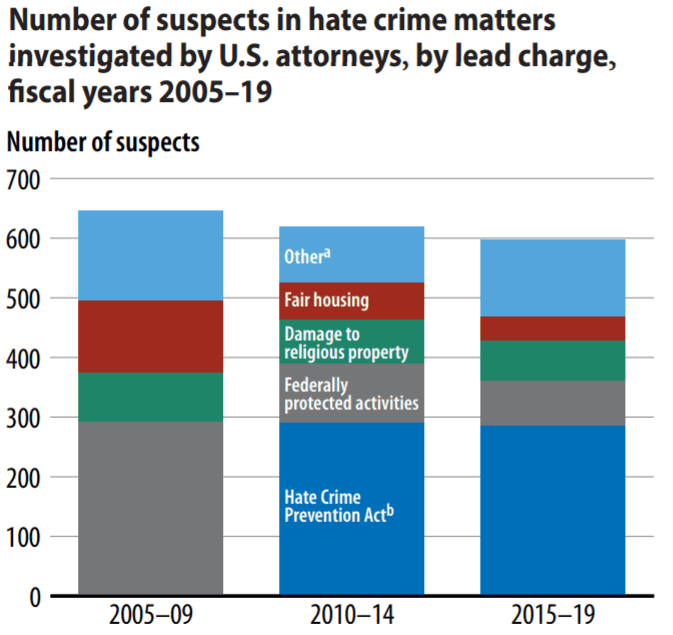
Key Takeaways From The BJS Report
Apart from the points we listed above, here’s a list of some of the other statistics from the comprehensive report that we thought were important:
Hate Crime Definition
In a piece published at the start of this year, we explained hate crime from the FBI’s perspective and definition. According to the Bureau: In the simplest terms, a hate crime must include both “hate” and a “crime.” But there’s more to it than just that. Take the word “hate,” for instance. While in regular usage, hate may mean rage, anger, or general dislike, in the context of hate crime it means bias against people or groups with specific characteristics that are defined by the law.
Crime in this context often refers to a violent offense, such as assault, murder, arson, vandalism, or threats to commit such crimes. It may also cover conspiring or asking another person to commit such crimes, even if the crime was never carried out, according to the FBI. Acts of prejudice that do not involve threats, property damage or violence are called “bias/hate incidents” by law enforcement.
The BJS report also draws on these definitions by federal justice agencies and defines hate crimes according to statute information. According to the report, that includes crimes in which the perpetrator selected the victim based on certain characteristics, such as race, color, religion, and national origin.
Federal Statutes Used In Hate Crime Prosecutions
There are four federal statutes specifically for hate crimes, and they are used along with a general conspiracy statute when it comes to hate crime prosecutions. For instance, HCPA, which we mentioned earlier, is actually known as The Matthew Shepard and James Byrd Jr. Hate Crimes Prevention Act, in its full form. It was approved by the U.S. Senate as an amendment to the Defense Authorization Act (H.R. 2647) in October 2009.
It extended hate crime law to cover gender, disability, sexual orientation, and gender identity. The Act is named after Matthew Shepard and James Byrd Jr., both victims of hate crimes. Shepard was a gay student who was beaten to death in Wyoming in 1998, and Byrd Jr. was an African American man who was murdered by white supremacists in Texas in 1998. A concise overview of this act can be found here.
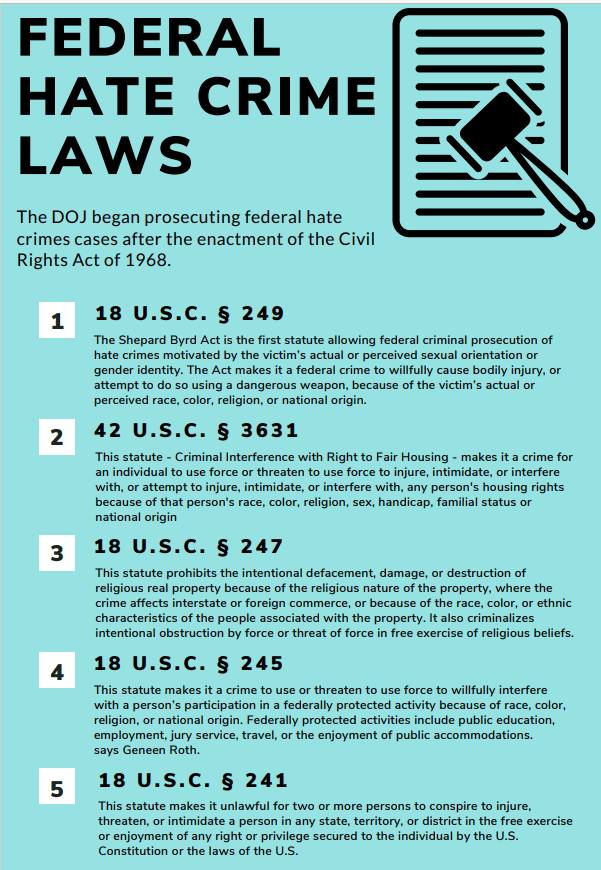
What does the BJS report from last week say about each of these laws? Here’s a quick excerpt:
18 U.S.C. § 245: Federally protected activities — Activities protected under this law include (1) enrollment in a public school or college, (2) participation in programs administered or financed by any state, (3) federal and state employment and jury service, (4) interstate travel by common carrier, and (5) use of restaurants, lodging, gas stations, public entertainment facilities, and other establishments serving the public.
18 U.S.C. § 247: Damage to religious property — Prohibits intentionally defacing, damaging, or destroying religious property because of the race, color, or ethnic characteristics of any individual associated with that property.
18 U.S.C. § 249: HCPA — Prohibits willfully causing bodily injury, or attempting to cause bodily injury with a dangerous weapon, when the crime was committed because of certain characteristics (of the victims involved).
42 U.S.C. § 3631: Criminal interference with right to fair housing — Prohibits forcible interference with any person in selling, purchasing, renting, financing, occupying, or contracting for any dwelling due to that person’s race, color, religion, gender, national origin, disability, or family status.
18 U.S.C. § 241: Conspiracy against rights — Prohibits conspiracies to injure any person who is exercising rights or privileges protected by the Constitution or laws of the United States.
A face search can do its job perfectly and still put the wrong person in...
Read articleIn the space of three days this month, two local governments walked away from the...
Read articleA stop or an arrest that starts from an identity match fails in one of...
Read article