On Monday, May 31, the Center for The Defense of Children’s Rights, published a report in which it said it had uncovered a “disturbing pattern” of child sexual abuse at as many as 18 schools and childcare centers in Mexico. The investigation alleges that it has found evidence that numerous adult employees coordinated to sexually abuse children as young as three years old, exhibiting tactics that were “eerily similar,” according to the Associated Press.
The Center’s legal team identified possible criminal patterns of abuse and then reviewed 37 cases to see if any of their details matched that pattern. They found such similarities in 18 schools. The group said that their findings “demonstrate patterns of criminal behavior characterized by organized aggressions committed by multiple adults perpetrated in mass scale within the premises of a given school.”
In many of these attacks, perpetrators used similar disguises or staged the act in similar ways. The victims were also made to watch adults engaging in sexual activity and abusing other children. The group says that in 2018 they found one case in which 11 adults at a preschool abused pupils between ages three and five, using a practice that they “found over and over in other cases.” In 2011, six staffers at one school — its principal, four teachers and the janitor — were found guilty of abuse. The report says that the assaults took place within the school and that the abusers “do not seem to hide when committing the repeated abusive behavior.” In fact, activists and lawyers prosecuting the cases expressed amazement at how brazen the abusers were.
These types of coordinated rings need to be met with an equal, if not greater, level of organization between various law enforcement agencies and the legal system. However, this does not appear to be happening on the ground, according to the Center. They say that rather than noting patterns or even questioning whether assaults involve more than one perpetrator, prosecutors tend to go after abusers as individuals. This disorganization and fragmentation makes it near impossible to draw links between criminal organizations and serial offenders.
The report highlighted that there is a chance that “numerous primary and pre-school facilities have been coopted and used to commit on-line child sexual abuse.” Many of the victims say that they were filmed or photographed during the assaults, raising the specter of child sexual abuse material being produced and disseminated out of these crimes.
Mexico’s president, Andrés Manuel López Obrador, termed the report’s revelations “reprehensible” and “appalling.” He said his government is engaged in ongoing work to tackle the problem of child sexual abuse. He said he has asked his administration to present a report on the status of these efforts.
Meanwhile, school shutdowns and the advent of online learning that has stemmed from the Covid-19 pandemic is unlikely to have helped matters at all. Organizations like UNICEF and INTERPOL have noted a worrying spike in reports of children being sexually abused and exploited online.
With patient, provider, volunteer, and public safety the focus in the physical and virtual worlds, Biometrica will give SoulSpark the ability to run fully-automated, continuous background checks on an individual to mitigate insider threats.
MESA, Ariz., June 1, 2021 – Biometrica Systems, Inc., an Arizona and Nevada-based technology company that tracks crime and criminals, and SoulSpark, an Arizona-based virtual clinic providing mental health services to young survivors of trauma, announced a public safety partnership to protect at-risk youth that had been victims of tragic events.
SoulSpark became the first healthcare organization to sign up for eMotive, Biometrica’s next generation, 24×7 criminal background checking software. Dr. Jania Davis, SoulSpark CEO, said they “wanted to add an extra layer of protection to at-risk children and youth that had lived through too much pain.”
“Last year, a healthcare facility I was part of was rocked by the arrest of a longstanding staffer, charged with multiple counts of sexual conduct with a minor. It was tragic for the teenager, but also a devastating indictment of the system for everyone who worked there. We had one question: How did we miss it? We think eMotive holds the key to proactive protection, inasmuch as any system can.”
eMotive gives an organization the ability to be notified in near real-time, through an encrypted alert to authorized personnel, that an employee has potentially been arrested or convicted. The notification happens within minutes of that event being updated in law enforcement databases.
“We can decide if an arrest is relevant to patient safety or not based on job function, conduct underlying the arrest, and business necessity,” said Dr. Davis. “If a provider is arrested for a bounced check, it isn’t relevant. But if they are arrested for child pornography or domestic violence, that is relevant, especially as they interact with vulnerable youth.”
Kadambari Wade, Biometrica’s CCO, said eMotive was built with at-risk children in mind. “My daughter is 12, but about three developmentally. She is deaf and autistic. She cannot tell you if someone touches her inappropriately, nor know it is inappropriate. We thought the best way to protect children like her would be by ensuring people around them could be monitored on a continuous basis for the potential to do harm.”
Charlotte Spencer, eMotive’s lead UI/UX developer, said eMotive’s difference was in how it worked. “Our algorithms run automated continuous monitoring of enrolled people, as opposed to traditional, manual, single point-in-time checks. We focus only on law enforcement-sourced data. We don’t track credit scores, license plates, drug tests, or social media — that isn’t our business. We’re interested in whether you were arrested or convicted, and why.”
About SoulSpark
SoulSpark (https://soulspark.co) is a virtual outpatient mental health clinic for at-risk youth, specializing in trauma-informed care for sex-trafficking victims. We utilize an integrative therapeutic approach while empowering youth to address mental health, behavioral and substance abuse challenges. Services include psychiatry, family and group counseling, and life-skills training, with family and system providers collaborating to identify client-specific treatment plans. Hello@soulspark.co 888.89.SPARK
About Biometrica
Biometrica Systems, Inc. (https://safience.io/) is a software & data company focused on public safety. We support federal, state, tribal and local law enforcement, organizations focused on child and vulnerable adult protection, and private sector safety teams. We are a PBSA member, committed to building better quality arrest and conviction data and more transparent access to it.
With several states across the U.S. legalizing the use of cannabis, for medical and/or recreational purposes, over the past six months or so, we began a series of posts on topics related to drug-free workplaces. Our very first post of the series gave an introduction to drug-free workplace programs, the Department of Health and Human Services’ (HHS) guidelines on federal workplace drug-testing programs, and an overview of drug-testing programs. Today, in the second post of the series, we give you a rundown of federal guidelines over reasonable suspicion testing.
Here’s a quick recap of drug testing at workplaces before we get into reasonable suspicion: – Drug-free workplace regulations are governed by the Drug-Free Workplace Act of 1988. The Act defines a drug-free workplace as one where “the unlawful manufacture, distribution, dispensation, possession, or use of a controlled substance is prohibited.” – Most employers strictly prohibit the use, possession, and sale of illegal drugs and alcohol at work. Some employers that are regulated by a U.S. government agency like the Department of Transportation have mandated procedures in place. The Federal Drug-Free Workplace Program is a comprehensive program that addresses illicit drug use by federal employees. – Employers with successful drug-free workplace programs report improvements in morale and productivity, and decreases in absenteeism, accidents, downtime, turnover, and theft. Those with long-standing drug-free programs have also reported better health status among employees and family members and reduced healthcare costs, the National Institute on Drug Abuse (NIH) says on its website.
Some schools, hospitals, and places of employment require drug testing. This can be done in various ways, including pre-employment testing, random testing, reasonable suspicion/cause testing, post-accident testing, return to duty testing, and follow-up testing. Tests vary, depending on the type of drug being tested for and the type of specimen being collected. Urine, hair, saliva (oral fluid), or sweat can be used as test specimens.
Consume alcohol while performing a safety-sensitive function, four hours prior to performing the function, and up to eight hours following an accident or until the employee undergoes a post–accident test, whichever occurs first.
Ingest illegal drugs at any time
Workplace drug-testing programs are formulated with the end goal of detecting the presence of alcohol, illicit drugs, or certain prescription drugs. It is considered a way to prevent and deter employees, and is often only one part of a comprehensive drug-free workplace program. Both federal and non-federal workplaces may have drug testing programs in place. All workplace drug-testing programs must comply with relevant local, state, and federal laws.
What Does Reasonable Suspicion Mean?
As the title suggests, reasonable suspicion implies that an employer has a sufficient cause to believe that someone employed by them has been using drugs, although it could also extend to include alcohol abuse on the job. It’s sometimes also interchangeably used with for-cause testing. “You may decide to test employees who show discernible signs of being unfit for duty (for-case testing), or who have a documented pattern of unsafe work behavior (reasonable suspicion testing.) These kinds of tests help to protect the safety and wellbeing of the employee and other coworkers,” the Substance Abuse and Mental Health Services Administration (SAMHSA), which runs a helpline to aid in the creation and running of drug-free programs at workplaces, says on its website.
It cannot be based on hunches. There has to be a legitimate reason behind it, and it has to be contemporary and not based on something that happened in the past. It can, however, vary depending on circumstances.
How does an employer arrive at a conclusion then? Several federal organization websites and some non-profits list out these signs that employers can look for:
Direct observation of drug use or physical symptoms of drug use (slurred speech, uncoordinated movement, dilated pupils, blackouts, sleepy condition, slower reaction rates, etc.)
A pattern of abnormal conduct or erratic or aggressive behavior
Attendance issues
Arrest or conviction for a drug-related offense, or the identification of the employee as the focus of a criminal investigation into illegal drug possession, use, or trafficking
Newly discovered evidence that the employee has tampered with a previous drug test
There can, of course, be other signs that may crop up depending on circumstances and the individual employee/employer involved.
So, what happens once an employer does identify enough cause for reasonable suspicion? We’ll use the FTA guide for transit supervisors to answer that.
“The regulations require that a reasonable suspicion referral must be based on a trained supervisor’s specific, contemporaneous, articulable observations concerning the appearance, behavior, speech, or body odor of the person for whom the referral is made. Supervisors must receive at least 120 minutes (60 on alcohol; 60 on drugs) of training and should be evaluated on their performance of that particular supervisory function,” the FTA says in that guide.
Only one trained supervisor’s opinion is required to kick off the process of a reasonable suspicion test. But, the supervisor’s decision must pass the “reasonable and prudent” rule of thumb. This is a cognitive judgment call that requires the supervisor to: 1) assess the facts, signs and circumstances for which the reasonable suspicion is being determined, AND 2) cognitively deduce that a similarly trained and experienced supervisor (having observed the same facts, signs, and circumstances) could have reached the same conclusion.
What Happens Once Reasonable Suspicion Is Established?
Once a supervisor establishes reasonable suspicion, the next step, of course, involves speaking with the employee in question. The supervisor explains why they believe there’s cause for reasonable suspicion and then ask the employee if they are willing to undergo a test. Ideally, every effort is made to conduct the test immediately. In some cases, employees may refuse to take the test. But a refusal can be viewed as tantamount to a positive test result. The supervisor then informs the employee what a refusal to take a test implies.
When an employee agrees to take a test, then the tests are typically done by a trained specialist who visits the workplace to collect specimens. Alternatively, the employee can also visit a certified laboratory. To ensure accuracy, the specimen’s chain of custody must be continuous from receipt until disposal. The kinds of drug tests vary, and there are five main categories that are typically tested for: marijuana, cocaine, amphetamines, PCP, and opioids. For alcohol abuse tests, a breathalyzer is used.
There are a few points to bear in mind here about this kind of testing. First, supervisors directly responsible for the decision to conduct a reasonable suspicion test are usually mandated to respect an individual’s dignity, and keep that information confidential. Second, as part of a comprehensive drug-free workplace program, employees are meant to be aware of their rights from the start of their tenure.
For instance, under the FTA’s drug rule, employees must receive 60 minutes of training on the drug testing program, including health and safety issues, employees’ roles and responsibilities, and the testing process. The FTA alcohol rule requires that employees be provided with additional materials addressing those same issues as they relate to alcohol. Employers must also distribute copies of their substance abuse policies to their safety-sensitive employees.
Third, an employee’s direct supervisor may not be allowed to collect urine specimens or perform a breathalyzer test on the employee concerned. As mentioned above, that task is usually done by a trained collector. Fourth, employees are meant to be given the opportunity to list prescription medications they are taking, typically on their copy of the Custody and Control Form.
Why Is Reasonable Suspicion Testing Necessary?
General workplace safety aside, according to federal guidelines, this kind of drug testing matters in particular to employees whose job functions are safety-sensitive. For instance, a bus driver who smoked pot just before or while he was driving passengers around could be putting his own life and the lives of several others at risk. Employees who perform safety–sensitive functions are responsible not only for their own personal wellbeing, but those of their colleagues and the public as well.
The intent of any drug and alcohol testing programs at workplaces is not to control the private lives of employees, federal guidelines explain. The primary concern is to protect the safety of employees, passengers, and the public.
Studies suggest that many adults who use illegal drugs are employed full or part time, the NIH says, adding that when compared with those who do not use substances, employees who use substances are more likely to:
Change jobs frequently.
Be late to or absent from work.
Be less productive.
Be involved in a workplace accident and potentially harm others.
File a workers’ compensation claim.
Next up in this series: How to get started with creating drug-free workplaces.
You can find the comprehensive guidelines on controlled substances and alcohol use testing under the Electronic Code of Federal Regulations here.
SAMHSA provides confidential, practical, impartial, and up-to-date information, advice, and support free of charge to employees and their families. You can reach the Drug-Free Workplace Helpline at 1-800-WORKPLACE (967-5752).
As the dust settles, more details are emerging about the past of the gunman who killed nine people and then himself in San Jose on Wednesday, May 26, in what is the Bay Area’s deadliest mass shooting. Samuel Cassidy, identified by the Santa Clara Sheriff’s Office as the killer, is reported to have had a history of alcohol abuse, sexual assault and rage against his coworkers, according to authorities.
Early Wednesday morning, Cassidy entered the Valley Transportation Authority (VTA) rail yard near downtown San Jose, firing 39 times and killing nine of his co-workers. Law enforcement responded within minutes, and as they closed in, Cassidy turned the gun on himself.
It has become almost familiar for law enforcement, elected officials and the public to engage in a post-mortem after incidents like this, looking for warning signs or previous brushes with police. In Cassidy’s case, questions have emerged as to how he managed to circumvent California’s tough gun laws, his motivations and what made him “snap.”
Experts point out that gunmen who carry out mass shootings “very rarely … snap.” There are usually warning signs, be they clues that the attacker themselves leave, or through previous interactions with law enforcement or mental health professionals. Cassidy, however, does not seem to have a criminal public record, so he would likely have passed a background check, which may have been how he was able to legally obtain firearms.
The three handguns he used at the shooting were not “ghost” guns, according to authorities. They were legally obtained and part of his larger collection, which included shotguns and rifles, the Sheriff’s Office said. However, the 32 high-capacity magazines he brought along to the shooting are illegal under California’s strict gun regulations.
Those who knew Cassidy say that his unhappiness with his job as a VTA maintenance worker was well known. He often complained about his coworkers. Investigators described him as a “highly disgruntled” employee.
Cassidy’s ex-wife Cecilia Nelms spoke to the media about his history of troubling behavior and his antipathy towards the VTA. Nelms, who was married to Cassidy for about a decade until they divorced in 2005, says that her ex-husband frequently complained about his coworkers, saying, “I’m going to kill the son-of-a-gun” about someone or talking about wanting to “beat [someone] up.” She described his tirades as “enraged ranting,” seemingly stemming from a feeling that he was being given harder jobs than his coworkers.
Authorities have indicated that the victims, many of them long-term employees of the VTA, and Cassidy knew each other fairly well. There seems to be some indication, as well, that he was systematic in his attack, choosing who to shoot and even sparing one person. An unnamed source within the VTA alleges that Cassidy was facing a disciplinary hearing over his past conduct at work on Wednesday, May, 26, the same day as his rampage. This claim has not yet been verified by authorities. A VTA spokesperson refused to comment on whether Cassidy had a disciplinary record at work or whether any of his colleagues had ever reported him for unsettling behavior.
Nelms said that Cassidy never mentioned any specific names to her, nor did he ever say he wanted to shoot the coworkers he talked about. She added that he never spoke of guns and she didn’t even know he wanted to own any. Nelms, who has not spoken with Cassidy for over a decade, said she was struggling to reconcile the person she knew with the violent perpetrator on TV. She admitted, however, that he had “two sides.”
An ex-girlfriend of Cassidy’s in 2009 accused him of alcohol-fueled rape, sexual assault and “enraged” mood swings. In a sworn statement filed with a court, the unnamed woman, who was in a relationship with Cassidy for about a year, says he was violent and “forced himself on [her] sexually.” If she refused, he would restrain her. Cassidy had filed a domestic violence restraining order against the woman on the basis of harassment.
On Thursday, it emerged that the Department of Homeland Security had previously circulated a memo about Cassidy when he was stopped and questioned by U.S. Customs and Border Protection (CBP) five years ago. In 2016, on his way back from a trip to the Philippines, CBP flagged him off after they found a number of troubling items in his possession, including books and “manifestos” about terrorism and “fear,” and a small notebook holding rants of hiw much he hated his workplace. When asked, however, Cassidy reportedly told them that he did not have problems with anyone at work.
Though the memo does not specify why he was stopped, it does mention a “minor criminal history” and 1983 misdemeanor charge for “obstruction/resisting a peace officer” in San Jose. A Biden official admitted that they knew about the DHS memo, while the FBI said they had never investigated Cassidy. The Santa Clara Sheriff’s Office did not comment on whether Cassidy was on their radar or whether they had ever investigated him.
Preliminary evidence from Cassidy’s home has allegedly yielded bomb-making materials, and there are signs that he hoarded weapons and ammunition. Before he left for the rail yard, he rigged up his house to explode, using a timer. The house caught fire just as 911 calls were coming in about the shooting at the VTA facility. There are signs that ammunition inside his house exploded, collapsing the second floor. This has complicated matters, as investigators from the San Jose police, ATF, FBI and Santa Clara Sheriff’s Office are having to sift through debris to find clues.
Cassidy appeared to expend some effort in planning his crime, going about it methodically. But instead of executing an even bigger attack, he channeled his knowledge of terrorism into his personal vendetta — murdering the coworkers he hated.
According to Dr. Ziv Cohen, an experienced forensic and clinical psychiatrist who spoke to USA Today, Cassidy seems to fit the “typical mass shooter profile,” based on everything discussed above. However, Dr. Cohen was quick to point out, there are probably plenty of people in the country who display similar red flags.
This, he says, is part of the bigger problem law enforcement faces. On a daily basis, police at all levels may come into contact with people who present “warning signs.” But the truth is that most of them will not go on to commit such heinous and large crimes; just because someone is suspicious does not mean that police can take action. “It’s hard because a crime has to happen before an arrest,” Dr. Cohen said, “you can’t always anticipate behavior.”
As is routine after events like this, multiple lawmakers have renewed calls for federal legislators to take action on gun ownership reform. This includes President Joe Biden, who has previously referred to America’s gun violence problem as an “epidemic” and an “international embarrassment.”
Reforms can range from enhanced background checks and not selling guns to people suffering from mental illnesses, to tightening concealed and open carry laws, and banning high-capacity “assault rifles.” Public support for these measures varies, but most Americans seem to agree that something needs to be done to prevent what have become routine news reports of mass shootings.
The nine victims of Wednesday’s massacre were identified as Abdolvahab Alaghmandan, 63; Adrian Balleza, 29; Alex Ward Fritch, 49; Jose Dejesus Hernandez III, 35; Lars Kepler Lane, 63; Michael Joseph Rudometkin, 40; Paul Delacruz Megia, 42; Taptejdeep Singh, 36; and Timothy Michael Romo, 49.
Early morning on Wednesday, May 26, a gunman — identified as Sam Cassidy by media reports — opened fire at a public transit rail yard in San Jose, California. He ended up killing at least eight of his co-workers and injuring several others in what has been identified by the Gun Violence Archive (GVA) as the 232nd mass shooting incident so far this year. In comparison, there were 417 mass shooting incidents in all of 2019, according to data from the GVA, the latest year in its six-year review.
The nine victims were identified later on Wednesday by the Santa Clara County Office of the Medical Examiner-Coroner as: Paul Delacruz Megia, 42 Taptejdeep Singh, 36 Adrian Balleza, 29 Jose Dejesus Hernandez III, 35 Timothy Michael Romo, 49 Michael Joseph Rudometkin, 40 Abdolvahab Alaghmandan, 63 Lars Kepler Lane, 63 Alex Ward Fritch, 49
Fritch was transported to Santa Clara Valley Medical Center in critical condition and died on Wednesday evening, the coroner’s office said. The alleged gunman’s ex-girlfriend is reported to have said that she was scared of him and that he sexually assaulted her, had major mood swings exacerbated by heavy drinking and was mentally unstable.
It is yet another mass shooting that has claimed the lives of essential workers in the U.S. On April 16, which happened to be the 14th anniversary of the Virginia Tech massacre that claimed 32 lives, eight people were killed at a FedEx warehouse in Indianapolis. On March 22, a gunman opened fire at a King Soopers outlet in Boulder, Colorado, killing ten people, including police officer Eric Talley, who responded to the incident.
President Joe Biden “yet again” ordered the flag over the White House to be lowered to half-staff after the San Jose mass shooting, and issued a single word plea: “Enough.” He added that Congress should immediately “heed the call of the American people, including the vast majority of gun owners, to help end this epidemic of gun violence.”
A mass shooting incident is defined as one where four or more people are killed, excluding the shooter. The GVA documents every reported incident of gun violence in the United States, collecting this information from more than 7,500 law enforcement, media, government and commercial sources daily, in an effort to provide near-real time data about the results of gun violence.
The San Jose shooting took place at around 6:30 a.m. PT on Wednesday, when several 911 calls reported shots fired near a Valley Transportation Authority (VTA) control center, a hub that stores light rail trains, houses a maintenance yard and employs about 2,000 workers, CNN reported. The VTA provides bus, light rail and other transit services throughout Santa Clara County, the most populated county in the San Francisco Bay Area, the Associated Press said in its report. The incident occurred in the rail yard as employees from the midnight shift and those from the day shift overlapped, Santa Clara County Deputy Sheriff Russell Davis said. Transit authority mechanic Rochelle Hawkins said she dropped her phone when she heard shots, adding, “I was running so fast. I just ran for my life.”
Multiple law enforcement agencies and fire department personnel are said to have responded with their “active shooter protocol.” Law enforcement officers (LEOs) did not exchange fire with the suspected gunman, who took his own life once he realized LEOs were on the scene, county sheriff Laurie Smith said. Multiple guns were used in the incident, per District Attorney Jeff Rosen.
Rosen did not go into the specifics of the weapons, nor whether they were obtained legally, but did say they were not considered to be untraceable “ghost guns.” Cassidy, the suspected shooter, also reportedly set fire to his own home on Angmar Court before the incident at the rail yard, according to a report by ABC7 News. When firefighters arrived on the scene, no one was inside the home. ABC7 News obtained surveillance video that shows Cassidy leaving his home shortly before it went up in flames. “It would appear as if the fire was set as the shooter was on his way to the worksite,” San Jose Mayor Sam Liccardo said.
#DEVELOPING Neighbor’s surveillance video shows @VTA shooting suspect casually loading truck, dressed in what appears to be his work uniform, carrying a bag…even wearing a face mask it appears to protect from COVID. A short time later, he allegedly killed 8 coworkers. pic.twitter.com/uccwPd2HkB
Source: ABC7 News reporter Laura Anthony’s Twitter account
#BREAKING Neighbor Doug Suh shot this video with his cell phone of @VTA shooting suspect’s home bursting into flames early this morning, about the same time the shooting began at the VTA Corp yard, 11 miles away. #abc7nowpic.twitter.com/FZrrxezuCv
Source: ABC7 News reporter Laura Anthony’s Twitter account
“The victims and all the colleagues knew the shooter well,” Liccardo told CNN. Cassidy’s ex-wife, Cecilia Nelms, told the Associated Press that Cassidy had a bad temper and would tell her that he wanted to kill people at work, “but I never believed him, and it never happened. Until now.” She said her ex-husband would come home wound up and mad about things that had happened at work, and would get angrier as he talked about it.
Nelms said there were times she was scared when he lost his temper, and he was someone who could physically hurt others. She said they were married for 10 years — he filed for divorce in 2005 — and had not been in contact for 13 years. She said Cassidy had been treated for depression.
His neighbor, Doug Suh, reportedly told both ABC7 News and the Associated Press that Cassidy would never respond to greetings, appeared to live alone and never seemed to have any visitors. Suh also described an incident when he was backing out of his driveway and Cassidy started yelling at him, and told both media outlets that he never spoke to Cassidy again after that.
As recently as Monday, May 24, CNN reported that there were at least 12 mass shootings that took place across the U.S. between Friday night, May 21, and Sunday, May 23. Those shootings were reported in eight states: Illinois, New Jersey, Ohio, Indiana, South Carolina, Virginia, Texas and Minnesota. Only two weeks before that, a man walked into a birthday party in Colorado Springs and killed six people and then himself. That was termed the deadliest mass shooting since the King Soopers incident in March.
Even while the debate over gun control continues, Biden has made it clear that gun violence is a focus of his administration. On April 8, he announced an initial set of measures to take on what he called “an epidemic” of gun violence. This came mere hours after a shooting in Rock Hill, South Carolina, claimed six lives in another senseless act of violence and a particularly bloody March, which saw several mass shootings.
On the other hand, half a dozen states have passed laws that make it easier to carry firearms in public since February. Gun control remains one of the most divisive and contentious issues in American politics. Opinions, both among lawmakers and the general public, tend to be split down party affiliation. Public opinion for stricter gun control measures has waxed and waned over recent years. Bipartisan support for more stringent regulation peaked in 2019 but has declined since then. Still, a majority of Americans continue to favor more gun control. A national poll in March found that 65% of those surveyed believed that gun laws should be stricter — 41% said they should be “a lot more strict” and 24% said they should be “somewhat more strict.”
The United States’ DNA database laws, many may be surprised to find, are not uniform across the country. Rather, they are a patchwork of laws that vary in when DNA can be taken, why DNA can be taken, how DNA information can be kept and what the qualifications are for labs that handle it. Your rights as a victim of a crime or as a person who has been accused of a crime vary a great deal depending on what state you are in. In many states, law enforcement is authorized to collect DNA upon arrest, but which crimes qualify are very different from state to state.
In some states a probable cause hearing is required first, but in others it is not. In some states such a determination is made by a judge, while in others it is made by a grand jury. Still other states specify in their laws when the collected DNA can be analyzed or uploaded. Even among these states there is no uniform law. Some allow this to happen right away under certain circumstances. In others, they must wait until the person has been charged. Some include juveniles in such collections, and others do not. This is just a small sampling of the differences you will find when combing through state law on DNA collection upon arrest.
What is the law in your state? Read on to find out.
Is There A DNA Arrestee Law In Your State?
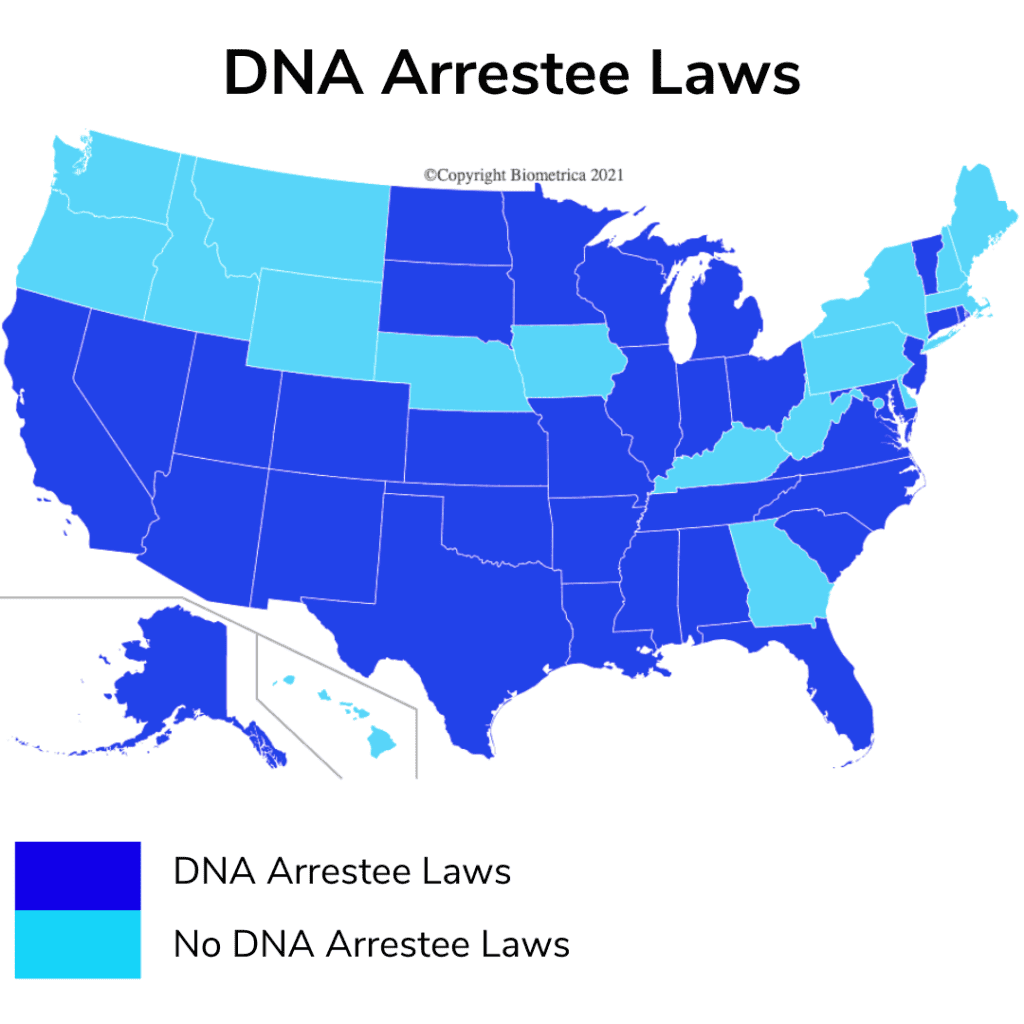
The map above shows which states have laws specifying instances when law enforcement can collect DNA from an arrestee. All states allow for DNA collection under certain circumstances, in many cases upon conviction or parole. If a state is not marked above, it simply means that the laws of that state do not specify DNA collection upon arrest, not that they don’t address DNA collection at all. As you can see, most, but not all, states allow for DNA collection upon arrest in some cases. The circumstances under which this is allowed vary by state. It is also interesting to note that states that allow this are often clustered amongst other states that allow it, and states that don’t allow this are often clustered among other states that don’t.
What Crimes Qualify For Collection Upon Arrest In Your State?
There is no consistent pattern from state to state in terms of which crimes qualify for DNA collection upon arrest. In some states all felonies qualify. In other states only certain felonies qualify. Even in these states, which felonies qualify is not consistent. In still other states all felonies and some misdemeanors qualify. In other states some felonies and some misdemeanors qualify, meaning that you will see, in certain instances, misdemeanors that qualify and felonies that don’t. Certain states, such as Alabama, apply this to all felonies and all sexual offenses regardless of whether they are felonies or misdemeanors. Other states, like Alaska, apply this to all felonies and all crimes against a person regardless of whether they are felonies or misdemeanors.
Some states focus on specific crimes that demonstrate behavior known to commonly escalate into more serious offenses. For example, in addition to murder, sex crimes and burglary, Arizona applies this to certain misdemeanors such as indecent exposure, public sexual indecency and prostitution. In addition to all felonies, South Carolina applies this to eavesdropping, peeping and stalking. For more on the link between peeping and more serious crimes see this article on the link between voyeurism and sexual assault, or this article on the link between voyeurism and serial killing.
Does The Law In Your State Include Juveniles?
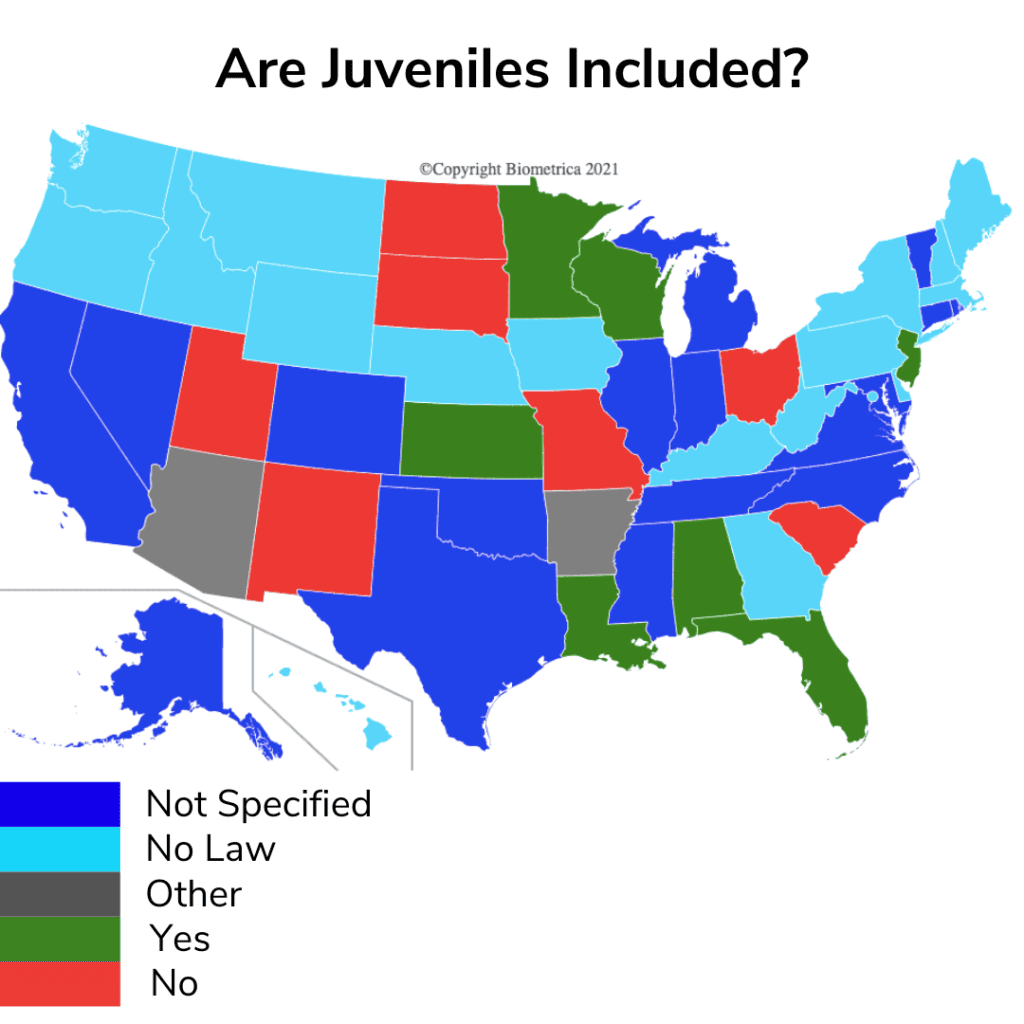
Some states’ arrestee DNA collection laws include language that specifically excludes juveniles from DNA collection upon arrest. Others have language that specifically includes them. In many states (marked in the darker blue in the map above) this is not specified in the language of the arrestee DNA collection statute in that state. In such states, there are often other statutes or case law relating to juveniles in the state that this article doesn’t go into. Other states (in grey) have specific intricacies involving juvenile arrestees and DNA collection. For example, in Arizona this law applies to adults at booking, and to juveniles at charging. In Arkansas, this applies to juveniles only if they are charged as adults.
When Can They Collect It And When Can They Process It?
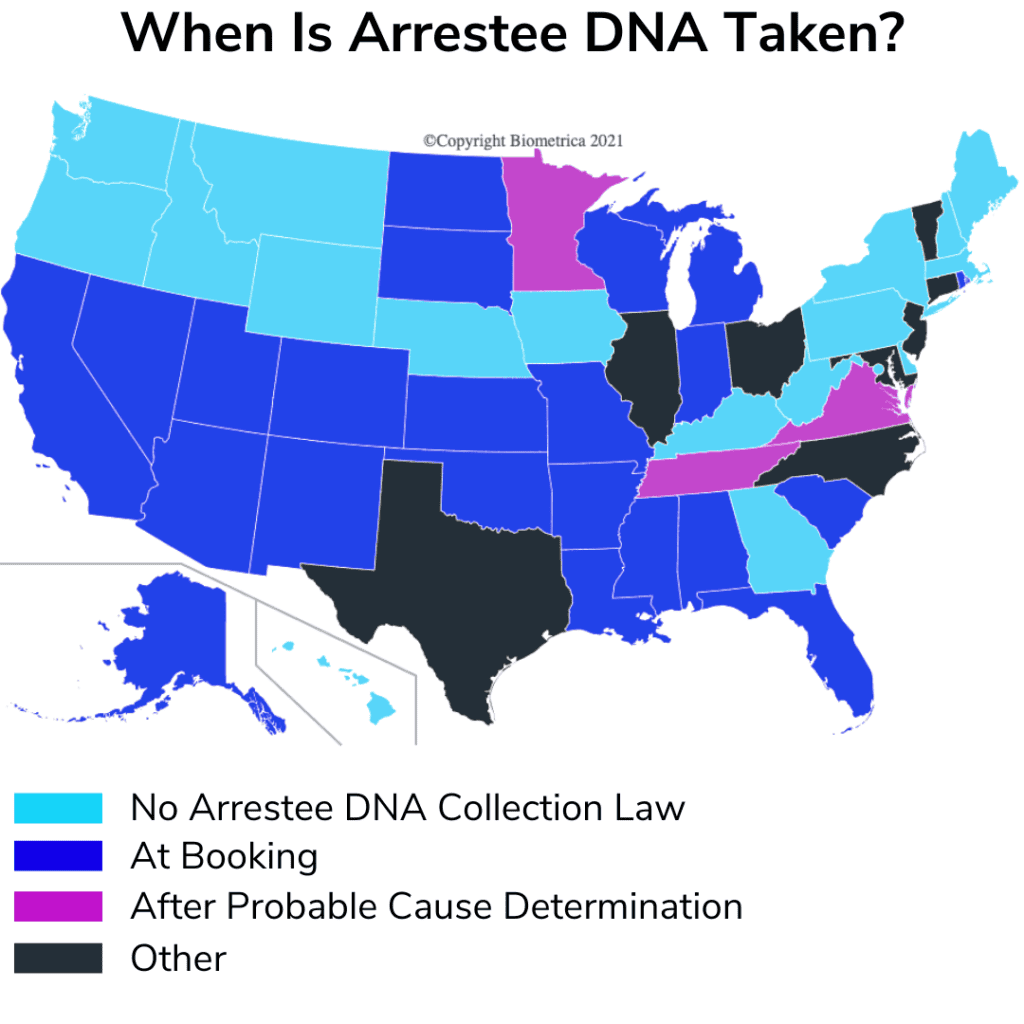
States also vary a large amount in terms of when arrestee DNA can be collected and processed. Many allow DNA collection at booking. Others allow DNA collection upon charging, prior to release, or after a probable cause hearing. It’s important to note that just because a state allows collection at a certain time this does not necessarily mean that they allow uploading or processing DNA at this point. Some make no distinction between collection, processing and uploading, but some do. The map above shows when collection is allowed, but does not include details on when processing and uploading is allowed. For example, Indiana and Colorado are both marked as blue because they both allow collection at booking. Indiana allows analysis and upload as soon as the sample is collected if the arrest was made with a felony warrant, but if the arrest was done without a felony warrant they must wait until a court has found probable cause for the arrest. New Mexico, Wisconsin, Oklahoma and Nevada also have laws similar to this. In Colorado, although DNA can be collected at booking, it is filed and maintained in the state index when the offender has been charged with a felony. Ohio, on the other hand, requires the sample be processed no later than 15 days after it is collected.
What About The Expungement Of Collected DNA?
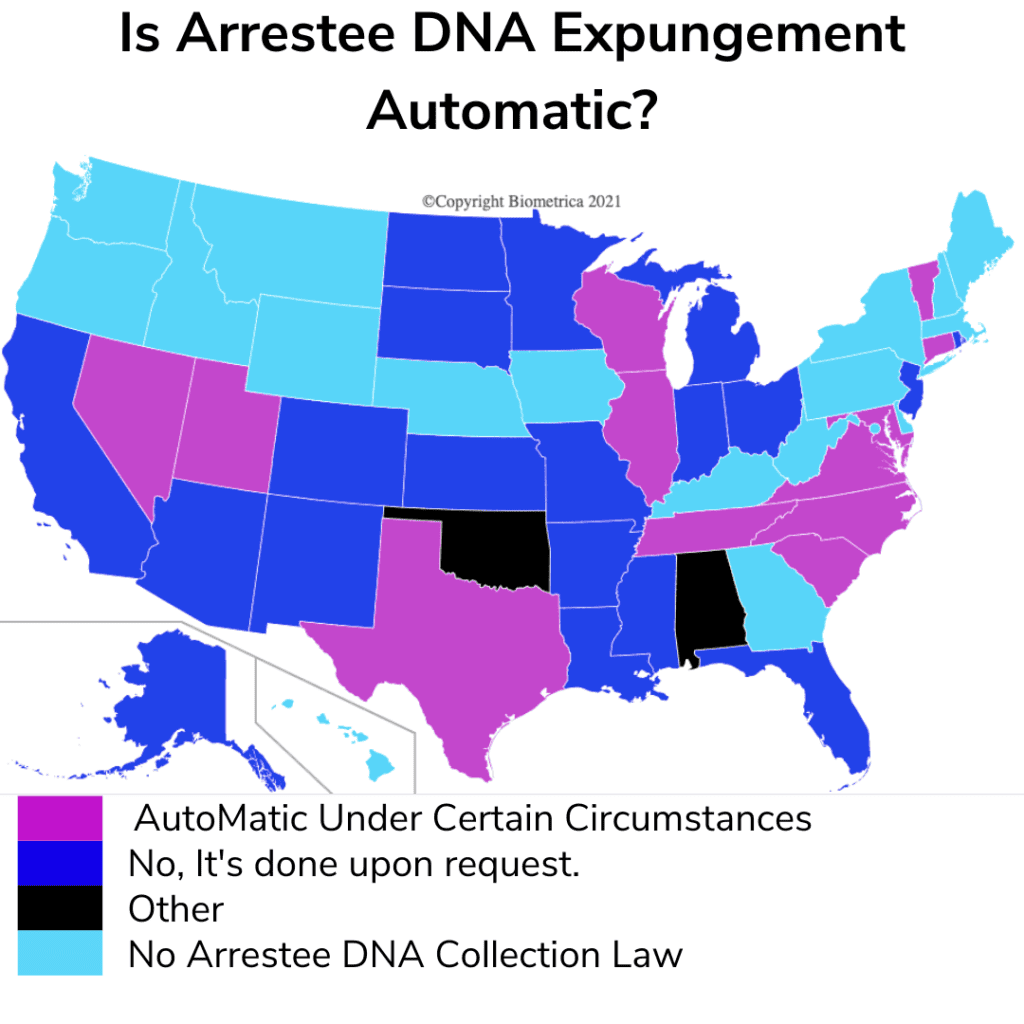
Finally, states also vary on how a DNA record can be removed and under what circumstances. Many, shown in the darker blue on the map above, allow for the expungement of arrestee DNA records upon request. This, of course, would depend on the circumstances surrounding the case. It is not to say that every request would be granted in every situation. Other states expunge such records automatically, depending on the circumstances. For example, in Utah, arrestee DNA is automatically expunged if criminal charges are not filed within 90 days of booking.
Where Can I Find Out More About This?
For more on DNA collection laws by state, see this excellent resource from the National Conference of State Legislatures. For the most up to date information on your state, or to find out about pending legislation, check the website for your state legislature.
The information provided in this article should not be considered legal advice or a substitute for legal advice. Biometrica is not a law firm and cannot offer legal advice.
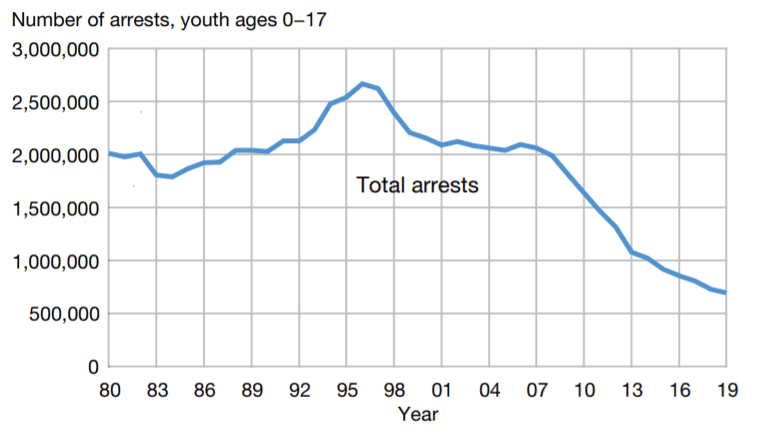
Source: Screengrab from the DOJ-OJP report showing total juvenile arrests since 1980
In 2019, the number of arrests involving juveniles — persons younger than 18 — was estimated to be less than 700,000. That’s the lowest level since at least 1980, with much of the decline happening in the last decade, according to a report published by the Department of Justice’s (DOJ) Office of Justice Programs (OJP) this month. The report draws on arrest estimates developed by the Bureau of Justice Statistics (BJS) and the National Center for Juvenile Justice based on analyses of data from the Federal Bureau of Investigation’s (FBI) Uniform Crime Reporting (UCR) program.
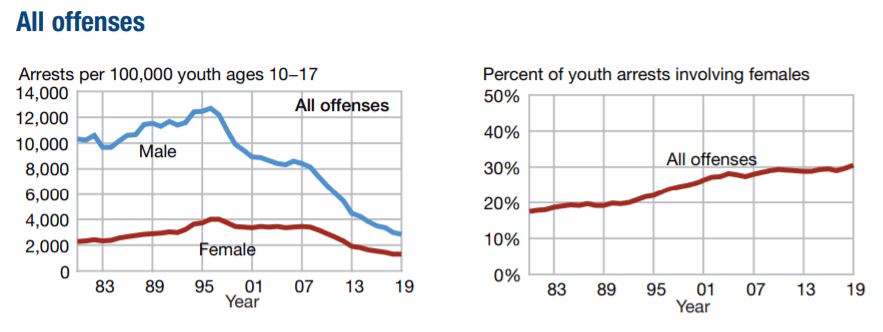
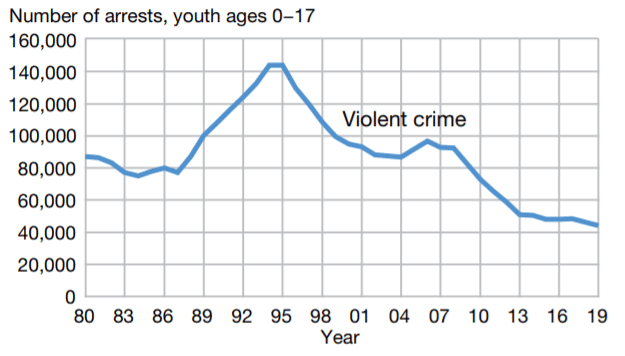
Arrests of juveniles peaked in 1996 at nearly 2.7 million. It has been on a more or less steady decline ever since, briefly trending upwards in the 2005-07 period. In 2019, the total number of arrests involving juveniles was estimated to be 696,620. When analyzed in terms of the types of crimes committed, juvenile arrests for violent crimes also decreased 40% between 2010 and 2019. Another trend that the report notes is that relative declines in arrests have been greater for boys than for girls across many offenses. As a result, the female share of juvenile arrests has grown since 1980.
We take you through some of the other key statistics and trends identified by the DOJ-OJP’s juvenile arrests report.
Overall Trends
On the whole, juvenile arrests have been on the decline for more than two decades, but patterns vary by demographic group and offense. Between 2010 and 2019, the number of juvenile arrests fell 58%, between 2015 and 2019 they fell 24%, and between 2018 and 2019, they fell 4%. Of the 696,620 estimated juvenile arrests, 31% were female, 32% were younger than 15, and 63% were White.
Gender-Based Trends
Source: Screengrab from the report
From 2010 through 2019, arrests of juvenile females decreased less than male arrests in most offense categories (for example, robbery, aggravated and simple assault, burglary, and drug abuse violations) the report says. In 2019, there were 212,650 arrests of females younger than age 18 and 483,970 arrests of males.
Although males accounted for the majority (69%) of juvenile arrests overall in 2019, the female share was relatively high for certain offenses: Those included liquor law violations (42%), larceny-theft (40%), simple assault (38%), and disorderly conduct (37%). Females accounted for 33% of juvenile Property Crime Index arrests and 21% of juvenile violent crime arrests in 2019.
Violent Crime Trends
Source: Screengrab from the report
As we said earlier, juvenile arrests for violent crimes decreased 40% between 2010 and 2019. It was down 8% between 2015 and 2019, and 5% between 2018 and 2019. Within violent crime categories, the largest portion of the pie was aggravated assaults, for which there were 27,070 juvenile estimated arrests in 2019. But that number was also down 40% between 2010 and 2019. The next largest category in terms of numbers was robbery with 16,080 estimated juvenile arrests, a decline of 41% between 2010 and 2019.
After falling 71% between 1993 and 2004, juvenile arrests for murder increased through 2007, then declined 46% through 2012 to reach the lowest level in three decades, the report says. The number of juvenile arrests for murder increased each year between 2012 and 2018, then fell 6% through 2019.
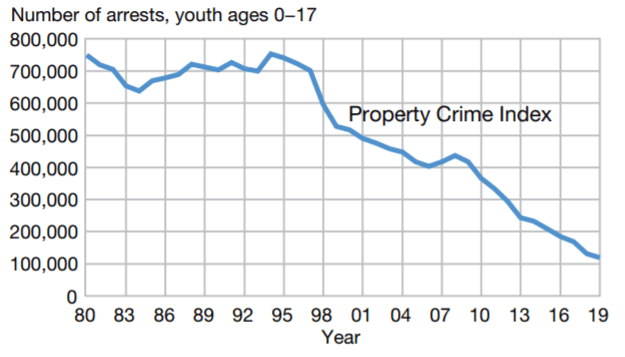
Property Crime Trends
Source: Screengrab from the report
Law enforcement agencies nationwide consistently report data on four offenses that form the Property Crime Index — burglary, larceny-theft, motor vehicle theft, and arson — to determine trends in the number of property crime arrests. “For the period 1980–1994, during which juvenile violent crime arrests increased substantially, juvenile property crime arrests remained relatively constant. After this long period of relative stability, juvenile property crime arrests began a 25-year decline,” the report says.
Between 1994 and 2019, the number of juvenile arrests for property crime fell 84% and reached its lowest level since at least 1980. Between 2010 and 2019, juvenile arrests declined for: Burglary (68%), larceny-theft (70%), motor vehicle theft (14%), and arson (61%). The total number of estimated juvenile arrests for property crimes (119,790) was much higher than those for violent crimes in 2019. Within property crimes, larceny-theft accounted for the largest portion of the pie with 83,690 estimated arrests, burglary was next with 20,700, motor vehicle theft with 13,610 and arson with 1,800. When it comes to the larceny-theft estimated arrests, 40% involved females, 30% involved youth younger than 15, and more than half (55%) involved White youth.
Age-Based Trends
Source: Screengrab from the report
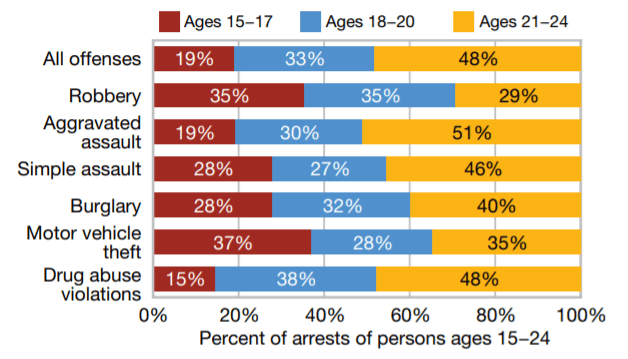
The rate of arrests of older juveniles was lower than those for young adults in 2019. Across most offenses, older juveniles accounted for a smaller proportion of arrests than young adults aged 18–20 or those aged 21–24. The overall arrest rate for older juveniles and those for young adults aged 18–20 have followed a similar pattern. Rates peaked in 1996 for both groups, then declined (76% and 66%, respectively) to reach their lowest level in 2019. In comparison, the arrest rate for adults ages 21–24 peaked in 1989 and then declined 54% by 2019 to its lowest level since at least 1980.
Other Demographic Trends
Source: Screengrab from the report
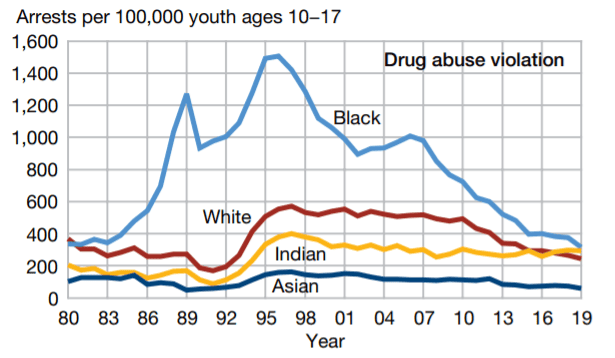
In the last 10 years, the drug arrest rate declined 56% for Black youth, 51% for White youth, 46% for Asian youth, and 3% for American Indian youth. The Black-to-White ratio in the drug abuse violation arrest rate has also narrowed in recent years, largely influenced by the considerable decline in the Black arrest rate since the mid-1990s (79% vs. 52% for the White arrest rate). The ratio peaked in 1991, at nearly 6 to 1. By 2019, the Black arrest rate was 1.3 times the White rate.
Arrest rates for murder and robbery were higher for Black youth than youth of other races in 2019, the report says. But the robbery arrest rate for Black youth has been on the decline, unlike the trend seen among other groups. Between 2008 and 2019, the robbery arrest rate for Black youth fell 57%, and reached its lowest level since at least 1980. The disparity gap between Black juvenile arrests and White is also narrowing.
The murder arrest rate for White juveniles reached a historic low in 2013, 82% below its 1994 peak, while the rate for Black juveniles touched a low point one year earlier, 87% below its 1993 peak. Since those respective lows, the rate for White youth increased 46% through 2019, while the rate for Black youth increased 47% through 2017 then declined 23% through 2019. The disparity in black-to-white juvenile murder arrest rates peaked in 1993, when the black rate was nearly nine times the white rate. Following the decline in the murder arrest rate for black youth, the ratio fell below 5 to 1 in 2019.
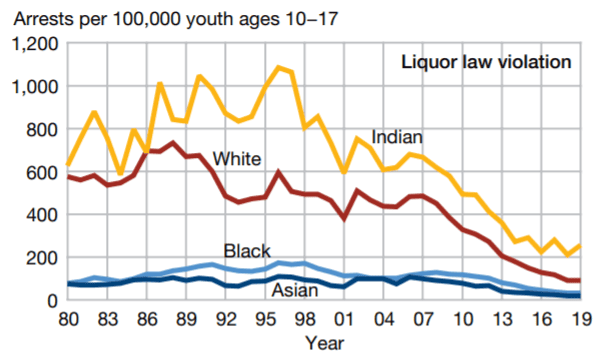
Liquor law violations are one of the few offenses for which rates are higher for American Indian juveniles than for other race groups. The American Indian rate in 2019 was more than twice the White rate, nearly 8 times the rate for Black youth, and more than 14 times the rate for Asian youth.
Source: Screengrab from the report
In other related news, UC San Diego said in a post on its website this month that disrupting the school-to-prison pipeline will be the debut project of the nation’s first civility research center to address juvenile justice reform. The project by the National Conflict Resolution Center’s (NCRC) at UC San Diego will study, evaluate and refine a national model of best practices to promote national criminal justice reform and reduce mass incarceration, the post added.
“The first juvenile court in the United States opened in Chicago in 1899 because of the belief that less stringent rules should apply to younger populations who ran afoul of the law. It wasn’t until 1945 that all states had a juvenile court. Now with a better understanding of child development, juvenile justice systems across the United States are reorienting themselves. Many states and municipalities are now adopting research-based approaches to juvenile justice reform, which demonstrate that children have better outcomes when their needs are met in the community, and that many youth offenders outgrow delinquent behavior as they become more engaged with school and work,” the UC San Diego post continues.
Americans appear to be preparing to flock to Las Vegas this Memorial Day Weekend to kickstart the summer in true pre-Covid style. Authorities in the City of Lights are expecting to have their busiest weekend yet since the onset of the pandemic over a year ago, with data indicating that Vegas is one of the top destinations for hundreds of thousands of Americans looking to travel.
According to official estimates, around 37 million people are expected to travel over the Memorial Day holiday. About 2.5 million of those are expected to travel by air — almost six times higher than did last year. Against this backdrop, Vegas has emerged as the the No. 1 road trip destination this year according to the American Automobile Association, and one of the top flight destinations as well.
The Nevada Department of Transportation is expecting heavy traffic this weekend along the interstate and the Strip, as the city sees an influx of tourists. Meanwhile, occupancy and room rates data also appear to show increased appetite for travel to Vegas.
The relief in this oasis at the center of the Mojave Desert, like rain after a drought, is palpable. Nevada was one of the states hardest hit by the pandemic. Roughly 25% of the state’s jobs are tied to the tourism industry. Last April, unemployment in Nevada hit 28.2%, the worst in the U.S. at that time and the worst in history since national unemployment hit 25% in 1933. Some estimates say that the hospitality industry alone lost around 41% of its jobs, compared to April 2019.
But the encouraging signs of a resurgence have been evident for a couple of months now. McCarran International Airport has seen a steady increase in the number of passengers passing through its doors. In April, 13% more people traveled through McCarran than in March, which itself registered a 60% jump over February numbers.
Hordes of visitors descended upon the Strip’s resorts and casinos during Spring Break and March Madness. The Las Vegas Convention and Visitors Authority highlighted robust growth in the city’s visitor volume. The number of visitors in March jumped to 2.23 million, from February’s 1.54 million and January’s 1.29 million. Weekend hotel occupancy rates that same month hit almost 80%.
In March, gambling revenue for Nevada totaled a staggering $1 billion, the highest monthly tally in more than eight years. Earnings on the Strip alone hit $501 million, on par with pre-pandemic monthly levels of $500–$600 million.
Casino resorts in Vegas are now nearly free of all Covid-19 restrictions. Currently, Clark County is operating at 80% capacity, but will be back to a full 100% on June 1, when all coronavirus restrictions will be lifted. Just a few days later, the Las Vegas Convention Center will host its first major convention since March 2020.
Americans as a whole seem to be gearing up for a summer of travel. In April, the U.S. Travel Association forecasted that more than half the population was set to take a trip in the next three months. With international travel still largely constrained by testing requirements and quarantine rules — if not forbidden altogether — domestic travel is set to benefit the most from the upcoming boom.
Across the board, various companies and experts are reporting a dearth of affordable flights and hotel rooms. Multiple airlines say that they are nearing 2019 pre-pandemic levels of operation. Even the rental car industry is seeing an unprecedented number of bookings and queries, as road trips look to be the preferred mode of travel this year.
Experts say there is a heady cocktail of factors driving travel demand. After being isolated for the better part of 18 months, Americans seem to have saved up money and are now itching to spend it on travel. This ideal intersection of people both willing and able to travel has been labeled by some as “revenge travel” or “vaxications.”
The CDC has said that fully vaccinated adults can return to pre-pandemic habits with some significant measure of confidence, as the vaccines are proving to be more effective than anticipated both in protecting people from contracting the virus and from transmitting it. The agency has also green-lit domestic travel, albeit with some protective measures recommended.
This week, the Homeland Security Secretary had to warn travelers about FAA regulations still in place, after an uptick in the number of reports of unruly passengers. Masks are still federally mandated in airports, on public transportation within airports and on the plane itself.
With the nationwide comeback truly underway, industry watchers say that the next step for Vegas is for “big-spending” business travelers to return to the city. Historically, conventions and trade shows have generated tens of thousands of jobs and billions of dollars in revenue for the Las Vegas area. The recovery of the convention and entertainment event industry in Vegas would herald a recovery all across the U.S.
The Gordian knot that is the gun control debate in America has flared up in recent weeks, as the number of mass shootings has surged and as the National Rifle Association (NRA) is battling bankruptcy and corruption charges in New York. Against this backdrop, half a dozen states have passed laws that make it easier to carry firearms in public, since February.
Gun control remains one of the most divisive and contentious issues in American politics. Opinions, both among lawmakers and the general public, tend to be split down party affiliation.
Public opinion for stricter gun control measures has waxed and waned over recent years. Bipartisan support for more stringent regulation peaked in 2019 but has declined since then. Still, a majority of Americans continue to favor more gun control. A national poll in March found that 65% of those surveyed believed that gun laws should be stricter — 41% said they should be “a lot more strict” and 24% said they should be “somewhat more strict.”
The most popular gun control measures across party lines are those that prevent people with mental illnesses from purchasing guns, and those that enhance background checks for private gun sales. In regards to allowing permitless concealed carry, majorities in both parties opposed the idea, with only 20% saying they would favor that.
The most recent development on this front came in Texas on May 24, when the state legislature sent Governor Greg Abbott a bill that would legalize the permitless carrying of concealed handguns by those who are legally allowed to possess them. Abbott has committed to signing the bill, which greatly expands gun rights in Texas, despite also including some concessions made to law enforcement. The House approved the deal on Sunday in a 82–62 vote, followed by the Senate on Monday in a 17–13 vote. Despite the bill’s smooth passage, recent polls indicate that almost 60% of Texan voters do not believe that adults should be allowed to carry handguns in public without licenses or permits.
Currently, all 50 states and the District of Columbia allow concealed carry in some form, and 20 have some form of permitless concealed carry laws in place. Nearly every state, however, has restrictions on where firearms may be carried, banning their presence at bars, schools, hospitals and public sporting events.
In April, the U.S. Supreme Court agreed to take up an NRA-backed challenge over New York’s restrictions on carrying concealed handguns in public, which lower courts ruled did not violate the Second Amendment. This lawsuit is likely to be a watershed moment in the gun control tussle, according to experts. The ruling is due by June 2022.
Earlier in May, the South Carolina House voted 83–34 to allow those who undergo training and background checks to openly carry firearms. At the same time, however, they rejected another attempt to do away with the permit requirement altogether. The bill was signed into law by Governor Henry McMaster on May 17. A number of prominent elected officials and law enforcement leaders were against the bill, calling it “too expansive” and “too permissive.” The law goes into effect August 16. State authorities have 90 days after the law was signed to reorganize and familiarize themselves with the new mandates.
At the tail end of April, the Louisiana state Senate sent to the House a measure that would allow anyone over the age of 21 allowed to possess a firearm to carry it in public without a permit. This eliminates previous provisions that required hours of training and a fee payable to the state police before a permit would be issued. The bill passed largely on party lines in a 27–11 vote. Democratic governor John Bel Edwards has signaled that he will veto the bill. If he does do so, Republicans in the legislature will struggle to override that veto without the support of their Democratic compatriots.
In March, the Tennessee state legislature passed a bill allowing most adults to carry handguns without requiring a permit. The law, signed by Governor Bill Lee on April 8, allows both permitless open and concealed carry. The measure passed the Senate in a 23–9 vote and the House in a 64–29 vote. Law enforcement officials in Tennessee largely opposed the measure.
Starting May 5, gun owners in Utah were no longer required to possess a state-issued permit to legally carry a concealed firearm. Previous laws had already allowed for the open carry of guns. The legislation was passed by both the state House and Senate in early February with little opposition. Governor Spencer Cox was quick to sign the measure into law shortly thereafter. Despite the relatively smooth process, 55% of voters said they did not believe that gun owners should be allowed to carry and conceal firearms without a permit, according to one poll.
In February, Montana governor Greg Gianforte made the concealed carry of firearms legal in the state. The new law, which went into effect immediately, allows adults to carry concealed weapons in bars, casinos, restaurants and financial institutions, while allowing owners of private properties to ban firearms at their individual locations. Meanwhile, the Montana University system is challenging the constitutionality of the law in regards to concealed carry on university property.
By some estimates, states that have weak permitting laws have a violent crime rate 13%–15% higher than states where the permit requirements are stricter. States with lax permit laws also see 11% higher rates of homicides committed with handguns than states with stringent permit policies in place.
On the federal level, there has been limited movement on the gun control front. In the wake of two mass shootings, President Biden in April 2021 announced a handful of executive actions designed to combat what he called “an epidemic and an international embarrassment.” In March, the House of Representatives passed two bills that would mandate universal background checks on all commercial gun sales and extend the waiting period for background checks to 10 days, from the current three. There are ongoing efforts to pass legislation that would close loopholes associated with so-called “ghost guns” and the concealed carry of “assault rifles.”
Today, May 25, is International Missing Children’s Day. Over one million children are reported missing every year, the International Centre For Missing & Exploited Children (ICMEC) says on its website. In 2020, the National Center For Missing & Exploited Children (NCMEC) assisted law enforcement and families with more than 29,800 cases of missing children. In terms of types of cases, 91% were endangered runaways, 5% were family abductions, 3% were critically missing young adults between the ages of 18 and 20, less than 1% were non-family abductions, and 1% were lost, injured, or otherwise missing children. Of the nearly 26,500 runaways reported to NCMEC in 2020, one in six were likely victims of child sex trafficking, the organization says on its website.
NCMEC also operates the CyberTipline, a national mechanism for the public and electronic service providers to report instances of suspected child sexual exploitation. In 2020, the tip line received more than 21.7 million reports. Most of those were related to apparent child sexual abuse material, online enticement of children or “sextortion,” child sex trafficking, and child sexual molestation. But today’s piece is about a specific, alarming trend that the NCMEC highlighted in a blog just last week: An increasing number of kids are going missing after being left alone in cars, which is closely linked to a surge in vehicle thefts over the past year or so.
Since the pandemic began, 40 children left alone in cars have been abducted during vehicle thefts in which an AMBER Alert was issued, the NCMEC says. But that’s just the tip of the iceberg, according to police, who say there have been many other cases where there was no need to issue an AMBER Alert. Once thieves realize they aren’t just stealing a car, but also a child, they ditch either the car or the child. In the last decade, NCMEC has sent out only an average of seven AMBER Alerts a year for this type of abduction, in comparison with the 40 they’ve issued since the pandemic began. The spike is being driven by a surge in vehicle thefts: There were 873,080 vehicle thefts recorded last year, the highest in more than a decade, according to the National Insurance Crime Bureau (NICB).
NICB analysts predict the trend will continue this year, with even more car thefts expected. “The pandemic has had a significant impact on society. Auto thefts have increased across the U.S. in almost every major city. Carjackings in major metropolitan areas such as Washington D.C., New York City, and Chicago are seeing major increases. As we examine in this issue, there are other, more systemic causes for the increase in thefts beyond individuals simply leaving their keys or fobs in their vehicles,” NICB President and CEO David Glawe said in a press release dated March 24, when the NICB released a report for CEOs in the insurance industry and law enforcement partners on the spike in auto crimes.
Before we go further, what exactly is an AMBER Alert? The AMBER Alert Program is a voluntary partnership between broadcasters, transportation agencies, law enforcement agencies, and the wireless industry to activate an urgent bulletin in the most serious child abduction cases. The acronym stands for America’s Missing: Broadcast Emergency Response. It began in 1996, when Dallas-Fort Worth broadcasters teamed up with local police. It was created as a legacy to honor 9-year-old Amber Hagerman, who was kidnaped while riding her bicycle in Arlington, Texas, and was then brutally murdered.
“Fortunately, the children in the AMBER Alerts were recovered safely, but the abductions took a toll on their parents,” the NCMEC blog says of the 40 alerts mentioned earlier in this piece. Families have been juggling kids and jobs since the pandemic began, with many schools and daycare centers closed. Many may have thought it safer to leave their child, or children, in the car while they dashed off to run a quick errand, what with all the Covid-19 restrictions in place. But even a few minutes is enough for a thief to steal a car. People picking up or delivering take-out food have been particularly targeted, the NCMEC blog says, citing police.
“Please, never leave your child alone in your car, not even for a few seconds, not even if you have them in your sight. The potential for harm is enormous: a speeding get-away car, a car thief afraid of getting caught with a child, or the unthinkable,” NCMEC’s President and CEO John F. Clark said in the blog.
Source: ICMEC’s YouTube channel
Recent Reports Of Such Cases
There have been several reports over just the last four weeks, too, of cases where carjackings also ended up involving the abductions of kids left alone in those vehicles.
For instance, on May 24media reported that the suspect responsible for causing an AMBER Alert to be issued for a five-month-old baby that was inside a stolen car in Greensboro, North Carolina, has been charged by the Winston-Salem Police Department. The baby had been left inside a Volkswagon that was stolen at a Marathon gas station on Randleman Road at 9:22 p.m. on May 21, officers said. The mother and a three-year-old sibling had gone inside the gas station to ask for directions while the five-month-old slept in the car. The baby, Nora Starr Grant, was luckily found safe outside an apartment complex in Winston-Salem on May 22. Officers said they do not know how long she was outside exposed to the elements; she was taken to the hospital on a precautionary basis after being reunited with her mother, the WXII 12 report said.
In a similar incident on May 19, a vehicle was stolen from a Shell gas station on Hartford Road in Manchester, Connecticut, with a sleeping nine-year-old child inside, ABC 17 News reported. The child woke up to find the suspect behind the wheel instead of her mother and began to cry. That’s when the suspect realized there was a child in the car, pulled over, and fled in another vehicle, according to the police. Manchester Police Lt. Ryan Shea said the department has received nine reports of stolen vehicles just this week. “Luckily this incident ended well, but certainly this is a risk that we’re seeing,” he said, per the ABC report.
On May 12,wtnh.com reported that police in Waterbury, Connecticut were looking for a suspect who stole a car with a baby inside. The incident happened on May 11 at a Shell gas station on West Main Street. In this case, too, the police issued a warning for parents: “We’re starting to see a trend where people are jumping into vehicles at convenience stores, at gas stations. So, it’s not worth those extra seconds. Remove your child from your vehicle,” said Sgt. Robert Davis of the Waterbury PD.
On May 4,Wave3 News reported that a Louisville man was arrested after stealing a car from a gas station in the Highview neighborhood in Louisville, Kentucky, with a five-year-old inside. The mother said her daughter was inside the car when she went into a Speedway at around 9:15 a.m. When she came out of the store, she found her vehicle had been stolen. In this case too, luckily, the child was found unharmed in the car about an hour later. The suspect, Stephen Murphy, allegedly made off with the victim’s cellphone though.
On May 3,NBC Connecticut reported that two children who were in another car that was stolen from Cumberland Farms on Meriden Road are safe. When officers received the 911 call, they only knew that a five-year-old child was inside the car. But it was later learnt that a 11-year-old boy had also been in the car but had jumped out before it was driven away.
On April 30,Fox 13 Memphis reported that four suspects were charged in the abduction of a four-year-old girl from a Memphis gas station in Tennessee. The suspects are all juveniles: one is 15, another 16, and two are 17. They have been charged with the following, the report said: Especially Aggravated Kidnapping, Theft of Property $10,000 -$60,000: Motor Vehicle (2ts), Evading Arrest: to wit Vehicle Pursuit & Possession of a Firearm During the Commission of a Dangerous Felony. The four-year-old victim, Samaria Bassera, was actually in Memphis to receive medical treatment at St. Jude Children’s Hospital.
On April 27, 7News Boston reported on new surveillance that showed the exact moment when a thief got behind the wheel of a running car and took off with the car and a child sleeping in the back in Woonsocket, Rhode Island. The child’s mother is seen coming out of Mason Grocery moments later to see her car and 2-year-old daughter were gone, the report adds. Police officers were called to the scene and were, once again, luckily able to re-unite the mother with her child. The suspect had left the car running and the child unharmed about a block away.
Fortunately, it does not appear as if there have been too many cases where unintentional abductions of children as a result of carjackings have taken a darker turn. But, even if a child goes missing only for a few hours, it’s still a harrowing experience for the families involved. Organizations like ICMEC also recognize that, and point out that it matters immensely from the perspective of being able to rescue the child.
In 2018, Biometrica had spoken with Caroline Humer, then Director of ICMEC’s Global Missing Children’s Center on missing kids. “In my opinion, a child is missing as soon as you do not know where he or she is, or where he or she is supposed to be. There is no defined period of time for how long a child must be gone before you can call them a missing child. It can be the 10 seconds you lose sight of your child at a playground or a supermarket, or it can be the 10 hours your child hasn’t come home from school… When you think your child is missing, report it immediately, don’t wait 24 hours, don’t wait two hours. Law enforcement should take the report immediately, should start an investigation immediately. A missing child is a vulnerable child,” she told us in a comprehensive interview. Humer is now Vice President of Global Alliances at ICMEC.
Even one missing child is one too many, ICMEC says – a reminder we could not agree with more on International Missing Children’s Day.
Source: ICMEC’s YouTube channel Elieth Samara was abducted when she was just 19-days-old. ICMEC coordinated recovery efforts with partners throughout Guatemala, and within 33 hours Elieth Samara was safely found. This is her story.