
Tech Support : support@safience.io

Blog

Runaways And Homeless Youth: Alone, At Risk, And Scared

By Deepti Govind

One in 10 people aged 18–25 and one in 30 people aged 13–17 experience homelessness each year. To put it another way, in a classroom of 30 students, at least one will experience homelessness this year, which means they won’t have a safe living environment to call home and will be forced to couch-surf, bounce around among relatives and friends, live in shelters, or stay on the streets, according to the National Runaway Hotline’s 2020 Crisis Services & Prevention Report.

As of December 31, 2020, the National Crime Information Center (NCIC) contained 89,637 active missing person records. Juveniles under the age of 18 account for 30,396 (34%) of the records and 38,869 (43%) of the records, when “juveniles” are defined as those under 21 years of age. The Missing Person Circumstances (MPC) field is optional and has been available since July 1999 when the NCIC 2000 upgrade became operational.

Of the 543,018 records entered in 2020, the MPC field was utilized in 259,802 records (or 48%). Within those records, 246,310 (or 94.8%) were coded as runaway, 1% as abducted by non-custodial parent, 0.11% as abducted by stranger, and 4.09% as adult–federally required entry. Further, when it comes to missing Indigenous Persons, there were 9,575 total missing American Indian/Alaska Native (AI/AN) person entries in 2020 and 1,496 end-of-year active records, according to the NCIC. Of the total AI/AN missing person entries, close to 75% were for individuals under the age of 18.
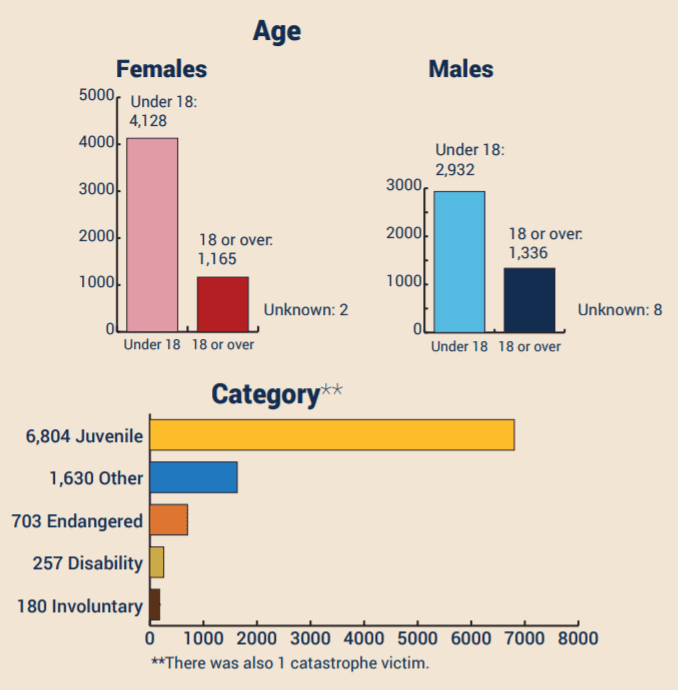
Image Source: Operation Lady Justice‘s 2020 Missing American Indian and Alaska Native Persons Data, based on the FBI’s NCIC Missing Person File

According to the National Human Trafficking Hotline, which maintains datasets on the issue of human trafficking in the United States, of the 11,500 cases reported in 2019, 2,582 involved minors. The data is non-cumulative and cases may involve multiple victims, and the latest period for which data is available is for the year 2019.

Why is homelessness among the young a crisis that goes much beyond them having a place to call home, and one that becomes a matter of public safety? Because homelessness puts youth at risk for several negative outcomes, ranging from struggles to find consistent food to mental, emotional, and physical health issues, and even physical and sexual abuse, substance use, and premature death. In many cases, these young people land up in situations similar to the very ones that drove them to run away in the first place. For instance, some who run away from homes where they face physical or sexual abuse may find themselves stuck with another person, or a trafficking ring, that inflicts the same horrors on them all over again.
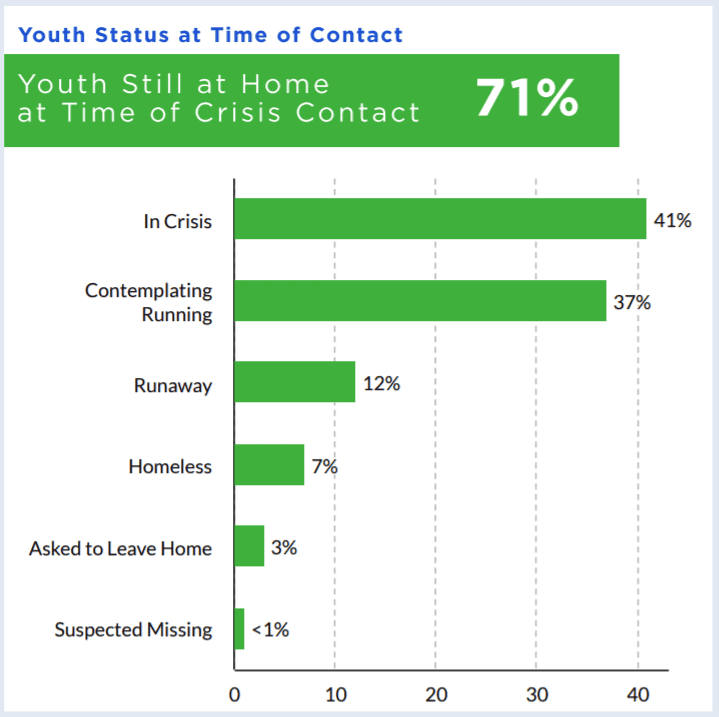
Image Source: National Runaway Safeline’s 2020 Snapshot

In the next section of this piece, we examine definitions related to runaways and homeless youth and the intersection between the two with darker, more insidious activities like sexual abuse and trafficking.

To start off with, when exactly is a child or a young adult considered to be a runaway? And are there different definitions for children who go missing under different circumstances? The International Centre for Missing and Exploited Children’s (ICMEC) Global Model Missing Child Framework says a “missing child” is any person under the age of 18 whose whereabouts are unknown. There are many different types of missing children cases and each category requires a different, yet immediate response, it adds. According to that framework, the categories and their definitions are:

  • Endangered runaways — The ICMEC defines endangered runaways as a child who is away from home without the permission of their parent(s) or legal guardian(s). The NCIC’s Missing Person File further adds that endangered runaways are those who are missing under circumstances indicating that they may be in physical danger.
  • Family abduction — The taking, retention, or concealment of a child or children by a parent, other family member, custodian, or their agent, in derogation of the custody rights, including visitation rights, of another parent or family member fall under this category.
  • Non-family abduction — The coerced and unauthorized taking of a child by someone other than a family member is called non-family abduction.
  • Lost, injured, or otherwise missing — Per this definition, facts are insufficient to determine the cause of a child’s disappearance.
  • Abandoned or unaccompanied minor — A child not accompanied by an adult legally responsible for them, including those travelling alone without custodial permission, those separated by an emergency, those in a refugee situation, and those who have been abandoned or otherwise left without any adult care come under this definition.

According to the National Incidence Studies of Missing, Abducted, Runaway, and Thrownaway Children (NISMART), a runaway episode is classified as one that meets any of the below criteria:

  • A child that leaves home without permission and stays away overnight.
  • A child 14 years old or younger (or older and with intellectual or developmental disorders) who is away from home, and chooses not to come home when expected to, and stays away overnight.
  • A child 15 years old or older who is away from home chooses not to come home and stays away two nights.

A thrownaway episode is one that meets either of the following criteria:

  • When a child is asked or told to leave home by a parent or other household adult, no adequate alternative care is arranged for the child by a household adult, and the child is out of the household overnight.
  • When a child who is away from home is prevented from returning home by a parent or other household adult, no adequate alternative care is arranged for the child by a household adult, and the child is out of the household overnight.

The same NISMART report, published in 2002, also states: “In the literature on missing children, runaways have sometimes been referred to as the ‘voluntary missing,’ to distinguish them from abducted and lost children. However, this term misstates the nature and complexity of the problem. It is generally recognized that children who leave home prematurely often do so as a result of intense family conflict or even physical, sexual, or psychological abuse. Children may leave to protect themselves or because they are no longer wanted in the home. The term ‘voluntary’ does not properly apply to such situations.”

Runaway and homeless youth are more likely to engage in substance use and delinquent behavior, become teenage parents, drop out of school, suffer from sexually transmitted diseases, meet the criteria for mental illness, and have an increased risk of being sexual exploited and trafficked, the Office of Juvenile Justice and Delinquency Prevention (OJJDP) and the National Center for Missing & Exploited Children (NCMEC) said in a statement in November 2019, while observing National Runaway Prevention Month.

The risk for homelessness is also increased for youth living in the foster care system, per that statement by OJJDP and NCMEC. In fact, youth who experience multiple placements in foster care, who have a history of running away from them, and who have spent time in a group home are most at risk of homelessness. Those aged 15 when they first enter foster care have the highest risk of running away. There are also gaps in the overburdened child welfare system that can lead to children being abused.

As we mentioned earlier, when it comes to the foster care system, too, while children are removed from their biological families for reasons that could include abuse, neglect, or abandonment, they may be subjected to these same traumas at the hands of anyone from caseworkers to even their foster and/or adoptive families.

In 2017, Biometrica published a piece by the Polly Klaas Foundation listing out one such example of foster care. Sandra,* a 16-year-old girl, was raised by her grandmother until the age of eight. She was placed in the foster care system upon her grandmother’s passing. At the age of 13, Sandra began running away from her placement home due to unwanted sexual attention from a caregiver in the home.

During her time away, a man named Darryl* befriended Sandra. She confided in Darryl about her grandmother’s passing and the discomfort she felt in her foster home. He sympathized with her and promised he would protect her. He offered Sandra the opportunity to live with him. Sandra met with Darryl several times before running away from home for good. Darryl told Sandra that she had to repay him for living expenses by exchanging sex with his friends and neighbors in the building for money.
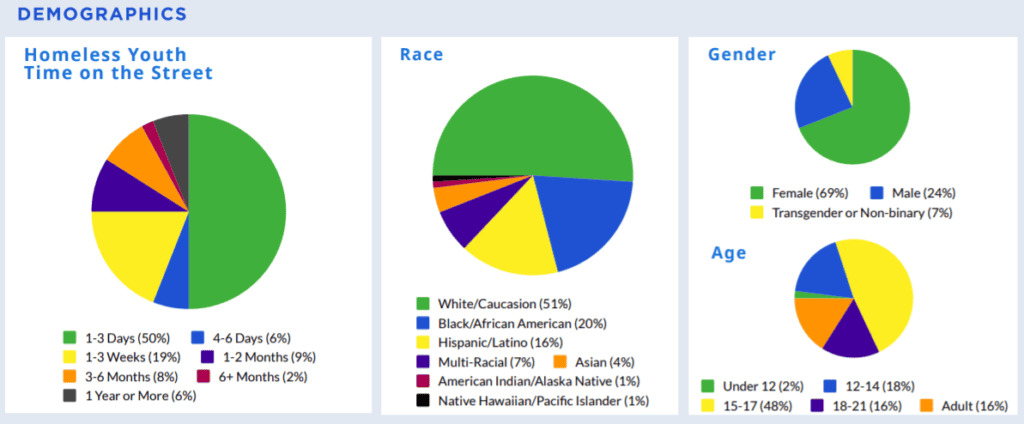
Image Source: National Runaway Safeline’s 2020 Snapshot

Homeless youth also have a high rate of involvement in the juvenile justice system. According to OJJDP data per that 2019 statement, on any given day, over 43,000 young people — many suffering from substance abuse and mental illness, or both — are in juvenile corrections and treatment programs. One of the aims of the Office of Justice Programs is to help homeless kids who enter the juvenile justice system make their way out of it, with the goal of living safer and more fulfilling lives.

In 2020, 27,546 individuals reached out to the National Runaway Safeline (NRS) through the 1-800-RUNAWAY hotline and the various digital services offered through 1800RUNAWAY.org (live chat, email, and forum). A majority of those who reached out to the NRS were youth seeking for help for themselves (81%). But concerned individuals also reached out on behalf of youth, such as parents (6%), friends (5%), and adults (4%), among others including relatives, agency representatives, and police or probation officers.

Although a majority of the youth (88%) who reached out to the NRS for crisis intervention did so because of family dynamics, other common problems were emotional abuse (31%), peer/social issues (27%) — including problems with friends, internet relationships, gang or cult involvement, sexual activity, relationship problems, and independence — and mental health problems (17%). These categories were not mutually exclusive and those contacting NRS could report multiple problems.

A majority of the youth who called the NRS were only able to survive homelessness because of friends and family networks, followed by personal funds, and through shelters and soup kitchens. But it’s important to note that 1% survived due to survival sex, another 1% by relying on the sex work industry, 1% by stealing, and under 1% on selling drugs.

*Sandra and Darryl are pseudonyms. Sandra’s story is like that of many at-risk youth, lured away from home by acquaintances and/or strangers who gain their trust.

Most Populous Counties In U.S. Hope To Stop ‘Ghost Gun Epidemic’

By Biometrica staffer

The two most populous counties in the country — Los Angeles County, California, and Cook County, Illinois — are moving to tackle the problem of “ghost guns,” as law enforcement and the government continue to grapple with an ongoing rise in violent crime and homicides, more of which include a firearm than ever before. 

Late last week, the Los Angeles Police Department (LAPD) released a report that said the spread of homemade “ghost guns” has begun to resemble an “epidemic,” with such weapons contributing to over 100 violent crimes so far this year. The LAPD says that they have linked 24 murders to the untraceable weapons, in addition to eight attempted homicides, and dozens of armed assaults and robberies.

Ghost guns are self-assembled firearms with parts that do not include serial numbers. Essentially, a person can use a kit to put together their own weapon that is untraceable and that technically does not require background checks due to the fact that they are handmade. Because of their lack of an audit trail, ghost guns are increasingly being used in violent crimes.

The LAPD report also said that between January and June this year, it confiscated an estimated 863 ghost guns, representing a whopping 400% increase over the same period last year, when it confiscated 217 such firearms. Police say that the sharp rise indicates that the problem is only going to get worse, unless stymied in some way. 

To combat this rising tide, earlier this month, California Governor Gavin Newsom signed a law that adds ghost guns to the list of weapons that are legally allowed to be seized under “red flag” laws, which enable police, family members, colleagues, employers, and teachers to ask judges to take away firearms of anyone believed to pose a credible threat to themselves or others.

The state of California has also joined a lawsuit against three gunmakers — Blackhawk Manufacturing Corp., MDX Corporation, and GS Performance, LLC — who manufacture and sell ghost gun kits. State Attorney General Rob Bonta had this to say about the suit: “When firearms are built at home by individuals who have not passed a background check and have not had their guns properly serialized, it leaves law enforcement in the dark, and the public less safe.”

Similarly, in Illinois, some lawmakers and law enforcement officials are pushing for a ban on ghost guns in Cook County, which includes the city of Chicago. The sheriff, Tom Dart, said at a news conference that his department is witnessing an “explosion” in the number of ghost guns flooding the streets. This, he says, has led him to partner with State Senator Jacqueline Collins on the proposed legislation.

Sen. Collins added that gun violence is “plaguing Illinois’ Black and brown communities,” and that “the proliferation of guns in our country and in our state drives this problem. Getting nonserialized ghost guns off the streets is a step forward in addressing violence so we can start healing our communities.”

Other anti-crime proposals in the state legislature are looking to increase the penalties for those found to be possessing illegal guns, as well as for criminals who are found to have bought a gun for someone who is not allowed to own one (i.e., “straw purchasing”).

Although the Chicago Police Department (CPD) does not specifically track the number of ghost guns recovered, it does track the number of confiscated guns that do not have serial numbers. In the first half of this year, CPD reportedly confiscated 245 guns without serial numbers — more than the annual total seized in each of the years between 2016 and 2020.

After President Joe Biden called on the Justice Department (DOJ) in April to craft a law to close the ghost gun loophole, the DOJ released a proposed rule in May that would, for the first time since 1968, revise the legal definition of a “firearm” to include ghost guns. In addition, the rule would require individual components in gun-assembling kits to have a serial number that can be traced. 

At that time, the DOJ said that between 2016 and 2020 more than 23,000 unserialized firearms were reported to have been recovered by law enforcement from potential crime scenes — including in connection with 325 homicides or attempted homicides. Per the Bureau of Alcohol, Tobacco, Firearms and Explosives (ATF), the number of ghost guns recovered by law enforcement increased nearly 400% over that same period.

In a statement, Attorney General Merrick Garland said, “Criminals and others barred from owning a gun should not be able to exploit a loophole to evade background checks and to escape detection by law enforcement […]. This proposed rule would help keep guns out of the wrong hands and make it easier for law enforcement to trace guns used to commit violent crimes, while protecting the rights of law-abiding Americans.”

Home Healthcare Background Check ABCs

By a Biometrica staffer

A paper published in 1999 stated, in very simple terms, that fraudulent and abusive practices in the home healthcare space are costly. They damage the integrity of the home health agency, the home care industry, and home care providers, it added. And, of course, they can collectively lead to billions of dollars in fines and settlements. It could be something that’s common like healthcare fraud and Medicare or Medicaid fraud. Last December, for instance, during the year of the Covid-19 pandemic, ten people were arrested in a widespread healthcare fraud scheme to falsely bill Medicaid for home-health and personal-care services that were not actually rendered. 

Then, there are much darker examples that serve to show why it is important to prevent crimes, whether frauds or abuse, in the healthcare industry. For example, in 2018, a former nurse at a long-term care facility sexually assaulted an incapacitated patient under his care who gave birth to a child later that year. The pregnancy was discovered by an employee at the Hacienda Healthcare facility in Phoenix, Arizona only when the woman was in the process of delivering the child. The surprise birth triggered reviews by state agencies, highlighted safety concerns for patients who are severely disabled or incapacitated and prompted the resignations of Hacienda’s chief executive and one of the victim’s doctors, the Associated Press said in its report on the ex-nurse, Nathan Sutherland, entering a guilty plea to charges related to the case.

It is critical to hire the right person for the job when it comes to healthcare providers who work at someone’s home or at long-term care facilities. These professionals are most likely being hired to take care of some of the most vulnerable individuals in society — from those who are incapacitated, to those with developmental needs, to those with disabilities, including children, and the elderly. Home healthcare providers, especially, also have access to spaces where everyone is at their most relaxed and vulnerable, and that makes hiring decisions even more important.

While there are several qualifications that one looks for when it comes to hiring home healthcare providers, this piece is concerned about only one aspect: making sure you don’t hire someone with a criminal background that would make them unsuitable for the job. On the other hand, home healthcare providers have also faced abuse at the hands of their clients or their clients’ families. From both perspectives, then, how do you ensure you know who you’re hiring or who you are working for? One simple step is to conduct a background check. In the rest of this piece, we give you a quick overview of what that could look like from a prospective employer’s perspective.

For example, let’s say you decide to go with a Home Health Agency (HHA) to hire a home nurse. HHAs are not mandated to run a background check on their caregivers by law. But those that want to receive Medicare or Medicaid funding have to comply with state laws governing home healthcare background checks based on regulations framed by the Centers for Medicare/Medicaid Services (CMS).

Per the National Background Check Program, states are given grants to create a standardized system for conducting background checks of home healthcare providers who will be in direct contact with patients. But the participation by states is voluntary, which means not all states have done so. Nevertheless, each state has its own requirements for HHA home healthcare provider background checks.

If we take New York, for example, the Department of Health (DOH) runs a criminal background check on most home health aides and certified nurse aides in the state. According to a Legal Aid article, once an employer wants to hire a home health aide or any other kind of healthcare provider in New York, the employer is required to submit an electronic background check request through the Criminal History Record Check (CHRC) system of the DOH.

The DOH, in turn, will request the Federal Bureau of Investigation (FBI) for the particular individual’s criminal record. Once the DOH receives the record, it will determine whether or not an individual is eligible for employment and then send a letter to the prospective employer. Some of the types of letters they may send include a no-hit letter, a non-denial, not held in abeyance, held in abeyance, pending denial, and final denial.

A no-hit letter, like the name suggests, means the individual has been cleared and approved to work per the DOH as they don’t have any pending arrests and no criminal convictions, or all their arrests and convictions have been sealed. A non-denial letter is when an individual has at least one criminal conviction but the DOH determines that the conviction shouldn’t prevent them from working as a home healthcare provider. The letter implies that the DOH has approved the individual, but the convictions will be listed and the employer must take the final hiring decision.

It is illegal for the employer to deny an individual a job based on their conviction record, unless there is a direct relationship between the record and the job. In other words, unless the record indicates that the individual would pose a risk to people or property if they were hired for the job, it would be illegal to deny them that position.

Similarly, a “not held in abeyance” letter would mean that an individual has open charges but that the DOH has determined it should not prevent them from working as a home healthcare provider. As with the non-denial letter, the charges will be listed by the DOH and the final hiring decision lies with the prospective employer. “Held in abeyance,” in contrast, means that the DOH thinks an individual’s open charges could prevent them from being eligible for employment as a home healthcare provider. It would mean the person is prohibited by the DOH from providing direct care to patients until the criminal case is resolved and DOH makes a final determination of eligibility for employment.

Pending denial is when an individual has at least one criminal conviction and DOH is considering denying their eligibility for employment. As with the previous one, it means the person is prohibited by the DOH from providing direct care to patients. The individual will have 30 days to submit information to the DOH, before the DOH makes a final determination. Final denial, as the name suggests, means the DOH has determined an individual ineligible for employment. They will be unable to work if this type of letter is sent to their agency.

DOJ Announces $7M In Funding For Mental Health And Wellness Programs For Law Enforcement Officers

By Biometrica staffer

On Thursday, Oct. 14, officials with the Department of Justice (DOJ) announced that it would be handing out 65 grants, totaling $7 million, to the Law Enforcement Mental Health and Wellness Act (LEMHWA) program. The announcement was made at a roundtable with state and local law enforcement. 

The funds will expand access to mental health and wellness services for law enforcement officers (LEOs), and will also improve those services, which include training, peer mentoring, and suicide prevention initiatives. 

The Community Oriented Policing Services (COPS) Office was established in 1994 as a way to advance community policing across the country. It disburses grants, engages in knowledge sharing, and provides training and technical assistance on community policing and building trust between law enforcement agencies and the communities they serve. Per the DOJ, the COPS Office has handed out over $14 billion since it was created to over 13,000 state, local, and tribal law enforcement agencies, resulting in the hiring of over 134,000 officers.

In 2017, Congress passed LEMHWA, which allowed the COPS Office to pilot peer mentoring mental health and wellness initiatives within state, tribal, and local law enforcement agencies. The LEMHWA Act is meant to recognize the fact that “good mental and psychological health is just as essential as good physical health” in law enforcement jobs.

“Each day, law enforcement officers across the country put their lives on the line for the communities they serve,” said Deputy Attorney General Lisa O. Monaco. “This has been especially true since the start of the COVID-19 pandemic, which has claimed hundreds of officers’ lives and added to the stress of an already difficult job.” She said this funding reiterates the DOJ’s commitment to supporting and helping local police departments.

In the line of duty, LEOs often suffer high stress and experience traumatic incidents multiple times, which can leave them suffering from various illnesses like post-traumatic stress disorder (PTSD) and anxiety. This, in turn, can take a toll on their cognitive abilities, emotional regulation, connections with others, judgement, and performance, the DOJ says — all of which can have serious consequences in this line of work.

One recent example of this playing out in the field is the case of Capitol Police officers who were at the scene of the Jan. 6 insurrection at the U.S. Capitol. Many officers were caught up in the crowd and as a result suffered PTSD, which they have spoken and testified about extensively. In addition to one officer who was attacked by protestors and died the next day, over 100 other LEOs were injured. There were at least 1,000 instances of assaults against LEOS on the day, a DOJ review of police officer bodycam footage concluded.

In the many months since, at least four other long-term police officers who were present at the Capitol have taken their own lives. Just yesterday, ABC News reported on the department’s efforts to help those suffering with mental health problems after the riot. Part of that includes adding two wellness support dogs to its health staff. Officers have also created a peer support group for those struggling. 

The Legislative Link Between Campus Police And Local Law Enforcement In California

By Biometrica staffer

Over Memorial Day weekend in 1996, Kristin Denise Smart, a freshman at California Polytechnic (Cal Poly) in San Luis Obispo, mysteriously disappeared in the middle of the night when she was walking back to her dormitory after a party.

Her parents say that it took campus police nearly a month to turn her missing persons case over to the sheriff’s department — a crucial oversight, they say, that delayed justice. Twenty-five years later, Kristin has still not been found. Though her parents declared her legally dead in 2002, six years after her disappearance, they have never received her remains nor any form of closure.

As part of their quest to honor Kristin’s memory, the Smarts championed and saw passed in 1998 a law in the state of California that they hoped would stop cases like Kristin’s from slipping through the jurisdictional gaps between campus police offices and local government law enforcement bodies. In today’s piece, we take a look at this relationship and the Kristin Smart Campus Safety Act.

Kristin Disappearance

Here is a brief overview of Kristin’s case. At around 2 am on the morning of May 25, 1996, Kristin, an architecture major, was walking home to her dormitory on the Cal Poly campus. She had just left an off-campus party and was reportedly slightly tipsy. She was accompanied by a friend, who soon peeled off towards her own room, and another student at the university, Paul Flores.

This was the last time she was seen alive and Paul was the last person to be seen with her. Authorities say Kristin did not have any identification, money, or extra clothing on her when she disappeared. She has not contacted her family or friends since.

Paul quickly became the focus of the investigation, but there was not much evidence to concretely tie him to Kristin’s disappearance at the time (more on this later), despite “troubling discrepancies” in his story, particularly in relation to how he had received a black eye he was sporting. He was interviewed by the police multiple times, but always pleaded his Fifth Amendment rights and never disclosed any information.

Though allegations of wrongdoing haunted Paul his entire life, it was only last year that he once again became the primary suspect in Kristin’s case. Earlier this year, in April, just a month short of the 25th anniversary of Kristin’s disappearance, prosecutors arrested and charged Paul, now 44 years old, with first-degree murder, alleging that he killed her during an attempted rape. Paul’s 80-year-old father, Ruben Flores, was also arrested and charged as an accessory after the fact for allegedly helping hide Kristin’s body. In September, a judge ruled that both men will stand trial.

Some scant forensic evidence has been cited in singling out Paul as the killer. Even in 1996, sniffer dogs apparently “alerted” when brought near his mattress and dorm room. Around the time he was arrested this year, authorities may also have found “a patch of disturbed soil under the deck, consistent with a shallow grave” at Ruben Flores’ home in Arroyo Grande, California. At this site too, cadaver-sniffing dogs indicated something suspicious.

If Kristin’s body had been buried there, however, it was “recently moved” and was, thus, not recovered. Officials say that the search warrants associated with the case are sealed and so they cannot disclose what was found, though in March 2021, the San Luis Obispo County Sheriff Ian Parkinson said some “forensic physical evidence” linked to Kristin was recovered.

Cal Poly Campus Police

Kristin’s disappearance, in some ways, served as a wake-up call. Because she vanished over a long holiday weekend, at first campus police were not sure whether she had just gone home or on vacation, or whether she was actually missing, even though her friend alerted them to her fears. It took them three days to open a formal investigation, and six days to bring Paul Flores in for an interview. Officials later admitted that this hampered the investigation.

Campus police departments rarely have to deal with issues as serious as homicide, so were less equipped to respond. The case was only turned over to the local sheriff’s homicide department when the academic year was over. By that time, the dorms had been cleared and cleaned, even the suspect’s, leaving little evidence behind. Paul himself had left for the summer. Before that, campus police said there had been little legal cause to search his room. Shortly after, Paul dropped out of college.

Kristin’s parents were “outraged” at the time lost in investigating their daughter’s disappearance and so campaigned for the law named after their daughter. The Kristin Smart Campus Safety Act, signed in 1998, mandated public colleges in California to set up a framework that made it clear exactly when campus police would have to call in outside police to help investigate violent crimes.

While campus police still have primary jurisdiction over crimes on their grounds, they have to at least establish some kind of minimum, formal, written agreements or Memorandums of Understanding (MOUs) with local policing bodies. This law served as a follow up to earlier federal legislation, the Crime Awareness and Campus Security Act of 1990 (also known as the Clery Act), which made amendments to the Higher Education Act of 1965.

Critics say that university officials are often reluctant to report statistics regarding violent and/or sexual crimes or engage with local police for fear that their institution’s reputation may be damaged, which, in turn, could affect enrollment. This is especially true if a college may be deemed unsafe just for an increase in such figures, when really what could be behind it is just more reporting due to tighter safety standards.

Another issue is that universities typically have their own internal “judiciary proceedings,” which could involve a tribunal or a trial of sorts that reaches a verdict on a case without informing police. These are often private and confidential events and punishments end up on the student’s academic record, which is protected by federal privacy laws. Through such mechanisms, victims may be dissuaded from officially reporting crimes to police and the perpetrator can avoid a potential public trial or arrest.

The Role Of Campus Police

So what are campus police and what is their role? The campuses of the roughly 4,000 colleges and universities in the country are home to millions of students, and it can be challenging and resource-draining for law enforcement to deal with every single case on their own. Campus police exist to provide assistance to local policing organizations as they can often respond quicker.

Per one definition, they are “sworn police officers” that are employees of the educational institution, not the state or local government. As sworn police officers, they have full arrest powers granted by a state or local authority. Their main duty is to protect people and property on what is officially defined as that institution’s campus. Public safety offices at universities employ a range of people, including former law enforcement, security guards, and even student workers.

In an ideal situation, they should be working in tandem with the local police or sheriff’s department, who probably have resources, avenues, and the ability to investigate more serious crimes that occur on or outside a campus but that involve someone with ties to the university.

A 2015 report (the latest such data available) from the Department of Justice (DOJ) found that roughly 68% of 4-year colleges and universities with 2,500 or more students had a campus police body made up of sworn police officers, though public institutions were more likely to have such a force than private ones.

As of the 2011–12 school year, the DOJ said, around 75% of campuses were using armed officers. Further, about 7 in 10 campus law enforcement agencies had an MOU or other formal written agreement with outside law enforcement agencies.

The issues most frequently addressed were rape prevention, drug and/or alcohol education, stalking, victim assistance, and intimate partner violence. Per the DOJ, between 2009 and 2018, the number of reported forcible sex offenses on college campuses increased over 380%, and constituted nearly half (43%) of all criminal incidents reported on campuses in 2018.

The Clery Act mentioned above governs crime reporting requirements for universities that receive federal aid. We will cover this piece of legislation in another story at a future date.

Supreme Court Starts Its Review Of The Boston Marathon Bomber’s Sentencing

By a Biometrica staffer

Just days after the Boston Marathon took place for the first time since the Covid-19 pandemic began, the U.S. Supreme Court heard arguments over whether the death sentence should be reinstated for Dzhokhar Tsarnaev, the Boston Marathon bomber. Tsarnaev was convicted of carrying out the deadly bombing on April 15, 2013, that killed three people and injured more than 260.

On Wednesday, Oct. 13, the Supreme Court seemed ready to reinstate the death penalty for Tsarnaev. Reciting the gruesome details of the 2013 bombing and its violent aftermath, an attorney for the Biden administration asked the Supreme Court to reinstate the death sentence for Tsarnaev, ABC News reported.

The court’s six conservative justices seemed likely to embrace the Biden administration’s argument that a federal appeals court mistakenly threw out Tsarnaev’s death sentence for his role in the bombing that killed three people near the finish line of the marathon in 2013, the Associated Press reported. The court’s three liberal justices appeared more favorable to Tsarnaev.

The 1st U.S. Circuit Court of Appeals in Boston ruled last year that the trial judge improperly excluded evidence that could have shown Tsarnaev was deeply influenced by his older brother, Tamerlan, and was somehow less responsible for the carnage, the AP News article added. The appeals court also faulted the judge for not sufficiently questioning jurors about their exposure to extensive news coverage of the bombing.

“After watching video of [Tsarnaev] by himself personally placing a shrapnel bomb behind a group of children at the Boston Marathon, the jury in this case returned a nuanced verdict unanimously recommending capital punishment for that specific deliberate act,” Deputy Solicitor General Eric Feigin said, adding that the court of appeals should have let that verdict stand, per ABC News.

The defense argues the prior killings illustrate that Tamerlan had a history of exerting influence over accomplices and that he helped indoctrinate his younger brother to participate in future acts of jihad. 

On April 13, 2013, the scene at the Boston Marathon was one of carnage. Two explosions in rapid succession were followed by a fireball and smoke. Children and adults were screaming, and severed limbs were everywhere as medics, police, and bystanders raced to staunch the bleeding, NPR said in a report. Three days later, the FBI released surveillance camera photos of two bombing suspects and asked for the public’s help in finding them. The two men were later identified as 26-year-old Tamerlan Tsarnaev and his 19-year-old brother, Dzhokhar. 

By then the brothers, after initially separating, had regrouped. After loading Tamerlan’s car with pipe bombs, a handgun, and another shrapnel bomb, they drove past the Massachusetts Institute of Technology, where they saw a campus police squad car, approached from behind, and shot officer Sean Collier in the head at point-blank range, the NPR report adds.

After that, they carjacked an SUV and stole $800 from the car owner at an ATM, but the owner managed to escape and the police used the car’s tracking device to find it in Watertown, still being driven by the brothers. Tamerlan was ultimately killed after a shootout with police, but Dzhokhar escaped.

He was found the next night hiding in a boat under a tarp and covered with blood. He had used a pencil to write out a manifesto warning that the mujahideen had “awoken” and that “you are fighting men who look into the barrel of your gun and see heaven.”

If the appellate ruling is affirmed, Tsarnaev will have to face a new sentencing trial if the administration decides to continue pressing for the death sentence. The Supreme Court is expected to hand down a decision in this case by June 2022.

Community Policing: An Introduction

By a Biometrica staffer

A majority of contacts between law enforcement officers (LEO) and the public only happens during emergencies, or situations that are highly charged and emotional. But these are not the most ideal circumstances for LEOs and the community they serve to use as a platform to develop a relationship. Some members of the public may even feel that LEOs are unapproachable when they meet them on the streets while handling an emergency. That’s where a national initiative called “Coffee with a Cop” comes in, through which a longer term relationship can be established between LEOs and the public using community policing.

In Iowa, for instance, the Cedar Rapids Police Department said it would host Coffee with a Cop on Oct. 6, which happened to fall right in the middle of the National Community Policing Week. The event was meant to give members of that community a chance to discuss issues, build relationships, and learn more about the department’s work in Cedar Rapids neighborhoods. Similar events were planned to be held across the country. Coffee with a Cop is a national initiative supported by the Department of Justice’s (DOJ) Office of Community Oriented Policing Services (COPS). The program aims to advance the practice of community policing by improving relationships between LEOs and communities, one cup of coffee at a time.

On Oct. 1, President Joe Biden issued a proclamation to kick off National Community Policing Week. In his message, he said: “I have long been an advocate for community policing […]. It is especially important now, as State and local governments across the country continue to climb back from the once-in-a-century economic crisis triggered by COVID-19 last year. With their budgets decimated, countless communities were forced to cut essential services in 2020, including law enforcement and social services, just as a second public health epidemic of gun violence threatened the safety of their cities and towns.”

“Evidence and experience tell us that strong neighborhood relationships, the use of problem-solving to address crime systematically, and improvements to policy and training — key tenets of community policing — are all tools that help make our communities safer,” he added.

A lot has been written about community policing in news reports, covering both the pros and challenges of it. But what exactly is community policing? When did it begin in the United States, and what is the role of the COPS Office when it comes to community policing? We give you an introduction to this broad ancillary system in today’s piece by answering those questions.

Community policing, or rather the modern form of it, is said to trace its roots back to the 1960s when riots and gang activities were on the rise. Law enforcement response to that increase in violent crimes dented police–community relationships and, hence, direct partnerships between the two were conceived as one idea to improve those relationships. The history of the COPS Office, though, goes back to 1994 when the Violent Crime Control and Law Enforcement Act authorized an $8.8 billion expenditure over six years. The COPS Office was created to distribute and monitor these funds.

The funds, in turn, were used to train police officers and community leaders on community policing strategies, terrorism prevention, school safety, and crime control. The COPS Office, under the DOJ, is responsible for advancing the practice of community policing by the nation’s state, local, territorial, and Tribal law enforcement agencies through information and grant resources.

Community policing, as Biden put it in his proclamation, is simply “the practice of law enforcement professionals working side-by-side with members of their communities to keep neighborhoods safe.” It is meant to recognize that police rarely can solve public safety problems alone, and, thus, encourages interactive partnerships with relevant stakeholders.

According to a document published by the office titled “Community Policing Defined,” it can be defined as: “A philosophy that promotes organizational strategies that support the systematic use of partnerships and problem-solving techniques to proactively address the immediate conditions that give rise to public safety issues such as crime, social disorder, and fear of crime.”

There are three key components of the program, per that document. We examine those three aspects, which together form the fundamentals of community policing in the United States, in some detail.

Community Partnerships

These are the collaborative partnerships between the law enforcement agency and the individuals and organizations they serve to develop solutions to problems and increase trust in police. The range of potential partners is large, and these partnerships can be used to accomplish the two interrelated goals of developing solutions to problems through collaborative problem solving and improving public trust.

For instance, LEOs can even partner with various other government agencies like legislative bodies, prosecutors, probation and parole, public works departments, neighboring law enforcement agencies, health and human services, child support services, ordinance enforcement, and schools.

Individuals who live, work, or otherwise have an interest in the community — including volunteers, activists, formal and informal community leaders, residents, visitors and tourists, and commuters—are a valuable resource for identifying community concerns. Advocacy and community-based organizations that provide services to the community and advocate on its behalf can be powerful partners. For-profit businesses and the media could be other key stakeholders.

Organizational Transformation

This is the alignment of organizational management, structure, personnel, and information systems to support community partnerships and proactive problem solving. The community policing philosophy focuses on the way that departments are organized and managed and how the infrastructure can be changed to support the philosophical shift behind community policing.

Under the community policing model, police management infuses community policing ideals throughout the agency by making a number of critical changes in climate and culture, leadership, formal labor relations, decentralized decision making and accountability, strategic planning, policing and procedures, organizational evaluations, and increased transparency.

Other structural changes include, for example, a shift to the long-term assignment of officers to specific neighborhoods or areas. Geographic deployment plans can help enhance customer service and facilitate more contact between police and citizens, thus establishing a strong relationship and mutual accountability. Another example is infusing the principles of community policing throughout the entire personnel system of an agency, such as recruitment, hiring, selection, and retention of all law enforcement agency staff, from sworn officers to civilians and volunteers.

Problem Solving

This is the process of engaging in the proactive and systematic examination of identified problems to develop and evaluate effective responses. Community policing emphasizes proactive problem solving in a systematic and routine fashion. Rather than responding to crime only after it occurs, community policing encourages agencies to proactively develop solutions to the immediate underlying conditions contributing to public safety problems. Problem solving must be infused into all police operations and guide decision-making efforts. Agencies are encouraged to think innovatively about their responses and view making arrests as only one of a wide array of potential responses.

A major conceptual vehicle for helping officers think about
problem solving in a structured and disciplined way is the SARA (scanning, analysis, response, and assessment) problem-solving model. Scanning involves identifying a basic problem, determining the nature of that problem, determining the scope of seriousness of the problem, and establishing baseline measures.

Analysis by definition, of course, involves developing an understanding of the dynamics of the problem and finding out as much as possible about each aspect of the crime triangle by asking who, what, when, where, how, why, and why not in regards to the victim, offender, and crime location. Response is about developing and implementing strategies to address an identified problem, while assessment attempts to determine if the response strategies were successful.

The entire process should be viewed as circular rather than linear, meaning that additional scanning, analysis, or responses may be required.

“America’s law enforcement officers play an essential role in protecting our communities and enforcing our laws. Every time an officer pins on their badge and walks out their front door, the loved ones they wave goodbye to are forced to wonder if they will return home safely,” President Biden said at the inauguration of National Community Policing Week. And, as the COPS Office put it, LEOs alone cannot solve the country’s public safety problems. Other services like mental health, drug treatment and prevention programs, services for people experiencing homelessness, and community violence intervention programs are equally important. It is important that all these various groups work together towards building safer communities.

Twenty-Eighth Guilty Plea Entered In String Of New Orleans Staged Crashes

By Biometrica staffer

A 28th woman pled guilty for playing a part in a scam from 2017, in which a group of conspirators planned to stage an accident with a tractor-trailer in New Orleans, to milk insurance payouts. The investigation revealed that although Aisha Thompson, 43, was not actually in the crash vehicle, she sought medical treatment for a back injury that she said stemmed from the accident.

The incident in question took place in New Orleans on Sept. 6, 2017, with the target vehicle being a Freightliner truck owned by Averitt Express of Cookeville, Tennessee. Court documents indicate that the group of co-conspirators and Thompson’s attorney split a $30,000 settlement with Averitt’s insurance company, with Thompson herself receiving about $7,500. She faces a three-year probation, as well as a maximum of five years in prison and/or a fine of $250,000 when she is sentenced on Feb. 16.

The federal investigation into the prolific number of crashes in New Orleans has been known as “Operation Sideswipe” and has thus far yielded 27 other guilty pleas. Per prosecutors, to date at least 40 people have been charged with staging approximately 100 accidents in the city. In September, seven others were charged in a four-count federal indictment for conspiracy to commit mail fraud — the same charge that Thompson pled guilty to earlier this month — in two separate accidents in June 2016 and June 2017.

It was in 2019 when reports began to emerge that federal prosecutors were looking into what were deemed “suspicious” accidents that led to legal action being taken by “victims” of a car crash against truck drivers, companies, and insurance carriers.

Similarities were identified by attorneys among at least 30 such cases which shared some salient features “including multiple people in a claimant vehicle, sideswipe allegations with commercial vehicle trailers, minimal damage to a claimant vehicle, little to no damage to the insured trailer and a commercial vehicle driver who is either unaware of or denies impact.” Some of the crashes even shared crash “victims,” including one who participated in two wrecks on the same day in May 2017.

At least four attorneys have been mentioned in the indictments, though only one — Danny Patrick Keating Jr. — has been charged. Keating Jr., a personal injury lawyer, allegedly represented around 77 plaintiffs who were seeking damages in 31 different staged accidents. The Department of Justice announced his guilty plea earlier this year, in June. The 52-year-old admitted to filing false lawsuits in Louisiana state and federal courts.

Staged accidents as a phenomenon in the U.S. began emerging first in the 1990s, and have grown significantly since. Today, the National Insurance Crime Bureau (NICB) calls such schemes a “big business,” and warns the public to watch out for telltale signs in order to prevent becoming a victim. For a primer on staged accident scams and how to avoid falling prey to them, you can refer to an earlier Biometrica piece here.

The Sordid History Of Match-Fixing And Illegal Sports Wagers

By Aara Ramesh

Earlier this year, two of the most traditionally prestigious tournaments in the global tennis circuit (the French Open and Wimbledon) were dogged by accusations of match-fixing. This put authorities on the alert for something similar happening at the U.S. Open. Similarly, in April, it was reported that U.S. and Australian authorities were investigating illegal betting and match-fixing claims within the eSports industry, which encompasses competitive, organized video gaming tournaments that often have prizes worth millions of dollars and millions of viewers globally.

While one of these sports is centuries old, the other is a fairly recent phenomenon. Both, however, are characterized by the fact that sports and betting on sports as a whole gained popularity during the pandemic as a result of more time spent online and increased isolation due to Covid-19 restrictions. Like all sports in all countries, they also share in common worries over match-fixing.

Last week, we wrote about how just as long as humans have engaged in some form of sport, we have also been betting on the outcomes of said sports. In today’s piece, we take a look at another long-term relationship — that between sports betting and match-fixing.

The Legality Of Wagering On Sports

Throughout the 1900s, regardless of whether gambling was legal or not, sports betting thrived in the U.S. Most commonly, however, it was linked to organized criminal syndicates that could bribe or threaten players to throw games so as to cash in big on bets. This negative association led to many professional leagues decrying sports betting “on the grounds of maintaining integrity for their respective sports.”

Then, in 1989, Pete Rose, a player and manager for the Cincinnati Reds, became embroiled in scandal when it emerged that he had been, for years, betting on the outcomes of some of the team’s games. Though it was not his intention, his betting patterns “gave inside information to bookkeepers and almost certainly influenced his decision-making process as a manager.”

The resulting outcry set the backdrop for Congress passing, in 1992, the Professional and Amateur Sports Protection Act (PASPA), which in essence outlawed sports betting in nearly every state, leaving Nevada officially the only state where placing single bets on different sporting events was legal.

Over the next two and a half decades, the debate over sports betting ebbed and flowed, with leagues, regulators, lawmakers, team owners, players, and all manner of stakeholders going back and forth on the pros and cons. Eventually, after a six-year legal battle, the matter reached the U.S. Supreme Court.

Regulating the market, advocates said, would result in billions of dollars in tax revenue directed towards the government for the provision of public goods, rather than to organized criminals and their illicit activities. In turn, a significant portion of law enforcement resources would be freed up to focus on other crimes.

Regulations would bring with it things like a concrete audit trail that could help law enforcement trace those who place unusual bets that could be a sign of match-fixing, which has been described as a “low-risk enterprise with the potential for large rewards.”  It would also allow for greater consumer protection, would provide benefits like jobs for communities, and would “safeguard” the integrity of the sport. 

Subsequently, in May 2018, the Supreme Court in a 6–3 decision in the case Murphy v. National Collegiate Athletic Association struck down PASPA, in effect making it legal for states to establish sports betting within their jurisdictions. As a result, now three years later, 27 states and the District of Columbia have legalized sports gambling, with many more negotiating to do so as well. 

Sports, Betting, And Rigging

Before the Supreme Court struck down PASPA, the American Gaming Association (AGA) held a law enforcement summit on the need to tackle the illegal sports betting market and how authorities could go about doing so. At that time, the AGA estimated that the market for what was then illegal sports gambling could be worth anywhere between $150 billion and $500 billion. With figures of that magnitude, experts said at the time, it’s no wonder that sports betting became an attractive target for criminal elements.

Today, some estimates say the global sports betting market is worth around $1.7 trillion, making it an attractive market for criminals to exploit. The U.S. sports gambling market alone is said to be worth between $67 billion and $400 billion, with rapid growth predicted as more states legalize the practice. 

Match-fixing refers to “deliberate manipulation of sports events, involving betting on previously agreed wins, defeats or even just individual games in a match.” It has long been a problem that has plagued sports like soccer, cricket, and darts, which are popular in countries that allow people to bet on sporting outcomes.

One market to look at for inspiration and lessons learned is that of the UK. One British economist drew parallels between the UK and the U.S. in terms of the sports betting industry as follows: “There is a large middle class with disposable income, a passion for sports, and – despite the previous American law – a desire to gamble.”

Sports betting was legalized in Great Britain in 1961, and since then the industry has thrived. At the same time, though more rigging scandals have come to light, match-fixing has also reduced overall, as has the role of organized crime within that niche. The increased regulation and scrutiny that comes with legalizing the market that have long been championed by advocates has made it more difficult to launder money or cheat through illegal bets and match-fixing.

The British government’s Gambling Commission has a Sports Betting Intelligence Unit (SBIU) and many of the biggest betting companies in the UK have data analysis teams who monitor bets being placed for any unusual patterns that may indicate a match has been fixed. It has been found that just legalizing wagering on sports and paying athletes better have reduced the risk of games being rigged. 

Focal Points For The American Market

There are multiple factors that have regulators worried as sports betting becomes more ubiquitous, particularly in relation to match-fixing or rigging in various sports, which can ruin the game for fans, casual bettors, and players alike, as well as for betting companies and team owners who stand to lose significant amounts of money through such acts.

One is that the idea of casual wagering on one’s team is becoming more attractive to average people making small-dollar bets. Today, you can find 24/7 coverage of sports, and people are spending more time online. The gaming and gambling industry as a whole is moving online at a rapid pace — one that was only hastened by the pandemic. Fixing a game can deprive these bettors of their winnings.

“The danger of match fixing is possible in any major sporting event. Criminal groups could potentially view these events as opportunities to leverage wagers through match fixing,” according to the Federal Bureau of Investigation (FBI). “The threat posed by match fixing will be present so long as criminal elements seek to leverage sporting competitions for illicit gains and illegal gambling exists.”

Also of growing concern in an increasingly digital space is the use of untraceable, unregulated cryptocurrencies to make these bets and fix matches. This provides a fresh avenue to savvy criminals who are constantly looking for loopholes to exploit in the system.

There is no doubt that the American sports betting industry is still in a nascent stage, with much to be learned and fine-tuned. Experts say that a crucial step at this juncture is to criminalize match-fixing so that malicious actors cannot take advantage. To not do so, they say, would be to compromise the integrity of the game and the fan experience.

The FBI has already set up an Integrity in Sport and Gaming Initiative (ISG) that is “designed to tackle illegal sports gambling and combat threats of influence from criminal enterprises.” The ISG is tied to an anti-doping law passed earlier this year that can be applied to anyone conspiring to cheat in major sporting events, like the Olympics.

Match-fixing has, in the past, left an unwelcome stain on American sports, the most infamous of which was the “Black Sox” scandal of 1919, in which the Chicago White Sox threw the World Series much to the disgust of spectators. That, however, is a story we will leave for the next part of this mini-series on sports betting. 

The Gun Violence Epidemic Is Increasingly Killing More American Children And Teenagers

By a Biometrica staffer

Gun violence has steadily been claiming the lives of, or injuring, an increasing number of American children and teenagers over the years, the Associated Press reported, citing data from the Gun Violence Archive (GVA). Shootings involving the young appear to be following a similar trend this year too.

Experts say idleness caused by the COVID-19 pandemic shares the blame with easy access to guns and disputes that too often end with gunfire, according to the Associated Press report.

So far in 2021, 1,181 children (defined as those aged 11 and below) and teenagers (those aged 12–17) have been killed because of gun violence, according to the GVA’s latest data, as of Oct. 12. In 2019, the total number of young people under 17 killed by firearms was 991. That number spiked to 1,375 in 2020, the Associated Press said.

In Missouri, for instance, four-year-old LeGend Taliferro was visiting his father and stepmother when someone shot through the window. The bullet hit the little boy, who was sleeping on the floor and later succumbed to the injury.

Operation LeGend, a federal partnership with local law enforcement addresses the increase in homicides and violent crime in Kansas City, Missouri. The operation was named in honor of the little boy, who became “one of the youngest fatalities during a record-breaking year of homicides and shootings,” as the Justice Department puts it.

This trend of spiking gun violence appears to be corroborated by data in the Federal Bureau of Investigation’s (FBI) Unified Crime Report for 2020, which showed the number of homicides increased by 30% from the previous year. There were more than 21,500 homicides reported last year, a height last reached in the 1990s, per the FBI’s data.

According to the GVA statistics, 848 children have been injured or killed by gun violence in 2021. That’s not very far off from the total number of children in the same age-category who were either injured or killed by firearms last year. The total for 2020 (999) was the highest in at least seven years (since 2014), according to the GVA’s Seven Year Review.

When it comes to teenagers (i.e., 12–17 years old), in total 3,637 have been either killed or injured due to gun violence in 2021. That compares with 4,142 for all of 2020, which, once again, happened to be the highest total in at least seven years per the GVA. Barring dips in a couple of years, overall the number of children and teenagers either injured or killed by gun violence has been on the rise in the last seven years per the GVA’s Seven Year Review.

One expert, the Associated Press article says, suggested adopting a threefold strategy that addresses legislation via strengthening background checks and weapon storage safety; investing in after-school programs, mental health support for young people, and other social service programs; and creating more economic opportunities including summer jobs.

Studies have shown that victims of violence are at an elevated risk of becoming violent themselves. Thus, St. Louis Children’s Hospital developed its Victims of Violence program that seeks to reduce recidivism by pairing surviving shooting victims with mentors and offering counseling, mediation and a link to social service agencies, the Associated Press article added.