Tech Support : support@safience.io

Blog

2021 Is On Track To Become The Highest-Grossing Year In Gaming History, AGA’s Q2 2021 Tracker Suggests

By a Biometrica staffer

Nationwide commercial gaming revenue from traditional casino games, sports betting, and iGaming came in at $13.64 billion in the second quarter of 2021 (Q2 2021), smashing the industry’s previous best-ever record from Q3 2019 by a whopping 22.5%. It was the easing of Covid-19 related restrictions, rising vaccination rates, an increasingly optimistic economic outlook, and, of course, pent-up consumer demand that helped the casino industry in Q2, the American Gaming Association (AGA) said on Tuesday, Aug. 10, when it published its latest Commercial Gaming Revenue Tracker.

In May, we wrote about the casino industry bouncing back strong in Q1 2021 with commercial gaming revenue soaring in that quarter to $11.13 billion, and breaking all records at that point. Now with Q2 2021’s new record-setting streak, this year is likely to become the best ever in U.S. casino history if this blistering pace continues.

The industry generated $24.8 billion in revenue in the first six months of 2021. So, despite a slow start to this year because of lingering shutdowns and substantial operating restrictions early in the year to curb the pandemic, the industry is on track to break 2019’s highest-grossing year record of $43.6 billion.

Overall commercial gaming revenue grew nearly 500% in Q2 2021 when compared with Q2 2020, but that’s definitely not an apples-to-apples comparison given that casinos were forced to shut down last year as the worst of the pandemic began to impact the entire world. However, Q2 2021 was 26.3% higher than revenue earned in Q2 2019 also, before the Covid-19 pandemic began. On a consecutive basis, i.e., from the previous quarter (Q1 2021’s $11.13 billion), revenue grew 22.6% in Q2 2021 — therefore proving that it’s been a really strong quarter by various yardsticks.
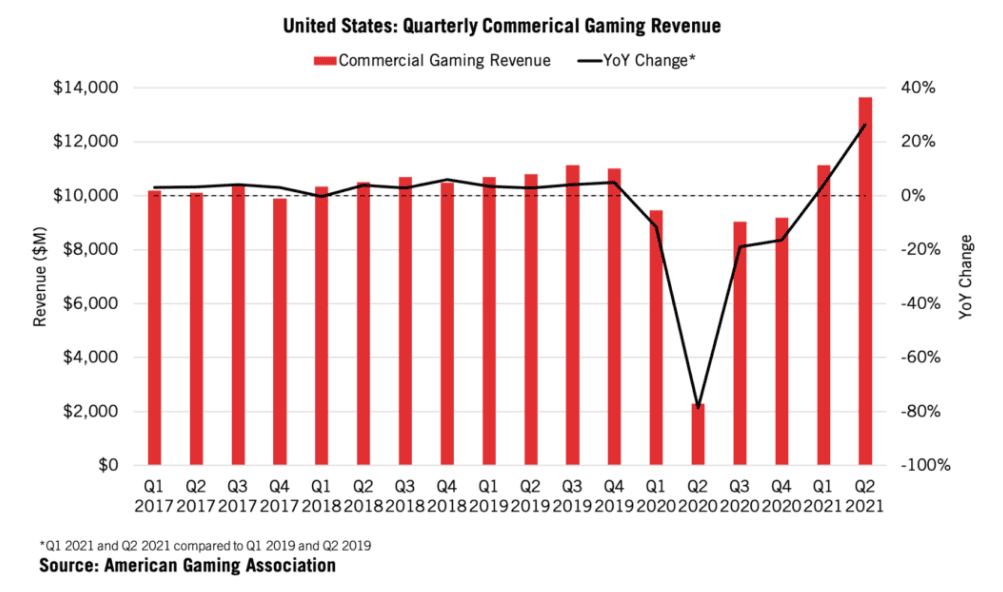
Image Source: Screengrab from the AGA’s Q2 2021 tracker

Slot And Table Games’ Performance

Within overall revenue, combined revenues from slot and table games hit a record $11.8 billion, an increase of 9.9% from the previous high and up 12% from Q2 2019. Slot revenue recovered at a faster rate than table games, though, growing at a rate of 16.7% compared with table games’ revenue growth rate of 0.8%.

In many states, Covid-19 related regulatory restrictions generally established limits on the number of players that could be seated at any table game, with some states suspending certain table games altogether. Even with such limitations still in place during parts of Q2 2021, 17 out of 25 states experienced a jump in traditional casino gaming revenue (combined slot and table game revenue) compared to Q2 2019.

This is the second consecutive quarter that gaming revenue has outperformed the broader economy. It also has more room to grow, given most U.S. casinos were still subjected to state reopening guidelines at the start of the quarter, which significantly limited casino capacity, offerings, and amenities, the AGA said. When Q2 2021 began, 15 of 25 states that are collectively home to three-quarters of commercial casinos in the U.S. had restricted their capacity to 50% or lower. By the close of the quarter, though, they had all fully reopened.

However, gaming revenue only constitutes one segment of overall casino revenue and other aspects like live entertainment, dining, hotel bookings, and meetings and conventions are yet to fully rebound.
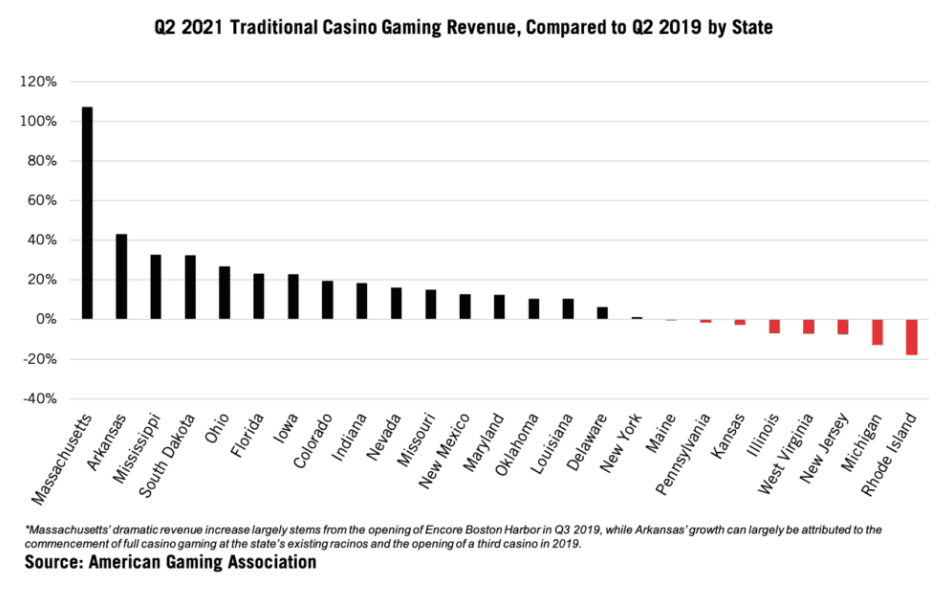
Image Source: Screengrab from the AGA’s Q2 2021 tracker

State-wise Spend Per Casino Visit

With consumers adopting an increasingly optimistic economic outlook during the quarter, though, the spend-per-casino-visit rate remained high. The spike in average traditional gaming revenue per admission that occurred last year after casinos reopened remains well above pre-pandemic levels, the AGA report showed. This is based in particular on data from four states: Illinois, Iowa, Louisiana, and Missouri. In Q2 2021, average quarterly casino win per visitor for all four states seemingly stabilized between 20.4% and 45.7% above Q2 2019 averages.

The second quarter of this year also saw 17 (of the 25) gaming states generate record quarterly revenue. That included 8 of the 10 highest-grossing states in 2019 — Indiana, Louisiana, Maryland, Missouri, Nevada, New York, Ohio, and Pennsylvania. Gaming revenue shrank only in three states when compared with Q2 2019. Those were Kansas (-0.5%), Maine (-2.6%), and Rhode Island (-14.7%), where the state’s two casinos only returned to full operating capacity in late May and faced a more competitive New England market.
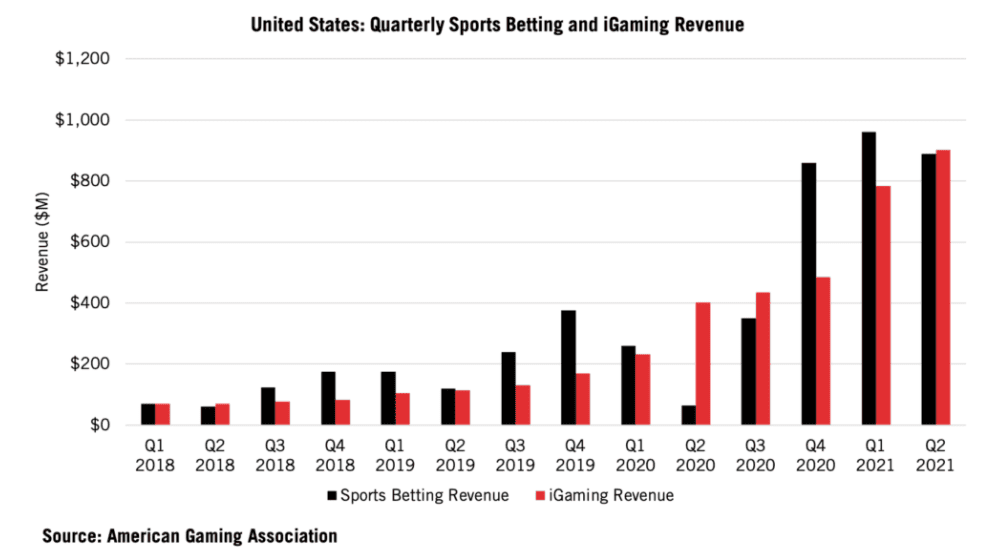
Image Source: Screengrab from the AGA’s Q2 2021 tracker

iGaming, Sports Betting Also Post Record Quarter

Meanwhile, iGaming continued to set new records, reaching $901 million during Q2 2021 (up 14.9% from Q1 2020) even as sports betting had its second-best quarter to date, the AGA said. Sports betting generated $888.9 million in Q2 2021, an increase of more than 600% over Q2 2019. Since Q2 2019, 12 states and the District of Columbia have launched commercial sports betting markets.

Just yesterday — i.e., Aug. 10 — we wrote about how sportsbooks crossed $300 million in operator revenue only for the fourth time since the Professional and Amateur Sports Protection Act (PASPA) law was struck down in mid-2018.

Combined revenue from sports betting and iGaming accounted for 13.1% of total gaming revenue in Q2 2021, down slightly from 15.7% in Q1 2021.

In the first six months of 2021, iGaming — legal and active in only six states — generated $1.66 billion in revenue, growing 160.8% from the same period in 2020 and already surpassing last year’s full year total of $1.55 billion. Similarly, first-half sports betting revenue in 2021 reached $1.85 billion, overtaking 2020’s full year total of $1.55 billion, the AGA said.

Las Vegas, the center of the country’s casino industry, has seen increases in tourism, gaming revenue, and airline passenger totals over the past several months, Casino.org reported. The $4.3 billion Resorts World Las Vegas also opened on the Strip this summer. It is the most expensive hotel-casino in the state’s history, and the first new resort to open on the Strip since 2010. Its grand opening in June had an estimated 20,000 visitors.

Still, challenges from the Covid-19 pandemic have not quite been left behind. Health officials in Los Angeles, Chicago, and Hawaii recently cautioned against traveling to Las Vegas because of Southern Nevada’s low vaccination rate and large number of new infections, Casino.org says in its report.

“These first half results are truly remarkable. COVID-19 is not yet in the rearview mirror, but I’m confident the record first half of 2021 has laid a strong foundation for the industry’s full recovery. We’ve had a setback for sure with the Delta variant and some challenges with vaccinations, but I think we’re going to get through it,” AGA President and chief executive officer Bill Miller said on Tuesday.


‘Clogged Arteries At The Heart Of Our Economy [Are] Going To Be Opened Up’ — Senate Approves $1T Infrastructure Bill

By a Biometrica staffer

On Tuesday, Aug. 10, the Senate passed the Infrastructure Investment and Jobs Act, a long-awaited, $1 trillion bipartisan bill, sending it onto the House for approval. All 50 Democrats voted in favor, joined by 19 Republicans. This is the first large-scale infrastructure package to be passed in decades and many of the measures within were at the center of President Joe Biden’s campaign promise to rebuild the nation.

“After years and years and years of ‘Infrastructure Week,’ we’re on the cusp of an infrastructure decade that I truly believe will transform America,” President Biden said in his remarks about the bill passing. Over the last few years, the country’s crumbling infrastructure has often come under the spotlight, and investing in it is long overdue according to some. For instance, the White House says that around 173,000 miles, or 20% of the nation’s highways and 45,000 bridges are in poor condition and require upgrading. 

Under the package that took over a month to negotiate, around $550 billion in new funds will be directed towards upgrading deteriorating transportation systems, including highways, bridges, and tunnels. Specifically, around $100 billion will go to roads and bridges, $39 billion to transit, $25 billion to airports, $66 billion to freight and passenger rail, $46 billion to making infrastructure more resistant to extreme weather events and climate change, and around $11 billion to boosting transportation safety and reducing accidents and crashes. 

The legislation has a number of provisions directed at trucking as well, allowing for apprenticeships for truckers younger than 21 to operate commercial vehicles across state lines and increased research into enhancing the safety of commercial vehicles. Its passage was lauded by many in the freight and transport industries. According to the President, “This bill is going to put people to work modernizing our roads and our highways and our bridges so commuters and truckers don’t lose time in traffic, saving billions of dollars nationally.”

Last week, the Congressional Budget Office said the measure will likely add $256 billion to the country’s deficit over the next ten years. Congress and the White House say the bill will pay for itself, relying mostly on unused Covid-19 relief funds like the Economic Injury Disaster Loan program, the Paycheck Protection Program, and the Education Stabilization Fund. According to legislators, the bill will generate around $56 billion in economic growth over the long-term.

The Senate delayed its August recess to continue working on the bill over the weekend, and some lawmakers in the House are now saying that they may cut their own recess short and return in two weeks on Aug. 23 (instead of Sept. 20, as previously scheduled). House Speaker Nancy Pelosi has said that the House will not vote on the deal until the Senate passes a separate set of social safety net measures.

According to polls, the public seems to be largely in favor of the bill, with one finding that around 65% of Americans support it.

How The Federal Government Hopes To Understand And Evaluate The Extent Of The Missing and Murdered Indigenous Persons Crisis

By a Biometrica staffer

Last Wednesday, Aug. 4, the Departments of Justice (DOJ) and Interior (DOI) together announced that they are seeking nominations for the non-federal seats on a Joint Commission on reducing violent crimes like murder, rape, and kidnapping against American Indians and Alaska Natives. This step is part of a broader implementation of the Not Invisible Act of 2019.

The violence experienced by Indigenous Peoples in general — and women, in particular — is not a recent phenomenon but it has been gaining attention and traction lately. Just a few months ago, President Joe Biden declared May 5, 2021, Missing and Murdered Indigenous Persons Awareness Day, calling attention to the “disproportionately high number of missing or murdered Indigenous people,” and acknowledging the collective “failure to allocate the necessary resources and muster the necessary commitment to addressing and preventing this ongoing tragedy.”

In April, earlier this year, the Bureau of Indian Affairs (BIA) established a new Missing & Murdered Unit (MMU) to coordinate and direct funding in intra-governmental and cross-agency efforts to solve Missing and Murdered Indigenous Persons (MMIP) cases. The MMU will work with Tribal, BIA, and FBI Investigators closely, to “provide the resources and leadership to prioritize these cases and coordinate resources to hold people accountable, keep our communities safe, and provide closure for families,” as Interior Secretary Deb Haaland, the first Native American to hold that office, said at the time.

Last month, we covered the efforts to reauthorize the Violence Against Women Act, and how that may empower Indigenous communities to better investigate and prosecute violent crimes committed against Native women. In today’s piece, we take a look at two other key pieces of legislation that have been enacted recently to help stall this crisis — the Not Invisible Act and Savanna’s Act.

What The Data Says

Per some estimates, over eight in 10 Native Peoples are likely to experience sexual violence or assault during their lifetime. Native women and girls are also more likely to be trafficked than other segments of the population. Over four in five Native women report having experienced some form of violence during their lifetime. 

According to the Centers for Disease Control and Prevention, for Native women aged 1–44, homicide was the sixth leading cause of death in 2018. For Native men, it was the third leading cause. In some tribal areas, the murder rate of Indigenous women is 10 times higher than the national average. Other estimates say that one in every three Native women is raped during their lifetime.

The DOI says that a lack of funding and resources means that MMIP cases often go unsolved, with it being difficult to re-examine evidence, find new witnesses, or further investigate suspects.

The Not Invisible Act

The Not Invisible Act was sponsored by then-congressperson Haaland and was passed unanimously by Congress in 2020. It requires the DOI to boost coordination across the government to mobilize resources in an effort to address the MMIP epidemic. Though the resources, grants, and programs existed before the Act was passed, the efforts to combat MMIP were without central leadership — a role that the DOI now plays.

The Commission, as detailed in the Act, is intended to serve in an advisory role and will be made up of at least 27 federal and non-federal members who run the gamut from law enforcement representatives and Indigenous-led organizations to healthcare and mental health experts who specialize in working with Native survivors of trafficking and sexual assault. The Commission will also include Native American survivors of human trafficking and family members of MMIP.

The Act requires the Commission to develop policy recommendations on how to best identify, report, and respond to epidemic violent crimes being committed against Native Americans and on Tribal land. As part of its duties, the council will seek out evidence and testimonies from hearings to base its recommendations on.

Savanna’s Act

Another bill, Savanna’s Act, was passed and signed into law at the same time as the Not Invisible Act. It is named after Savanna LaFontaine-Greywind, a 22-year-old who was eight months pregnant when she disappeared in 2017. She was eventually found murdered and butchered by a neighbor, who had cut her unborn baby out and stolen it.

Savanna’s Act requires the DOJ to review, revise, and create uniform law enforcement and justice standards on how to respond to violent crimes against Native American women. Crucially, it also requires federal agencies to collect and routinely make public statistics on the MMIP problem. The DOJ did not release any data around Native peoples until just over two decades ago. Enhancing data collection and reporting is expected to help experts craft evidence-based and effective measures to combat this problem.

Under this, the DOJ will train appropriate law enforcement agencies on how to use federal missing persons databases to record Tribal figures. Authorities will also be running a public awareness campaign on how to capitalize on the National Missing and Unidentified Persons System.

With the start of the process of putting the Not Invisible Act Commission together, the plight of Indigenous communities is being put under the spotlight once more. In announcing the opening of nominations, both Secretary Haaland and Attorney General Merrick B. Garland highlighted the importance of allowing Native leaders and communities to lead the way.

“Incorporating Indigenous knowledge, Tribal consultation and a commission that reflects members who know first-hand the needs of their people will be critical as we address this epidemic in Native American and Alaska Native communities,” said Secretary Haaland.

Attorney General Garland added, “The membership of this joint commission must represent a diverse range of expertise, experience and perspectives, and we will consult with Tribal leaders who know best what their communities need to make them safer.”

The public can submit nominations for the non-federal positions on the Commission here.

Sportsbooks Cross $300M In Operator Revenue For Just The Fourth Time Since Mid-2018

By a Biometrica staffer

Monthly operator revenue at sportsbooks across the country came in at $318 million in June, the highest nationwide win rate for this year, and only the fourth time that the number has clocked in higher than $300 million since the Professional and Amateur Sports Protection Act (PASPA) law was struck down, US Bets reported on Monday, Aug. 9. The operator revenue and $48.4 million in tax receipts for June were both also the third-highest monthly totals in the post-PASPA era.

In May, operators claimed $255 million in revenue, down 4.2% from April’s $266.1 million, while the amount that went into tax coffers also dipped slightly to about $39.4 million in May from $39.8 million in April, a US Bets article from July said.

With that, for the first half of this year there has been over $24.2 billion worth of wagers, which has translated into more than $1.75 billion in operator revenue. These amounts have, in turn, generated over $260 million in tax revenue for the state governments (and the District of Columbia) where sports betting is legal. For all of 2020, those three numbers came in at $21.5 billion (wagers), $1.47 billion (operator revenue), and $241 million (tax revenue).

On their part, bettors wagered around $3.68 billion in June, compared with about $3.72 billion in May. The number for May, in turn, was an increase of 0.4% from April.

The national win rate for June was 8.64%, the fifth-highest of the 37 months post-PASPA and easily clearing the previous 2021 high of 8.23% set in January, US Bets said in its report. The “hold” (or win rate) nationwide was 6.86% in May compared to 7.19% in April. 

Hold refers to the amount of money the house holds or keeps after all bets are paid out. June’s win rate was weighed down by Nevada’s hold of 5.35%, the report added. The hold climbed substantially in five of the six largest states — New Jersey, Illinois, Pennsylvania, Michigan, and Indiana — with Nevada again proving to be a group outlier.

Baseball betting, especially in Las Vegas, made an impact in the monthly numbers for June according to the report. A post-PASPA monthly high of $226.2 million was wagered, but the hold was just 1.41% as operators claimed only $3.2 million in revenue. Meanwhile, in Illinois, basketball revenue climbed 39.3% to nearly $9.6 million despite a 17.1% drop in handle. 

Meanwhile, legislation to license and tax sports betting in North Carolina cleared another state Senate committee on Monday. It was approved by the finance committee last week, and still needs to clear two more Senate panels before heading to the floor for a full vote. If the bill passes the Senate and House, and if Democratic Gov. Roy Cooper signs it into law, the North Carolina Education Lottery commission pans to issue 10 to 12 interactive sports wagering operator licenses.

The Dark Side Of The Web: Drug Trafficking On The Darknet Grew Nearly Fourfold Recently

By Deepti Govind

At the end of last month, a drug dealer called Chukwuemeka Okparaeke, whose online darknet avatar is “Fentmaster,” was sentenced to 15 years in prison. He imported and trafficked fentanyl analogues and other synthetic opioids through the dark web, including one controlled substance called U-47700 that he sold to an 18-year-old individual who died from an overdose after using the drug. Okparaeke used the dark web marketplace AlphaBay to peddle his drugs between 2016 and 2017, engaging in over 7,000 sales of synthetic opioids.

The “Fentmaster,” who attended medical school before he turned into a darknet drug dealer, shipped these drugs to customers throughout the country using the U.S. Postal Service. He used extensive measures to conceal his identity, including software to encrypt his internet traffic and the communications sent from his cellphone. Using alter egos, he boasted online about his exploits as a darknet drug trafficker, offered advice to other drug dealers and even publishing a short story describing his criminal activities and his strategies for evading law enforcement. 

It took the combined efforts of the U.S. Customs and Border Protection (CBP), Homeland Security Investigations (HSI), the United States Postal Inspection Service (USPIS), the Federal Bureau of Investigation (FBI), and multiple other law enforcement agencies to investigate Okparaeke’s case. During just one search of a premises he maintained, law enforcement agencies seized over 10 kilograms of U-47700, acryl fentanyl, and furanyl fentanyl, as well as a quantity of 4-ANPP (despropionyl fentanyl) and roughly 82 mailing envelopes containing smaller amounts of those substances that had been packaged for his customers.

This is just one case of a single darknet drug dealer.

Major drug markets on the dark web are now worth around $315 million annually, the United Nations Office on Drugs and Crime (UNODC) said in a report. From 2011 all the way until mid-2017, drug markets on the dark web were estimated to be worth around $80 million in annual sales. But, in under three years since (i.e., between mid-2017 to 2020), there’s been a near 300% increase in growth in the size of this market (i.e., to $315 million). What makes this more important is the fact that drug markets on the dark web only emerged a decade or so ago.

As with everything else during the year of the Covid-19 pandemic, contactless drug peddling was identified as an accelerating trend. Even before Covid-19, though, the accessibility of drugs had begun widening, with dealers turning to social media and even popular e-commerce platforms to peddle their wares. Currently it is cannabis, which has been fully legalized across several states in the U.S., that dominates darknet sales. Meanwhile, marketing on the “clear web” often involves new psychoactive substances (NPS) and those used in the making of synthetic drugs, including precursor chemicals.

Image Source: Screengrab from the UNODC World Drug Report 2021

A study conducted in 2016 by research firm Terbium Labs found that of the close to 200 domains it catalogued as illegal out of 400 randomly selected darknet sites on the Tor (The Onion Router) network, over 75% were marketplaces. Recreational and pharmaceutical drugs were the most popular products on these marketplaces, followed by stolen and counterfeit documents such as identities, credit cards, and bank credentials, the International Monetary Fund (IMF) said of the Terbium Labs study in a blog published in September 2019.

Before we delve a little more into the UNODC’s recent findings, here’s a quick explainer on darknet marketplaces and how they evolved.

Darknet Drug Marketplaces

A darknet marketplace is no different, really, in the way it is meant to operate when compared with regular online marketplaces that most of us are familiar with like Amazon or eBay. The main difference, of course, is that darknet marketplaces give their users anonymity. These marketplaces, and the dark web itself, can be accessed through various ways — including by using platforms like Tor, a browser that can be downloaded for free. Tor offers up a collection of sites (with .onion addresses) inaccessible via a regular browser and not indexed by search engines like Google, as the IMF blog explains.

Then there are mirror sites on the surface web that provide hyperlinks to corresponding hidden sites, and “invitation-only” markets where users need to be referred by a current user, the European Monitoring Centre for Drugs and Drug Addiction (EMCDDA) says.

“The earliest modern online anonymous markets, often referred to as darknet markets or cryptomarkets, appeared in early 2010, and evolved from an encrypted email service and migrated on to a Tor anonymity network to guarantee better anonymity to users. The first darknet market of notoriety was Silk Road, which opened at the end of January 2011 and was seized by the FBI in October 2013. Silk Road 2.0 was launched soon after the original Silk Road was seized and since that time there has been a proliferation of darknet markets,” the EMCDDA website adds.

Specialized “darknet explorers” enable customers to access their desired market platform, where goods are then typically paid for in cryptocurrencies — in particular bitcoins — which can be used subsequently to buy other goods and services, or can be exchanged for various national currencies. The delivery of drugs purchased on the darknet is generally carried out by public and private postal services without their knowledge, with parcels often being sent to anonymous post office boxes, including automated booths, or “pack stations” for self-service collection. In jurisdictions with strong secrecy-of-correspondence laws, drugs are often dispatched in letters, the report adds.

Cut to today, where the pandemic has pushed everything online, where technological advances are only becoming more rapid, and where criminals are constantly becoming more agile and adapting to these new technologies, and it’s possible that we could soon see a globalized market where all drugs are more available and accessible everywhere. “This, in turn, could trigger accelerated changes in patterns of drug use and entail public health implications,” the UNODC report says.

What makes the darknet a conducive platform for drug trafficking is the anonymity of the transaction, the fact that no physical contact is required, that it takes away hesitance among some consumers who may have otherwise been reluctant to interact with drug dealers, and that it also removes the obstacle of consumers having to go to potentially dangerous or lonely places to buy the drugs. It also means sellers and buyers need not be in the same location — hence the fear that it could become a globalized market, as we mentioned earlier.

The other advantage of not having to be in the same location is that drug dealers who sell over the dark web do not need a critical mass of customers to sustain themselves like they do with a localized market. And, as with other online marketplaces, customers can also view feedback about the quality of drugs sold by suppliers, once again making it all the more easier for the illegal drug market to thrive.

Thus, the very nature of the dark web that makes it a useful tool for those who could otherwise be endangered by revealing their identities online, like victims of abuse and persecution or whistleblowers, has been turned on its head and has become an unintentional advantage that criminals are exploiting too. The good news is such platforms do not really last long, per the UNODC report.

An analysis of 103 darknet markets over the period 2010–2017 revealed that they were active for, on average, just over eight months, the report says. A similar analysis showed that of more than 110 darknet drug markets that were active during 2010–2019, just ten remained fully operational in 2019. Most of them were only started in 2018, and almost all of those that became major darknet markets had disappeared by December 2020. Without intervention from law enforcement, the dynamic and resilient darknet market ecosystem could have grown even faster over the past decade. But major law enforcement operations have led to the dismantling of a number of darknet platforms, including AlphaBay, which we mentioned at the beginning of this piece when talking about the “Fentmaster” case.

Still, more needs to be done to combat this rising trend. Although darknet marketplaces have a tiny share of the overall illegal drug-market pie, their very nature could make them tougher to crack, as we saw in the “Fentmaster” case. Public–private partnerships need to be forged with participation from internet service providers, tech companies, and shipping and mailing companies to improve government response to drug trafficking on the internet, the UNODC report says. The internet drug supply-chain has to be controlled, drug adverts and listings need to be removed, information must be shared with law enforcement, cryptocurrency markets have to be regulated, electronic payments must be monitored, and expert access to the dark web needs to be enhanced to take down illegal online markets and platforms, the report adds.

This is part one of a series Biometrica plans to do on the dark side of the web. Up next in this series will be an even deeper look at the world of illegal darknet drug trafficking.

How Pilots Arrested For Driving Drunk Or High Can Still Fly Without Anyone Ever Knowing

By Aara Ramesh

In July, a pilot from Florida was convicted for operating a commercial airplane despite his airman’s certificate having been revoked and his medical certificate being suspended by the Federal Aviation Administration (FAA) on May 7. According to the FAA, Eduardo Aching failed to report that he had been arrested for Driving under the Influence (DUI) — an action that would have required reporting under the law.

Instead, Aching continued to fly, operating an aircraft on at least ten different occasions after his medical certificate was suspended. He also presented an FAA inspector with a falsified medical certificate. 

There are many parts to this story, but perhaps the one that may cause the most confusion is the fact that Aching did not necessarily get into trouble because of the DUI, but rather because he failed to report it.

In today’s piece, we take a look at what the laws and rules are around an airman’s license and what it means if a pilot is accused, arrested, and/or convicted of a DUI.

Self-Reporting Rules And Procedures

An airman’s certificate or license is issued by the FAA, contingent upon a medical examination and subsequent certificate conducted and issued by an Aviation Medical Examiner (designated by the FAA). There are varying classes of medical certificates and the validity of each depends on the class and the pilot’s age, ranging from six months to five years. Once the period has lapsed, the medical needs to be redone for the airman’s certificate to be renewed.

Under the Code of Federal Regulations at 14 C.F.R. § 61.15(e), all pilots, flight instructors, and ground instructors that fall under Part 61 of the code have to send a “notification letter” (a report) to the FAA’s Security and Hazardous Materials Safety Office about any drug- and/or alcohol-related motor vehicle actions (MVAs), within 60 days of the incident.

There are several types of MVAs, including:

  • A conviction for DUI or Driving While Intoxicated/Impaired (DWI), as it relates to alcohol or drug consumption.
  • A conviction for Driving with an Unlawful Blood Alcohol Level.
  • A conviction for operating While Under the Influence (OWUI).
  • Any incident that leads to a driver’s license being cancelled, suspended, or revoked for an alcohol- or drug-related reason.
  • A driver’s license being cancelled, suspended, or revoked for failing or refusing a chemical test (like a breathalyzer analysis or a blood test), even if the driver was not drinking or imbibing drugs.
  • Having a driver’s license application rejected due to an alcohol- or drug-related offense.

A pilot must report any alcohol- and/or drug-related administrative action, regardless of whether it led to a conviction or not. It does not matter if the charges are reversed, dismissed, or pled down later — the administrative incident still has to be reported to the FAA. Pilots are also required to submit these reports even if they are not actively flying when the incident occurs.

The FAA says that the notification must be submitted within 60 days of the effective date of the license being suspended. A second notification is required if the person is then convicted for the crime that led to the suspension, again within 60 days of the conviction date. It is perfectly normal to have to submit two notifications if the suspension leads to a conviction, but the case is usually treated as one under the law — the FAA will likely not increase the penalty for two notifications from the same arrest.

Most aviation experts suggest retaining the legal services of a specialized lawyer as soon as an incident like this takes place, though they also warn that everyone should be wary of attorneys who may say that the FAA notification isn’t necessary because there was no action taken beyond a license being temporarily suspended. 

This is all separate from what happens if a pilot operates a plane while impaired or under the influence, or who has drugs on their person while flying. Further, it does not appear as though holders of an airman’s licenses have to report arrests or convictions for any other crimes.

Outcomes And Penalties

Once a notification is submitted, the FAA conducts a preliminary inquiry to make sure that the report was made within the time frame and that all actions that need to be reported have been.

The FAA encourages a pilot to report an incident even outside the 60-day period, saying that a submission made before the agency itself finds out is “normally considered a mitigating factor when determining sanction.”

If a pilot fails to submit a report but the FAA discovers the record, then a formal investigation is opened. If the person is found guilty, the FAA may deny any application for a certificate, rating, or authorization for up to one year, or suspend/revoke the certificate, rating, or authorization.

The typical sanction of failing to report and being caught is a 30-day suspension of the airman’s license. If the report is made after the 60-day deadline but before the FAA discovers the arrest, the person will likely only be sent a letter of reprimand, and there will likely be no civil penalty or action taken against the license.

For any offense related only to drugs, the FAA is allowed to penalize the airman’s certificate, with revocation being the general course of action (unless the charge was “simple possession of a small amount”).

How The FAA Finds Out

It may come as a surprise to some that the FAA does not have a database that automatically updates periodically with the latest convictions and arrest information (most of which are generally publicly available).

Rather — after an initial check when the person first applies for a license — the FAA partially relies on the aforementioned self-reporting (under particular circumstances) and partially on a “periodic” manual check of the National Driver Registry and state registries for any drug or alcohol driving-related convictions involving pilots. When an individual consents to the medical, they also consent to the FAA requesting information from the registries about that person’s driving record. 

Some say that federal regulators do not conduct frequent-enough criminal background checks on pilots who have already been licensed once, mainly due to a lack of the resources that would be required to do so. It is estimated that the total number of licensed pilots in the U.S. stood at just over 690,000 as of 2020, indicating the mammoth task that regulatory agencies are faced with.

The FAA does conduct random, on-the-spot alcohol and drug tests on pilots, it said. In 2015, the agency caught around one pilot a week (48 in total) for having alcohol above the legal limit and/or illicit drugs in their system during such checks.

What This All Means

Experts say that the FAA operates on a good-faith, honor-based system, expecting that their pilots will display “good moral character” and self-report any violation of the law.

Unfortunately, this is not always the case. “I don’t think the public has a clue as to how dangerous the skies actually are in terms of the people flying them around,” said one ex-government official.

An investigation conducted in 2016 by News8 in Texas found that over 80 pilots still had their licenses despite having been arrested and convicted for crimes like sexual assault or abuse of child, aggravated assault with a deadly weapon, grand theft, domestic battery by strangulation, aggravated stalking, aggravated attempt to elude police, and endangering lives of others while attempting to elude police.

When questioned by the investigative team, the FAA said that in the five years prior it had caught around 67 airline pilots who had falsified their medical forms. Per the report, these were for criminal offenses such as aggravated assault and battery, rape and aggravated sodomy, online solicitation of a minor, and inducing a minor child younger than 18 years of age to engage in sexual performance.

What this boils down to, experts point out, is that a person who has been arrested for driving a motor vehicle while drunk or while on drugs can continue to fly a plane indefinitely, until such time that the FAA conducts a background check and finds the arrest — if they ever do.

One pilot summed up the situation quite succinctly to News8: “This is a problem, but very few people know about it.”

Nursing Home Covid-19 Cases Rose Sharply Last Week As Staff Vaccination Rates Still Lag

By a Biometrica staffer

The number of nursing home patients and staff infected with the Covid-19 virus rose sharply last week, at a time when the nation is reeling under the menace of the highly contagious delta variant and as total cases in the U.S. have climbed to a six-month high with over 100,000 infections. States that have lower vaccination rates have been ravaged the most, overall, with the recent surge affecting unvaccinated people more severely than others.

On Thursday, Aug. 5, White House chief medical advisor Dr. Anthony Fauci warned that a more severe Covid variant could emerge, while also estimating that there are roughly 93 million people nationwide who are eligible for the vaccine but haven’t received it yet. Healthcare systems are under immense strain and are running out of space in Florida, Georgia, and Louisiana, which account for almost 40% of all hospitalizations in the country.

Louisiana and Georgia have some of the lowest vaccination rates in the nation. In Florida, hospitals are using everything from conference rooms and auditoriums to cafes to set up more beds. The Biden administration, meanwhile, is said to be developing a plan that requires nearly all foreign visitors to the United States to be fully vaccinated against Covid-19 as part of a plant to eventually lift the travel restrictions that currently bar much of the world from entering the country.

Now, against this backdrop, the lag between vaccination rates among nursing home staff and nursing home residents is back in the limelight. On July 22, the Associated Press reported that the Centers for Disease Control and Prevention (CDC) was investigating facilities in the Grand Junction, Colorado, area that was hit hard by the recent surge in cases. The federal investigation, which suggested a link between lagging vaccination rates among nursing home staff and a national spike in infections, found that many nursing home workers were not inoculated.

In that article, the AP said that about 59% of nursing home staff have been vaccinated nationally, about the same as the overall percentage of fully vaccinated adults. However, that rate was significantly lower than the roughly 80% of residents vaccinated. The CDC investigation raised concerns that successes in protecting vulnerable elders with vaccines could be in peril as the more aggressive delta variant spreads across the country, combined with a lag in the vaccination rates among staff.

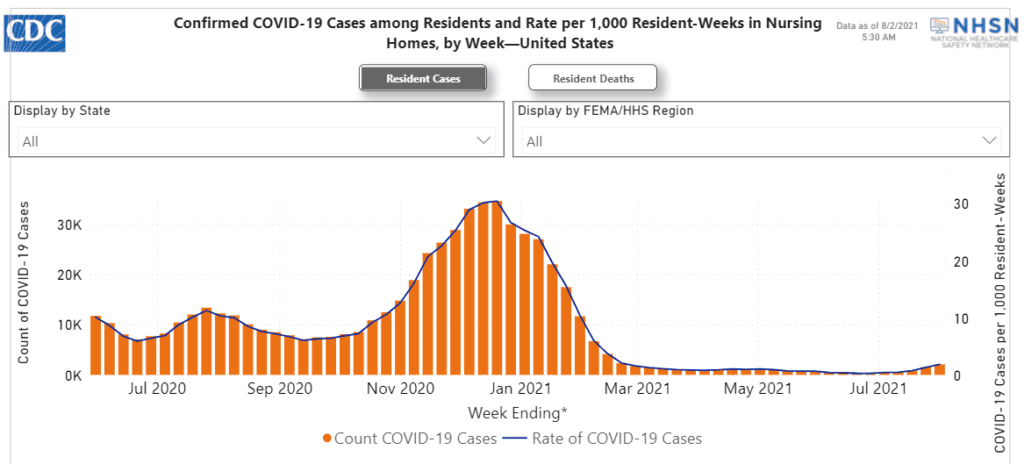
CDC data for the most recent week, i.e., between July 25 and Aug. 1, shows that Covid-19 cases among nursing home residents rose 38% to 2,041 from 1,478, NBC reported. Florida’s long-term care facilities account for more than a quarter of the cases, with 564, up from 348 the previous week. The number of nursing home residents who died of Covid-19 nationwide rose to 281 last week from 163. Cases among nursing home staff jumped 31% to 3,252 from 2,467 in the last week.

Image Source: Screengrab from the CDC Covid Data Tracker

Whenever there’s been a rise in cases in the community, it’s been known to infiltrate nursing homes, Dr. Morgan Katz, an assistant professor of medicine at the Johns Hopkins School of Medicine is quoted as saying by NBC News. Much of the reason behind this, though, is that only 60% of the nursing home staff is vaccinated, which allows the virus a potential entry into the facility, Katz added.

Some experts have been urging the government to close the gap by requiring nursing home staffers get shots. “Vaccinating workers in nursing homes is a national emergency because the delta variant is a threat even to those already vaccinated,” Dr. Joshua Sharfstein, vice dean for public health practice at Johns Hopkins Bloomberg School of Public Health, was quoted as saying in the AP report from July 22. But some nursing home operators have expressed concerns that a mandate could backfire and prompt staffers who are skeptical of getting the vaccine to simply quit, at a time when the load on the healthcare system is already extremely high.

Still, a couple of states have begun to issue such mandates. Massachusetts Gov. Charlie Baker’s administration announced on Wednesday, Aug. 4 that all unvaccinated employees and contractors at skilled nursing facilities in the state will be required to get their first vaccine shot by Sept. 1 and be fully vaccinated by Oct. 10. California went one step further on Thursday when it issued a mandate that requires all healthcare workers to be inoculated, allowing only for religious or rare medical exemptions. Employees of hospitals, nursing homes, doctors’ offices, clinics, and other medical facilities have until Sept. 30 to get at least one dose of the vaccination, under the new order.

And it’s not just state governments that are mandating vaccinations for nursing staff.

Genesis Healthcare, which has 70,000 employees at nearly 400 nursing homes and senior communities, announced this week that its employees must get the shot to keep their jobs. Nursing home residents, even those who have been inoculated, are more vulnerable than many other demographics because many are elderly and frail, with weak immune systems. The mandate by Genesis Healthcare suggests that private facilities may be willing to risk an exodus, despite already dangerously understaffed homes, to quickly vaccinate those still resisting shots and fend off the surging delta variant, the AP reported.

The CREEPER Act: The Case For Banning Child Sex Dolls And Robots

By Deepti Govind

Just three weeks ago, the Department of Justice said a 53-year old Maryland resident, Jeffrey John White, was sentenced to more than 11 years in federal prison for possessing thousands of files of child pornography. When the case was being investigated by law enforcement in 2020, a search of White’s residence led to the seizure of his laptop and SD card that contained downloaded files of child sexual abuse material (CSAM), plus a child-sized sex doll with anal and vaginal openings.

Similarly in Alabama this March, a 35-year-old who impersonated Federal Bureau of Investigation (FBI) agents, approached an employee of a local business with a handgun drawn, and then tried to enter the police department building. When law enforcement agents executed a search warrant on Kelcey Turner’s car and house, they found everything from a rifle with more than a hundred rounds of ammunition, hundreds of CSAM images, an infant-sized sex doll, and — even more disturbingly — a daybed set up with stuffed animals and recording devices.

Such cases are not new to Alabama, or really any state, though. Child sex dolls are often shipped from overseas into the U.S., mostly after buyers find them available online. In 2019, when Baldwin County sheriff’s deputies had to search convicted sex offender Bobby Ricky Bible’s trailer, they found a child sex doll, AL.com reported. We will go into more details based on that report later on in this piece.

What many of these cases appear to prove is a statement made in the text of the Curbing Realistic Exploitative Electronic Pedophilic Robots Act 2.0, or CREEPER Act 2.0: “There is a correlation between possession of the obscene dolls, and robots, and possession of and participation in child pornography.” Yet, the legislation has not managed to pass through Congress ever since an earlier Act, called the CREEPER Act of 2017, sat dormant in the Senate after passing the House in 2018. That a ban on child sex dolls ought to be instituted, though, probably goes unsaid.

To cite another example of how the sale of these can take a really dark turn, a few people may recall an incident last year in which a mother in Florida went through what no parent ever ought to. In August 2020, Terri received a message from a friend alerting her to the existence of a sex doll that resembled her daughter. The doll was advertised on Amazon and other websites as “a high quality sexy dolly live dolls for men” for sale at $559, but looked like her eight-year-old, Kat.

Kat, who suffers from Common Variable Immune Deficiency (CVID), is a child model and pageant contestant. Terri has posted photos of her daughter on a Facebook group where she shares updates on Kat’s illness, community projects, and modeling work. Eerily, the doll was modeled after a photo that Terri had shared on the Facebook group.

“This image had the same socks as my daughter and the same pose as my daughter on our sofa at home. She had that same sweatshirt and facial features as that image, even the same stuffed animal! I couldn’t imagine that some sicko would use my daughter’s photo to create something so ugly and evil to be used for abuse by pedophiles,” Terri was quoted as saying in September 2020 when news media reported on it. Amazon removed the ad for the doll after Terri contacted them. But she knew that wasn’t enough.

Terri partnered with the Child Rescue Coalition, a nonprofit that rescues kids from sexual abuse, to ban the sale and possession of child sex dolls across the country. Child sex dolls were only banned in Florida, Tennessee, and Kentucky when NBC 6 reported on Terri’s case at that point in 2020. This year, on June 25, the Child Rescue Coalition reported that Hawaii had become the fourth state to enact such a ban with its new law, SB 834, making the importation, sale, and possession of a childlike sex doll a felony offense.

But, as the Child Rescue Coalition says, there are “46 more US states” and “many other countries worldwide who need to consider passing similar laws.” Before we get into why outright bans on child sex dolls has proven to be difficult, here’s a quick look at the summary of both CREEPER acts.

The CREEPER Act of 2017

This was introduced on Dec. 14 2017 by Rep. Daniel Donovan Jr. in the 115th Congress, which met from Jan. 3, 2017 to Jan. 3, 2019. It was labelled H.R. 4655 in the House and was passed in that chamber on June 13, 2018. It was never approved by the Senate.

Even in the 2017 version of the CREEPER act, the very first finding was on the correlation between possessing child sex dolls and possession of, and participation in, child pornography. A few other key findings listed in the act, which basically aimed at prohibiting the importation or transportation of child sex dolls, were:

  • The physical features, and potentially the “personalities” of the robots are customizable or morphable and can resemble actual children.
  • The robots can have settings that simulate rape.
  • The dolls and robots not only lead to rape, but also make rape easier by teaching the rapist about how to overcome resistance and subdue the victim.
  • For users and children exposed to their use, the dolls and robots normalize submissiveness and sex between adults and minors.
  • As the Supreme Court has recognized, obscene material is often used as part of a method of seducing child victims.

CREEPER Act 2.0

The text of this act included the same key findings as the one from 2017. It was originally introduced with the number H.R. 8236 on Sept. 14, 2020 in the 116th Congress, which met from Jan 3, 2019 to Jan 3, 2021, but did not receive a vote. It was reintroduced in the House by the same sponsor, Congressman Vern Buchanon, in January. The last action on the act was taken in March when it was referred to the subcommittee on Crime, Terrorism, and Homeland Security.

Why has legislation banning child sex dolls struggled, though? There could be a few reasons behind that. Some free speech advocates have predicted that criminalizing childlike dolls or robots would spark constitutional challenges, as AL.com reported in 2019. Then there is the school of thought that the use of these dolls may actually shield real children from abuse, which — needless to say — has been a controversial approach. And finally, a lot of thought needs to go into how such “toys” are defined so as to prevent other, non-harmful doll sales from being impacted.

Regardless of the challenges, many experts seem to have clearly been in favor of a ban over time, though. As a spokeswoman for a Democratic Florida state senator once put it: “Once pedophiles are sexually triggered, children are in harm’s way.”

MN Becomes First State To Allow Pregnant Inmates To Stay With Newborn After Birth

By Aara Ramesh

As of Sunday, Aug. 1, Minnesota’s Healthy Start Act kicked in, allowing some incarcerated pregnant and immediately postpartum women to serve their sentences in halfway houses, rehab centers, and other similar community facilities, so as to encourage bonding between mother and child during the first few months of life. With Governor Tim Walz’s signature in May, Minnesota became the first state in the nation to adopt such a measure.

Under the new law, the inmate can spend the entirety of their pregnancy and up to one year after the child is born in these community alternatives, which will be able to provide them with pre- and post-natal care, as well as parenting classes, the latter of which is highly requested among inmates. The Commissioner of the Department of Corrections (currently Paul Schnell) will be responsible for deciding if a given person falls into this category.

The Governor’s Office highlighted that “there are multifaceted societal and fiscal benefits for keeping the mother and newborn together, including reduced recidivism, re-entry support for individuals being released into the community, improved parenting, enhanced child wellbeing, and community involvement, all of which prompt a cascade of long-term, compounding benefits.”

Previously, inmates were returned to prison facilities around two or three days after they gave birth, possibly adding complications to what can be a difficult and traumatic time. It is estimated that, between 2013 and 2020, 278 pregnant people were handed jail terms in Minnesota.

Research indicates that in over half the cases in Minnesota, incarcerated mothers reach their release dates anyway within six months of giving birth, and over three in four do so within a year. Furthermore, 84% of the pregnant people incarcerated were convicted of nonviolent governing offenses, and 77% were imprisoned for technical violations of supervision.

Childcare experts say that this initial bonding is particularly crucial to the child’s development and the mother’s health. The National Institutes of Health says that not allowing a parent and a child to bond immediately after birth can have an adverse effect on the child’s cognitive, social, and emotional development in the long run. In addition, people who are jailed during and after their pregnancy are more likely to suffer postpartum depression.

Minnesota currently has one only-female prison, established in 1920 and located in Shakopee. Backers of the Healthy Start Act highlighted how the baby’s temporary caregiver can often find it difficult to travel to the women’s prison, either due to time or distance constraints. The state’s Corrections Department already works with the Minnesota Prison Doula Project, which sends doulas and other delivery specialists to Shakopee to support pregnant inmates. 

The bill initially gained attention as a result of it being the first-ever all-women sponsored, bipartisan bill in the history of the Minnesota House. When the bill was signed into law, the state Lieutenant Governor Peggy Flanagan said, “This is what happens when you center the voices of women at the decision-making table. Minnesota is the better for it. I am so proud of this historic policy that will improve the lives of moms and babies in our state.”

Observers say that women are the fastest growing demographic represented in America’s prison population, which itself is disproportionately higher than the rest of the world. According to some studies, 64.6 of every 100,000 American women are incarcerated; most of them are within their optimal reproductive age.

Infographic source: The Sentencing Project

The Child Welfare League of America estimates that 4% of women in state prisons and 3% of women in federal prisons were pregnant when they were sentenced. Other studies say that this number can actually be as high as 5–10%.

Nationwide, there are 29 facilities for women convicted of federal offenses, run by the Federal Bureau of Prisons. There are also numerous others across all 50 states, though there is no comprehensive, one-stop list of those. There are about eight prisons all over the country that allow select pregnant inmates who give birth while incarcerated to keep their newborns with them for a limited amount of time. 

Why ‘Double Brokering’ In The Freight World Is Risky, Regardless Of Confusions Over Its Perceived Legality

By a Biometrica staffer

Towards the end of June, as part of an investigative series, FreightWaves asked many transportation professionals whether “double brokering” is legal. The most common answer? It’s complicated. Double brokering, which we will explain further through this piece, has been around ever since shippers began relying on brokerages to find truckers to haul their freight. That said, double brokering scams end up costing the industry over $100 million annually, the FreightWaves article adds.

Brokering is a key component in the freight space, and — as with all other cogs in the interconnected world of transport and logistics — if anything goes wrong at the brokering stage, the repercussions can be far reaching. There has been news recently of a sophisticated, elaborate double-brokering scheme that has allegedly defrauded hundreds of trucking companies.

To make matters worse, it comes at a time when the trucking industry is already reeling under immense pressure to make up for a shortage of drivers across the nation. While the lack of drivers has been an ongoing challenge for years, the Covid-19 pandemic sent demand for shipped goods soaring even as early retirements spiked. This has led to everything from gasoline outages at filling stations to airports running short on jet fuel. In fact, the trucker shortage has become so severe that companies are trying to bring in drivers from abroad seemingly like never before, Bloomberg reported on Monday, Aug. 2.

Against this backdrop, it is perhaps more crucial now to examine the issues of double brokering than it ever was earlier.

The Recent Scam In Brief

One scheme, as we mentioned earlier, has allegedly affected hundreds of companies. It was discovered when Joe Howard, who works for an unnamed Midwestern logistics company, grew frustrated with brokers and carriers being looted by the elaborate network of load-board scammers posing as legitimate companies. Two years ago, Howard created a spreadsheet to track a list of suspect companies, of which a large number were based in Southern California, FreightWaves reported.

When Howard started the spreadsheet, it only included a handful of suspect companies. In May 2021, when FreightWaves reported on the issue, the list had grown to nearly 500. In July, the list had more than 600 companies on it. Howard said the alleged double-brokering ring originally started with three large brokerages who used a network of employees and fake motor carrier (MC) numbers to pretend to have a truck, so that they can then re-broker the loads.

For our non-transportation readers, we pause at this point to explain a couple of industry terms: An MC number is a unique identifier assigned by the Federal Motor Carrier Safety Administration (FMCSA) to moving companies operating in interstate commerce, i.e., those that haul cargo across state lines. And a load board, sometimes called a freight board, is an online marketplace for truck owner-operators, shippers, and freight brokers to post and search for loads. Users of a specific load board typically pay a subscription fee to log into the load board to post loads or post empty trucks, in order to either cover their freight or get their truck loaded. For more information on how load boards work, we recommend this blog on Truckstop.com.

Now back to the scam that’s come to light this year.

Although Oregon-based DAT load board removed the three brokerages, as FreightWaves reports (citing Howard), they were back vying for loads not long after under the guise of two new brokerages. Several complaints are said to have been lodged against the original three brokerages. Meanwhile, the CEO of several transportation companies linked to the ring has claimed he’s been unfairly targeted, and has denied any involvement in the double-brokering network.

Howard says, per FreightWaves, that the cities of Glendale, Tujunga, North Hollywood, and Burbank in Southern California “could maybe hold between five to 10 legitimate trucking companies,” yet over 400 MCs are registered there. “This is definitely the most complex operation I’ve seen in my 20 years in the logistics industry. I’ve shared this information with several brokers and receive multiple requests for the list daily,” FreightWaves quotes him as saying.

For further information and updates on this particular scam, we’d recommend FreightWaves’ Long-Haul Crime Log podcast.

When Does Double Brokering Become Illegal?

We take you back to the beginning of this piece now, where we said transportation professionals said the question of whether double brokering is legal or not is complicated to answer. Why? It is, indeed, a practice that’s been around seemingly forever, and if done right, it is also legal. When does it cross over into the realm of the illegal? If it is done without the explicit knowledge and consent of the shipper, or the carrier.

In other words, the shipper has to consent to the double-brokering arrangement and the carrier hired to haul the load also needs to be privy to the details and is paid. But freight brokers agree that even when done legally, double brokering is an arrangement that can be fraught with risk. It becomes illegal, of course, if the shipper has specifically said that its loads are not to be re-brokered.

For instance, in the case of the double brokering ring we spoke about in the previous section, the fake network involved allegedly ended up creating hundreds of fake MC numbers according to Howard, FreightWaves reports. Then, another entity that was also part of the same elaborate set up would re-broker the freight to legitimate carriers, who often have no idea that the freight has been illegally double brokered.

Once the legitimate carriers pick up the load, the scammers seek payment from the broker they booked the load with for transportation services or request fuel advances from the brokers before their unauthorized re-brokering scheme is discovered, the article adds. Ultimately, and often, it’s the legitimate trucking companies that end up paying the price for the scheme. They have little to no communication with the shippers who, in cases of illegal double brokering, themselves have no idea about the arrangement and have not authorized it. The end result is that legitimate trucking companies often have to fight to be paid, if at all.

For more information on fraud in the transportation industry, check out this webinar by Moseley Marcinak Law Group on YouTube.