Tech Support : support@safience.io

Blog

Despite Military Withdrawal And Taliban Takeover, US Remains Entangled In Afghanistan’s Turmoil

By a Biometrica staffer

The U.S. government and intelligence community are keeping their focus on the events unfolding in Afghanistan after the country was swiftly taken over by the Taliban in the wake of the withdrawal of American troops from the country. The two-decade military presence in Afghanistan saw the deployment of more than 750,000 American military personnel, with over 2,400 service members being killed and 22,000 wounded in the war.

Here’s a quick round-up of what we know so far about what’s happening in Afghanistan and what this could mean going forward.

Evacuations

Per Jake Sullivan, President Joe Biden’s national security advisor, the Taliban is cooperating with American forces trying to evacuate civilians from the country. The extremist group has agreed to provide “safe passage” out of the capital, on a U.S.-direct airlift. Some sources are estimating that there could still be as many as 15,000 American citizens stuck in Afghanistan today. 

Details on the timeline of such an evacuation are still being worked out, while American citizens, their Afghan allies, and others struggle to make their way to Kabul. U.S. officials are speaking to Taliban commanders “multiple times a day,” trying to ensure peace at the airport, per a Pentagon spokesperson. President Biden has set a deadline for Aug. 31 for the evacuations to conclude.

It appears as though the only way out of the country is through the Hamid Karzai International Airport in Kabul, with the Taliban having set up checkpoints all across the rest of the country. As such, the Pentagon is sending in additional U.S. troops to help secure the airport over the next few days, bringing the total military presence up to over 6,000.

By Wednesday, the government hopes to be conducting one evacuation flight every hour. The passengers on board will include American citizens, Afghans who have applied for Special Immigrant Visas (SIVs), and nationals of other countries stuck in Afghanistan. On Monday, the U.S. government also said it would usher around 20,000 Afghans who had qualified for SIVs to U.S. air bases.

The airlift was briefly interrupted on Monday, Aug. 16, when a scramble led to many attempting to cling to the wheels and exterior of American military aircrafts that were departing Afghanistan. At least seven people died, with the U.S. Air Force announcing Tuesday that it had discovered human remains in the wheel well of one of the aircrafts. 

Some of those who had made it to the airport managed to get on board the cargo plane, scrambling up the half-open ramp as it prepared for take-off. An image went viral on the internet showing hundreds of Afghans crowded into the holding, desperate to take any opportunity they can to leave the country as the Taliban takes over.

On Tuesday, 12 flights evacuated 1,100 U.S. citizens, permanent residents, and their families, according to the White House. 

Terrorism

On last Sunday, Aug. 15, as it became apparent that the Taliban’s progress had been quicker than expected, General Mark Milley, the chairman of the Joint Chiefs of Staff, cautioned senators that the country needs to be alert, as the resurgence of the ultra-conservative and religious group could prompt quicker-than-expected rise in the number of terrorist threats directed at the U.S. 

The Taliban, however, has begun what some are calling a publicity campaign, with the group’s spokesperson, Zabihullah Mujahid, holding a news conference in Kabul on Tuesday, Aug. 17, in which he reassured the West that no harm would come to anyone in the newly christened Islamic Emirate and that no one would be harmed “from [Afghanistan’s] soil,” either. 

Mujahid stressed that Afghanistan would no longer prove a fertile ground for radical Islamic terrorism, in an attempt to show that the organization has matured past its reputation from 20 years ago. The country’s sheltering of Al-Qaeda leader and mastermind of the 9/11 terrorist attacks on U.S. soil is what had initially led to American and NATO intervention in the country.

Experts on Middle Eastern politics are warning, however, that the Taliban has made similar promises in the past and cannot be trusted. Defense and intelligence experts say that a Taliban-controlled Afghanistan will undoubtedly prove to be a safe harbor for extremist groups like Al-Qaeda or the Islamic State.

Despite how keen the group seems to be to establish ties with the international community and gain legitimacy for its rule, the Biden administration has not yet decided whether it will recognize the Taliban as the legitimate government of Afghanistan. Officials say the organization will have to show it can walk the walk before it gains any degree of trust.

Per Mujahid, the Taliban will continue to allow foreign embassies, international organizations, and aid agencies to operate in the country, and will guarantee their security. The new government also committed to allowing a private, free, and independent media, who will be allowed to critique the Taliban, though Mujahid did add that they “should not work against [our] national values.” 

He also said that there will be no back-sliding on women’s rights, as has been widely feared over the last several weeks. He confirmed there will have to be compliance with the constraints of sharia law, but added that women will be allowed to work and study. He said anyone who had worked with foreign governments or militaries, Afghanistan’s previous administration, or against the Taliban in general would be “pardoned.”

Protecting Afghan Allies

Federal agencies and other organizations that engaged in humanitarian work in Afghanistan over the last 20 years are now urging their employees and other personnel to purge websites and social media of any information that could put Afghan civilians and allies into the Taliban’s crosshairs. The State and Agriculture Departments, as well as the U.S. Agency for International Development (USAID) are just a few of the entities making such recommendations.

The fear is that the Taliban will dole out retribution against anyone found to have worked with in the past or who are currently working with Americans or pro-government figures. The animosity also extends to those groups or people who may have simply benefited from the services provided by Western agencies, and anyone who provided support in infrastructure development, education, and farming to Afghans.

Afghans are themselves battling over which documents to destroy or erase, knowing that some of the paperwork they possess is crucial if they are to have any hope of getting a visa out of the country, but also knowing that anything that shows ties to anti-Taliban forces could be found and could result in retribution from the new government.

Meanwhile, the Washington Post, New York Times, and Wall Street Journal have jointly asked the government to ensure the safe evacuation of hundreds of their journalists, local citizens who have worked with the organizations, and their family members who are stuck in Afghanistan. The Committee to Protect Journalists estimates that there are around 300 journalists struggling to reach safety in Kabul, and are reviewing hundreds of additional cases.

The Washington Post is reporting that the Office of Foreign Assets Control within the Department of the Treasury has frozen that portion of the Afghans’ central bank reserves that are held in American bank accounts, amounting to billions of dollars that the Taliban will not be allowed to touch.

The Insidious Link Between Animal Cruelty And Violent Crimes Against Humans

By Deepti Govind

Historically, animal cruelty was considered an isolated issue — one that didn’t really harm the human population. As a result, perhaps, the process of recognizing animal cruelty as a serious violent offense in and of itself developed only slowly over time. But several recent studies have shown that there is a well-documented link between the two. Animal cruelty, research has found, can be a predictive or co-occurring crime along with violence against humans, especially intimate partners, children, and elders, the Federal Bureau of Investigation (FBI) said in an article last week.

While the link does not hold true for all offenders, of course, it can serve as a precursor to progressively more violent offences, leading up to and including homicide. Studies of serial killers, mass killers, and school shooters have demonstrated that animal abuse is often a forerunner to these more heinous crimes, the Department of Justice’s Community Oriented Policing Services and the National Sheriffs’ Association said in a report published in 2018.

Last month, for instance, Las Vegas reported a disturbing trend of several animals being abused and neglected. In one case, a woman found a dog mutilated, abused, killed, and left in a metal crate on the side of a street. The woman, Lisa Jagodzinski, said it was an image she will never get out of her head. In other cases over the last few months in the city, a dog was found with severe chemical burns, another was hung from a fence in the heat, and several animals have been left in hot cars and garages. As Jagodzinski put it to 8 News Now: “If somebody can harm a dog like that, what would they do to a human?”

The recent case of the star of the Netflix docu-series “Tiger King” is an example of this link. Jeff Lowe, a tiger breeder and ruthless zookeeper, and his wife Lauren were accused of violating the Endangered Species Act and Animal Welfare Act, and of “inhumane treatment” of their exotic animals. On Tuesday, Aug. 16, Lowe agreed to give up the rest of his animals to the DOJ. The zoo Lowe ran was previously managed by Joseph Maldonado-Passage (or Joe Exotic), and has a history of ill-treating its animals. However, what’s important to note is that the increase in both the owners’ cruelty towards animals and humans appears to have gone hand in hand.

After the Covid-19 pandemic, in particular, a spike in animal abuse cases has been reported across various countries including India, Kazakhstan, and the United Kingdom. There’s documented evidence of humans inflicting the worst horrors on animals, including sexually abusing and maiming them using instruments of torture. Humans have been species-agnostic when it comes to cases of animal cruelty, with reports of abuse involving everything from hedgehogs to swans, monkeys to big cats, and, of course, household pets like dogs and cats.

One of the worst cases of animal cruelty to come to light this year has been of people paying to “adopt” baby long-tailed macaques in Indonesia that are then subjected to brutal torture based on their “buyer’s” requests. An investigation by animal advocacy groups Action for Primates and Lady Freethinker found that people based in the U.S. had been setting up private group chats — including on Telegram — and forums to purchase and share these horrific videos. While the forum and Telegram chat have been taken down, in a report last week Vice said the abusive videos were still on YouTube and Facebook.

The videos show the baby monkeys being flayed, pierced, cut, beaten, and burned. One video even shows a monkey’s finger being cut off. The monkeys are captured on the Indonesian island of Java, and the people carrying out and filming the torture and abuse receive payments. Members of the group can pay for their “own private monkey” to be filmed while being tortured through their chosen method, or several members make smaller contributions towards a $150 fee for their “share” of a community monkey.

Those who share a community monkey can put in requests for acts of cruelty and torture to be inflicted on the shared monkey and decide how their monkey is to be killed, Action for Primates says. While U.S. and Indonesian law enforcement have been contacted about this particular ring, animal advocacy groups are not sure if this is just the tip of the iceberg, and wonder how many other people are out there on the internet doing the same thing.

Why does this matter in terms of violent crimes against human beings, or those that affect human lives in some manner? Here are some key statistics that speak to the link between the two, per the FBI article and other sources:

  • According to The Humane Society of the United States: A 2001-2004 study by the Chicago Police Department “revealed a startling propensity for offenders charged with crimes against animals to commit other violent offenses toward human victims.” Of those arrested for animal crimes, 65% had been arrested for battery against another person.
  • Of 36 convicted multiple murderers questioned in one study, 46% admitted committing acts of animal torture as adolescents. And of seven school shootings that took place across the country between 1997 and 2001, all involved boys who had previously committed acts of animal cruelty, the Humane Society adds on its website.
  • Seventy-five percent of abused women who have companion animals report a history of their companion animal being threatened or intentionally harmed by their intimate partner, with children being present and witnessing the violence over 90% of the time, one study showed. Pet abuse is one of four predictors of domestic partner violence, according to a six-year “gold standard” study conducted in 11 metropolitan cities, the Humane Society says.
  • Half of all children are exposed to animal cruelty at some point in their lives, other studies show.
  • Children who are exposed to interpersonal violence (IPV) at home are 60 times more likely to suffer emotional maltreatment and physical abuse or neglect. These circumstances place children at an increased risk of perpetuating the cycle of violence in the future due to desensitization and the belief that violence is an acceptable way to resolve interpersonal conflict.
  • A majority of IPV victims who report co-occurring animal cruelty are also concerned the abuser eventually will kill them and should be considered at extremely high risk of suffering severe injury or death.
  • Animal cruelty is a better predictor of sexual abuse than a history of homicide, arson, or even weapon convictions.
  • Another study found that the participants drawn to the thrill of animal fighting are axiomatically woven into the world of drugs, money laundering, illegal weapons, and illegal gambling. Nearly every dogfighting raid involves the discovery and seizure of illegal drugs, and two-thirds of the cases involve the seizure of illegal weapons. The U.S. Drug Enforcement Agency has prosecuted various cases involving drug cartels trafficking narcotics though dogfighting and cockfighting enterprises.
    Biometrica wrote about dogfighting rings and their nexus with other crimes in June.
  • Researchers examined the demographic and criminal characteristics of 150 adult males arrested for animal cruelty. The mean age of the offenders included in the study was 37, with 41% arrested at least once for interpersonal violence, 18% for a sex offense, and 28% for different interpersonal crimes (e.g., violating a restraining order or harassment).
  • Studies showing the link between violence towards animals in childhood and aggressive behavior towards humans in adulthood are not new. Back in 1964, a paper by cultural anthropologist Margaret Mead found that across a range of cultures, extraordinary abuse of animals (e.g., torture, killing) by children may precede more violent acts by that individual as an adult. Mead argued that an act of cruelty towards an animal by a child could prove a diagnostic sign, and that such children, identified early, could be helped instead of being allowed to embark on a long career of episodic violence and murder.
  • It is estimated that animal abusers are five times more likely than non–animal abusers to commit violent crimes against people, four times more likely to commit property crimes, and three times more likely to have a record for drug or disorderly conduct offenses, according to a study. the DOJ cited in its 2018 report on animal cruelty.

Why should everyone from law enforcement to the community care about animal cruelty? We leave you with one self-explanatory quote from the Action for Primates animal advocacy group, listing yet another reason why animal cruelty matters, particularly given that the world is still reeling under the effects of a disease that is thought to have had a zoonotic source.

“As a veterinarian with many decades of experience, I have never witnessed the degree of sadism I have seen in these videos. What the people are doing to these infant monkeys is particularly vile and disturbing. No responsible company should tolerate the existence of such individuals and groups on their platforms, not only because of the appalling nature of the atrocities being inflicted upon non-human primates, but also because of the alarming implications for public health,” Dr Nedim Buyukmihci, veterinarian and co-founder of Action for Primates, said.

‘Fire As Medicine’ — Exploring The Millennia-Old Indigenous Tradition Of Prescribed Burns

By Aara Ramesh

For a few months now, it seems like there has been fresh news about the western United States burning almost every day, with record heat-waves and fires sweeping through the region. Per the National Fire Information Center (NFIC), the country’s National Preparedness Level is currently at 5, the maximum — something that has been the case since July 14. The NIFC says that “above normal significant fire potential” will likely continue through September for some regions of the country, including the northwest and Northern Rockies.

As of Monday, Aug. 16, more than 25,000 firefighters and associated personnel are engaged in fighting 97 large fires and complexes that have collectively burned over 2.1 million acres. They are supported in these efforts by six military aircrafts and a large air-tanker from Australia. A simple perusal of the Associated Press website shows that it is not just the U.S. that is facing this battle — areas as far apart as Siberia and Jerusalem are also fighting active blazes.

Amidst this, scientists and experts are sounding the alarm over the likelihood of climate change only exacerbating this problem, saying that record-breaking wildfire seasons may come to be a way of life in the near future.

While the solutions to this broad problem are multifaceted, one idea that has gained traction recently is allowing the “prescribed” burning of select areas, to help prevent and stall deadly wildfires. In fact, in urging the public to do their part in limiting damage, the NIFC asked citizens to safely clear potentially flammable vegetation around buildings, in large lots, and along roadsides.

What sometimes may slip under the radar is that prescribed burns are part of cultural tradition that traces back millennia, to some of the earliest peoples of North America. In today’s piece, we look at the Indigenous practice of cultural burning and what relevant lessons can be learned from that history.

Indigenous Peoples And Climate Change

As awareness and worries over climate change have increased over recent decades, many have been highlighting the fact that, in addition to the poorest communities around the world, Indigenous Peoples are being disproportionately affected by the effects of extreme weather events.

Forest fires tend to affect those areas where Indigenous reservations are located, and the drying up of oceans and other water bodies has led to a loss in traditional food sources and species that Native Peoples depend on for hunting, their livelihoods, and their survival. Their very way of life is at stake, Indigenous leaders warn.

Despite the fact that there are many who would argue that Indigenous Peoples have had little to do with exacerbating climate change, the truth is that the secret to conservation and the mitigation of this global disaster may also lie in the hands of these communities, known sometimes as the “custodians” of the Earth.

According to the UN, Indigenous Peoples account for less than 5% of the world’s population but safeguard 80% of the planet’s biodiversity. As a result, they are considered one of the most critical demographic groups when it comes to fighting climate change and building resilience to its effects.

One of these tried-and-tested solutions that is simple and well-backed by science is the practice of prescribed burns.

Cultural Burning As A Practice

Historically, cultural burns or prescribed burns have also been called “controlled” burns. But the truth, as anyone who has ever come face to face with a raging fire will tell you, is that fire is extremely difficult — and sometimes impossible — to really control. It has, however, also long been considered a tool of human progress and development.

Though the idea of purposely setting a fire in a forested area might seem anathema to some, Indigenous Peoples in North America have been conducting light burns with “good fire” for centuries now. In fact, some 70 different uses of fire by Indigenous Peoples have been documented across the world.

The reasons for deliberately setting fires to some parts of forests are manifold. On one hand, razing a piece of land to the ground promotes the growth of food sources that tribes used to rely on before settled farming became the norm. Some species like salmon also see life cycle benefits from managed burns. It can also be beneficial for non-food plants that are used in manufacturing like, for instance, the hazel used by the Yurok peoples for weaving baskets, which needs fire to grow straight and sturdy. 

Another way managed burns were used by Native Americans was to provide nutritious fodder for deer. It was also used to clear travel routes, as a way to send messages over long distances, control populations of pests like rats and insects, and to both drive away and lure in animals like buffalo or deer for hunting purposes.

One of the most important benefits, however, is that prescribed burns of a small or medium scale are crucial to clearing the forests of fuel that would otherwise feed a spontaneous fire. Without regular burns, vegetation is allowed to grow unchecked and, as the climate dries up (either due to changing seasons or climate change), this turns into an abundance of kindling that is just waiting for a spark, like a lightning strike.

Prescribed burns are considered to be one of the best methods to manage and mitigate potentially catastrophic wildfires because they involve systematically clearing vegetation build-up and removing this kindling from the path of a naturally occuring fire.

History Of Cultural Burning

Historians say that many of the most treasured natural assets of the U.S. today have been traditionally cultivated and nurtured by Native Americans for thousands of years, largely through the use of fire.

With European arrivals, however, came a belief that the practices of setting fires as a way to control wildfires was primitive and that fire itself was destructive at best. Expressing a healthy fear of flames, the leaders of the colonies — and eventually the United States — outlawed many Indigenous religious ceremonies, including cultural burning. At stake were efforts to protect the highly lucrative timber trade, as well as watersheds, cattle and other domesticated animals, and rapidly expanding communities. 

This policy was, by all accounts, largely misguided. After all, Native Americans had extensive practice and experience with setting fires. “We don’t put fire on the ground and not know how it’s going to turn out,” Ron Goode, tribal chairman of the North Fork Mono, is quoted as saying by NPR. What’s more, such ritual burnings were highly common even in Europe, where experienced farmers and herdsmen had been likewise utilizing fire on their own lands for centuries. Their knowledge, however, was just as summarily dismissed.

This negative cultural association between fire, primitivism, and economic interests among the new peoples of the Americas culminated in a widespread policy of complete fire suppression. Part of this was the passing of the Weeks Act of 1911, which allowed the government to purchase millions of acres of land, ostensibly for preservation purposes and on which they banned fire-setting.

In 1910, a series of fires over a two-day span burned over 3 million acres in Montana, Idaho, and Washington, killing scores of firefighters. Known as the “Big Blowup” or the “Great Fires of 1910,” it further cemented beliefs that total fire suppression was the only way to stop such a thing from happening again.

For the majority of the 1900s, the U.S. government continued to focus on this policy, choosing not to embrace the cultural burns practices that Native American tribes endorsed. Without the aforementioned burns, fuel was plentiful, meaning that those once safe landscapes now became primed for out-of-control wildfires.

It has only been in recent years that non-Native officials have come to realize the many benefits of prescribed burns. Today, many Indigenous organizations are working to bring the practice of cultural burns back, including through cooperation with local, state, and the federal governments.

There are a number of “Prescribed Burn Associations” (PBAs) in areas like California, where wildfire season is a way of life. These PBAs are “community based, mutual aid networks” between neighbors, farmers, and private landowners, who routinely come together to help each other with deliberate burns, through sharing labor, equipment, and skills.

Still though, Indigenous Peoples are not entirely allowed to take the lead or chart the path forward. Due to federal laws, those who do still have the historical knowledge on how to conduct safe burns are not allowed to do so — even if that would mean preserving their culture or protecting the surrounding community and ecosystem. Even if they have the right (under treaties with the government) to hunt and fish on public lands, they are not allowed to set fires. Sometimes, they are not even allowed to do so on their own reservation land.

Per Bill Tripp, director of Natural Resources and Environmental Policy for the Karuk Tribe, the inability for his people to conduct prescribed burns has meant a loss of heritage, as the materials they once were skilled in using now no longer grow properly, meaning that treasured techniques and practices can no longer be passed down to the next generation.

The prevailing understanding is that many more prescribed fires are needed, across many more acres, and more frequently, to minimize the damage that wildfire seasons are now wreaking on the western U.S. This is especially urgent due to the fact that, according to experts, fire seasons are starting earlier in the year now and are proving to be more severe than ever.

There are some who advocate for a bottom-up approach to solving this crisis. One of these people is Margo Robbins, the co-founder and president of the Cultural Fire Management Council and a member of the Yurok Tribe. “People need training in how to do it safely, but there’s so much land that needs to be taken care of and there’s no way the agencies can do all that,” Robbins says.

“I think […] fire should be put back into the hands of all people,” she suggests. “Let’s all pitch in.”

You can see a live, interactive map of the active wildfires in the U.S. here

You can find a list of Prescribed Burn Associations here.

Greyhound Racing Industry’s Lawsuit Challenging Florida’s Dog Racing Ban Gets Thrown Out Of Court

By a Biometrica staffer

A move by the greyhound racing industry to have Florida’s dog racing ban declared unconstitutional was rejected last week by a federal appeals court, Casino.org reported on Monday, Aug. 16. Once considered “the mecca of dog racing in America,” a 2018 voter-approved ballot measure axed commercial greyhound racing in Florida. The state used to be home to 11 of the country’s remaining 17 dog tracks before the measure was overwhelmingly approved by some 69% of Floridians. The state’s final race was run at the Palm Beach Kennel Club on Dec. 31, 2020, the Casino.org report says.

In October 2019, a group calling itself “Support Working Animals Inc.” sued Florida Governor Ron DeSantis, Secretary of State Laurel Lee, and State Attorney General Ashley Moody over the 2018 ballot measure. The group argued that the measure, termed “Amendment 13” amounted to a “taking” of property under the Fifth Amendment. The lawsuit went on to state that the ban deprived the greyhound industry of “substantially all economically beneficial or productive use of their property and return on their investments.”

The greyhound industry also argued that the ban violated their equal protection rights because Florida continued to allow betting on horse racing, and they argued that dog racing had been singled out because it was “politically unpopular.” But the equal protection rights claim was rejected last April by Chief US District Judge Mark Walker, who said the ban did not “involve suspect classes such as race, gender, or national origin.”

Judge Walker had also dismissed a subsequent amended complaint on the grounds that the plaintiffs did not have “standing” to sue State AG Moody. While the panel of appellate judges did not address the constitutional argument, they upheld the dismissal on the same grounds and said: “The plaintiffs’ real problem, as we understand their complaint, is with (the amendment) itself — its existence — and the economic consequences that its passage has visited or will visit on their businesses.” The panel added, “None of that, though, appears to be due to any past, present, or likely future conduct of the attorney general.”

Before Florida banned dog racing, dog tracks existed in the state in part because of a quirk in the law that required pari-mutuel venues to offer a quota of racing — whether they desired to or not — as a condition of their license to offer card games. Amendment 13, which we mentioned earlier in this piece, allowed the pari-mutuels to “decouple” themselves from dog racing and required commercial racing to be phased out completely by January 2021.

When Florida’s ban went into effect, it became the 41st state in the U.S. to outlaw dog racing. Active dog racing tracks currently exist only in Arkansas, Iowa, Texas, and West Virginia, according to greyhound not-for-profit GREY2K USA. In Arkansas, a phasing out of dog racing is already in progress, though, while Iowa has announced a cessation on the practice by 2022. A quarter-century ago, there were 60 greyhound tracks in the U.S., Casino.org says.

Although it may be a dying industry, the National Greyhound Association claimed that dog racing was doing robust business in West Virginia. The state’s Wheeling Island and Tri-State reported a combined handle of $124 million in 2019, per Casino.org. Through the first three months of 2021, the two tracks reported $80 million. There is bipartisan support to continue with dog racing in West Virginia, even as the bipartisan push to end it nationally continues.

On May 19, 2021, a bipartisan group of US House members filed legislation that would ban greyhound racing and would amend the Wire Act to eliminate betting markets for the sport. The short title of this bill is the Greyhound Protection Act of 2021. It was sponsored by Rep. Tony Cárdenas, along with various other co-sponsors, including Reps. Mike Waltz, Steve Cohen, Elvira Salazar, Stephanie Murphy, and Brian Fitzpatrick. It marked the second straight year of Cárdenas filing a bill against greyhound racing.

There has been no action yet on the bill but if it does pass, it could likely become effective from Dec. 31, 2022. The aim of this legislation is to help protect greyhounds from abusive practices cited in the findings of this legislation, including prolonged confinement, drugging, and injury from over-racing.

According to the GREY2KUSA website, the dogs are confined for 20 to 23 hours each day and barely have enough room to stand up or turn around. They routinely suffer broken legs and other serious injuries, test positive for serious drugs including cocaine, are fed meat from drowned animals, are trained using barbaric “live lures” like rabbits and possums, are hauled long distance to commercial tracks, and are made to race year-round from the hottest days to the harshest of winters.

Commercial Cargo Thefts: Some Great — And Just Plain Odd — Train Heists Of Our Time

By Deepti Govind

Jesse James and his band of outlaws are probably not immediately associated with train heists, given banks were more their area of, er, expertise. Yet one of that outlaw’s most infamous burglaries was of a moving train that he and his gang believed was hauling a big shipment of gold, heading west to east via the Chicago, Rock Island & Pacific Railway. So somewhere likely in the middle of July, in the year 1873, James and his gang of co-outlaws — allegedly seven of them — hit up their “sources” and managed to discover that the shipment would be passing through Adair, Iowa one evening that month.

The gang — that included James’s brother Frank — is said to have ridden to a point west of Adair, where a sharp curve in the track was identified by them as the perfect spot to use to ensure the train’s derailment. There, they loosened a section of the track on the Chicago, Rock Island & Pacific Railway. It is said that as the train rounded the curve, driven by the unsuspecting engineer John Raffeity, James and his gang used a rope that they had tied around the loosened section of track to dislodge it, causing the train to derail and topple into a ditch. 

When Raffeity suddenly noticed an inexplicable movement on the track, he is said to have quickly put the engine in reverse but it was far too late, according to a paper published by the State Historical Society of Iowa. The engineer lost his life in the ensuing crash, which resulted in only the engine and the tender (i.e., the coal car) being thrown off while the rest of the train remained upright and came to a halt on the tracks. Two Pullman sleeper coaches and five day coaches made up the rest of the train. Luckily, although several passengers were bruised, none suffered any life threatening injuries.

With everyone on the train shaken, James and his outlaws appeared, running at the train from both sides, pistols blazing. They boarded the express car (cars that carried high-value freight) and took all the money it contained. Sadly for James and his band, that amounted to just a few thousand dollars and not the near-$75,000 in gold they were expecting. They went around robbing the passengers instead — to make up for their error, perhaps. The train that was actually carrying the $75,000 gold shipment is said to have whizzed past down the same track between 12 and 24 hours after James and his gang robbed the wrong train, although this is a disputed fact that’s never really been proven, according to the State Historical Society of Iowa paper.

That was by no means America’s first train robbery. But the sheer audacity of it, and the fact that it was James who was involved, made it a story that spread far and wide, even all the way to Europe. James and his gang had to remain in hiding for quite a while after this somewhat-misplaced train heist.

Overall, cargo thefts hit a five-year high in 2020 according to an annual report by Sensitech, a product and service provider of solutions to monitor the supply chain, Truckinginfo reported in April. Cargo theft increased in terms of both volumes and values in the U.S. last year. So far, the levels of theft activity for the first quarter were similar to the same period last year, cargo theft recording firm CargoNet reported, according to a CCJ story.

Granted, train or rail cargo thefts are not at the top of the list in terms of the mode of transport where most cargo thefts occur. An overwhelming majority of cargo thefts typically occur due to robberies of trucks (71%), and burglaries of facilities (parking lots and the like) account for 25% while all other modalities of theft fall under a mere 4%, according to the 2021 cargo theft report by BSI Supply Chain Services and Solutions and TT Club. But as with Jesse James and his band of outlaws, when rail cargo thefts do happen, they are generally cause for much concern. Permit us to explain why through a few more select stories in today’s piece.

Of Taps, TVs, And Grenades

Given that India has one of the largest railroad networks in the world, it’s perhaps no surprise that it ranks among the top five countries in the world for cargo theft, along with Brazil, Mexico, Germany, Russia, and the United Kingdom, per the BSI-TT Club report. In India, it is the task of the Railway Protection Force (RPF) to safeguard railway property and to provide security to passengers. Since its inception in 1872, we’re sure the RFF must have seen its share of the bizarre. But one story from last year particularly caught our eye.

In 2020, the RFF managed to nab a thief in the state of Tamil Nadu, in southern India. His loot: 28 stainless steel taps stolen from a train called the Cholan Express, a feat that left a trail of baffled passengers wondering why the bathrooms on the train suddenly had no taps. Odder still, the Cholan Express tap thief was not alone, and neither was it the only such incident of its kind. The stealing of taps from Indian trains is a “trend” that began in western India, in the country’s financial hub of Mumbai, and appears to have spread to the south. Authorities believe it’s an organized group of burglars that are pulling off the taps. It was only after thieves stole bathroom accessories worth Rs. 5 lakh (about $6,700) from two trains in Mumbai that the matter became serious, according to a report by the New Indian Express.

In another instance, a gang of ten robbers in the U.S. decided to target televisions on a train. This July, in Memphis, Tennessee, thieves tried to make away with televisions that would’ve fetched them nearly $70,000. The men probably hid out in a wooded area that has a path leading right up to the tracks. Memphis police got a call about a train burglary in progress. When they got there, they found it was a boxcar of a CSX Transportation train that had been burgled, and the thieves were seen loading big screen TVs into a pickup truck and a white SUV.

All but one of the suspects managed to run away and evade the police. A 21-year-old was nabbed by the cops, though, and charged with burglary, theft of property, and evading arrest. Police say the pickup truck and white SUV that the thieves were loading their stash into was also stolen. As with the case of the tap thieves, in this instance too, it wasn’t the first recent boxcar burglary attempt.

Six months before the Memphis train heist, thieves made off with big screen TVs worth $60,000 from another CSX train, according to Action News5. In that case, the $60,000 worth of TVs were later found at a home, along with more than $4,000 in cash, weapons, and marijuana. Police arrested several people in that case. And in June, the Wichita Falls police in Texas announced that they had made another arrest in the case of a gang connected to railroad cargo thefts. Interviews of suspects in this case led to other possible suspects in a ring that involved the theft of everything from air conditioning units and furniture, to tires, cigarettes, TVs, and motorcycles from rail cars.

Meanwhile, a box of stolen armor-piercing grenades caught everyone’s attention when it went missing from an ammunition train that rolled out of Florida a while back. The grenades can penetrate three inches of steel and have a kill radius of nearly 50 feet. They’re linked together and fed into an MK-19 launcher, a sort of machine gun for grenades that can shoot one nearly a mile every second. The box of 30 grenades ended up behind a construction company owner’s home in southwest Atlanta. Christopher Zachery, the homeowner who found the metal box that was stuffed inside a bright pink pillowcase stashed in the bushes, said the discovery left him scared and confused.

Atlanta police evacuated five houses in both directions of Zachery’s, as well as the houses across the street. Investigators concluded the box was last seen eight months ago on an ammunition train and were probably stolen somewhere on the rails to Pennsylvania, the Associated Press reported. The train is said to have passed through Atlanta twice before it arrived 17 days later at Letterkenny Army Depot in central Pennsylvania, where a worker unpacking the container discovered the theft. The most shocking part about this train heist, though, is not that investigators have not yet unearthed any real clues to the identity of the thief or thieves. What Zachery discovered was a canister that is typically packed with 32 rounds. Yet the one he found only had 30, which means two grenades with the capacity of a 50-foot kill radius remain missing.

In today’s piece, we’ve barely scratched the tip of the proverbial iceberg of the problem that is railroad cargo theft, which can sometimes even bring entire systems to a standstill. For instance, last year, South Africa’s commuter rail services all but ground to a halt due to a cable theft epidemic that involved the burglary of hundreds of kilometers (or over 60 miles) of overhead cables, signaling wires, and catenary masts. Mexico, which also ranks high among incidents of cargo theft, witnessed an average of two railcar robberies a week in 2019, a number that shot up to three per day in the first six months of 2020, according to a Mexico News Daily report from last August.

Although not directly related to railroads, when the Suez Canal was blocked by a massive container ship earlier this year, one of the worries that the unprecedented buildup caused for everyone in the supply chain was the increased risk of freight crime. In March, when billions of doses of coronavirus vaccines were going to be dispatched via trucks, planes, ships, and rail to hospitals, clinics, and pharmacies around the world, it was considered to be one of “the biggest” security challenges “in a generation” for all freight haulers.

We could go on about other big, or bizarre, rail cargo thefts. But those — and an exploration of the various kinds of cargo thefts starting with the largest, trucking — are stories for another day.

This is the first piece in a series of articles Biometrica plans to do on commercial cargo thefts.

Concern For Afghan Women And Girls Takes Center Stage In Aftermath Of The Fall Of Kabul

By Aara Ramesh

On Sunday, Aug. 16, as the world watched on in horror and shock, the capital of Afghanistan, Kabul, fell to the forces of the notoriously extremist Taliban, prompting the U.S.-endorsed president to flee the country and American operatives to evacuate all diplomatic personnel from the local embassy.

As Taliban forces have advanced over the last month, there was a growing sense of fear that the group’s territorial gain would undo all the human rights gains achieved in the past several decades, since the international community, led by the U.S. in the aftermath of 9/11, intervened in the region.

Now, as the world grapples with what this will mean for the global order and the future of Afghanistan, the most amount of concern seems to be reserved — and perhaps rightly so — for Afghan women and girls. Per one Afghan activist and former legislator, “Women in Afghanistan are the most at danger or most at-risk population of the country.” In fact, per reports, those women who have already been caught up in the Taliban’s forward sweep are being treated “like prisoners in [their own] home.”

Though the job was admittedly far from being complete, Human Rights Watch says that it is hard to ignore the fact that, over the past two decades, tremendous strides have been made in women’s and girls’ rights, particularly in terms of their access to the justice system, through the support and funding from international communities. 

This has included legal protections, new and revised laws, advocacy organizations being created and grown, and educating women lawyers, prosecutors, and judges. As a result, the reporting and investigation of violent crimes against women has increased, as have convictions, albeit to a lesser extent.

Now, apparently, the Taliban intends to return the country to the era of the “Islamic Emirate of Afghanistan,” as it was known in 1996–2001. Under that highly oppressive regime, government and policy were guided by a narrow, harsh interpretation and strict enforcement of sharia law. 

The Washington Post recounts that, at the time, men were forced to sport beards and women had to wear burqas. Famously, girls were not allowed to go to school, and women had to be accompanied by a male chaperone at all times. Anyone found to be breaking these laws were subjected to corporal punishment, public floggings, and executions, some of which were even held at Ghazi Stadium in Kabul.

Already, some sources are reporting instances wherein Taliban leaders of the Badakhshan and Takhar provinces demanded a list from local religious leaders of unmarried girls and widows between the ages of 15 and 45, with the intention of marrying them off to Taliban commandos. This is tantamount to sexual slavery, with the “offering” of women serving as an incentive for men to join the Taliban.

Apparently, they are also planning to take the coerced brides across the border into Pakistan for “re-education” and indoctrination in “authentic” — and austere — Islamic practices. Allegedly, they are also planning to prohibit girls being educated after the age of 12, and will not allow women to work.

All of this is strictly prohibited by international law. Resolution 1820, adopted by the UN in 2008, says that sexual violence during war time is a tactic used to humiliate and dominate local communities by inspiring fear, and that “rape and other forms of sexual violence can constitute war crimes [and] crimes against humanity.” 

One Kabul woman, in an anonymous op-ed, recounted her harrowing tale of facing intimidation, threats, and harassment in the lead-up to this latest Taliban take-over. Writing about her fears, she says that she has been forced to hide her hard-won identification documents, diplomas, and certificates as a precautionary measure.

But in her account, it is apparent that it is not just the economic and academic rights that women stand to lose. The author talks wistfully about the manicures she loves getting, meeting friends for coffee, listening to non-religious music, going out alone, wearing dresses, and lipstick — all of which are most likely going to be outlawed by the new government.

The situation extends even further, however, with the UN categorically saying that “the situation has all the hallmarks of a humanitarian catastrophe.” Just last week, the UN High Commissioner for Human Rights spoke about the “fear and dread” across Afghanistan, which had driven people to flee their homes.

Per a report from the agency from just a handful of days ago, nearly 250,000 Afghans have fled their homes since the end of May as a result of the Taliban advance, with a full 80% of those being women and children. The UN also estimates that there are already 5 million internally displaced people within Afghanistan, with almost 360,000 joining the category this year alone.

The UN says that almost half of the country’s population are in dire need of emergency relief assistance — a proportion that will likely rise as the Taliban extends and tightens its grip on political power.

​In addition, the agency has documented cases of severe malnutrition to the point of being sick in half of all children under the age of five. As people fled to Kabul, the refugee camps set up reported an acute dearth of clean water and hygiene, prompting the spread of further diseases like cholera.

And of course Covid-19 is still a reality plaguing the population, with at least 2,000 cases being reported and counted daily, 100 of which end up being fatal. Healthcare centers are saying that their patient load has nearly doubled in the last couple of months, and has increased 30% overall compared to last year, 

On top of all this, “disturbing” reports have emerged about Taliban commandos’ actions during their advance, with multiple international organizations — echoed by the U.S. — airing suspicions that Taliban forces are engaging in extrajudicial killings. For instance, in July, video emerged that apparently depicted Taliban operatives executing, via gunfire, at least 22 members of an Afghan Special Forces unit.

They are said to be executing women, journalists, dissidents, and human rights activists over the past few months as they advanced towards the capital. At the end of July, the Human Rights Watch (HRW) said that Taliban troops were enacting violence upon people known to be critical of them, including by detaining and executing suspected members of government, soldiers, civilians, and law enforcement forces, as well as anyone suspected of harboring pro-government sympathies.

The UN also says that more women and children were killed and wounded in the first six months of the year than in the first half of any year since 2009, when the agency started maintaining such records. Per the UN, in the month beginning July 9, at least 183 civilians have been killed and an additional 1,181 injured in just four cities. It also called out the “rapid escalation of violations against children,” with 27 killed and 136 injured in a span of 72 hours.

Under international law, it is a war crime to summarily execute anyone in custody, force their disappearance, or mistreat them in any way. Even detaining civilians is illegal, except under very specific security circumstances, as are retaliatory attacks.

How ‘The Youths’ Are Being Scammed By Influencers Into Investing In Cryptocurrency

By Aara Ramesh

A couple of months ago, members of an esports organization called FaZe Clan started promoting a new cryptocurrency called “Save the Kids,” which promised to “build a better world for kids” through donating some proceeds of the sales of its tokens to charity. This drew the attention of their millions of followers, many of whom were young and not knowledgeable about investing.

Fans put their money into these new and exciting tokens, believing and trusting the people endorsing it and hoping to make money from it. But over the month of June, the value of “Save the Kids” plummeted 60%, causing many who had invested to lose their money. Influencers who had promoted it pulled their ads and FaZe Clan was forced to suspend four members who had marketed the coin.

This is but the latest in a long string of influencers, celebrities, and other famous people using their social media platform and “clout” to promote cryptocurrencies. These people often have millions — if not hundreds of millions — of followers, many of whom look up to them and trust the products they vouch for.

For instance, Kim Kardashian has, in the past, promoted an altcoin to her 228 million followers. Though she indicated on the post that it was an ad and also said she was not offering financial advice, there is reason to believe she could have made up to half a million dollars just for that one post. Other celebrities like boxer Floyd Mayweather and YouTube personality Logan Paul have also promoted various cryptocurrencies.

In today’s piece we look at why such influencer-backed cryptocurrencies can be dangerous and how you can protect yourself from falling prey to a scam.

Crypto Basics

Just as a refresher, the term “cryptocurrency” refers to purely digital financial tokens that are an alternative to fiat currency. Traditional forms of cryptocurrency may be familiar to the layperson, including such tokens as Bitcoin, DogeCoin, and Ethereum. With the rising infamy of crypto, however, has come a flood of “altcoin,” a phrase that is used to refer to less-legitimate cryptocurrencies, such as those based on an internet meme or joke.

The way crypto works makes it easy for skilled coders to create billions of their own tokens that use an existing blockchain and that cost “hardly anything.” This has led to an exponential growth in the number of crypto varieties available in the market, with one source estimating that this figure has doubled in the last year alone, up to nearly 10,000.

Once they’ve created these altcoin, all that is left for the developers to do is to bring enough attention to it so that people buy it and raise the token’s value. This is where influencers and celebrities come in. They are sought out as brand ambassadors, who can go so far as to endorse the coin itself or may just direct their followers’ attention to the new, probably unheard-of token.

These so-called ad campaigns can take many forms, such as “giveaways” or trade deals on social media platforms mainly frequented by young, often-inexperienced investors, including on TikTok, Instagram, YouTube, Reddit, Discord, and Telegram. In return, the influencer may receive a standard monetary compensation like in any traditional ad campaign, or they may receive, for free, some of the altcoin that they can then sell off once the value goes up.

Young People And Investing

Experts who have studied the financial proclivities of young people say that they tend to invest more based on “competition” or “novelty,” and are less concerned with things like building up savings for retirement or their kids’ college funds — the more “conventional, more functional reasons” of previous generations.

One study in the UK found that young people are more likely to invest in cryptocurrencies than in stocks, bonds, or other share-based items. A JPMorgan report said that during the pandemic, older investors in the U.S. turned to gold as an investment vessel, while young people were more likely to eye bitcoin.

Part of the allure of crypto, according to some, is that there is a measure of the risk-taking, thrill-seeking behavior often ascribed to youngsters in investing in a market so novel, so volatile, and so heavily promoted by celebrities. Others say that after seeing the financial crisis in 2008, young people tend to be more distrustful of centralized banking systems.

On the other hand, “traditional crypto” like Bitcoin, Ethereum, and DogeCoin may have become mainstream enough to be too expensive for the average youngster. Thus, they are turning more and more to altcoin, which they learn about through social media tutorials, rather than from standard sources.

Why Is This A Problem?

While this may seem like a harmless, innocuous way for young people to get started with investing early, the trend of glamorous influencers promoting bitcoin to their followers has raised concerns among many. The market, watchdogs say, is rife with scams and fraud. As one article put it, “Where there’s money to be made, scammers aren’t far behind.”

A few months ago, we wrote about Federal Trade Commission (FTC) data that showed cryptocurrency scams, as reported by consumers between October 2020 and March 2021, had spiked 1,000% in terms of value lost and 12X in terms of the volume of complaints received, as compared to the same period the previous year. One study found at least 355 instances of cryptocurrency scams over a period of seven months, wherein investors lost big and organizers made off with millions.

In that report, the FTC also said that “people in their 20s and 30s have lost more money on investment scams than on any other type of fraud.” Roughly $35 million or over half of the losses to investment scams reported, they added, were tied to cryptocurrency alone, with Elon Musk being a particularly popular subject to impersonate in such scams.

Old-school stock investments had their “pump-and-dump” scams, cryptocurrencies have their “rug pulls,” i.e., pulling the rug out from under investors. Both are just roses of a different name, in the end. They both involve seemingly trustworthy people promoting the token, enticing people to invest in it to raise the value. And when the value is sufficiently high, the scammers sell their own horde of the token and get rich, while the average investor is left to bear the losses as the price tanks.

According to some experts, this is nothing more than an attempt to capitalize on those looking for a “get rich quick” scheme or hoping to get in on the ground floor of a blockbuster investment opportunity. It is easy for those just casually interested in investing to fall prey to survivorship bias or “FOMO” (the fear of missing out).

Survivorship bias refers to the human tendency to look at a small sample of the ones who “made it,” the successful ones, and think it is representative of a whole population. For instance, it may be easy to look at a popular actor who started from nothing and became wildly successful and think anyone can make it. But focusing on that one case discounts the thousands — if not millions — of others in similar circumstances who didn’t make it. Statistically, the average person is more likely to fall into the latter category than the former. This is quite a well-known phenomenon in investment.

In the case of crypto, it is easy for an inexperienced person to see the successful stories of those who have gotten rich off crypto by investing in unknown coin early, or to look at a trusted celebrity endorsing a new coin, and worry about missing out on a golden opportunity. What they don’t realize, experts warn, is that they are not seeing the stories of the millions who lost their livelihoods or savings to crypto scams.

The problem is that unlike in the stock market, such Ponzi schemes in crypto are not illegal, with the market being largely unregulated and with a key feature of the currency being that it is not backed by a central bank. 

So what can someone do to protect themselves?

What To Watch Out For

The FTC and many other sources have lists of things to look out for before investing in crypto and how to identify if you are being targeted by a scammer.

  • Look out for the term “rug-proof” when it comes to crypto, because even if it may seem counter-intuitive, it more often than not is a sign of a “rug pull” scam.
  • Be aware that you might be being taken advantage of or that your lack of knowledge about the subject may be misleading you.
  • Do your own research. Reports find that young people are getting advice on investing from social media apps and influencers, which may be a good way to start the learning journey. But do not rely exclusively on that; vet the coin for yourself. The FTC suggests looking up the name of the coin along with the term “review” or “scam.”
  • Be wary of anyone promoting a new, obscure coin too enthusiastically, particularly those who have rarely or never mentioned financial topics or crypto, and who suddenly start talking about it.
  • Seek out professional advice from a knowledgeable person.
  • As with all investments and past-times like betting, experts advise to never put in more than you are willing to lose.
  • Be wary of emails or phone calls from people telling you you’ve won bitcoin, especially if you never entered a contest or giveaway to begin with.
  • Never trade cryptocurrencies on dating apps.
  • Do not trust guarantees or big promises in general, such as “quick return” schemes, “guaranteed” returns, “multiplied profits,” free money, etc.
  • Be suspicious of those who make big claims about returns without providing specifics or explanations.
  • Do not blindly follow a celebrity or a non-expert who says they know a better way to invest, even if you trust that person or have benefitted from their recommendations in the past. 
  • Look out for anyone demanding that a transaction only be settled via cryptocurrency. Like with wire transfers and gift cards, the money once gone is generally impossible to retrieve.
  • Be aware that cryptocurrency scams also have Ponzi-scheme-like features, such as saying that you will be paid in a digital token for the more people you bring into a program, or that the more you pay the more you’ll earn in profits.
  • Look up and vet for yourself anyone claiming to be an expert or an “investment manager.” If applicable, look up a license or certification standard for them to ensure they are legitimate.
  • Be extra cautious of people pretending to be banks, other reputable institutions, or government agencies. They will never trade directly in bitcoin or ask you to first transfer money to get a return.
  • Keep an eye out for unsolicited and fake job offers that involve cryptocurrency in any way. It might just be a way to lure you into a scheme or to steal your money and personal information.
  • Do not fall prey to blackmail or extortion emails or phone calls, where someone contacts you to say that they have embarrassing, illegal, or compromising material about you and that they will release it to the public if you do not pay them in cryptocurrency. If you send them any money, there is no way to get it back, and they may just blackmail you for more. Instead, report the communication to authorities immediately.

Silver Lining?

It’s not all doom-and-gloom, though. There are some influencers out there acting as forces for good, and there are legitimate cryptocurrency investments. 

There are influencers who know what they are talking about and can explain, in simple terms, how things like cryptocurrencies work and how to make money. This quick-bite, basic educational content may be easy to understand but should not, experts say, be construed as serious financial advice. For young people, watching videos on YouTube, Instagram, or TikTok may be a great starting point and a way to begin their financial literacy journey early, when they don’t have that much money to lose. 

Other influencers dedicate their time to unmasking and warning followers about various crypto scams doing the rounds. But even these people are powerless to do much, beyond just warning of such schemes.

In the end, however, experts warn everyone to be cautious and extra vigilant when it comes to investing in cryptocurrency, as even the government cannot help retrieve money lost to a crypto scammer — regardless of how famous they are — in the end. With the industry being so new and unregulated, authorities’ hands are tied.

We will leave you here with a sage word of advice from the Securities and Exchange Commission: “It is never a good idea to make an investment decision just because someone famous says a product or service is a good investment.”

The information provided in this article should not be considered financial advice or a substitute for financial advice. Biometrica is not an investment firm and cannot offer financial advice.

If you believe you’ve been the subject of a cryptocurrency scam, you can report it to the FTC here .

If someone is attempting to blackmail or extort you using cryptocurrency, you can report it to the FBI here.

There Have Been Over 9,000 Anti-Asian And Pacific Islander Hate Incidents Since Covid-19 Began

By a Biometrica staffer

Stop AAPI Hate, a national coalition, said it received 9,081 reports of hate incidents committed against the Asian Americans and Pacific Islander (AAPI) community since the Covid-19 pandemic began, i.e., between March 2020 and June 30, 2021. The total number of such incidents this year, at 4,533 through the first six months, appears poised to overtake last year’s entire total of 4,548 hate incidents that were reported to Stop AAPI Hate.

The coalition tracks and responds to incidents of hate, violence, harassment, discrimination, shunning, and child bullying against the AAPI community and, according to Associated Press News, became the authority on gathering data on racially motivated attacks related to the pandemic. In just the three months of April–June 2021, the number of incidents reported to Stop AAPI Hate spiked to 9,081 from 6,603 (when taken as a cumulative total starting from March 2020).

AAPI victims have faced everything from taunts to outright assaults after the pandemic began and the virus was first reported in China. It was a tenuous association between these two facts that led to people of AAPI descent being at the receiving end of hate. Lawmakers, activists, and community groups have pushed back against the wave of attacks, the Associated Press said in its report on the Stop AAPI Hate numbers.

There have been countless social media campaigns, bystander training sessions, and public rallies. The bipartisan Covid-19 Hate Crimes Act was signed into law by President Joe Biden in May, with the express aim of curtailing a dramatic rise in hate crimes against the AAPI community. While the incidents appear to be continuing seemingly unabated, Stop AAPI Hate leaders said supporters should not feel discouraged because the data hasn’t shifted much, the Associated Press said.

“When you encourage hate, it’s not like a genie in a bottle where you can pull it out and push it back in whenever you want. There’s too much perpetuating these belief systems to make them go away,” said Manjusha Kulkarni, co-founder of Stop AAPI Hate and Executive Director of the Asian Pacific Policy and Planning Council, according to the Associated Press.

According to Stop AAPI Hate data, verbal harassment (63.7%) and shunning (16.5%) — the deliberate avoidance of people belonging to the AAPI community — continue to make up the two largest proportions of the total incidents reported. A majority of these incidents are traumatic and harmful, but are not hate crimes, the coalition adds on its website.

Physical assault (13.7%) was the third largest category of total reported incidents, followed by being coughed at or spat on (8.5%). Physical assaults increased from 10.8% of the total hate incidents in 2020 to 16.6% in 2021. Civil rights violations — for instance, workplace discrimination, refusal of service, and being barred from transportation — accounted for 11% of the total incidents while online harassment made up 8.3% of the total.

Most of incidents reported took place outside the home and in spaces often open to the public. Public streets (which accounted for 31.6% of incidents) and businesses (30.1% of incidents) remain the top sites where anti-AAPI hate occurs, the coalition said. Hate incidents reported by women accounted for 63.3% of all reports. Youth (0 to 17 years old) reported 9.9% of incidents and seniors (60 years old and older) reported 6.9% of the total incidents.

Chinese people have reported more hate incidents (43.5%) than all other ethnic groups, followed by Koreans (16.8%), Filipinx (9.1%), the Japanese (8.6%), and the Vietnamese (8.2%). Of all hate incidents reported, 48.1% included at least one hateful statement regarding anti-China and/or anti-immigrant rhetoric.

In February, we wrote about how an FBI report released in November 2020 showed that hate crime in the U.S. reached its highest level in more than a decade in 2019, and that was before the pandemic struck. According to that FBI report, there were 7,314 hate crime incidents in 2019, up from 7,120 the year before — the highest since 7,783 in 2008.

It was during the same month that a spate of attacks on Asian Americans, especially the elderly, left the community shocked and worried. Per the latest Stop AAPI Hate data, more seniors (60 years old and older) reported hate incidents in 2021 than they did in 2020. Also in February of this year, a report from the American Bar Association showed that the New York Police Department saw an eightfold increase in reported anti-Asian hate crimes compared to the same period in 2019.

A total of 1,864 suspects in matters involving violations of federal hate crime statutes were investigated by U.S. attorneys during the fiscal years 2005 to 2019, the Bureau of Justice Statistics had said in a report published in July on federal hate crime prosecutions. The number of hate crime matters investigated during 2015–19 fell 8% from 2005–09, the report added. However, the conviction rate rose to 94% from 83% during the same comparable periods.

In June, California’s Department of Justice released a recently compiled report on hate crime events and offenses that showed reports of overall bias-related events increased 31% in 2020, up to 1,330 from 2019’s 1,015. The last time it was that high was in 2008. Anti-Black and anti-Asian prejudice was “particularly pronounced,” that report had noted.

The impact on the elderly from these crimes, particularly since Covid-19, was summed up well by Anni Chung, president and CEO of San Francisco-based Self-Help for the Elderly: “Sometimes when we talk to seniors, they say this hatred drove them to be stuck in their house even worse than the pandemic,” Chung told the Associated Press.

How A Law Intended To Dismantle The Mafia Is Being Used To Prosecute Long-Running Sexual Abuse

By Aara Ramesh

On Wednesday, Aug. 11, a federal jury of seven men and five women was impanelled in New York in the trial of disgraced R&B superstar Robert Kelly (known professionally as R. Kelly) on racketeering and sex trafficking charges.

This is just one recent example of prosecutors using the Racketeer Influenced and Corrupt Organizations (RICO) Act, conceived as a means to dismantling organized crime syndicates, in a particularly creative way. Just a few years ago, it was used by federal prosecutors in New York’s Brooklyn office to charge and prosecute 14 people for running a racketeering, wire fraud, and money laundering operation in connection with FIFA, the powerful global governing body of soccer.

It was also used against NXIVM, the infamous cult masked as a self-help organization that rose to prominence when allegations of sexual slavery and abuse came to light. Keith Raniere, the alleged leader of the group, was convicted by a federal jury on charges that included racketeering and sex trafficking, leading to him being sentenced to 120 years in prison.

In today’s piece, we look at the history of RICO and how it has been used in a non-traditional manner in the past.

What Is The RICO Act?

The RICO Act was passed in 1970 to further empower law enforcement in their fight against the mafia. Since its passage, it has been used successfully to convict mob bosses acting as the head of criminal enterprises. RICO explicitly criminalizes using illegal income to “acquire, establish, or operate an enterprise” and using an enterprise to collect a debt.

There are several specific crimes covered under RICO, but they must indicate “a pattern of criminal behavior spanning years and multiple persons.” These offenses include gambling, murder, kidnapping, extortion, arson, bribery, robbery, drug trafficking, counterfeiting, embezzlement, fraud, obstruction of justice, and human smuggling, among many others.

The key — and most alluring — feature of RICO is that it allows prosecutors to bundle together numerous, varied crimes within the preceding ten years by linking it to an organization’s activity, thereby going after the organization itself, not individual members who are carrying out orders to commit crimes. Before the Act, prosecutors could target, for instance, the person who shot the gun in a series of murders, but had little grounds to go after the person who ordered the hits.

When Has It Been Used?

The first time that the RICO Act was used (albeit unsuccessfully) after its passage was in the late 1970s and early 1980s when the federal government brought charges of criminal conspiracy against 11 members of the Oakland Hells Angels motorcycle club. The defendants were accused of manufacturing and distributing methamphetamine, in the course of which they apparently were involved with murder and attempted murder. 

A fairly straightforward recent use of RICO to target organized crime syndicates is a December 2020 case in South Carolina, when a federal grand jury returned a superseding indictment that charged 40 defendants, slapping them with a whopping 147 counts, in what turned out to be the state’s largest racketeering conspiracy ever.

According to reports, four prisoners ran a criminal enterprise from within South Carolina Department of Corrections facilities, making use of contraband cell phones and contacts outside prison. They were engaged in everything from planning murders and kidnappings, to weapons and trafficking.

Investigations began in July 2017, initially just looking at illegal firearms sales and the trafficking of methamphetamine. But eventually, the trail led right to the Insane Gangster Disciples, an offshoot of Folk Nation, a gang with a presence all over the country.

The comprehensive 101-page indictment said that to keep the enterprise going and evade law enforcement, members of the gang “committed, attempted to commit, and conspired to commit, additional acts such as armed robbery, extortion, arson, assault and battery, drug trafficking, money laundering, and obstruction of justice.”

One of the most famous cases to cite RICO unfolded in the 1990s and involved abortion clinics and a woman’s group, the National Organization for Women (NOW), on one side, and anti-abortion protestors on the other.

A coalition of anti-choice groups had engaged in a concerted campaign to picket and block off abortion clinics in the 1980s. As a result, NOW and two clinics sued the coalition under RICO and another separate law, the Hobbs Act (1946), which bans the obstruction of commerce by “robbery or extortion.” A minimum of two violations of the Hobbs Act can be used to identify a “pattern of racketeering activity,” which is where RICO can be applied to triple the damages won.

The case made its way through the judicial system, with a Federal District Court in Chicago ruling in favor of the plaintiffs and the United States Court of Appeals for the Seventh Circuit upholding that verdict in 2001. The 17-year case came to an end in 2003, with a U.S. Supreme Court hearing on Scheidler v. National Organization for Women. 

In an 8–1 ruling, the Court found that the incidents in question did not equate to extortion, as the protestors had not “obtained” any of the clinics’ property — a crucial requirement in the official legal definition of extortion. Though the actions may have counted as coercion, the Court said, that particular crime is not included in the Hobbs Act. Experts interpreted this overturning of the lower court’s judgement as an expression of concern, from the Supreme Court justices, about what it would mean to use the RICO Act against political protests and whether that could be a violation of the First Amendment right to free speech.

The Case Against R. Kelly

The nine-count indictment against R. Kelly, 54, says he was the head of a “criminal enterprise” that used his celebrity status, entourage, and “musical talents” to “satisfy Kelly’s personal sexual urges,” manufacture child sexual abuse material, and sexually abuse and exploit at least 19 young women, seven of whom were underage, as well as one 17-year-old boy. Kelly allegedly required “absolute commitment” from his victims, separated them from their loved ones, and demanded they call him “Daddy.” This, according to prosecutors, amounts to racketeering, bribery, and extortion, at the very least.

The way one legal expert puts it is that Kelly was the so-called “Godfather,” with his staff, associates, and other members of his circle acting as his enforcers. The use of RICO in this case, it is said, allows prosecutors to paint a broader picture for the jury, by linking various victims through similar crimes across a lengthy period — a pattern, in essence.

In fact, prosecutors in the case apparently intend to present evidence that is three decades old, from when the singer’s career was just beginning and when, they say, his “enterprise” was also being established. Trial proceedings are set to begin on Aug. 18 with opening statements and testimony. Kelly has denied the allegations and faces decades in prison if he is convicted.

G. Robert Blakey, one of the original architects of RICO, called the statute “extraordinarily flexible,” and said that the government’s case here is strong. According to Blakey, they only need to prove that there was some kind of loose structure under Kelly, one that resembles “a pickup basketball game” more than a sophisticated mob structure.

Interestingly, Forbes reported in 2018 that RICO had become less popular with prosecutors, as criminal syndicates have weakened, and has instead been picked up by civil litigators. The Forbes piece cites one report from a data organization at Syracuse University that found that in the 2018 fiscal year, 1,405 civil suits were filed under RICO, compared to only 213 criminal cases and the 693 RICO-based civil suits filed in 2017.

Law Enforcement Officers Feloniously Killed So Far In 2021 Almost At Par With 2020’s Total Count

By a Biometrica staffer

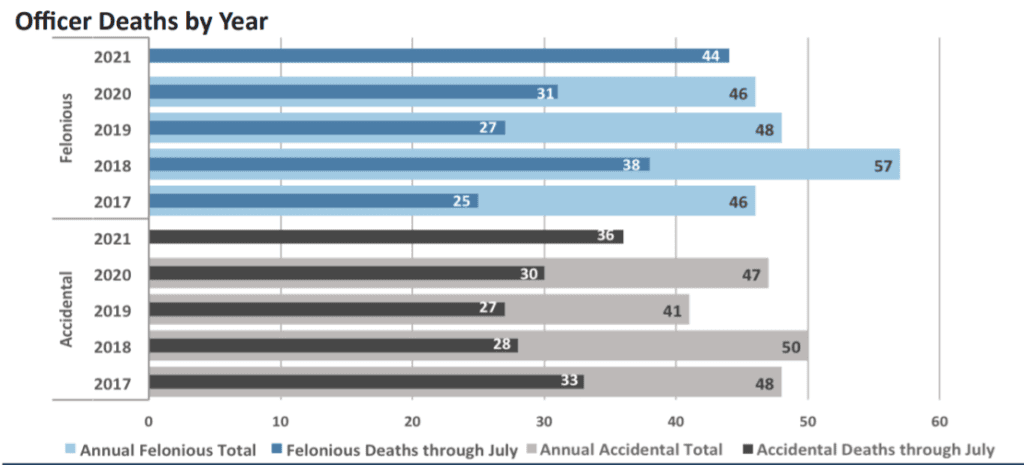
In the first seven months of 2021, there were 44 law enforcement officers (LEOs) who were feloniously killed. That number is just two away from the 46 officers who were reported as being killed feloniously in all of 2020. To be sure, 2020 was a relatively quieter period for all aspects of life given the Covid-19 pandemic and the related shutdowns, perhaps skewing the comparison a bit. Still, the number of officers feloniously killed so far this year is sharply higher than it has been over the past five years during the first seven months of the year.

Last year, 31 officers were reported to have been feloniously killed through July, according to data from the Federal Bureau of Investigation’s (FBI) latest Law Enforcement Officers Killed and Assaulted (LEOKA) data. This year’s number, at 44, is also more than 2019’s (27) and 2017’s (25). What’s important to note is that it is also sharply higher than the number for the first seven months of 2018 (38), which was the year with the highest total number of officers feloniously killed in the past five years.

Image Source: Screengrab from the FBI’s LEOKA report for August

Of the 44 felonious deaths thus far in 2021, 36 have been firearm-related, with the remainder involving the use of vehicles (5), personal weapons (2), and a knife/cutting instrument (1). In comparison, of the 46 total felonious deaths of officers reported in 2020, 41 were firearm-related, four were vehicle-related, and one involved personal weapons. For this year, i.e., as of July 2021, only 36.3% of those feloniously killed were reported to have been wearing body armor at the time of the firearm-involved incident that led to their deaths. That’s sharply down from 61.2% in 2020.

Tragically, accidental LEO deaths have also increased 20% when one compares the first seven months of this year to 2020, at 36 and 30 respectively. The accidental deaths this year were the result of motor vehicle crashes (19), pedestrian officers struck by vehicles (15), and drowning (2). Of the 15 deaths caused by pedestrian officers struck by vehicles, six occurred specifically while assisting/investigating vehicle crashes.

So far in 2021, 54 LEOs have also died in the line of duty from illnesses related to the Covid-19 pandemic. In total, there were 63 deaths of LEOs from illnesses during the first seven months of this year. Among the officers who died from illnesses was one officer who passed away from conditions associated with responding to the terrorist attacks of 9/11.

Image Source: Screengrab from the FBI’s LEOKA report for August

The southern region continued to have the most law enforcement deaths with 41 in total (of which 24 were felonious and 17 accidental).

Of the felonious deaths in 2021, the highest number occurred during the month of April, which saw the deaths of eight officers. In comparison, the highest number of LEOs feloniously killed in a single month in 2020 was in March (7). April 2021 proved to be a tragic month overall for LEO deaths, with the highest number of accidental deaths in a single month for the year, so far, also taking place then.

“We continue to witness horrific acts of violence being committed against those who we need to protect our communities. These senseless acts have a chilling effect across the law enforcement community, and we wait for the day where line of duty deaths reach an all-time low,” ABC News reported Laura Cooper, the executive director of the Major City Chiefs Association (MCCA) that represents police chiefs from across the country, as saying.