Tech Support : support@safience.io

Blog

Amid All The Ransomware Attacks, The Scope Of The Unnoticed Pulse Connect Hack Is Just Starting To Show

By a Biometrica staffer

It was in April that cybersecurity firm FireEye said on its Threat Research Blog that Chinese hackers suspected to be state-backed had exploited widely used networking devices for months to spy on dozens of high-value government, defense industry, and financial sector targets in the U.S. and Europe, according to the Associated Press. In its blog post, FireEye said it believed that two hacking groups linked to China broke into several targets via Pulse Connect Secure devices, which several companies and governments use for secure remote access to their networks.

Today, on June 15, the Associated Press reported that the cyberespionage campaign was more sweeping than previously known and its scope is only now starting to become clear. The Associated Press said it has learned that the hackers targeted telecommunications giant Verizon and the country’s largest water agency. But while ransomware attacks have been in the spotlight — and have even been given the same priority as terrorism, as reported by Reuters earlier this month — the Pulse Connect Secure devices attack has gone largely unnoticed.

This news comes even as U.S. officials are still grappling with the aftereffects of the SolarWinds hack, whose targets included the Treasury, Justice and Homeland Security departments. On May 28, Microsoft said the state-backed Russian cyber spies behind SolarWinds had launched a targeted phishing assault on U.S. and foreign government agencies and think-tanks that week, using an email marketing account of the US Agency for International Development (USAID), a Guardian report said. And it was only a few weeks before that when cybercriminals hacked into Colonial Pipeline. In June, a cyberattack on the largest global meat producer in the country, JBS SA, forced the shutdown of all its U.S. beef plants.

Security researchers said dozens of other high-value entities that have not yet been named were also targeted as part of the breach of Pulse Secure, according to today’s Associated Press article. It’s still unclear if any sensitive information was accessed as part of this hack, although some of the targets have said they haven’t seen any evidence of data being stolen.

Verizon said it found that one of its labs had been compromised in a Pulse-related incident, but that lab was quickly isolated from its core networks, and no data or customer information was accessed or stolen. The Metropolitan Water District of Southern California, which provides water to 19 million people and operates some of the largest treatment plants in the world, said it found a compromised Pulse Secure appliance after the Cybersecurity and Infrastructure Security Agency (CISA) issued its alert in April. There was “no known data exfiltration,” in this case either, the Associated Press report added.

Even so, experts say it is worrisome that hackers managed to gain footholds in networks of critical organizations whose secrets could be of interest to China for commercial and national security reasons. “The threat actors were able to get access to some really high-profile organizations, some really well-protected ones,” Charles Carmakal, the chief technology officer of Mandiant (FireEye) told Associated Press. The Chinese government has denied any role in the Pulse hacking campaign, and the U.S. government has not made any formal accusations.

After FireEye’s blog was published, CISA had issued an emergency directive on April 20 requiring federal civilian departments and agencies running Pulse Connect Secure products to assess and mitigate any anomalous activity or active exploitation detected on their networks. The directive also said that if mismatches or new files were found, the departments and agencies had to take mitigation actions, and contact CISA for potential incident response activities. On April 30, CyberScoop reported that the Justice Department was undertaking a four-month review of its approach to combatting a range of malicious cyber activity from foreign governments and criminals.

Only on June 2, news had broken that the New York Metropolitan Transportation Authority’s computer systems had been hacked into in April by a group believed to be linked to the Chinese government. The hackers did not gain access to systems that control train cars and rider safety was not at risk, the New York Times reported, but added that transit officials raised concerns that they could have entered those operational systems, or could continue to penetrate the agency’s computer systems through a back door. Two days later, the Director of the Federal Bureau of Investigation (FBI), Christopher Wray, said the agency was investigating about 100 different types of ransomware, many tracing back to hackers in Russia, according to a Wall Street Journal report.

In May, President Joe Biden issued an executive order aimed at improving the country’s cybersecurity. “The United States faces persistent and increasingly sophisticated malicious cyber campaigns that threaten the public sector, the private sector, and ultimately the American people’s security and privacy,” he said at the time.

Cyber threats from nation states and their surrogates will remain acute, the Office of the Director of National Intelligence (DNI) said in its 2021 Annual Threat Assessment report. “Although an increasing number of countries and nonstate actors have these capabilities, we remain most concerned about Russia, China, Iran, and North Korea. Many skilled foreign cybercriminals targeting the United States maintain mutually beneficial relationships with these and other countries that offer them safe haven or benefit from their activity,” the DNI report added.

LEOs Worry Over Surge In Mass Shootings Across The Nation Ahead Of Habitual Summer Spike In Crime

By Deepti Govind

Typically, it is the summer months that are the bloodiest in terms of mass shootings across the U.S. But what’s worrying law enforcement officers (LEOs) particularly this year is the unrelenting surge in gun violence that began well before that habitual summer increase. Several LEOs and policing experts interviewed by CNN acknowledged alarming shooting and homicide numbers so far this year, following jumps in violent crime not seen in more than a decade.

The Gun Violence Archive (GVA) data shows that there have been 272 mass shooting incidents in the country so far in 2021. Just over the weekend, two people were killed and at least 30 others were injured in mass shootings according to authorities, the Associated Press reported. As states continue to lift Covid-19 restrictions, and with more people out in warmer weather, top brass across the country are worried and looking for solutions. Some cities are bulking up patrols in high-crime neighborhoods, putting rookie officers on the streets and increasing overtime spending, the CNN article added.

“The whole nature of proactive policing is being questioned at the same time you’re seeing increases in murders and shootings. It’s challenging to be a police officer right now but it’s also from a police chief’s standpoint. They’re not getting much sleep,” CNN quoted Chuck Wexler, executive director of the Police Executive Research Forum, a law enforcement policy group, as saying. Another former top cop told CNN that the acceleration in gun violence as the nation is coming out of the pandemic is of concern, as is the fact that “just about every major American city, let alone the suburbs, are experiencing significant crime increases.” The New York Times also reported on the crime spikes facing mayors across the country as the public emerges from a prolonged period of isolation.

In New York, where shootings increased 73% this May compared with the same period last year, the New York Police Department (NYPD) and the Bureau of Alcohol, Tobacco, Firearms and Explosives (ATF) are forming a partnership to reduce gun violence and stop the flow of illegal guns into the city. Meanwhile, Florida’s largest county is moving forward with a nearly $8 million plan to reduce gun violence after a recent spike in shootings, seeking to focus on jobs for troubled teens and added funding for LEOs.

An 18-month-old and 4-year-old were among the youngest victims in the mass shootings this weekend, authorities said, according to CNN. The CNN article says that at least nine people were killed and 47 others were injured in mass shootings from Friday afternoon until Sunday. The total number of mass shootings is about 40% higher than at this point in 2020, and about 65% higher than at this point in 2019, according to data from the GVA, CNN added.

A mass shooting incident is defined by the GVA as one where four or more people are shot at, regardless of whether they are killed or injured, excluding the shooter. However, some consider a mass shooting as one where four or more have been killed. The GVA documents every reported incident of gun violence in the United States, collecting this information from more than 7,500 law enforcement, media, government, and commercial sources daily, in an effort to provide near-real time data about the results of gun violence.

This weekend’s bloody shootings happened to coincide with the fifth anniversary of the Pulse nightclub massacre in Orlando, on June 12, Saturday. The shooting at the gay club in Orlando remains one of the deadliest in U.S. history, leaving 49 dead and wounding over 50. It’s also the deadliest attack on a group of LGBTQ people. Over the weekend, President Joe Biden said he would sign a bill naming the Pulse nightclub shooting site a national memorial.

One of the mass shootings this Saturday occurred at a crowded pedestrian-only street packed with bars and restaurants in Austin, wounding 14 people. Austin Mayor Steve Adler said in a tweet that the mass-casualty shooting occurred even as police initiated multiple violence prevention programs intended to combat a recent increase in shootings in the Texas capital city, ABC News reported. “One thing is clear – greater access to firearms does not equal greater public safety,” he added.

On the other hand, on Friday, June 11, a federal judge struck down California’s 32-year-old ban on assault weapons, ruling that it violated Americans’ constitutional right to own guns for self protection, The Guardian reported. If the case is appealed to the Supreme Court, the court’s new conservative majority could use the legal battle to rule that banning military-style “assault weapons” is unconstitutional, undermining the Biden administration’s endorsement of a national ban, the article added.

Biden has made it clear that gun violence is a focus of his administration. On April 8, he announced an initial set of measures to take on what he called “an epidemic” of gun violence. This came mere hours after a shooting in Rock Hill, South Carolina claimed six lives in another senseless act of violence and a particularly bloody March, which saw several mass shootings.

The spate of deadly shootings this year began with the one in Boulder, Colorado, when a gunman opened fire at a King Soopers outlet and killed ten people in March. At the same time, the Federal Bureau of Investigation (FBI) had conducted more background checks for individuals wanting to buy firearms in the first quarter of 2021 than over corresponding periods in the five previous years.

After Colorado, came the mass shooting at Orange, California where four people, including a child, were gunned down in an office complex. That was followed by one at a FedEx facility in Indianapolis, which left eight dead. Most recent, of course, was the San Jose massacre at a public transit rail yard. It was, quite literally, just three weeks ago that we did a piece on a mass shooting-ridden weekend.

“Public safety isn’t the sole province of the police. It’s a partnership with communities and with government agencies and corrections agencies, substance abuse and mental health agencies, social services and employment agencies all have critical real time roles to play. They need to step up and be held accountable as well,” Adam Gelb, president of Council on Criminal Justice, is quoted as saying in the CNN article. He added that being a police chief right now has to be the “toughest job in America.”

Crime And Punishment – A Brief Overview Of The Death Penalty And Death Row

By Aara Ramesh

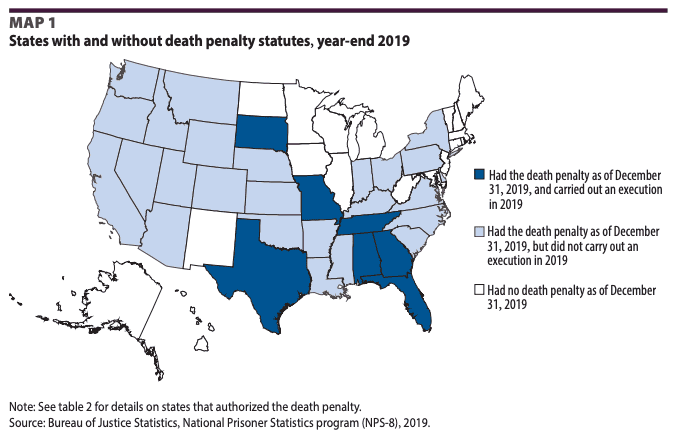
Earlier this month, the Bureau of Justice Statistics (BJS) released its report concerning the application and execution of capital punishments in the U.S. in 2019. As of the year under review, capital punishment was legal in 32 states and on the federal level. By their estimation, as of the end of 2019, there were 2,570 inmates on death row in 29 state and Federal Bureau of Prisons (BOP) facilities. A total of 31 people were sentenced to death and sent to prisons in 11 states and institutions run by the BOP, and 22 prisoners were executed across seven states.

According to the BJS, “capital punishment” – commonly known as the “death penalty” – refers to “the process of sentencing convicted offenders to death for the most serious crimes (capital crimes) and carrying out that sentence.” Usually only a particularly heinous murder charge results in a death sentence, though what falls under this category varies by state and on the federal level. The term “being on death row” refers to those who have been sentenced but are still awaiting execution, mostly as a reason of their appeals process not being exhausted.

Graphic Source: BJS

The number of people incarcerated on death row in 2019 was 2% lower than the number at the end of 2018. It was also the 19th straight year of a decline in that figure, with the peak being 3,601 in 2000. Of those living with a death sentence, 1,443 were white; 1,064 were black; and 63 were of another ethnicity/race.

In terms of executions, the 22 executed in 2019 was also significantly lower than the peak of 98 in 1999. Executions in Texas accounted for 41% of the total, with 9 carried out in that state alone. Across the system, 65 prisoners were removed from death row by means other than execution.

Methods of execution included lethal injection (authorized in all 32 states with capital punishment provisions), electrocution (authorized in 9), lethal gas (3), hanging (2), firing squad (3), and nitrogen hypoxia (3). 

The number of prisoners on death row decreased the most in California (by 11), followed by Pennsylvania (8), Texas (7), and Tennessee (6). North Carolina, Ohio, and South Carolina increased the number of prisoners on death row by 3, 2, and 1, respectively.

The statistics were also broken down demographically by the BJS. Of all the death row inmates in 2019, 98% were men; 56% were white and 41% were black. Of those with known ethnicities, 15% were of Hispanic origin. The average prisoner had been on death row for 18.7 years and the average length spent on death row among those executed was 22 years. Around 68% of those sentenced to death had prior felony convictions, with 9.5% having prior homicide convictions. Around 64% of white prisoners and 73.1% of black prisoners had prior felony convictions.

The death penalty has long been debated in the U.S. The Supreme Court suspended it in 1972, voiding 40 death penalty statutes, but then reinstated it in 1976. Over the years, the highest court in the land has made a few significant rulings on the constitutionality of the death penalty, including in regards to which crimes it is reasonably applicable to, the proportionality of the punishment versus the crime, and whether those mentally incapacitated can be put to death.

The controversy around the death penalty is multifaceted. It is associated with higher bills for the taxpayers (running into the billions of dollars), as capital murder trials tend to be more expensive and as the appeals process is quite lengthy and costly. Further, there is an angle of moral justification and arbitrariness involved, as it regards taking a life and is based on the individual prosecutor, judge, or juror.

Public support for the death penalty has been declining for three decades now, from a peak in the 1990s, when – The New York Times reports – almost four out of every five Americans supported it. However, according to a survey conducted by the Pew Research Center and released in April this year, 60% of American adults still support the death penalty for murder convictions, with 27% among that indicating they “strongly favor it.” Only about 39% oppose it, with 15% of those strongly opposed. The public seems to strongly believe that the death penalty is morally justifiable in cases of murder, with 64% supporting capital punishment in murder cases.

With that in mind, though, 78% of Americans (nearly eight-in-ten) say that there is “some risk that an innocent person will be put to death.” A large swathe are concerned about how the death penalty is administered and whether it is really a deterrent for future crimes. Around 63% of Americans say it is not a deterrent, with that number being about 48% even among those who support the death penalty. According to one survey, 88% of the nation’s top criminological experts said that the death penalty is not a deterrent to murder.

In 2019, New Hampshire struck down its death penalty law, but left one man on death row, due to the fact that the repeal was prospective. The New Mexico Supreme Court also declared the state’s death penalty clause unconstitutional, and, as a result, the two prisoners who had been on death row have now been sentenced to life in prison instead.

In May this year, South Carolina legislators voted to go ahead with reinstating death by firing squad as one of the methods of executing inmates on death row. This was on the heels of a 10-year moratorium on executions as a result of the state’s inability to procure the chemical needed for administering a lethal injection. Two inmates are suing the state on the grounds that using a firing squad is unconstitutional as that was not a legal means of execution when they were sentenced.

In March this year, Virginia became the 23rd state to abolish capital punishment, a move hailed by many as historic, given the fact that it had the second highest number of executions in the country, behind only Texas. To many, this is a signal of “the erosion” of capital punishment as a sentence all over the country. Since its initial establishment as one of the original colonies, Virginia has executed nearly 1,400 people; 113 of those have come since the Supreme Court reinstated the death penalty in 1976.

There are three bills currently passing through various committees in the U.S. Congress – two in the House (H.R.97 and H.R.262) and one in the Senate (S.582) – to abolish or reform the federal capital punishment provision.

The BJS publishes its capital punishment report annually and tracks national and state-level counts of persons given the death sentence and the number executed. The process of data collection is time-intensive and is mainly collected through administration records and interviews with inmates as disclosures are not legally mandated.

Though 2020 numbers will not be released until next year, the BJS says that initial estimates indicate that 17 inmates were executed last year, by five states and the BOP. The latter was responsible for 10 of those, followed by Texas with 3. Of those executed, 10 were white, 5 black, 1 Hispanic and 1 Native American. They were all men.

The the Death Penalty Information Center maintains an ongoing list of the legislation concerning capital punishment at the state level, including bills to repeal, reform, or expand it.

The UN Says The Number Of Children Forced Into Labor Increased Last Year For The First Time In Two Decades

By a Biometrica staffer

In what was supposed to be the International Year for the Elimination of Child Labour, a joint report published by the International Labour Organization (ILO) and the United Nations Children’s Fund (UNICEF) has sounded an urgent alarm over the increased number of children forced into labor worldwide.

According to the report, roughly one in ten children globally — amounting to 160 million young individuals — were involved in child labor at the start of 2020, the first spike in this figure in 20 years. This marks the undoing of the progress that the ILO and UNICEF announced in 2019, which highlighted that between 2000 and 2016, 94 million children globally had been liberated from working, a 38% reduction over that 16-year-period. This also marks an increase of 8.4 million children employed in the workforce between 2016 and 2020.

Worryingly, the UN says that this statistic is at real risk of rising as a result of the Covid-19 pandemic and its associated lockdowns, which severely impacted jobs, incomes, employment and economies, forcing many children to enter the workforce so as to provide for their families. The already precarious situation was likely also further exacerbated by widespread school closures.

UN researchers believe that the problem will worsen by 2022 if the tide is not checked immediately. Modeling suggests that another 9 million children could potentially be forced into labor as a result of the pandemic by next year. In the worst case scenario, this number could even rise up to 46 million.

The Human Rights Watch (HRW) had noted the upward trend in child labor rates in May. According to them, in the midst of the pandemic, young people were being exploited, as many felt they had no choice but to work to help their families survive. Further, many children were rendered their family’s sole breadwinner due to their parents falling ill, being incapacitated, or dying. The children they interviewed reported long, debilitating work hours, low pay, wage theft, and instances of violence and harassment.

The HRW is clear, however, that this increase in child labor is not an “inevitable consequence” of the pandemic, and that it can actually be stopped.

The UN report highlighted some solutions that need to be implemented immediately to counter this trend. These include providing critical social services as a safety net, workarounds that would allow children to stay at school even in times of economic strife, greater investment in rural development, and the transition into safer, more decent agricultural work.

The HRW says that there is currently inadequate financial assistance being provided to families in need and that governments should give them cash allowances so that they can “maintain an adequate standard of living without resorting to child labor.”

When broken down, the statistics reported by the UN are even more concerning. While the 160 million figure includes children between the ages of 5 and 17, a full half of that are actually between just 5 and 11 years of age. 

Half the children forced into labor were involved in dangerous agriculture and mining work, risking their health, safety, growth, and development. Worldwide, 70% of the children engaged in labor were in the agricultural sector and 10.3% in industry, mining, construction, and manufacturing. This exposes them to pesticides, chemicals, extreme temperatures, and heavy equipment, among many other hazardous work conditions. The remaining 19.7% were engaged in services, such as domestic work and transportation.

There are a total of 3.8 million child laborers in North America and Europe, and the rates have been trending downward in Asia, the Pacific, Latin America, and the Caribbean. The situation remains unresolved, however, on the African continent, particularly in sub-Saharan Africa. Here, 86.6 million children are engaged in labor, more than the rest of the world combined. Around four out of every five children in the region are employed in the agriculture sector. These overall high numbers have been attributed largely to enduring poverty, the prevalence of HIV/AIDS and regional conflicts.

Demographically, 63 million of the children were girls and 97 million were boys. Young girls were more likely to be engaged in service and domestic work. The gap between the number of boys and girls working was shown to widen with age, as boys between 15 and 17 years old were almost twice as likely to be working than girls in that same age range. Rural children were three times more likely to be working than their city-dwelling peers.

For 100 years now, the ILO has been working towards eradicating child labor, forced labor, modern slavery and human trafficking. UNICEF is engaged in protecting children, defending their rights, ensuring their survival and helping them fulfil their potential.

Student Threat Assessments: An Introduction

By a Biometrica staffer

Even one incident of mass violence at a school is one too many. Going by that metric, the United States has had far too many to ignore over the course of the last two decades: from Virginia to Parkland, from Columbine to Newtown. What makes a child or an adolescent turn into a real threat, whether to themselves or to others, is a complex question to answer. But there can be some checks in place to try and prevent the threat from becoming reality.

That’s where the schools themselves can play a role, or at least that’s the philosophy behind creating student threat assessment systems at educational institutions. These assessments are supposed to be a systematic approach to violence prevention, designed to distinguish serious threats from ones that are not.

Serious threats are defined in various ways, and there are signs and actions that schools can look for. Broadly, any behavior or communication in which a person poses a threat of violence is considered a serious threat. Formal threat assessment programs are increasingly gaining traction in schools, the National Institute of Justice says.

The National Association of School Psychologists (NASP) recommends all school districts develop and implement threat assessment procedures and clearly communicate them to staff and families. One of them is the well-known Comprehensive School Threat Assessment Guidelines (CSTAG) model, which was originally called the “Virginia Student Threat Assessment Guidelines,” developed by Dr. Dewey Cornell and colleagues at the University of Virginia in 2001.

What does the model say, what are some of the warning signs, and has there been research to suggest these programs work? We try and put together answers to these questions in today’s piece.

The CSTAG Model — A Quick Look

After a series of school shootings in the 1990s, officials in law enforcement and education recommended the use of behavioral threat assessments in schools.

“Both the FBI and the Secret Service conducted studies of school shootings and found that these students were often victims of bullying who had become angry and depressed, and were influenced by a variety of social, familial, and psychological factors,” according to a paper on an overview of the CSTAG Model published on the University of Virginia’s website. Unfortunately, these studies concluded that these characteristics can be found in so many students so it is not possible to develop a profile or checklist based on them, to be used to pinpoint the small number of truly violent students among the rest, the paper adds.

While both the FBI and the Secret Service cautioned schools against adopting a profiling approach, they did discover that almost all of the students who attacked their schools had communicated their intentions to carry out violence through threats and warnings to others, typically their peers. Had these threats been reported to authorities and investigated, the shootings might have been prevented. Multiple studies have identified potential school shootings that were prevented because other students reported a threat to authorities that was then investigated and determined to be serious, according to the paper.

The CSTAG Model integrates recommendations from FBI and Secret Service studies of school shootings with practical advice and field-tested experiences obtained from educators working in Virginia public schools. It offers schools guidelines through which they can figure out if a threat is transient or substantive. Most student threats are transient ones that reflect expressions of humor, anger, frustration, or fear. Such threats, the paper on the model says, could even involve students shouting, “I’m gonna kill you,” as a joke, a competitive statement made during a game, or a rhetoric that is, in fact, meant in anger but does not carry with it any actual intention or plan to kill. From a threat assessment perspective, transient threats are viewed as those that do not reflect a real intention to harm others.

Substantive threats, on the other hand, are behaviors or statements that represent a serious risk of harm to others, such as planning and preparation, recruitment of accomplices, and acquisition of a weapon. It could, for instance, involve a situation where a student threatens to stab a peer and is then found carrying a knife in their backpack. The distinction between transient and substantive threats is critical in determining appropriate responses and management strategies. This is where the CSTAG model uses a decision-tree approach to making this determination. For more on the decision tree, and to access the full model, click here.

Risk Factors And Warning Signs

Although no one risk factor, or set of factors, perfectly predicts violence, the greater the number that can be identified, the greater the need to be vigilant, NASP says. It identifies some suggested risk factors as cases where a student:

  • Is socially withdrawn, isolated, and alienated or rejected
  • Has been a victim of violence and/or bullying, or feels persecuted and picked on
  • Has low school interest and performance
  • Expresses intolerance and prejudice
  • Has used drugs and alcohol
  • Has been affiliated with gangs
  • Expresses personal grievance, moral outrage, or ideological thinking
  • Is unable to affiliate with prosocial groups
  • Is dependent on virtual communities
  • Has occupational goals that have not been achieved or that are unattainable
  • Has interpersonal relationship(s) failures
  • Has had a mental health disorder
  • Has access to or possesses firearms
  • Has a history of violent expressions in writings and drawings; serious threats of violence; uncontrolled anger; impulsive and chronic hitting, intimidating, or bullying; disciplinary problems that involve violence; and/or criminal violence

Warning signs are statements, actions, and appearances suggesting that a student is about to display violent behavior. Although it is a critical element in initiating a threat assessment, the absence of warning signs does not necessarily mean there will not be a future act of violence, according to NASP. It is critical to look at both the static and the dynamic factors occurring in a student’s life. The NASP lists the following violence warning signs:

  • Specific targets, which may or may not be verbalized and could be related to: persons, places, programs, processes, philosophies, or proxies of those.
  • Articulated motives, which could be: personal, political, religious, racial or ethnic, environmental, or special interest
  • Increasing intensity of violence-related efforts, desires, and planning
  • Direct or indirect communications about violence
  • Access to weapons or methods of planned harm
  • An emotional state of hopelessness, desperation, despair, or one filled with suicidal thoughts
  • Increasing capacity to carry out threats
  • Engagement with social media facilitating or promoting violence
  • Intimate partner problems
  • Interpersonal conflicts

The Effectiveness Of Threat Assessment Programs

There has been criticism of student threat assessment programs, with most critics saying it could lead to a surge in suspensions or expulsions of students. And, overall, while many schools are adopting threat assessment programs, research on the impact of these programs has lagged. A recent study of student threat assessment efforts in Virginia’s K–12 public schools, however, sponsored by the National Institute of Justice, found progress in resolving threats without further incident or resorting to suspending or expelling students. 

“Nearly three of every five threats assessed were threats to self, rather than to others, the report said. The research team pointed out that self-threats rose from a mean of 2.5 cases per school in the 2014-2015 school year to a mean of 4.5 cases in 2017-18. Factors informing the increase could include both an increase in the number of students at risk of self-harm, the study team reported, and increased awareness among school authorities that self-harm threats should be referred to threat assessment teams,” the NIJ said on May 12.

Across four school years ending in 2017-18, evidence suggests that all threats were resolved without serious injury. In around 97% of cases, the threat was resolved without the student attempting to carry out the threatened action. Most students subject to a threat assessment received a combination of discipline and some form of counseling or support services. A significant majority of students (84%) subject to threat assessments were able to continue at their school.

In schools that followed the CSTAG method, only 5% of threats resulted in criminal charges and 1% in arrest, with less than 1% of students who made the threats being placed in juvenile detention. Disciplinary and law enforcement responses to threats were observed to be equitable across racial and ethnic lines, NIJ adds. Overall, the study found that students, parents, staff, and threat assessment teams all demonstrated better knowledge of threat assessments. Students, in particular, voiced greater willingness to report threats.

However, there were some areas for improvement that the study identified. To begin with, implementation was found to be uneven across schools, with nearly a quarter of all schools (24%) reporting they conducted no formal threat assessments in the 2017-18 school year. In many schools, threat assessment teams rarely met, with 13.4% reporting no meetings during the year and 10.3% reporting only one meeting. Only 77% of threat assessment team members reported having received training in the preceding three years.

The Combating Human Trafficking In Commercial Vehicles Act: An Overview

By Charlotte Spencer

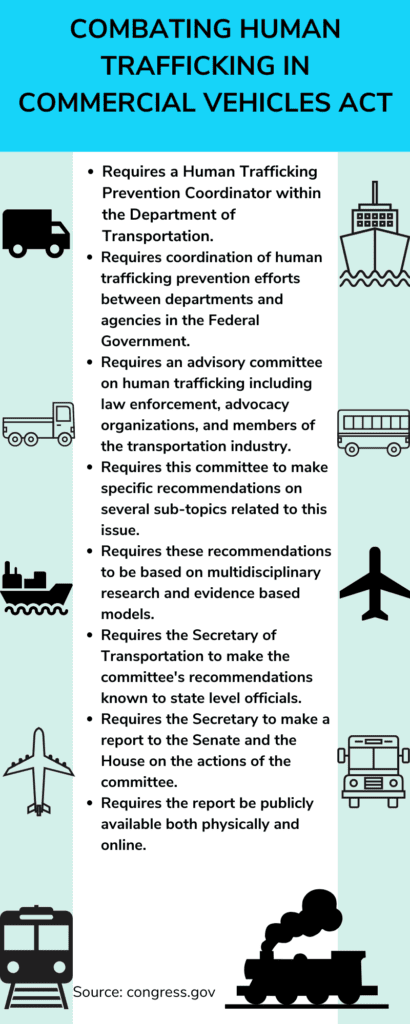
The Combating Human Trafficking in Commercial Vehicles Act (hereafter, the Act) is a relatively new law designed to help do exactly what its title suggests. The Act — S. 1536 — passed the House and Senate in 2017, and was signed by then-president Donald Trump and made law in 2018. It passed with unanimous approval in the Senate. In the House it was one vote short of unanimous approval, with only Rep. Matt Gaetz voting against it. The main purpose of the act is to designate a human trafficking prevention coordinator and to expand the scope of activities authorized under the Federal Motor Carrier Safety Administration’s (FMCSA) outreach and education program to include human trafficking recognition, prevention and reporting activities.

We will break down the Act in plain language further on in this piece. But before that, here’s a quick look at its background.

First, how is human trafficking defined, from a legal standpoint? The Trafficking Victims Protection Act of 2000 defines it as:

  • sex trafficking in which a commercial sex act is induced by force, fraud or coercion, or in which the person induced to perform such an act has not attained 18 years of age; or
  • the recruitment, harboring, transportation, provision or obtaining of a person for labor or services, through the use of force, fraud or coercion for the purpose of subjection to involuntary servitude, peonage, debt bondage or slavery.

Why was the Combating Human Trafficking in Commercial Vehicles Act necessary to begin with? Commercially operated truck stops and state-operated rest areas through out the United States are known grounds for human trafficking activities, particularly sex trafficking, but also for other forms like labor trafficking.

What makes these stops unwittingly favorable for traffickers? These locations are usually isolated from communities, which means traffickers can operate from such places without much concern over being discovered. Typically, traffickers tend to move their victims around often to maintain control and authority over their victims, and to avoid being detected by law enforcement.

“Truckers, who also travel from location to location and state to state, can provide observed intelligence to include word of mouth and overheard chatter in public locations to the attention of law enforcement, who can conduct appropriate follow-up investigations. Our collaboration with Truckers Against Trafficking has become another key weapon to assist law enforcement in combating human trafficking,” according to Gerald Green, SRTC Criminal Justice instructor and a former agent with the FBI, per a TTNews report.

Southern Regional Technical College in Georgia, for instance, uses Truckers Against Trafficking’s (TAT) free educational materials to train students in a classroom setting to identify and respond to potential human trafficking activities. The TAT organization originally set out to teach truck drivers about trafficking, but it has now expanded its reach to train bus drivers, taxi drivers, shipping corps and even casino security, TTNews said in the report.

“Nonprofit organizations like Truckers Against Trafficking (TAT) have made substantial progress in spreading awareness of areas where human trafficking and the trucking industry intersect. Their efforts have resulted in increased reporting of trafficking incidents by truckers who can act as ‘eyes and ears’ on roads nationwide,” the Senate Report 115-177 from Oct. 23 2017 says. The Act basically builds on and provides additional tools to educate truckers and enlist their cooperation in preventing these crimes, while providing greater coordination between modal administrations of the Department of Transportation (DOT) to centralize efforts in combating human trafficking.

Human trafficking has been reported in all 50 states, and the number of victims in the country is estimated to be in the hundreds of thousands. TAT, which began in 2009, says on its website that over 1.2 million people are registered as TAT trained; 2,782 calls were made to the national hotline by truckers; 715 likely cases generated and, 1,303 victims identified. The organization’s mission is to educate, equip, empower and mobilize members of the trucking, bus and energy industries to combat human trafficking, it says.

Our Plain Language Break-Down of The Act

  1. It required the Secretary of Transportation to designate an official within the DOT to deal with this issue. That official is known as the Human Trafficking Prevention Coordinator.
  2. It required the Human Trafficking Prevention Coordinator to coordinate human trafficking prevention efforts between departments and agencies in the federal government. 
  3. It also required the Coordinator to take into account the challenges of combatting human trafficking in different types of transportation.
  4. It amended existing federal law [49 U.S.C. 31110(c)(1) and 49 U.S.C. 31313(a)(3)] to address funding these efforts to combat human trafficking.
  5. It required the Secretary of Transportation to establish an advisory committee on human trafficking.
  6. It specified that members of the advisory committee should be external stakeholders, from trafficking victim advocacy organizations, law enforcement and members of the transportation industry including trucking, bus, rail, aviation, maritime and port sectors, including industry and labor.
  7. It required that this committee make recommendations to the Secretary on actions the Department could take to help combat human trafficking.
  8. It required that these recommendations include successful strategies for identifying and reporting instances of human trafficking. It also required these recommendations to include administrative or legislative changes that should be made to be able to use DOT resources to combat human trafficking.
  9. It also required this committee to develop recommended best practices for states and state and local transportation stakeholders to follow in combating human trafficking. These are required to be based on multidisciplinary research and promising, evidence-based models and programs. They must also be up to date on technology and include sample training materials, strategies to identify victims, sample protocols, strategies to collect and share data across agencies, strategies to help agencies better understand the problem and strategies to identify effective pathways for state agencies to utilize their position in educating critical stakeholder groups and  assisting victims.
  10. It also required the Secretary of Transportation to make sure that appropriate state-level officials were aware of these best practices recommendations.
  11. It required the Secretary of Transportation to make a report to the Senate and the House on the actions of the committee.
  12. It also required that this report be made publicly available, both physically and online.

Other DOT-related Initiatives To Combat Human Trafficking

This Act aside, DOT is also a member of the President’s Interagency Task Force to Monitor and Combat Trafficking (PITF), a cabinet-level entity chaired by the Secretary of State and created by the Trafficking Victims Protection Act of 2000 to coordinate federal human trafficking efforts. The DOT also created the Transportation Leaders Against Human Trafficking (TLAHT) partnership to maximize the transportation industry’s collective impact in combating human trafficking. The partnership focuses on five key areas and connects transportation stakeholders to available resources on industry leadership, industry training and education, policy development, public awareness and information sharing and analysis, the DOT says.

The DOT’s 55,000 employees are required to take an anti-human trafficking training every three years and were trained in 2012 and 2016, according to its website. It also collaborates with the Department of Homeland Security and non-governmental organizations to offer its stakeholders a suite of training tools tailored for the transportation industry. Under this initiative, Amtrak trained all 20,000 employees, Greyhound trained its drivers and 18 airline partners trained over 100,000 aviation personnel under the branded Blue Lightning Initiative (BLI) training for aviation personnel. 

To date, more than 100,000 personnel in the aviation industry have been trained through BLI. The Federal Aviation Administration’s (FAA) Air Traffic Organization (ATO) plays a key role in BLI when aviation personnel report a human trafficking tip through the domestic events network or DEN, an interagency teleconferencing system that operates 24/7. The DEN permits FAA’s partners — flight crews, customer service representatives for the airlines, and state and local law enforcement agencies and law enforcement — to communicate human trafficking concerns and coordinate appropriate responses. DEN air traffic security coordinators are specially trained to assist flight crews and other aviation industry professionals in responding to suspected human trafficking events. 

When it comes to roadways, the FMSCA’s steps and outreach programs help. The No Human Trafficking on Our Roads Act permanently prohibits anyone who has used a commercial vehicle to commit a felony involving human trafficking from operating a commercial motor vehicle in the future. The Federal Transit Administration (FTA) supports the DOT’s TLAHT initiative through transit-focused industry engagement, education, public awareness and outreach, and research and technical assistance to combat human trafficking in transit. 

Human trafficking hotlines in the U.S. and Canada
Image Source: TAT

The information provided in this article should not be considered legal advice or a substitute for legal advice. Biometrica is not a law firm and cannot offer legal advice.

INTERPOL Takes Down Record Number Of Fake Online Pharmacies Looking To Cash In On Pandemic

By a Biometrica staffer

INTERPOL announced on June 8 that it had succeeded in taking down a “record number” of fraudulent online pharmacies and arresting 277 people worldwide with the help of law enforcement, customs and health regulatory authorities in 92 countries. The actions were part of Operation Pangea XIV and took place between 18 and 25 May.

Authorities seized “potentially dangerous pharmaceuticals” worth more than $23 million and over 113,000 web links were shut down or removed (including  online marketplaces and websites for selling fake products), INTERPOL said. This is the highest number of links taken down since 2008, when Operation Pangea, created to tackle the trade of counterfeit and illegal medicines and medical products, began.

The operation was supported by multiple agencies and authorities, including Europol, the UNO on Drugs and Crime/World Customs Organization’s Container Control Programme and the Pharmaceutical Security Institute. Over 710,000 packages were inspected and more than 9 million medical devices and illicit pharmaceuticals were seized. The latter category included hypnotic and sedative medication, erectile dysfunction pills, painkillers, anabolic steroids, anti-cancer medication, anti-malarials, vitamins, syringes, catheters and surgical devices.

The contraband was also hidden inside innocuous products like clothes, jewelry, toys, food and baby products. Almost 3,000 nerve pain tablets were found inside cans of baked beans in Qatar. Italian authorities confiscated over half a million fake surgical marks and one man in Venezuela was caught using WhatsApp as an e-commerce platform to sell illicit medicines.

This is part of a larger trend noted worldwide of Covid-19 related crimes. For instance, the U.S. Department of Justice announced at the end of May that it was charging 14 defendants in seven federal district courts for Covid-related false billings worth around $143 million. The crimes included defrauding the Paycheck Protection Program, designed to financially aid struggling small businesses, and the Provider Relief Fund, targeted at providing medical care to victims of Covid-19.

At the time, Deputy Attorney General Lisa O. Monaco called this “theft” and “the exploitation of [a] national emergency.” INTERPOL officials echoed this sentiment in the statement released on Tuesday, June 8, saying that the pandemic had forced more people to “move their lives online,” which made it easier and quicker for criminals to target them.

The agency added that the criminal exploitation of the initial panic and fears has continued, in the form of catering to the incredible demand for personal protection and hygiene products. In fact, over 50% of the medical devices seized during Operation Pangea XIV were fake and unauthorized COVID-19 tests. 

“It’s clear fraudsters see the COVID-19 pandemic as a money-making opportunity,” the Deputy Inspector General for Investigations of Health & Human Services, Gary L. Cantrell, said in the statement released by the DOJ in May.

Separately, in May, the Center for Program Integrity, Centers for Medicare & Medicaid Services (CPI/CMS) announced that it had taken action against 50+ medical providers who allegedly abused programs aiming to improve access to medical care. Today, criminals are selling fake vaccination cards — the only official proof of immunization — online, for as low as $12.99 for 10 blank cards. 

INTERPOL also conducted ongoing education campaigns to help people securely and legally buy medications online, as part of Operation Pangea. It urged buyers to be careful, highlighting the public safety and health risks posed by the unregulated sale of fake, untested or illegal medicines online. Products might have the wrong composition, may have been compromised by improper storage or might even have expired, rendering them ineffective and, in some cases, even deadly.

According to Forbes, healthcare fraud is “the largest category of criminal behavior in the United States today.”

The Worrying Resurgence Of Antisemitism In The US

By Deepti Govind

Sometime between Friday night and Monday morning over this weekend, the Chabad on River synagogue was vandalized with a swastika and an antisemitic slur. A congregant found the hate symbols at 8 a.m. Monday, June 7, when they arrived early to teach a religion class, tucson.com reported. This is the second vandalism incident in three weeks at a Tucson synagogue in Arizona.

There’s no doubt that, as a whole, hate crimes have been worryingly on the rise in the U.S. In November last year, the Federal Bureau of Investigations (FBI) released a report that showed that in 2019 hate crimes reached the highest level in over a decade in 2019, with 7,314 hate crime incidents reported that year, up from 7,120 in 2018 — and the highest since 7,783 in 2008. Towards the start of this year, it was the Asian American community that seemed to be on the receiving end. That appeared to extend to those in the Sikh community after a mass shooting at a FedEx warehouse in Indianapolis. In terms of race, nearly half of the 3,963 incidents of hate crimes reported in 2019 were directed against those belonging to the Black or African American community, the FBI Hate Crime Statistics report shows.

Now, in the past month or so, a lot of the anger appears to be aimed at the Jewish community. The attacks seem to be a fallout of the most recent outbreak of violence between Israel and Hamas. On May 20, Reuters reported that Israel and Hamas had called a ceasefire across the Gaza Strip border, bringing a potentially tenuous halt to the fiercest fighting the region has seen in years. On the same day, the Anti-Defamation League (ADL), an anti-hate organization founded to combat antisemitism in 1913, said preliminary data from its Center on Extremism showed an increase in online and real-world incidents of antisemitism in the United States.

An analysis of Twitter in the days following the recent outbreak of violence showed more than 17,000 tweets that used variations of the phrase, “Hitler was right” between May 7 and May 14, 2021, the ADL said. Extreme antisemitic and anti-Zionist content can be found across a wide variety of channels calling for the destruction of the Jewish state and for a “race war.” The organization said it had also documented dozens of anti-Israel protests in the U.S. since the violence in Israel began, and while a majority of those protests stayed within the lines of free and civil discourse, it has seen some expressions of clear antisemitism too. Those included signs that invoke the age-old antisemitic accusation that Jews are responsible for killing Jesus, as well as Holocaust analogies that demonize Zionists.

The ADL also said it had received more reports of possible antisemitic incidents since the conflict broke out in Israel: 193 reports in the week after the crisis began, up from 131 the previous week. According to an analysis of the FBI’s hate crime data, the number of anti-Jewish hate crime incidents grew over 14% to 953 in 2019. “To those who choose to indulge in age-old antisemitic tropes, exaggerated claims and inflammatory rhetoric, it has consequences: attacks in real life on real people targeted for no other reason than they are Jewish. This is antisemitism, plain and simple. And it’s indisputably inexcusable in any context,” ADL CEO Jonathan Greenblatt said on May 20.

In the latest Tucson synagogue vandalism case, the police said there were no suspects identified or in custody; that was as of the morning of June 8. Whoever committed the act snipped a wire on a gate to gain access to the synagogue, Rabbi Yehuda Ceitlin of Chabad Tucson said, according to an Arizona Republic article. Ceitlin cited recent reports of rising antisemitism across the country, saying that the Tucson incidents reflect a worrying national trend, the article added. Several people, including Arizona Gov. Doug Ducey, tweeted about the most recent act of vandalism and the general rise in antisemitic sentiment.

It was just three weeks ago that Congregation Chaverim was vandalized sometime between nightfall on May 18 and around 8 a.m. on May 19. The Tucson Police Department said the synagogue’s front door was damaged, leaving a “rock-size hole not big enough for anyone to enter,” Arizona Republic reported. The incident happened only days after the synagogue welcomed members back inside for the first time since the beginning of the Covid-19 pandemic.

State Rep. Alma Hernandez, D-Tucson, who is a member of the synagogue, told Arizona Republic that the synagogue was “fairly small” and tucked inside of a community, making it unlikely that the incident was accidental. Hernandez had said back then that she believed the incident was tied to the Israeli-Palestinian conflict. “A lot” of antisemitic discourse and misinformation regarding the conflict was moving throughout social media and other channels, leading to “more anger and hate” toward Jews, she said. “We shouldn’t have to pay the price here in Arizona, or anywhere, for what’s going on in the Middle East,” the Arizona Republic report quoted Hernandez as saying.

On May 21, five Jewish groups wrote to President Biden expressing concern about the recent surge of antisemitic hate crimes in the U.S. The American Jewish Community, the ADL, the Jewish Federations of North America, Hadassah and the Union of Orthodox Jewish Congregations of America urged the president to condemn antisemitism and take a number of actions to combat anti-Jewish hate in the country.

There have, indeed, been several other incidents of hate crimes committed against the community over the past month. In mid-May, two people shattered a window at a synagogue in Skokie, Illinois, according to local police. A Jewish family visiting South Florida were harassed by four men in an SUV who hurled insults and garbage at them and even shouted, “Die Jew,” according to a Miami Herald report. On May 21, a Brooklyn man was arrested for setting fire to a yeshiva and synagogue on May 19. Separately, in New York City, over two dozen people were arrested after clashes broke out between pro-Israel and pro-Palestine protesters, after reports of the ceasefire between Israel and Hamas emerged.

This is not the first time in history that there has been a surge in antisemitic hate crimes in the aftermath of conflicts in the Middle East, Arizona Republic said, citing Brian Levin, director of the Center for the Study of Hate and Extremism at California State University, San Bernardino. In the 1990s, the month that saw the most antisemitic hate crimes in the U.S. was March 1994, following the Ibrahimi Mosque massacre, when an American-Israeli man fatally shot 29 people and wounded more than a hundred in the West Bank, Levin added. In the 2000s, the worst month for antisemitic hate crimes in the U.S. was October 2000, during the Palestinian uprising against the Israeli occupation of the West Bank and Gaza.

While these crimes have continued to be committed historically, the Jewish community says it is staying strong. After the Congregation Chaverim vandalism, Rep. Hernandez said she and others at the synagogue were not going to let fear win. That sentiment was echoed by Ceitlin of Chabad Tucson after this weekend’s vandalism when he said: “We have to speak in a united front against this. This is not acceptable — not in Tucson and not anywhere in America, not now or not ever.”

Tucson police spokesperson Officer Frank Magos urged anyone with information about the Chabad on River synagogue incident, or who sees similar graffiti in the area, to contact the Pima County Attorney’s Office’s anonymous crime tip line at 520-882-7463.

‘Thanks For The Invite, Party’s Over’ — Europol and FBI Take Down Hundreds Of Organized Crime Syndicates

By Aara Ramesh

In what is being called the “largest and most sophisticated” operation ever against encrypted criminal activities, Europol, the Federal Bureau of Investigations (FBI) and law enforcement agencies in 16 countries across the world have managed to take down hundreds of criminals and organized crime syndicates, officials said on Tuesday, June 8.

Stunning reports from all over the globe detail the activities of the nearly three-year-long “OTF Greenlight/Trojan Shield,” which persuaded criminals to use an encrypted device and technology developed by the Australian Federal Police (AFP) to communicate and plan crimes over messages that were simultaneously being copied to the FBI.

The coordinated takedowns over the last few days involved over 9,000 officers from agencies such as the FBI, the U.S. Drug Enforcement Authority, Europol, the AFP, the Dutch National Police and the Swedish Police Authority, among others. The operation resulted in:

  • More than 700 house searches
  • Over 800 arrests 
  • The seizure of vast quantities of narcotics, including more than 8 tons of cocaine; 22 tons of cannabis and cannabis resin; 2 tons of synthetic drugs (amphetamine and methamphetamine) and 6 tons of synthetic drugs precursors
  • The dismantling of 50 clandestine drug labs, including one of the biggest in German history
  • 250 firearms being confiscated
  • Over 100 threats to lives being foiled
  • 55 luxury vehicles being impounded, and
  • The recovery of over $48 million in various currencies and cryptocurrencies.

It also yielded a treasure trove of evidence and intelligence that will help authorities all over the world in the weeks and years to come. 

The operation resulted from a need to innovate in order to seriously impact the most sophisticated and active crime organizations in the world. The AFP began developing the encrypted device company and service called “Anom” in about 2018. They then provided the technology to the FBI, who used it to exploit the substantial demand that exists for platforms where criminals can securely communicate without being monitored by law enforcement or private companies.

According to FBI’s Criminal Investigative Division Assistant Director Calvin A. Shivers, “Encrypted criminal communications platforms have traditionally been a tool to evade law enforcement and facilitate transnational organized crime.”

However, the market is quite volatile, which has allowed authorities to successfully infiltrate and dismantle various platforms. In July 2020, Operational Taskforce EMMA (run by France and the Netherlands) took down the  EncroChat platform. And earlier this year, in March, Operational Task Force Limit (coordinated by Belgium, France and the Netherlands) took down the Sky ECC communication service tool.

The latter, in particular, sent transnational organizations scrambling to find a replacement, which allowed OTF Greenlight/Trojan Shield to attract new users to the Anom platform, playing right into the FBI’s hands.

The FBI sold over 12,000 of these encrypted devices (sometimes costing up to $2,000) and services to over 300 criminal syndicates in more than 100 countries. “Hardened” encryption devices are usually sold only through “word-of-mouth” networks within criminal circles. Thus, to proliferate the device, the FBI had to infiltrate these trusted networks and present the device as reliable and helpful.

Anom was promoted within criminal networks as being a completely secure way to send “encrypted messages in a closed digital environment,” with the guarantee that the device would be wiped remotely if the police managed to seize one.

Over the last 18 months, the FBI has been copied on every single message sent through Anom. Agents have combed through, recorded and translated over 27 million text messages, photos, audio messages and other pieces of digital information shared on Anom. Some officials expressed surprise at how forthcoming and open criminals were about their activities on the platform they were sure was safe.

The conversations included included intricate details about how to generally evade law enforcement; the cost of services; methods of concealing drugs (such as hiding them in pineapples, bananas and tuna cans); instructions on how to smuggle drugs and firearms; snapshots of shipments; details on how to go about money laundering; and plans to commit acts of violence and even murders.

The FBI then shared this intelligence with the international community. After months of surveillance, the coordinated raids and attacks commenced a few days ago. After sweeping through Australia and Europe, the operation finally concluded on Tuesday in San Diego, where officials unsealed the grand jury indictment of 17 foreign nationals who had allegedly participated in disseminating thousands of the Anom devices to their criminal associates.

Authorities are hoping that criminals will now think twice before using encrypted communications to conduct their illicit activities, armed as they are with the knowledge that the FBI might be looking over their shoulders.

Once the operation was complete, Anom was taken down by the FBI yesterday.

DOJ Issues Model ‘Red Flag’ Gun-Removal Laws That States Can Use As Blueprint

By a Biometrica staffer

On Monday, June 7, the Department of Justice (DOJ) issued model legislation for states to use as a blueprint to create their own extreme risk protection order (or ERPO) gun removal laws — sometimes called “red flag” laws — in a bid to address the ongoing epidemic of gun violence in the country. Along with the model red flag laws, the DOJ also issued a notice of proposed rulemaking that makes it clear that when individuals use accessories to convert pistols into short-barreled rifles, they must comply with heightened regulations on those “dangerous and easily concealable weapons.”

The steps announced by the DOJ on Monday are a part of the executive actions that President Joe Biden announced in April to tackle rising gun violence. To be sure, mass shootings and gun violence continue to be on the rise. Just last weekend, for instance, this type of crime claimed at least 16 lives in the country, according to a CNN report.

Red flag laws allow family members or law enforcement officers (LEOs) to petition for a court order temporarily banning people in crisis from accessing firearms if they present a danger to themselves or others. By allowing family members or LEOs to intervene and to petition for these orders before warning signs turn into tragedy, ERPOs can save lives, the DOJ said in the statement. They are also an evidence-based approach to the problem. Research has shown that states can save lives by authorizing courts to issue ERPOs, the DOJ added.

Orders of this nature may be sought in some jurisdictions, for example, by family members or others concerned that an individual who is suicidal or otherwise in crisis will use a firearm to seriously injure or kill themselves or another person. The model legislation to address such cases draws on a significant number of similar laws adopted across the country. Existing state statutes can be of two types, the DOJ says:

  • “Warrant” statutes provide an immediate basis for law enforcement to seek court orders temporarily preventing individuals in crisis from accessing or possessing guns. But they do not provide an ongoing prohibition against such individuals from possession or acquisition of firearms, and do not provide a basis for entering those persons into the National Instant Criminal Background Check System, and corresponding state firearm background check systems as individuals prohibited from possessing firearms.
  • “Order” statutes provide for ongoing prohibitions of firearms possession and acquisition, and a basis for entering dangerous individuals into the background check systems as ineligible to possess firearms. But their design may require an LEO to initially present the order to the said person, and ask them to surrender their firearms. If the person does not comply, and the firearms are not in plain view during the encounter, a second step may be required in which the LEO goes back to court and secures a search warrant to look for and seize the subject’s firearms. The delay may inadvertently give the subject advance notice and time to hide the firearms, or potentially even time to use them to seriously injure or kill someone before the police can return with a search warrant.

“This model legislation combines both approaches. It includes language that would authorize the judicial issuance of no-firearms orders for dangerous individuals and the concurrent issuance of search warrants to search for and seize their firearms. It further provides that, in qualifying emergency circumstances, the subject may be served with the order concurrently with or after the search is carried out. The process would be overseen by a court to ensure the protection of the individual’s rights. Legislation authorizing ERPOs would supplement, not replace, existing laws authorizing the issuance of protection orders to prevent intimate partner violence. This legislation similarly would not displace existing state laws on involuntary commitments,” the DOJ says.

“ERPO laws are likely to be more effective when their implementation is adequately funded and supported by a broad array of affected stakeholders. Law enforcement, health care providers, community leaders, victim advocates, and others may not only help shape the appropriate scope of a state’s particular legislation, but also be critical to ensuring that people in the community are aware of the process for petitioning for an ERPO. Similarly, law enforcement should receive adequate training on ERPO laws, including on issues, for example, like filing a petition and executing an ERPO, implicit bias, de-escalation techniques, and crisis intervention,” it adds. You can find more from the DOJ on recent measures to reduce gun violence here.

While those who are for the updated red flag law say it allows a person’s loved ones to warn LEOs before the person is even given a chance to endanger themselves or others, critics say the rules are too arbitrary and can be weaponized against gun owners during personal disputes, an NPR report details.

The other measure announced by the DOJ ensures statutory restrictions on short-barreled rifles apply to pistols that are equipped with certain stabilizing braces, intended to be fired from the shoulder as well. The National Firearms Act imposes heightened regulations on short-barreled rifles because they are easily concealable, can cause great damage and are more likely to be used to commit crimes. The shooter in the Boulder, Colorado mass shooting in March reportedly used a pistol with an arm brace. A brace is a modification to a pistol that can effectively turn it into a short-barreled rifle by stabilizing the shooter’s arm.

But companies now sell accessories that make it easy for people to convert pistols into these more dangerous weapons without going through the statute’s background check and registration requirements, the DOJ said on Monday. These requirements regulate the transfer of these dangerous weapons, and help ensure they do not end up in the wrong hands.

What exactly does the rulemaking propose? Here’s an excerpt from the Bureau of Alcohol, Tobacco, Firearms and Explosives website saying the rulemaking proposes to:

  • Amend the definition of “rifle” in 27 CFR 478.11 and 479.11, respectively, by adding a sentence at the end of each definition to clarify that the term “rifle” includes any weapon with a rifled barrel and equipped with an attached “stabilizing brace” that has objective design features and characteristics that indicate that the firearm is designed to be fired from the shoulder.
  • Set forth a worksheet “Factoring Criteria for Rifled Barrel Weapons with Accessories commonly referred to as ‘Stabilizing Braces,’” ATF Worksheet 4999, to aid the firearms industry and public in understanding the criteria that ATF considers when evaluating firearm samples that are submitted with an attached “stabilizing brace” or similar component or accessory.
  • It would not affect “stabilizing braces” that are objectively designed and intended as a “stabilizing brace” for use by individuals with disabilities, and not for shouldering the weapon as a rifle. Such stabilizing braces are designed to conform to the arm and not as a buttstock.

Once the proposed rule is published in the Federal Register, the public will have 90 days to submit comments. To view the entire Notice of Proposed Rulemaking, click here.

The measures listed by Biden in April also included closing a loophole to help stop the proliferation of “ghost guns,” by updating the definitions of firearm and related parts for the first time since 1968, which the DOJ announced in May.

Ghost guns are self-assembled firearms with parts that do not include serial numbers. As they’re handmade, they do not require background checks and the acquisition of a ghost gun skirts federal gun laws.
When you buy a gun from a licensed dealer, that gun, or more specifically, its receiver, is made by a licensed manufacturer, and is marked. It has a serial number that can be traced, which is invaluable for tracking crimes. The intention of the ghost gun rule would be to require that components in gun-assembling kits have serial numbers that would allow them to be traced, and for the kits (receivers) to be legally classified as firearms. 

“The Justice Department is determined to take concrete steps to reduce the tragic toll of gun violence in our communities. Today we continue to deliver on our promise to help save lives while protecting the rights of law-abiding Americans. We welcome the opportunity to work with communities in the weeks and months ahead in our shared commitment to end gun violence,” Attorney General Merrick B. Garland said in the DOJ statement on Monday.