Tech Support : support@safience.io

Blog

Latest Developments On Jan 6 Insurrection Include Arrest Of An Active Duty Marine

By Aara Ramesh

Four months later, America is just starting to grapple with the iceberg that is the January 6 riot at the U.S. Capitol in Washington. While the political debate over the nature of the insurrection rages on, federal law enforcement have been working behind the scenes to identify, arrest, charge, and prosecute those involved in the attack.

As of May 6, around 440 people have been arrested for the attack, according to the Department of Justice (DOJ). At least 45 of those are either currently serving in the armed forces, or are former members. A further 10 of those arrested are either former or current members of various law enforcement agencies. Despite some rioters claiming that they were not there to harm police and were actually protecting them, the five deaths included one Capitol Police officer and an ex-Air Force veteran; there were also injuries to 140 other officers.

On May 13, 40-year-old Christopher Warnagiris, a Major in the Marine Corps was arrested for participating in the insurrection, becoming the first active-duty service member charged by the government in this riot. Warnagiris, who has been in the military since 2002, faces federal charges that include assaulting, resisting or impeding officers, and obstructing law enforcement during civil disorder. The maximum sentence he might be handed ranges from five years in prison to 20 years. There is no indication of whether the military will take additional action against him, though the Marine Corps said they would cooperate with authorities, as some forms of “protest activity” and “negative behaviors” are strictly prohibited under the Corps’ code.

In February, new Defense Secretary General Lloyd Austin instituted a 60-day, service-wide “stand-down,” to allow top officers to discuss the rising threat of right-wing extremist ideology with their subordinates. In April, General Austin established the “Countering Extremism Working Group” to investigate the scope of the problem, which is complicated by insufficient data. Part of these efforts will involve better training and preparing those leaving active military duty. The goal is to teach them to be on the lookout for possible recruitment efforts by extremist groups such as the Oath Keepers, an extremist anti-government militia with a focus on “recruiting current and former military, law enforcement and first responder personnel.” 

On May 14, a federal judge refused to release a Texas man who boasted on a Zoom call of his exploits at the Capitol, and his plans to attack a “prominent” social media company’s facility in Wylie, Texas. Guy Wesley Reffitt has ties to the “Three Percenters,” an anti-government extremist militia whose members consider themselves modern-day Revolutionary War soldiers fighting governmental oppression. Prosecutors allege that Reffitt took an AR-15 rifle and a pistol with him to the riot in January. The judge presiding over the case indicated that she did not believe his threats to be baseless, and that there was a chance his release would endanger public safety. Reffitt is currently jailed in Washington DC.

The scale of the investigation is staggering. According to the FBI, in addition to the 270,000 digital tips submitted to the agency by the public, the government has examined over 15,000 hours of surveillance and body-camera footage and has issued a total of 900+ search warrants. The DOJ said it expects to arrest “at least 100 more” people and added that this is “likely the most complex investigation [it has] ever prosecuted.”

The charges so far range from assaulting, resisting, or impeding officers or employees, with some rioters additionally being charged with using a deadly or dangerous weapon in relation to this; to entering or remaining in a restricted building or grounds and/or entering the Capitol with a dangerous or deadly weapon, as well as destruction of government property. The government is also looking into conspiracy activity before, during, and after the attack. 

The Department of Homeland Security launched a new initiative earlier in May, designed to collate and analyze data from social media platforms in an effort to predict security threats in advance. Though the DHS does not intend to identify individuals and is, rather, focused on “potential security threats based on emerging narratives and grievances,” there are some who say that the move is reminiscent of controversial, sweeping legislation implemented in the aftermath of 9/11, including the Patriot Act, which were then labeled as threats to civil liberties and the rights to privacy and free speech.

Last week, the US Attorney General and the Homeland Security Secretary both said that right-wing, white supremacist extremists represent the largest domestic threat facing the country. In March, FBI Director Christopher Wray told the Senate Judiciary Committee that his organization classified the insurrection as an act of domestic terrorism. 

Tax Season & Frauds: Return Preparer Scams

By a Biometrica staffer

Every year, as the tax season begins, so does an uptick in tax related frauds and scams. The season began on Feb. 12 this year, when the window for taxpayers to start filing their returns to the Internal Revenue Service (IRS) opened. Scams are also exacerbated during times of crisis, as with the Covid-19 pandemic. In July 2020, the IRS issued a statement listing out the “Dirty Dozen” scams for the year and urged Americans to be vigilant of those scams during the pandemic and its aftermath. Today, on Tax Day, we focus on one of those Dirty Dozen scams from the 2020 list: Unscrupulous tax preparers.

Since February, several fraudulent tax return preparers have been shutdown, or sued by the Department of Justice (DOJ) to shut down. Most tax professionals provide honest, high-quality service, but dishonest preparers pop up every filing season committing fraud, harming innocent taxpayers, or talking taxpayers into doing illegal things they regret later. And it has never been more important to take care in selecting a credible tax preparer than now, when the country and the world is still coping with an ongoing pandemic. These unscrupulous tax preparers have pulled off, and some have been shut down for, various scams.

We take you through the gamut of tax preparer frauds in the country so far in 2021 below, based on statements made by the DOJ since the tax season began in February. The complaint seeks to bar these tax preparers from preparing tax returns for others in every single one of these cases.

On Feb. 23, the DOJ said the United States had filed a complaint seeking to bar three Miami Gardens-area tax return preparers and their businesses and franchises, from owning or operating a tax return preparation business and preparing tax returns for others. John L. Gay Jr., Tammi King, and Norman G. Williams Jr. manipulated Florida-area taxpayers’ returns — often without taxpayers’ knowledge — to significantly understate their tax liabilities or falsely render them eligible for tax credits. The complaint alleges they fabricated charitable contributions, unreimbursed employee expenses, residential energy credits, and head-of-household filing status, as well as business income or expenses in order to overstate claims for earned income tax credits. Their consistent understatement of liabilities and overstatement of refunds has resulted in millions of dollars of lost tax revenue to the United States, the statement says. For example, Williams claimed more than $1.3 million in false or inflated charitable contributions for 96 of his fellow firefighters in 2020 alone. These individuals, and many other of defendants’ customers, are now liable for repayment of income tax refunds wrongly claimed in their names, plus penalties and interest.

Read more here.

On March 17, the DOJ said a complaint was filed against Gretchen Alvarez, aka Gretchen Trejo, and Sick Credit Repair Tax and Legal Services, the name under which Alvarez sometimes does business. Alvarez prepares federal income tax returns for Rockford, Illinois-area taxpayers that significantly understate her customers’ tax liabilities by fabricating business losses. The suit also alleges that Alvarez fraudulently claimed that some customers attended higher education institutions, when they did not, to fraudulently claim education credits on the returns she prepared. In particular, she fabricated money-losing “side businesses” to fraudulently reduce her customers’ legitimate taxable income, the suit alleges.

Read more here.

On March 18, the DOJ said a complaint was filed against Leannette Scott alleging that she prepares federal income tax returns, on which she reports false sole-proprietorship business expenses and education credits. The IRS interviewed 21 of Scott’s customers, 17 of whom allegedly stated that Scott included incorrect and false information on their 2018 income tax returns. Just the returns of those 17 customers reflect an actual tax loss to the United States of $39,287, the IRS determined. Scott prepared at least 562 income tax returns from 2016 to 2020, for tax years 2015 through 2019, the complaint adds, the DOJ said.

Read more here.

On March 19, the DOJ announced that a complaint was filed against Kathy R. Moton and alleges that she owns and operates defendant K&M Tax Essentials LLC. Moton and K&M Tax Essentials prepared and filed hundreds of tax returns from 2018 through 2020. The complaint alleges that Moton and the company prepared returns that claimed false American Opportunity Tax Credits, which provide a tax credit for tuition and expenses for an undergraduate or other recognized education credential. The complaint further alleges that defendants submitted forms to the IRS falsely, attesting that they confirmed the taxpayer’s eligibility for the credits, but concealed the fraudulent claims from their customers by omitting forms from the copies of returns provided to those customers. The defendants’ practices resulted in a loss to the IRS of over $1 million, the complaint says according to the DOJ. On May 14, the DOJ said that a federal court has permanently enjoined Kathy R. Moton and K&M Tax Essentials LLC from preparing returns for others and from owning, operating, or franchising any tax return preparation business in the future.

Read more here and here.

On March 19, the DOJ said that a complaint had been filed seeking to bar a Visalia, California tax return preparer from owning or operating a tax return preparation business and preparing federal income tax returns for others. It was filed against Esther Oregon both individually and doing business as “Mex Tax Service,” which the complaint alleges is a sole proprietorship. Oregon and Mex Tax Service allegedly prepared federal income tax returns for taxpayers that underreported their customers’ federal tax liabilities for the 2017 and 2018 tax years by including, among other things, inflated or false claims for tax credits, itemized deductions, and income or business expense deductions. defendants prepared over 3,600 tax returns in aggregate for tax years 2017 and 2018.

Read more here.

On March 29, the DOJ said a complaint had been filed against Gerald Vito, James Eleby, and Gerald Vito LLC dba Income Tax Services and alleges that defendants prepared federal income tax returns for numerous Miami-area taxpayers that significantly understated their customers’ tax liabilities. In reporting their customers’ itemized deductions, defendants fabricated or inflated charitable deductions, medical expenses, and employee business expenses, the complaint alleges. The defendants prepared over 1,900 tax returns during the 2018 and 2019 calendar years, and each such return, on average, understates the tax the customer owes by thousands of dollars. As a result, the defendants have likely cost the United States millions of dollars in lost tax revenue, according to the complaint says the DOJ.

Read more here.

On March 31, the DOJ announced that a complaint was filed against Alicia Coarsey, aka Meredith Coarsey, and Tax Xpress of Tifton LLC, alleging that Coarsey owns Tax Xpress and prepares federal individual income tax returns claiming fabricated medical expenses and charitable contributions. Coarsey fabricates claimed business losses, in some cases for non-existent businesses, in order to claim improper earned income tax credits, the complaint added. For example, she claimed over $19,000 in medical deductions for tax year 2019 for one customer, who has since stated that he did not have significant medical expenses in that year. The United States has likely lost millions of dollars in tax revenue as a result of her activities, the complaint says according to the DOJ statement.

Read more here.

On April 1, the DOJ said a federal court had permanently enjoined a Dallas-area tax return preparer from preparing federal income tax returns for others pursuant to a stipulated permanent injunction. Keysha Briseño continually and repeatedly included false business losses and fabricated business expenses on some of her clients’ returns, according to the complaint. Briseño and her spouse allegedly own and operate a tax preparation business known under the names Tax Genius LLC; Tax Genie; and K&J Tax Service. She controls Tax Genius and has prepared over 4,200 tax returns between 2017 through 2019, more than 25% of which contained fabricated business losses. Even after after the IRS revoked her federal return preparer identification in 2012, Briseño continued to prepare tax returns using her sister’s preparer identification. Her fraudulent return preparation activities have caused significant harm to her customers and resulted in millions of dollars in tax losses to the United States, the DOJ statement said.

Read more here.

On April 23, a federal court  permanently enjoined the owner of tax preparation businesses in Suwanee, Georgia, from preparing federal tax returns for others. Tiffany Nakia Expose of Buford owned and operated Expose Tax & Financial Services Inc, and prepared tax returns that understated tax liabilities and/or overstated refunds, the complaint alleged. Her alleged schemes included understating business income by fabricating or inflating reported business losses, fabricating or overstating itemized deductions, and claiming unsupported education credits. For example, on over 100 returns, Expose falsely claimed that taxpayers attended school at a particular institution despite knowing that they had not done so. She knowingly prepared and filed hundreds of false returns, and did so despite two separate attempts by the IRS to bring her into compliance, both of which resulted in penalties assessed against her.

Read more here.

On April 30, the DOJ said that a federal court had permanently barred a Florida tax return preparer from preparing federal tax returns for others. Brandhi Shaw prepared tax returns in Belle Glade, Florida, at Premier Financial Services and Premium Financial Solutions. Shaw prepared tax returns that purposefully understated the tax her customers owed or overstated the refunds they were entitled to claim, the complaint alleges. For example, Shaw allegedly prepared tax returns for customers that fabricated business expenses of over $40,000 in one case and over $20,000 in expenses plus over $22,000 in costs of goods sold in another.

Read more here.

On May 13, the DOJ announced that a complaint had been filed against Archibald W. Smith Jr., also known as Archie Smith, and alleges that he operated a tax preparation business in San Diego, California, under his own name and the names “Ablizzia Bookkeeping and Production” and “ABPC Inc.” He allegedly prepared and filed tax returns that falsely understated his customers’ federal income tax liabilities by fabricating businesses and related business expenses, fabricating deductions for unreimbursed employee business expenses and charitable contributions, and overstating tax credits for solar-panel installation. The defendant prepared over 3,500 tax returns in aggregate for tax years 2013 through 2020, the complaint adds.

Read more here.

In its 2020 Dirty Dozen list, IRS Commissioner Chuck Rettig said: “Tax scams tend to rise during tax season or during times of crisis, and scam artists are using pandemic to try stealing money and information from honest taxpayers. The IRS provides the Dirty Dozen list to help raise awareness about common scams that fraudsters use to target people. We urge people to watch out for these scams.”

If you are a taxpayer, here are a few things you can do to avoid ending up choosing an unscrupulous tax preparer, according to the IRS:

  • Definitely avoid the “ghost” preparer. Ghost preparers don’t sign the tax returns they prepare. They may print the tax return and tell the taxpayer to sign and mail it to the IRS. For e-filed returns, the ghost preparer will prepare but not digitally sign as the paid preparer.
  • Check a preparer’s ID for authenticity. By law, anyone who is paid to prepare or assists in preparing federal tax returns must have a Preparer Tax Identification Number (PTIN). Paid preparers must sign and include their PTIN on returns.
  • Avoid preparers who ask you to sign a blank return, promise a big refund before looking at your records, or charge fees based on a percentage of the refund.
  • Check the Directory of Federal Tax Return Preparers with Credentials and Select Qualifications to find preparers in your area who currently hold professional credentials recognized by the IRS, or who hold an Annual Filing Season Program Record of Completion.

You can find more tips from the IRS on choosing a reputable tax preparer here. Remember, taxpayers are ultimately responsible for the accuracy of their tax return, regardless of who prepares it.


Drug-Free Workplace Programs: A Brief Introduction

By a Biometrica staffer

Several states across the U.S. have legalized the use of cannabis, either for medical or recreational purposes or both, over the past six months or so. With that comes questions for employers on how to address a possible impact on their workplace drug testing programs. Fifteen states, as well as the District of Columbia and some cities, prohibit employers in some form or fashion from testing or taking adverse employment actions based on an employee’s legal marijuana use, an article by legal intelligence repository, JD Supra, states. With this in mind, we bring you the first of a series of posts on drug-free workplaces.

In today’s post, we take you through the fundamentals of the concept, the Department of Health and Human Services’s (HHS) guidelines on federal workplace drug-testing programs, and drug-testing programs. Drug-free workplace regulations are governed by the Drug-Free Workplace Act of 1988. The Act defines a drug-free workplace as one where “the unlawful manufacture, distribution, dispensation, possession, or use of a controlled substance is prohibited.” It is as important for employers, as it is for employees, to create a safe working environment and encourage personal health and well-being. But, the abuse of drugs, alcohol, and other substances on the job can be unsafe and counterproductive to good work practices. It can also pose a serious threat to other employees, customers, vendors etc.

Most employers strictly prohibit the use, possession, and sale of illegal drugs and alcohol at work. Some employers, regulated by a U.S. government agency like the Department of Transportation, have mandated procedures in place. The Federal Drug-Free Workplace Program is a comprehensive program to address illicit drug use by federal employees.

Studies suggest that many adults who use illegal drugs are employed full or part time, the National Institute on Drug Abuse (NIH) says. The NIH adds that when compared with those who do not use substances, employees who use substances are more likely to:

  • Change jobs frequently.
  • Be late to or absent from work.
  • Be less productive.
  • Be involved in a workplace accident and potentially harm others.
  • File a workers’ compensation claim.

On the other hand, employers with successful drug-free workplace programs report improvements in morale and productivity, and decreases in absenteeism, accidents, downtime, turnover, and theft. Those with long-standing drug-free programs have also reported better health status among employees and family members and reduced healthcare costs, NIH adds on its website. Some organizations with drug-free workplace programs also qualify for incentives, such as decreased costs associated with short- and long-term disability and workers’s compensation.

The National Drug-Free Workplace Alliance (NDWA) — a division of Drug Free America Foundation, Inc. (DFAF), an international drug prevention and policy organization dedicated to prevention of substance abuse around the world — says there are six major components of a drug-free workplace:

  • Assessment: Allows an employer to assess the workplace environment to determine the needs of the company.
  • Policy Development: Creating a written drug-free workplace policy that tells everyone the organization’s position on alcohol and other drug abuse and explains what will happen if the policy is violated.
  • Employee Education: Introducing the drug-free workplace program to employees and informing them about alcohol- and other drug-related issues.
  • Supervisor Training: Providing managers and supervisors with valuable support in introducing and carrying out a drug-free workplace program. They are trained in the signs and symptoms of substance use and how to intervene.
  • Employee Assistance Program (EAP): Allows an organization to offer help to employees with a variety of problems which could affect their job performance, including personal problems or problems with alcohol or other drugs. 
  • Drug Testing: A means to determine the facts of whether an employee or prospective new hire has recently used drugs. Programs require the following, to be fully successful: careful planning, consistently applied procedures, strict confidentiality, and provisions for appeal.

Creating drug-free workplace programs can sometimes make you wonder where and how to begin, or you may have more specific issues that you need help dealing with. The Substance Abuse and Mental Health Services Administration (SAMHSA) runs a helpline to aid in the creation and running of drug-free programs at workplaces. provides confidential, practical, impartial, and up-to-date information, advice, and support free of charge to employees and their families. You can reach the Drug-Free Workplace Helpline at 1-800-WORKPLACE (967-5752).

HHS Mandatory Guidelines

According to the SAMHSA website: The HHS, by authority of Section 503 of Public Law 100-71 (PDF | 31 KB) 5 U.S.C. Section 7301 and Executive Order 12564, establishes the scientific and technical guidelines for federal workplace drug-testing programs. HHS also establishes standards for certified labs that conduct urine drug-testing for federal agencies. Mandatory guidelines for federal workplace drug testing of urine specimens were established in 1988 and updated in 2017. In 2019, Congress allowed federal executive branch agencies to also collect and test oral fluid specimens as part of their drug testing programs. For more on everything from the revised Urine Mandatory Guidelines, Oral Fluid Mandatory Guidelines, other new proposed guidelines, drug-testing and other employer resources, specimen collection resources, and more, from SAMHSA click here.

Drug Testing

Some schools, hospitals, and places of employment require drug testing. This can be done in various ways, including: Pre-employment testing, random testing, reasonable suspicion/cause testing, post-accident testing, return to duty testing, and follow-up testing. It typically involves collecting urine samples to test for drugs such as marijuana, cocaine, amphetamines, PCP, and opioids. Tests vary, depending on the type of drug being tested for, and the type of specimen being collected. Urine, hair, saliva (oral fluid), or sweat can be used as test specimens.

Workplace drug-testing programs are formulated with the end goal of detecting the presence of alcohol, illicit drugs, or certain prescription drugs. It is considered a way to prevent and deter employees, and is often only one part of a comprehensive drug-free workplace program. Both federal and non-federal workplaces may have drug testing programs in place. All workplace drug-testing programs must comply with applicable local, state, and federal laws.

Federal agencies must use certified labs and follow other guidelines for drug testing. But even before you begin drug testing, the SAMHSA website says, you need to ask the following questions and consider how they will affect the program, and address each question when framing policy around it:

  • Who receives testing?
  • When are the drug tests given?
  • Who conducts the testing?
  • What substances are tested for?
  • Who pays for the drug testing?
  • What steps are taken to ensure the accuracy of the drug tests?
  • What are the legal rights of employees who receive a positive test result?

Tests may be done by a trained collector who visits your workplace to collect specimens, or your employees can also visit a certified laboratory. To ensure accuracy, the specimen’s chain of custody must be continuous from receipt until disposal.

SAMHSA says employers need to develop a system to protect the confidentiality of employee drug-testing records. “Select a person within your organization who will be responsible for receiving employee drug test results, and make sure that the person is aware of confidentiality protocols. Explain the relationship of the drug testing program to your organization’s employee assistance plan (EAP), if one is offered. Let employees know how drug-testing results can be used to inform their treatment, rehabilitation, and re-integration into the workplace,” it says.

As mentioned earlier, the kinds of drug tests vary, and there are five main categories that are typically tested for. But some additional categories of drugs may include barbiturates, Benzodiazepines, ethanol (alcohol), hydrocodone, MDMA, methadone, methaqualone, or propoxyphene. Random tests are the most effective for deterring illicit drug use. Employers conduct random tests using an unpredictable selection process.

Employers may conduct drug tests during the following circumstances:

  • Pre-employment tests
  • Annual physical tests
  • For-cause and reasonable suspicion tests
  • Post-accident tests
  • Post-treatment tests

Ensuring the accuracy of drug-testing results is critical, and employers are advised to use an HHS-certified laboratory to test the specimens and a Medical Review Officer (MRO) to interpret the test results. MROs are licensed physicians who receive laboratory results and have knowledge of substance use disorders and federal drug-testing regulations. MROs are trained to interpret and evaluate test results together with the employee’s medical history and other relevant information. A negative test result does not indicate that an employee has never used alcohol or illicit drugs, nor is it a guarantee against future use. Depending on the workplace and the circumstances, employees who test positive may be referred to EAPs, into treatment, or for possible disciplinary action depending on the severity.

Next up in this series: Federal rules on reasonable suspicion testing.

IA, LA, CO, AR Strengthen Legislation Around Child Sexual Abuse, While Efforts In PA Stall

By Aara Ramesh

It might be tempting to think that child sexual abuse is a phenomenon of the digital age, a purely modern trend. While it is true that the epidemic has worsened with the advent of the internet, it has been a problem confronting law enforcement authorities for decades now, and has been just as difficult to prove and prosecute these types of crimes.

Recently, however, as society reckons with the problem of sexual abuse in general and child sexual abuse in particular, a slew of state legislatures have been passing laws designed to eliminate the statutes of limitations (SOL) on child sexual abuse cases, allowing victims of these crimes to get some form justice as adults for the trauma they faced when they were children. In 2021 alone, several states have introduced amendments intended to reform their SOL.

As is characteristic of a federal-style government, each state has different rules. While there are federal laws that establish standards for child protection — for instance the 1974 Child Abuse Prevention and Treatment Act — and while all 50 states do have a legal infrastructure for the protection of children, each state’s own laws on mandatory reporting and criminal and civil SOL vary. 

Here is a roundup of the latest legislative action by various states on child sexual abuse:

Iowa became the 14th and latest state to eliminate the SOL on criminal charges for sexual abuse of minors on May 13. The new law covers sexual abuse, incest, sexual exploitation, and human trafficking on all children under 18. Before it was signed into law by Governor Kim Reynolds, there were specific loopholes that meant such crimes could not be pursued beyond 10–15 years after a victim had turned 18. The law only addresses criminal charges, not civil suits, though some lawmakers have expressed openness to addressing this loophole next year. The law passed unanimously in the Senate and with an 84–2 vote in the House.

On May 12, the Louisiana House passed, without dissent, an amendment to the SOL, extending it from 10 years after the crime to 35 years after. The final vote tally was 102–0, and the bill will now go to the State Senate for further debate. This moment is particularly significant as it boosts the oldest age at which a victim can come forward to their 53rd birthday (from the previous 28th). Evidence suggests that, on average, those who have suffered childhood sexual abuse only come to terms with their trauma at 52. According to the bill, however, criminal charges cannot be applied retroactively, meaning that the opportunity for justice has been lost by many victims. There is hope that may be revisited at a later point.

Colorado’s law altogether abolishing the civil SOL on sexual abuse at all ages was passed in April this year and is set to come into effect from Jan 1, 2022. At the time, it did not allow for a retroactive application. On May 13, however, the State Senate passed a bill 31–4 that would “allow survivors’ claims to go forward regardless of when the abuse occurred,” thereby providing recourse for victims who were previously “time-barred from filing claims.” The bill will now head to the State House. 

At the end of April, Arkansas legislators passed a law that extends the SOL to age 55 (from the previous 21) and that will establish a lookback window of 2 years, running November 2021–October 2023. This was largely driven by sexual abuse allegations made against the Boy Scouts of America, which has filed for bankruptcy in Delaware. There are almost 900 men from Arkansas included in the suit.

It is not all rosy, however. In Pennsylvania, efforts to pass a bill to temporarily expand the SOL have stalled as the state’s Senate Majority Leader, Kim Ward, said on May 12 she believes doing so would be unconstitutional and would invite lawsuits. Advocates say that she is being pressured by the Catholic Church, but Ward denies these allegations, saying that she is hoping instead to draft a bill that would pass muster in the courts. The state has one of the worst records of child sexual abuse committed by clergymen in the country. 

According to some estimates, “About one in 10 children will be sexually abused before their 18th birthday.” The CDC says that about one in four girls and one in 13 boys experience some form of child sexual abuse at some point when they are young. Worryingly, only about one-third of the overall incidents are identified, with even fewer being actually reported, casting doubt about the true scale of the problem. While doing away with SOLs on child sexual abuse cases is a welcome move, a whole lot more still needs to be done to bring justice to many victims, and to prevent more cases from occurring.

President Biden Issues Directives On Securing Energy Supply Chains And Countering Ransomware Attacks

By Aara Ramesh

The fallout of last week’s ransomware cyberattack on Colonial Pipeline continues. On Wednesday, May 12, the Biden–Harris administration announced that it was implementing an all-of-government plan to combat fuel shortages resulting from the attack, with the president also issuing an executive order detailing how the federal government plans to tackle the rising threat of cybercrime.

On May 10, DarkSide, an organized crime group that is thought to be based in Eastern Europe, possibly Russia, targeted the largest energy pipeline in the U.S., forcing it to shutdown its entire 5,500-mile network, which runs from the Gulf Coast, through Houston, all the way up to New York. As ransom, the group demanded almost $5 million in the cryptocurrency bitcoin, according to sources. The attack did not affect the pipeline itself but, as a precaution, Colonial had to power it and the information systems down, until it was able to ensure the safe flow of fuel.

The Colonial Pipeline supplies 14 states and Washington DC, accounting for just under half of all fuel consumed on the East Coast. Given the critical role it plays in energy distribution for one of the most populous regions of the country, it is unsurprising that its closure has resulted in acute fuel shortages in the southeast, leading to consumers panic-buying gas. In turn, gas prices have increased — on May 12, the average price of gasoline breached the $3 per gallon mark, the highest it’s been since late 2014.

In order to immediately address these consequences, President Biden has issued orders across all government offices to “help alleviate shortages where they are occurring.” As part of the comprehensive response, Biden has tasked an inter-agency response group with evaluating the situation and suggesting solutions in real time. The goal is to ensure the uninterrupted supply of fuel to communities on the East Coast. The White House has also been implementing steps to make it easier and quicker to transport fuel through alternate means, including ship, rail, and tankers. Some of the measures already taken include waivers on environmentally non-compliant fuel, and on labor regulations, to allow drivers transporting fuel to the affected areas to work in a more flexible manner. However, tankers have a limited carrying capacity, so there is only that much help they can provide.

Late in the evening on May 12, Colonial announced that it had restarted its operations, but took pains to caution that a full return to service would take several days. Meanwhile, the company’s employees are manually operating the fuel-pumping process, which is grueling and time consuming. Sources say that the company has not paid the ransom, and, in fact, may be able to restore its systems without doing so because of its fast response to the attack. Allegedly, the company and federal authorities have been able to recover its stolen information working off domestic servers and saved back-ups.

Some government sources have said that if the pipeline is not operational in the next 3–5 days, mass transit will be affected. In 10 days, air travel out of the southeast could be completely suspended. Though the government cannot order the privately owned company to do much, it has said that it is “prepared to issue orders to direct Colonial Pipeline to prioritize fuel” for those places that are suffering particularly severe shortages.

In the executive order he issued, Biden narrowed in on the rising threat of cybercrimes. Ransomware attacks have become the crime du jour for organizations based abroad, most of whom seem to be operating out of Russia and its allied countries, knowing full well that there is little the U.S. federal government can do to stop or prosecute them. Last year alone, over 2,200 local governments, police departments, educational institutions, hospitals, and thousands of businesses were attacked, leading to huge financial losses, “in the tens of billions.” Fearing a loss of reputation, most private companies do not even report hacks, nor do they have systems in place to protect and ward off these attacks — something that President Biden is no doubt aware of, going by the particulars of the executive order.

The president stressed the need for public–private cooperation to combat cyberattacks and called for the removal of barriers to sharing threat information. The order says the federal government is committed to taking “decisive steps to modernize its approach to cybersecurity,” while also respecting private and civil liberties. There are plans to establish a Cyber Safety Review Board under the purview of the Department of Homeland Security and the Attorney General. The hope is to build networks that are resilient in the face of attacks, as well as institute an infrastructure that is better able to identify potential vulnerabilities and threats well in advance.

The executive order also lays out a roadmap for securing critical energy supply chains, under the supervision of the FBI. If nothing else, the Colonial attack seems to have been an eyeopener to how dated and lacking the country’s cyber infrastructure is. Cybersecurity experts believe that DarkSide and its associates are not particularly sophisticated hackers. Indeed, one even said, “An eighth-grader could have hacked into that system.” At the very least, private and public entities now seem to be approaching this rising threat with the serious consideration it deserves.

The History Behind The NRA’s Attempt To File For Bankruptcy In Texas, And Its Dismissal

By Charlotte Spencer

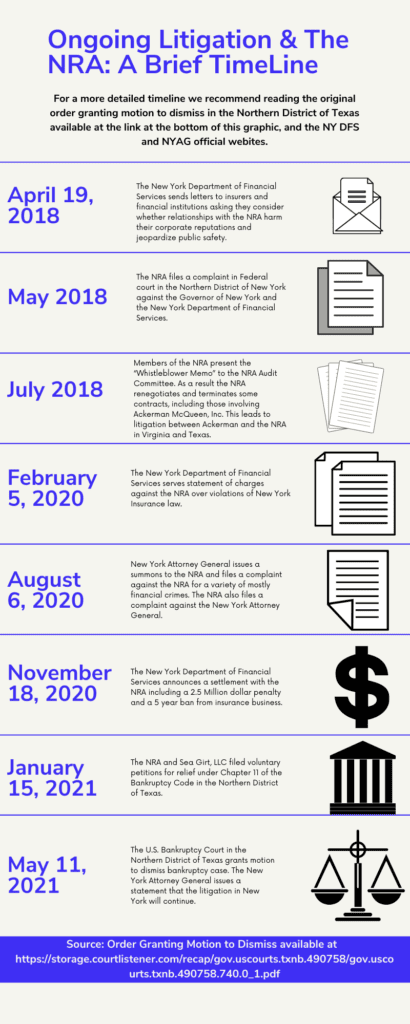
On Wednesday, we ran a short article going over the basics of the recent court decision in the Northern District of Texas which granted a motion to dismiss the National Rifle Association’s (NRA) attempt to file bankruptcy. This article gives a more in depth look at the history behind this litigation. The NRA has over the past few years been involved in a large amount of litigation. This article, and accompanying graphic, do not cover all litigation in recent years, only the litigation relevant to yesterday’s dismissal of the NRA’s attempt to file Chapter 11 bankruptcy.

Why Is This Important?

The dismissal of this bankruptcy case in Texas means that the NRA will not be able to use bankruptcy and reorganization in Texas as a means of avoiding trouble in New York. If the the New York Attorney General (NYAG) wins the case against the NRA, which the NRA was hoping to get out of, the NRA could cease to exist. In addition, high ranking NRA and former NRA officials could face repercussions for financial crimes. This could also provide a template, moving forward, for how states can crack down on charities and political organizations for financial misdeeds and misreporting. In other words, in addition to legal consequences this could impact charities and politics moving forward.

What Happened on Tuesday, May 11, 2021?

On Tuesday, May 11, 2021 a Texas Judge granted a motion to dismiss the NRA’s attempt to file for Chapter 11 bankruptcy, reasoning that “the NRA did not file the bankruptcy petition in good faith because this filing was not for a purpose intended or sanctioned by the Bankruptcy Code.” Specifically, the NRA seems to have filed for bankruptcy in an attempt to avoid legal trouble in New York. The U.S. Bankruptcy Court in the Northern District of Texas stated in its conclusion “The Court agrees with the NYAG [New York Attorney General] that the NRA is using this bankruptcy case to address a regulatory enforcement problem, not a financial one.”

The case was dismissed without prejudice, meaning that the NRA can file again, however, the court strongly cautioned them on this matter. The court pointed out several areas of concern including lack of transparency, secrecy, lack of disclosure, conflicts of interest, and “unusual involvement of litigation counsel in the affairs of the NRA…” The court further warned that it would immediately take up these concerns should the NRA file again. In other words, they would be wise not to press their luck.

What Was the History Behind This Decision?

The NRA’s current legal troubles involving alleged financial mismanagement first began to surface in 2017, although the alleged actions underlying these troubles began earlier than that. In mid-2017, the NYAG called an NRA board member to inform him that they were opening an investigation into the NRA. The NRA responded by hiring a law firm in 2017, and another in 2018, along with a new CFO in 2018.

In April 2018, the New York Department of Financial Services (NY DFS) sent letters to financial institutions and insurers warning them that their involvement with the NRA posed a potential danger to their reputation and to public safety. The NRA subsequently filed a complaint against NY DFS and the Governor of New York in May of 2018 alleging that they had defamed the NRA and had targeted the NRA together based on politics and the viewpoints of their speech, using law enforcement action as a pretext.

In July 2018, whistleblowers within the NRA presented the NRA audit committee with a “Whistleblower Memo” outlining concerns including conflicts of interest, financial mismanagement, deceptive practices, and management making decisions against the best interest of the NRA. The NRA took measures to address this warning, including renegotiating and cancelling certain vendor contracts of concern. This led to litigation between the NRA and vendor Ackerman McQueen, Inc in Texas and Virginia, as well as litigation involving other vendors.

In August 2018, the NYAG filed a motion to dismiss the NRA’s complaint against NY DFS and the Governor, which the Judge granted in part and denied in part in a ruling on November 6, 2018.

In February 2020, NY DFS served a statement of charges against the NRA for violations of New York Insurance Law.

In August 2020, following a 15 month investigation that had been conducted while all this was going on, the NYAG filed a complaint and summons. The complaint alleged that Executive Vice President, Wayne LaPierre, and his associates had exploited the NRA financially, punished those who raised concerns, hired unqualified individuals whose real purpose was to help them maintain control, and entered excessive post-employment payment agreements. On the same day as this filing, Aug. 6, 2020, the NRA filed a complaint against the NYAG alleging that the NYAG had targeted the NRA based on politics and the viewpoints of their speech, using law enforcement as a pretext.

In November 2020, the NRA and NY DFS reached a settlement agreement, in which the NRA agreed to pay $2.5 million and was banned from the New York insurance market for 5 years.

In January 2021, the NRA filed for Chapter 11 bankruptcy in the Northern District of Texas. This is the case that the court dismissed on Tuesday, May 11.

What Happens Now?

The case in New York is still ongoing. This involves alleged misuse of assets by LaPierre, and others close to him, for personal benefit. In the summons dated Aug. 6, 2020, the NYAG alleged that LaPierre and his associates exploited the NRA financially, punished those who raised concerns, hired unqualified individuals whose real purpose was to help them maintain control, and entered excessive post employment payment agreements. In the same complaint, the NYAG further accused other associates of diverting charitable assets, billing the NRA for millions of dollars in travel and entertainment, wasting charitable assets, concealing and misreporting information, and causing the NRA’s reports filed with the NYAG to be materially false.

If the NYAG wins, this could result in the NRA being dissolved. It could also result in LaPierre and these associates being banned from acting as fiduciaries for New York charities, and the voiding of transactions in question, many of which were for large amounts of money. Shortly after the May 11 decision in Texas, the NYAG posted a statement on the matter stating that the fight for dissolution of the NRA will continue in New York.

What Other Litigation Is The NRA Involved In?

This is not a complete list of litigation, but an overview of other recent litigation involving the NRA over the past few years that was happening at the same time as the cases discussed above. This also does not include the many cases in which the NRA argues on behalf of other parties. This list is constantly changing. For the most recent cases check the news or a legal research service.

  • Linlor v. Nat’l Rifle Ass’n of Am. (S.D. Cal., 2017)
  • Kalmbach v. Nat’l Rifle Ass’n of Am. (W.D. Wash., 2017)
  • Estate of Tabler v. Nat’l Rifle Ass’n of Am. (Md. App. 2017)
  • Kapoor v. Nat’l Rifle Ass’n of Am., 343 F.Supp.3d 745 (N.D. Ill., 2018)
  • Kalmbach v. Nat’l Rifle Ass’n of Am. (W.D. Wash., 2018)
  • Estate of Tabler v. Nat’l Rifle Ass’n, 457 Md. 144, 177 A.3d 75(Table) (Md. App., 2018)
  • Nat’l Rifle Ass’n of Am. v. Cuomo, 350 F.Supp.3d 94 (N.D. N.Y. 2018)
  • Nat’l Rifle Ass’n of Am. v. James, 2019 NY Slip Op 81329(U) (N.Y. App. Div., 2019)
  • Nat’l Rifle Ass’n of Am. v. City of L. A., 441 F.Supp.3d 915 (C.D. Cal. 2019)
  • Nat’l Rifle Ass’n of Am. v. Cuomo (N.D. N.Y. 2020)
  • Nat’l Rifle Ass’n of Am. v. North, 69 Misc.3d 1201(A), 130 N.Y.S.3d 925(Table) (N.Y. Sup. Ct. 2020)
  • Nat’l Rifle Ass’n of Am. v. Ackerman McQueen, Inc. (N.D. Tex. 2020)
  • Ackerman McQueen, Inc. v. Nat’l Rifle Ass’n (W.D. Tex. 2020)
  • RSUI Indem. Co. v. Nat’l Rifle Ass’n of Am. (W.D. Okla. 2020)
  • McEwen v. Nat’l Rifle Ass’n of Am. (D. Me. 2021)
  • Nat’l Rifle Ass’n of Am. v. Cuomo (N.D. N.Y. 2021)
  • McEwen v. Nat’l Rifle Ass’n of Am. (D. Me. 2021)

This is one of a series of articles that we are doing on gun law. Check back for more on this case as it continues. This article was last updated May 12, 2021.

The information provided in this article should not be considered legal advice or a substitute for legal advice. Biometrica is not a law firm and cannot offer legal advice.

Casino Industry Bounces Back Strong, Q1 Revenue Matches Best-Ever Quarterly Performance

By Aara Ramesh

In a heartening sign, the commercial gaming industry posted record revenues in Q1 2021, the American Gaming Association (AGA), the casino industry’s national trade group, announced on Tuesday, May 11. With intakes soaring above $11 billion and a 21.1% increase in revenues over Q4 2020, it seems like the comeback is truly on.

According to the AGA’s Commercial Gaming Revenue Tracker, the income generated in the first three months of 2021 matches the industry’s best-ever quarter — Q3 in 2019. This represents a 4.1% increase over pre-pandemic performance in Q1 2019 and a whopping 17.3% increase over Q1 2020, when casinos were forced to shut down as the pandemic began to ravage the country. Of the states with commercial casinos, half reported quarterly gaming revenue increases over Q1 2019. March was particularly good, with 12 states reporting their highest-grossing monthly gambling revenue that month.

This recovery, which is ahead of schedule according to experts, has been largely driven by sports and internet betting. This is hardly surprising, given that most professional sports leagues are on track, and many states still have rules in place prohibiting large gatherings. Over the past year, people have been spending more time indoors and online, meaning that many have turned to iGaming as an alternative to playing the slot machines, as it were. Sports betting revenue in Q1 set a quarterly record, up a staggering 270% over the same period last year, and outstripping 2019’s full-year total.

What is sure to be especially encouraging, however, are indications that in-person commercial gaming is also making an accelerated recovery. In particular, the March 2021 revenue for slots and table games fell short of March 2019 totals by just one percent. The reason why this is welcome news is that many states still have Covid-19 capacity restrictions in place. While 97.8% of all commercial casinos in the US were open by the end of the quarter, most were still operating under 100% capacity. In fact, 14 of the 25 states with commercial casinos, which represent over 75% of the nation’s total, had a limited occupancy of below 50%. For the industry to still be seeing such high numbers, despite being hamstrung by the pandemic, is highly noteworthy.

Industry-watchers cheered the news. “Today’s report shows gaming’s comeback is ahead of schedule,” said AGA President and CEO Bill Miller. “Throughout the COVID-19 pandemic, our industry has faced numerous challenges head-on while still reopening responsibly and providing a safe, exciting environment for customers.” He also suggested this represents “pent-up demand among customers.

Indeed, this seems to be one of the strongest indications yet that Americans are raring to get back to “normal.” As of March 2021, 53.4 million Americans (about 16.1% of the population) had been fully vaccinated. Now, with vaccines open to all citizens aged 18 above, there is good reason to be optimistic.

Texas Judge Rejects NRA’s Attempt To File For Bankruptcy

By Charlotte Spencer

On Tuesday May 11, 2021 a Texas Judge granted a motion to dismiss the National Rifle Association’s (NRA) attempt to file for Chapter 11 bankruptcy, reasoning that “the NRA did not file the bankruptcy petition in good faith because this filing was not for a purpose intended or sanctioned by the Bankruptcy Code.” Specifically, the NRA seems to have filed for bankruptcy in an attempt to avoid legal trouble in New York.

The U.S. Bankruptcy Court in the Northern District of Texas stated in its conclusion “The Court agrees with the NYAG [New York Attorney General] that the NRA is using this bankruptcy case to address a regulatory enforcement problem, not a financial one.” The case was dismissed without prejudice, meaning that the NRA can file again, however, the court strongly cautioned them on this matter.

The court pointed out several areas of concern including lack of transparency, secrecy, lack of disclosure, conflicts of interest, and “unusual involvement of litigation counsel in the affairs of the NRA…” The court further warned that it would immediately take up these concerns should the NRA file again. In other words, they would be wise not to press their luck.

Meanwhile, the case in New York is still ongoing. This involves alleged misuse of assets by the Executive Vice President (Wayne LaPierre), and others close to him, for personal benefit. In the summons dated August 6, 2020 the NYAG alleged that LaPierre and his associates exploited the NRA financially, punished those who raised concerns, hired unqualified individuals whose real purpose was to help them maintain control, and entered excessive post employment payment agreements.

In the same complaint the NYAG further accused other associates of diverting charitable assets, billing the NRA for millions of dollars in travel and entertainment, wasting charitable assets, concealing and misreporting information, and causing the NRA’s reports filed with the NYAG to be materially false. If the NYAG wins this could result in the NRA being dissolved. It could also result in LaPierre and these associates being banned from acting as fiduciaries for New York charities, and the voiding of transactions in question, many of which were for large amounts of money.

Shortly after the May 11 decision in Texas the NYAG posted a statement on the matter stating that the fight for dissolution of the NRA will continue in New York.

This is one of a series of articles that we are doing on gun law. Check back for more on this case as it continues. This article was last updated May 11, 2021.

The information provided in this article should not be considered legal advice or a substitute for legal advice. Biometrica is not a law firm and cannot offer legal advice.

Searches Need More Than Magic, Your Dog Needs Training, But So Do You

By Kacy Robinson

Search dog handlers have a unique advantage simply because we have highly trained and very specialized canines to aid us in our work, but that doesn’t mean we can allow all the other skills we have spent decades gaining go to waste. It is the culmination of both the skills of the handler and the skills of the canine that make our teamwork successful.

Like any skill, search and rescue or recovery skills must be consistently practiced to maintain proficiency. For the search and rescue, and/or recovery canine handler, these also include your canine’s skills. For those just beginning their career in this field, there are a myriad of skills to obtain. While it may seem overwhelming, each search mission is different, and any number of those skills may be needed to complete a successful search. As I repeat over and over during training, demonstrations and actual searches, our canines do not conjure things up by magic. It is the job of the handler to ensure canine success by being prepared for any situation which may arise during an actual search.

So, where do you begin if you are interested in becoming a search and rescue and/or recovery canine handler? The first step is to find a team you are interested in joining. There are many different types of canine teams located throughout the world. Some focus only on live finds, some focus only on cadaver recoveries. Others do a combination of both. Some teams provide tracking canines, while others focus on disaster recovery, live or cadaver. And then there are teams like ours, that focus on cold case recoveries and critical incidents.

Once you have decided the type of team that interests you the most, the best thing you can do is observe those handlers while they are training. Most teams allow individuals who are interested in joining to attend trainings and see how they train and observe their work. Our team, Fide Canem Cold Case, Inc., allows anyone interested to attend and observe trainings.

We also encourage those that are interested to get involved as a volunteer for the team, hiding for the canines to train on live find scenarios, and/or placing source for the canines to locate for human remains training. This type of hands-on participation allows the interested individual to see the kinds of search work the team undertakes, along with getting a basic sense of what it takes to be a canine handler and complete the necessary training.

Rappelling training in progress. Photo courtesy Kacy Robinson.

Scenario Training Matters, As Does Situational Diversity

Our team, Fide Canem Cold Case, Inc., trains for real-world scenarios. Our handlers constantly review cases, consult cases, study, and seek information about the cases that are taking place in the areas in which we search. Training on real-world scenarios allows our handlers to respond quickly and competently to any situation we may encounter. We also ensure we are training in worst-case scenarios. This means we train with the smallest or most degraded source, in the hardest area or situation possible. By training for the worst, we are confident we will be successful even during the best-case scenario.

We also expose our canines, handlers and search support to as many different search types and scenarios as possible. This means hot-loading into helicopters, searching from boats and the shore, searching with ATVs, flying fixed-wing aircraft to remote locations, searching from snowmobiles, and ensuring we have the necessary back-country skills to survive if stranded alone for several days. Observing and participating in any of these activities builds skills that are essential for canine handlers and search support staff. Observe trainings held by the team you want to join and any other teams to which you have access. You may think you want to be a part of a specialized canine team only to find that you are better suited to a county or local team instead. Having experienced many different types of teams ensures you will make the best possible decision when joining a team.

It is important to note that most search and rescue and/or recovery teams are comprised of volunteers and many are non-profit. This means the time, travel and any expense associated with training and or searching will be the responsibility of the searcher. With the cost of travel and equipment, searching can be quite expensive. The time required to become an active member of a search team is also extensive and often requires being on call 24 hours a day, 7 days a week. It is important to bear both the expense and time required before deciding that search and rescue/recovery is the right fit for you.

When someone wants to join our team, we make sure they understand that there are no halfway measures when it comes to being a search and rescue and/or recovery canine handler or a search team staff member. When you commit to a team, you must commit fully with the understanding that a significant amount of time and expense will be incurred in order to be a part of the team. Searchers do what they do because they are passionate about helping their communities and bringing the lost home. If you don’t have that passion, search work is not for you.

Avalanche training in progress. Photo courtesy, Kacy Robinson.

Research & Keeping Pace With Advancements Is Necessary

It is also important is to begin researching and studying to complete the necessary certifications required for the team in which you are interested. This may mean a wilderness survival course, map and compass certification, first aid/CPR, advanced man tracking, line/grid searching, blood borne pathogens, FEMA Incident Command Structure Training, evidence collection and preservation, crime scene preservation, high angle rescue, ropes and knots, and a variety of other specialized skills. The team in which you are interested likely has an extensive list of training and certifications required before you can began assisting with searches and/or training a canine for search and rescue/recovery work.

There are many informative search training manuals and books available for each type of search or recovery discipline. As established handlers, our team studies and reads constantly in order to remain current on techniques. The team in which you are interested likely has training manuals and information for you to study, but any outside information you can learn will only enhance your skills and prove you valuable to their organization.

Water recovery training at Mantua. Photo courtesy, Kacy Robinson.

Because our team concentrates on aged missing persons and cold cases, Fide Canem Cold Case, Inc., requires highly specialized certifications and skills in order to be considered for membership. Some of our requirements include current or previous law enforcement or military experience, crime scene analysis certifications, specialized evidence identification, preservation and recovery techniques, forensic anthropology, and expert witness testimony and report writing expertise. Established team members or team management members can guide you through the necessary requirements and certifications.

Beyond the basics, studying lost person behavior, forensic psychology, and forensic pathology can also be helpful in understanding the cases in which you will be assisting. It is helpful to understand how different types of mental states can lead people to behave in certain ways. It is also helpful to understand how human behavior does or does not change when facing trauma or being lost. For example, it has been proven that those who are left-handed tend to make more left turns when lost and searching for a way out of a wilderness area. Likewise, right-handed people tend to make more right turns. When you have a quiver full of basic and advanced human behaviors and psychology when you reach a search, or are consulting a case, you have the ability to ask the questions which can ultimately lead to successfully finding or recovering the missing person.

It’s important to remember that there is a wealth of information to learn prior to embarking on a search career, but the learning continues throughout a search career as well. Technology changes, techniques evolve and those who search have to adapt, but that is all part of the adventure. Utilizing the many resources available, seeking out opportunities to observe and participate in training with search and rescue/recovery teams, and always being open to learning the skills necessary to be successful are all keys to a lifelong career serving the community in this unique capacity.

You can read Kacy Robinson’s previous piece for Biometrica on canine training here and on the life of a canine handler dealing with cold cases here.

Human Remains Detection training in Brigham City. Photo courtesy, Kacy Robinson.

Author Bio: Kacy Robinson got her associate of science degree in Criminal Justice at the College of Eastern Utah and followed it up by certifying as a Crime Scene Analyst from the Utah Bureau of Forensic Services Crime Scene Academy. She also has a BA Communications through the University of Utah and an MS in Computer Forensics from the Henry Lee College of Forensic Science at the University of New Haven. While attending, she was the Lead Archivist on the Robert F. Kennedy Assassination Project, and spent twelve years with the oldest and largest search and rescue organization in the state of Utah with her two canine partners, the late Uintah, and Wahsatch, both Golden Retrievers.

In 2017, Kacy and search partner Bret Sayer established Fide Canem Cold Case, Inc., the first search and recovery team focused exclusively on cold case missing persons and evidence recovery. Bret is a Salt Lake City native who has worked in public safety and security for 20 years. As security manager for a major corporation, he oversees a team of more than 50 officers. Bret attended Weber State University in Ogden, Utah, with a focus on Criminology, Forensics, Chemistry and Laws of Evidence. He is a K9 Human Remains (Cadaver) Handler in tandem with Halo, his 6-year-old Black Labrador Retriever, and has been a search and rescue K9 handler for 8 years. He was assigned to be the callout coordinator and law enforcement liaison in deploying and activating search and rescue teams. Kacy and Bret can be reached here.

Europol’s Trace An Object Initiative Appeals To Public For Help To Combat Child Sexual Abuse

By Aara Ramesh

On Monday, May 10, Europol released a new batch of photos as part of its “Trace an Object” program, an ongoing effort to solve child sexual abuse cold cases across the continent.

In their public appeal, the agency said that they are particularly looking for details that might help identify the products’s country of origin. The six pictures released originate from the background of child sexual abuse footage, and have been cropped, censored, and digitally enhanced. Some of the objects are part of cases that are months, or even years, old. Where the trail has gone completely cold, investigators are hoping for fresh clues from average citizens that might help inch them forward.

According to Bellingcat, the British investigative news site that specializes in open-source intelligence, the spread of child sexual abuse material “has been classified as an epidemic of unprecedented proportions, overwhelming law enforcement resources” on a global scale. Cybercrime as a whole is also proving to be a formidable threat, taking on a more “aggressive and confrontational” avatar.

Europol says that online offenders “exhibit considerable resilience in response to law enforcement actions.” They are becoming wiser and more sophisticated; and are more aware of what authorities are looking for. Like the mythical Hydra, when one platform is shut down, new communities pop up elsewhere or old ones are brought back to life. The tech-savvy criminals behind these platforms are making strides in organizing, administering, protecting, and hiding their activities.

Countries where the internet infrastructure is quite advanced and where privacy laws offer a veil of protection are facing the brunt of the problem. In recent years, Europe has become the epicenter of this epidemic. The Internet Watch Foundation’s 2019 Annual Report found that European countries hosted 89% of the known URLs containing child sexual abuse material, up 10% from their share the previous year.

The advent of the internet and the social media age has, however, also helped authorities catch such criminals. Despite offenders growing more sophisticated, law enforcement organizations are developing innovative ways to combat the most difficult problems they face. It may seem like the only way to combat this issue is through crowdsourcing help—which is where “Trace an Object” comes in.

Anyone can submit the tiniest detail on the website in an anonymous and secure manner. They say no clue is too small or irrelevant. Once they receive a tip, victim identification specialists work to verify them. In cases where they result in particularly strong leads, the information is sent to the relevant country’s authorities to pursue it further.

Since it went live in May 2017, investigators have received over 26,000 tips and have been able to zoom in on the country of origin in 93 cases. Europol has identified 10 victims of child sexual abuse, who have been removed from harm. The initiative has also resulted in 3 sexual offenders being identified and prosecuted. But there are numerous other investigations ongoing in Europe to identify victims and their abusers.

Europol’s database has over 51 million unique video or images containing instances of child sexual abuse, which its taskforces are working on. A portion of the material, however, also makes its way onto privately owned social media platforms like Facebook, which is then responsible for flagging this content off with the authorities.

There is some concern that the EU’s latest privacy protection laws, targeting “Big Tech” companies like Facebook and Microsoft, may actually worsen the problem. These companies rely on software that automatically identifies images and videos containing child abuse, as well as instances of online grooming. They claim that the new laws will severely handicap those efforts.

Earlier this month, Europol announced the arrest of four German nationals involved in one of the continent’s most sprawling child sexual abuse platforms on the dark web. Data seized from this operation will be sent to the agency’s Victim Identification Taskforces, which is the same team behind the “Trace an Object” initiative. And in March, it expanded to the Asia-Pacific region, with the Australian Federal Police launching its own version of the project. The subjects of some footage are believed to be in the APAC region.

The solution, experts say, will have to be a coordinated effort. While Europe hopes to take the lead, they will need to be supported by global stakeholders, including private companies, non-profits, various governments, law enforcement agencies, and ordinary citizens who are equally committed to the cause of stopping child abuse.

As criminal syndicates and abusers grow ever smarter, so too do the authorities. Innovations like “Trace an Object” seem to indicate that Europol is betting on the efforts of the many to outnumber the efforts of the few.

You can submit a tip to Europol’s ‘Trace an Object’ team here.