In March, just a day after a 21-year-old shooter opened fire at a supermarket in Boulder, Colorado, killing 10 people including a police officer, we examined the felony killings of American law enforcement officers (LEO) in 2019. Today, we take a look at the numbers for 2020.
By any yardstick, when you factor in the rate of assault and injury on duty, being in law enforcement gets catapulted to the top of any “most dangerous jobs in America” list. While being a law enforcement officer may not necessarily be the most “dangerous job in America” in terms of numbers, it is probably the only legal peacetime job out there where you wake up and leave for work every morning, knowing someone may intentionally try and kill you that day. And the next. And every single day thereafter. Day in, day out. Week in, week out, year in, year out. Or at least, someone may try their best to do so.
On May 3, the Federal Bureau of Investigation (FBI) released statistics on Law Enforcement Officers Killed in the Line of Duty for 2020. Its more comprehensive report on assault data, which is on the number of LEOs assaulted while performing their duty — typically, an exponentially higher number than those killed — is scheduled to be released in the fall.
In total, 93 LEOs were reported to have been killed in line-of-duty incidents in 2020. Of those, 46 officers lost their lives due to felonious acts while 47 died in accidents. The 46 felony killings of LEOs in 2020 compares with 48 in 2019, and 55 in 2018. The 5- and 10-year comparisons show a decrease of 20 felonious deaths compared with the 2016 figure (66 officers), and a decrease of 26 deaths compared with 2011 (72 officers).
But in 2019, firearms were used in the felony killings of only 29 of the 48 victim officers’s deaths. Whereas, in 2020, offenders used firearms to kill 41 out of the 46 victim officers. Of those, 21 were slain with handguns, 10 with rifles and in the remaining 10 instances, the type of firearm was either unknown or not reported.
Of the five remaining victim officers in 2020 (out of 46): four were killed with vehicles used as weapons, while one was killed by the offender’s use of personal weapons (hand, fists, feet, etc.).
In 2020, the 46 felony killings took place in 25 states. While felonious deaths were reported across all four U.S. regions, the south saw the highest with 24 reported deaths, followed by the Midwest with 11, the West with 10, and finally one in the Northeast.
The average age of the officers who were feloniously killed was 39 years old. The victim officers had served in law enforcement for an average of 12 years. In terms of profiles of the officers feloniously killed:
• 41 were male • 5 were female • 32 were White • 10 were Black/African American • 2 were Native Hawaiian/Other Pacific Islander • 1 was American Indian/Alaska Native • The race of 1 officer who died was not reported
The following are the circumstances encountered by the victim officers when they arrived at the scenes of the incidents:
• 9 were ambushed (entrapment/premeditation) • 7 died as a result of investigative or law enforcement activities • 7 were assisting other law enforcement officers • 5 were responding to crimes in progress • 4 were responding to disorders or disturbances • 3 were involved in arrest situations • 2 were responding to citizen complaints • 2 were involved in tactical situations serving/attempting to serve an arrest warrant • 2 had encountered or were assisting a person experiencing an emotional disturbance • 2 were killed during an unprovoked attack • 1 was serving/attempting to serve court order (eviction notice, subpoena, etc.) • 1 was assisting a motorist • 1 was killed in an incident reported in the category of “other”
In terms of the offenders who killed the victim officers, 20 had prior criminal arrests, and five were under judicial supervision at the times of the incidents.
Accidental deaths of LEOs in 2020 (of 47 officers) increased by 6 when compared with data for 2019. A majority of the 47 deaths happened due to motor vehicle crashes. The average age of officers who were accidentally killed was 40, while the average number of years the victim officers had served in law enforcement was 10.
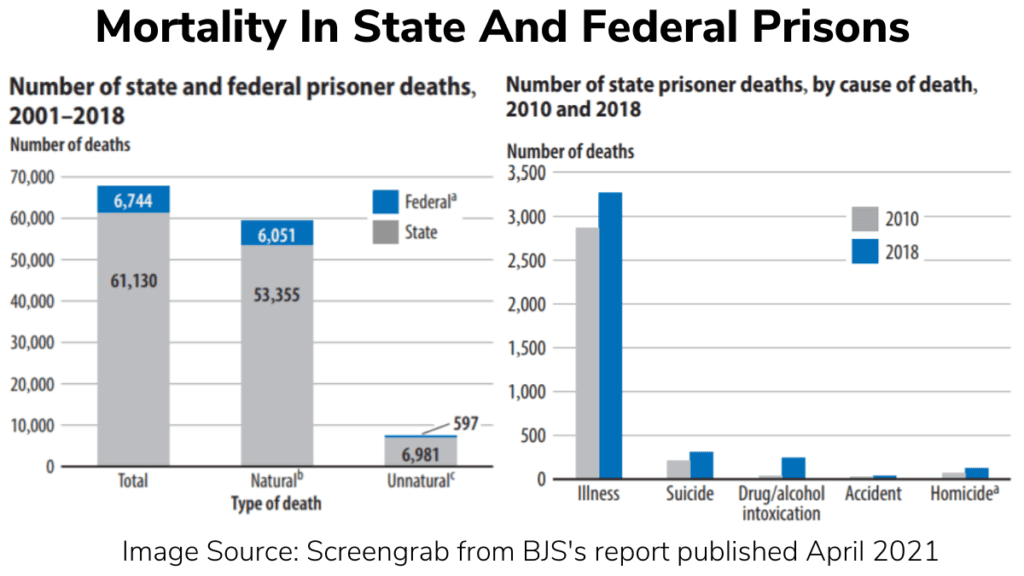
In 2018, a total of 4,135 state prisoners died in publicly or privately operated prisons, and an additional 378 federal prisoners died in facilities operated by the Federal Bureau of Prisons (BOP), according to a report published by the Bureau of Justice Statistics (BJS). The first number represents an increase of 5% from 2017, and is the highest level reported since the BJS began gathering data on mortality in state prisons in 2001. Deaths of federal prisoners decreased nearly 1% from 2017 to 2018. State prisons had a preliminary count of 3,293 deaths in 2019, based on data from 49 of the 50 state departments of corrections.
But, the number one cause of deaths in both state and federal prisons in 2018 remained illnesses. Even if you consider data from 2001 to 2018, it shows that 87% of state prison deaths and 90% of federal prison deaths occurred due to illness. Suicides accounted for 6% of state prison deaths and almost 5% of federal prison deaths over the same period. However, the number of state prisoners who committed suicide in 2018 was up by a sharp 20% from 2017, marking the highest number of suicides that BJS has recorded in 18 years of collecting mortality data, it said in the report.
State prisoners had a lower overall mortality rate when compared with adult U.S. residents in 2018 — 319 per 100,000 vs 419 per 100,000 (with the data adjusted for differences in age, sex, and race or ethnicity between the two populations). But, they were “slightly more likely” to die of cancer, liver disease, and suicide and more than twice as likely to die from homicide than the adjusted population of adult U.S. residents, the report added. In fact, 10 in 100,000 state prisoners died from homicide in 2018, the highest homicide rate in state prisons since 2001. The rate of death by homicide among state prisoners was more than twice the rate when compared with adult U.S. residents.
Between 2001 and 2018, the total number of state prisoners in custody increased 1%, while the number of deaths in state prisons rose 44%. In terms of race, even though they made up less than a third of the state prison population, White prisoners accounted for more than half of all deaths in 2018.
The suicide rates among those in federal prisons were less than those in state prisons from 2001 to 2018 — 11 suicides per 100,000 vs 17 per 100,000. When you look at data for just 2018, though, the suicide rate for federal prisoners was 19 per 100,000, up from 16 per 100,000 in 2017. The rate at which federal prisoners died of illness was also at its lowest since 2012 at 190 deaths per 100,000. It was at 182 per 100,000 in 2012.
Here are a few other key findings when it comes to state and federal prisoners, as listed in the report:
In 2018, a total of 22 state prisoners died from AIDS-related illnesses, a 92% decrease from 2001 (275 deaths)
From 2001 to 2018, a total of 1,258 state prisoners, or 2% of all deaths in state prisons, were due to homicide
Cancer and heart disease accounted for 53% of all state prison deaths from 2001 to 2018
Unnatural causes, including suicide, homicide, drug or alcohol intoxication, and accidents, accounted for 17% of deaths in state prisons in 2018
The mortality rate for state prisoners due to cancer in 2018 (95 deaths per 100,000 state prisoners) was the highest since 2001
In state prisons, the number of deaths and mortality rate of females increased by more than 37% between 2017 and 2018
Prisoners age 55 or older made up 34% of all state prison deaths in 2001 but nearly double that (61%) in 2018
American Indians and Alaska Natives accounted for 646 (1%) of all deaths in state prisons from 2001 to 2018
In state prisons from 2001 to 2018, white prisoners had the highest average annual mortality rate for all causes of death other than AIDS
Over one-third of deaths in state prisons occurred in the states with the largest prison systems in 2018: Texas (505 deaths), California (449), and Florida (440)
Ten states had fewer than 10 prisoner deaths in 2018, including North Dakota, which had none
The average annual mortality rate due to suicide was lowest in Alabama and Kentucky (9 deaths per 100,000), followed by Florida and North Carolina (10 per 100,000)
Mortality In Local Jails In 2018
The BJS also released a separate report on mortality in local jails. A total of 1,120 inmates reportedly died in local jails in 2018, which is an increase of nearly 2% from the 1,099 deaths reported in 2017. It was also the highest number of deaths reported in local jails since the BJS began collecting mortality data on local jails in 2000. As of July 10, 2020, the preliminary number of deaths reported by local jails in 2019 was 1,088.
Of the 1,120 deaths in local jails in 2018, a total of 335 were suicides, 290 were due to heart disease, and 178 were due to drug or alcohol intoxication. Deaths in local jails due to drug or alcohol intoxication increased almost 19% from 2017 to 2018, and 381% since 2000.
For local jails too, illnesses accounted for a significant portion of all deaths reported. Slightly less than half of all deaths were due to illnesses (46%), such as heart disease, liver disease, and cancer, the report said. But suicide also continued to be a leading cause of death in 2018, accounting for almost 30%.
Inmates in local jails also had a lower overall mortality rate in 2018 (146 per 100,000 jail inmates) than the United States resident population adjusted for sex, race or ethnicity, and age (322 per 100,000 U.S. residents age 18 or older). Jail inmates were less likely than adult U.S. residents to die from all causes of death except suicide and homicide in 2018. Jail inmates were twice as likely to commit suicide in 2018 (45 per 100,000 jail inmates) than adults in the adjusted U.S. resident population (22 per 100,000 adult U.S. residents).
However, the homicide mortality rate was the same between the two populations in 2018. About 46% of inmates who died of homicide from 2000 to 2018 were being held for a violent offense.
In terms of race, about 25% of deceased local jail inmates n 2018 were Black, and 13% were Hispanic. Inmates who were age 55 or older had the highest mortality rate of all age groups across all causes of death from 2000 and 2018.
The BJS reports say: Findings are from BJS’s data collection on Mortality in Correctional Institutions (MCI; formerly the Deaths in Custody Reporting Program). The MCI is the only national statistical collection that obtains comprehensive information about deaths among prisoners and jail inmates in the custody of adult correctional facilities.
The middle of a once-in-a-lifetime pandemic is probably not the time to have to worry about another potential virus outbreak, but that’s exactly what the U.S. Customs and Border Protection’s (CBP) agriculture specialists had to deal with in April, after a U.S. citizen, flying into Dulles Airport from Africa, was found to be carrying potentially virulent porcupine quills.
And yes, that isn’t an error, we did say porcupine quills. In a news release on Friday, April 30, CBP detailed some of this strange story. Apparently, the passenger — who was later released with a warning after the perilous barbs were confiscated — flew in on April 21 and went through a secondary examination after declaring possession of an animal horn. That more thorough exam resulted in the discovery of 100 porcupine quills. On April 22, the Centers for Disease Control and Prevention (CDC) stepped in and advised CBP to seize the quills as a potential vector for the monkeypox virus.
Just FYI, on a typical day in 2020, the CBP’s agriculture specialists seized 3,091 prohibited plant, meat, animal byproducts, and soil, and intercepted 250 insect pests at U.S. ports of entry.
What was the 2003 outbreak?
So, in case you’re too young or too zoned out to remember the 2003 U.S. outbreak and are wondering what the heck the monkeypox virus is, well, it’s kind of like smallpox. According to the CDC, in humans, the symptoms of monkeypox are milder than the symptoms of smallpox, but the main difference is that monkeypox causes lymph nodes to swell while smallpox does not. In Africa, monkeypox has been shown to cause death in as many as 10% of persons who contract the disease. There was even an outbreak just last year in the Democratic Republic of the Congo (DRC).
In fact, unfortunately, the DRC’s relationship with monkeypox goes back 40 years to when the first human case of monkeypox was recorded there, during a drive to eliminate smallpox. According to the CDC, the virus was originally discovered in 1958 when two outbreaks of a pox-like disease occurred in colonies of monkeys kept for research, hence the name.
The 2003 U.S. outbreak — 37 confirmed and 10 probable cases across Illinois, Indiana, Kansas, Missouri, Ohio, and Wisconsin — was, in fact, the first time human monkeypox was reported outside of Africa.
How was monkeypox virus first introduced into the U.S.?
According to the CDC, investigators concluded that a shipment of animals from Ghana, imported to Texas on April 9, 2003, introduced the U.S. to the horrors of the virus. The shipment contained approximately 800 small mammals representing nine different species, including six species of African rodents, including rope squirrels, tree squirrels, African giant pouched rats, brush-tailed porcupines, dormice, and striped mice. The CDC’s labs found that two African giant pouched rats, nine dormice, and three rope squirrels were infected with the virus. On arrival in the U.S, some of the infected animals were reportedly housed near prairie dogs at an Illinois animal vendor; the dogs were subsequently sold as pets.
Everyone infected had encountered a dog and had either touched a sick animal, received a bite or scratch that broke the skin, or cleaned a cage or touched the bedding of a sick animal.
According to the CDC, virus transmission occurs when a person contracts the virus from an animal, human, or materials contaminated with the virus. The virus enters the body through broken skin (even if not visible), the respiratory tract, or the mucous membranes (eyes, nose, or mouth. Human-to-human transmission is thought to occur primarily through large respiratory droplets. Respiratory droplets generally cannot travel more than a few feet, so prolonged face-to-face contact is required.
There is no proven, safe treatment for any infection from the monkeypox virus. The U.S. uses the smallpox vaccine, antivirals, and vaccinia immune globulin (VIG) to contain the virus. Here’s hoping this Dulles encounter has been contained already. We don’t need another virus outbreak of any kind.
Wisconsin’s first wolf hunt in six years did little to resolve man-wolf conflicts, and may have harmed breeding among as many as 100 wolf packs instead, a report by conservation group Wisconsin’s Green Fire said. During the last week of February 2021, Wisconsin allowed public hunting and trapping of wolves for the first time since 2014. The last time wolves were hunted legally in Wisconsin in February was in 1956.
Hunters killed 218 wolves in less than 72 hours, according to the report, which adds that wolves were killed primarily in their core habitats, on public lands where conflicts with pets, livestock or human safety are already rare. The number of wolves in the state grew from just 25 in 1980 to 1,195 wolves before the February hunt, according to the Wisconsin Department of Natural Resources (DNR). There are recovering wolf populations today in Minnesota, Wisconsin, Wyoming, Montana and Idaho, even as wolves have begun to inhabit Washington, Oregon, and California, the Center for Biological Diversity said.
“The lack of consultation with Wisconsin Ojibwe Tribes over the February hunt failed to meet the state’s responsibilities under both the LCO/Voight Decision that applies specifically to the Ojibwe tribes of Wisconsin, as well as broader obligations under the doctrine of Federal Indian Trust Responsibility,” the Wisconsin’s Green Fire report adds.
The report comes just as lawmakers in Idaho approved a bill authorizing the state to kill up to 90% of its wolf population, a measure championed by farmers and cattle ranchers that will become law if signed by the governor in the coming days. The Idaho House of Representatives voted 58-11 to approve the fast-tracked legislation, which passed the state senate with backing from the agricultural sector, Reuters reported. The legislation is now headed to the office of Republican Governor Brad Little. If he signs it, it will take effect within months.
The move threatens to partially undo decades of intense efforts—costing tens of millions in taxpayer dollars—to recover wolves in the region, a National Geographic article said. The bill would allow for wolves to be hunted just about any way, including being shot from airplanes, helicopters, ATVs, and snow machines. Baiting and night hunting with spotlights would be permitted. It would allow trapping and snaring wolves on private property year-round, and each hunter could purchase an unlimited number of tags for killing the predators, the Nat Geo article added.
The Idaho bill also calls for $300,000 in state funds to go specifically toward killing wolves that prey on elk. Since some of those funds can be given to hunters as reimbursement for expenses accrued killing wolves, critics see it as a return to the bounty-hunting system that led to the near-elimination of wolves from the Lower 48 in the early 20th century, the article goes on to say. It was even opposed by many organizations that traditionally support hunting, including the Idaho Department of Fish and Game and the Idaho Sportsmen group.
In October 2020, the Trump administration announced that it would remove the gray wolf from the endangered species list. That delisting, done by the U.S. Department of the Interior that said the population had sufficiently recovered to no longer warrant protection, went into effect in January 2021. After it went into effect, wildlife and environmental groups said they were suing the administration to restore federal protections for the gray wolf, a report by Wisconsin Public Radio said.
“The U.S. Fish and Wildlife Service made its decision despite the science that concludes wolves are still functionally extinct in the vast majority of their former range across the continental United States. Gray wolf recovery in the United States should be an American conservation success story. Once found nationwide, gray wolves were hunted, trapped, and poisoned for decades; by 1967 there were fewer than 1,000 wolves in one isolated part of the upper Midwest,” the Center for Biological Diversity, a non-profit conservation organization said in a press release on Jan. 14 2021.
As the wolf population has grown, farmers and hunters have reported increasing conflicts with wolves. Since 2017, the number of wolf depredation complaints has grown from 111 to 148 complaints in 2020. The number of verified attacks increased from 82 in 2019 to 98 confirmed depredations last year.
Across the border too, the wolf population is suffering. On Wednesday, April 28, Pacific Wild said in a post that it had learned the British Columbia government has killed 237 wolves during the winter of 2021 in its “continued war on wolves,” even though the lawfulness of the culling was still before the courts.
It is estimated that more than 600,000 individuals go missing in the United States every year. While many of those missing are found relatively quickly, thousands disappear, for different reasons, whether by choice or not, for more than a year, becoming, in effect, what investigating agencies often call “cold cases.” Additionally, it is estimated that 4,400 unidentified bodies are recovered each year in the United States, with approximately 1,000 of those remaining unidentified after one year.
If you or your loved one goes missing what happens next, and what resources are used to help you, depends on what state you’re in. Although NamUs is available to all states, its use is not mandated in all states. NamUs stands for the National Missing and Unidentified Persons System. NamUs is a government system created to improve access to information to help solve missing and unidentified persons cases. Created by the Justice Department, it provides technology, forensic, and investigative support. Although NamUs is available for any state or local law enforcement dealing with such cases, not all use it. Most states haven’t mandated reporting local cases to it, but that’s starting to change. A few states passed such laws in 2017, and a handful of states have followed since. So far 10 states have mandated reporting to NamUs. In addition, Connecticut has made it protocol to report to NamUs, although there is no statute requiring this, and Texas is currently considering legislation.
Whether or not you may automatically benefit from NamUs if one of your loved ones goes missing may come down to what state your loved ones live in. It’s important to note, however, that you can still reach out to NamUs even if you don’t live in one of these states. In 2019, NamUs launched its Victim Services Division. Laws like this can still make a difference when a loved one goes missing, though, because they make it more likely that a match to you or your loved one will already be in the system. Further, these laws see to it that missing and unidentified people will be reported into the system even if their loved ones didn’t know about this system. Finally, these laws can help close more cases, thus helping to get murderers off the street before they strike again. Read on to learn if you and your loved ones live in a state mandated to use NamUs.
Federal Law
34 U.S.C. §§ 40501 through 40505 focuses on the reporting of unidentified and missing persons. It includes an authorization of grants for combating the problem of missing and unidentified persons, grant eligibility, use of funds, and reports to Congress on such matters. This section of the law has been amended and added to throughout the years, including recently. Recent updates include the Missing Persons and Unidentified Remains Act of 2019. These laws likely will continue to be updated as technology advances. Federal law does not require local law enforcement to use NamUs services.
New York
In New York NY EXC Law 837 as amended by S6739 requires that missing persons be reported to NamUs within 30 days. In addition, medical examiners and coroners must report unidentified remains to NamUs. As explained in the Justification section of S6739 as written in 2017:
“While the NYS Division of Criminal Justice Services recommends that law enforcement agencies report missing persons to NamUs as well as NCIC, many do not. NamUs reports that a recent review showed 4000 open missing persons cases in the NCIC register, but only 551 in NamUs. This discrepancy in cases show that there is a need to require that missing persons be reported to both databases in order to increase the chances that the missing are found.”
This illustrates why laws like this are so important. Many may expect that it’s unnecessary to mandate behavior which generally everyone agrees is a good idea anyway, expecting that it will be carried out whether or not it’s mandated. As these statistics illustrate, however, such a step often falls through the cracks, especially in jurisdictions where people are juggling large caseloads.
Texas
Texas is currently considering legislation to mandate using NamUs. 2021 TX HB1419, also known as John and Joseph’s Law would require law enforcement to enter all available identifying features of an unidentified body into NamUs. It would also require entering missing persons into NamUs, and NCIC, and if applicable, into the clearinghouse and into the Alzheimer ’s Association Safe Return emergency response center.
Washington
As of June of 2020 Cody’s Law (Washington HB 2792 – 2019-20) has been in effect, after passing unanimously amongst those who voted. When a person has been missing more than 30 days, or when criminal activity is suspected in a missing persons case, the investigating agency must file a report with the Washington State Patrol, collect DNA, and request family consent for retrieving dental records. This information must be forwarded to appropriate labs and the Washington State Patrol. Law enforcement, coroners, or medical examiners must collect identifying information on unidentified human remains and provide this information to the Washington State Patrol. If a person has been missing for more than 30 days, or if criminal activity is suspected in the disappearance, the law enforcement agency must submit this information to NCIC (The National Crime Information Center). Once funded, the Washington Association of Sheriffs and Police Chiefs must regularly transmit information contained within the statewide missing persons website to NamUs. This law also contains details on what must be included in reports depending on the circumstances. Full text of the final bill as passed is available here.
New Mexico
2019 NM HB16, also known as the Mark Daniel Aguilar Information Sharing Requirement, passed unanimously amongst those who voted and was signed and enacted in 2019. It requires the Department of Public Safety to share information with NamUs “as soon as is practicable.” This includes all information in the Missing Persons Information Clearinghouse, and all information the Department receives “pursuant to the Missing Persons Information and Reporting Act regarding the identification and location of missing and unidentified persons or human remains.”
Oklahoma
Okla. Stat. tit. 74 § 151.3. also known as Francine’s Law requires the OSBI (Oklahoma State Bureau of Investigation) to share missing and unidentified persons cases with NamUs. This law also passed unanimously amongst those who voted in 2019. OSBI must share fingerprints, dental reports, DNA information, radiology and medical information, date and place of death, and all other identifying information on unidentified persons if it is available to them. Law enforcement must, within 30 days of a missing persons report, submit a case to NamUs, and any other database required. In addition, they must obtain biometric records of the missing person including medical, dental, and imaging records when possible and submit it to NamUs. They must also submit fingerprints and DNA if possible. They must also report to NamUs when a person previously reported has been found.
Illinois
50 ILCS 722, also known as the Missing Persons Identification Act was recently amended in 2021. Law enforcement must submit details of missing persons to NamUs within 45 days. Under 50 ILCS 722/10 law enforcement must also enter missing person information into the Law Enforcement Agencies Data System (LEADS), the National Crime Information Center (NCIC) databases, the missing person databases of the State DNA Index System (SDIS) and National DNA Index System (NDIS), and use appropriately trained people to enter the details of these reports. They must also follow special procedures for anyone considered a “high-risk missing person.” This law also contains details on what must be included in reports depending on the circumstances.
Michigan
Since 2018 law enforcement must submit records to NamUs as a result of HB 4633. Specifically, law enforcement must report missing persons to NamUs, the law enforcement information network (LEIN), the national crime information center (NCIC), and if the person is a child to the missing child information clearinghouse. This applies if the person is disabled, is a child, is believed incapable of returning without assistance, disappeared during a catastrophe or disaster, disappeared under circumstances that indicated that the disappearance was not voluntary, or disappeared under circumstances that indicated that the person was in danger. If a person has been missing for more than 30 days, law enforcement must seek out and submit dental records of the missing person also. Unidentified bodies must be entered into NamUs, NCIC, and if the body is that of a child, into the clearinghouse. This law also contains details on what must be included in reports depending on the circumstances.
Arkansas
Since 2019, Arkansas law has required law enforcement to enter data into NamUs. All law enforcement must complete training in handling missing and unidentified persons cases. They must submit all missing and unidentified persons cases into NamUs within 30 days including, if available, fingerprints, dental records, descriptions, radiology images, DNA, medical data, and identifying data including date and place of death.
Tennessee
As a result of Tenn. Code 38-6-125, also known as the Help Find the Missing Act, since 2017 forensic centers must enter information on unidentified bodies into NamUs and into the Tennessee Bureau of Investigation. This information must include, if available, fingerprints, dental records, descriptions, DNA, and other identifying information such as date and place of death. Law enforcement must submit missing persons records including dental records and x-rays, if available, to NamUs.
North Carolina
Under NC 143B – 1011 through 1015 law enforcement must immediately upon receiving a missing person report make arrangements to enter data into the national missing persons file, inform all on duty law enforcement, and broadcast to all appropriate agencies to be on the lookout. If the report involves a child they must also notify the National Center for Missing and Exploited Children. Law enforcement must enter information into NamUs if a person has been missing more than 30 days, or a person has been unidentified for more than 30 days. This must include, if available, medical and dental records, and DNA.
West Virginia
Under West Virginia’s Missing Persons Act law enforcement must submit missing persons information if applicable to NCIC, NCMEC, NamUs, CODIS, and the West Virginia Automated Police Network (WEAPON) in a timely manner. Medical Examiners must promptly submit all available information to NamUs and WEAPON for entry into all other appropriate law enforcement databases. This law also contains details on what must be included in reports depending on the circumstances. This law went into effect in 2019.
Connecticut
Although there is no legislation in Connecticut that mandates using NamUs, officials put a statewide protocol in place to use NamUs. See Connecticut Police Officer Standards and Training Policy for Handling Missing Persons Investigations. Missing persons must be entered into NamUs within 30 days. This protocol also contains details on what must be included in reports depending on the circumstances.
This list does not cover the entire content of the laws mentioned above, only the parts relevant to NamUs. For more on the laws in your state follow the links to the original text of the laws provided above. If your state is not on the list above you can still reach out to NamUs or other similar organizations for help. If you live in an area where NamUs is not used, and you would like to encourage your local law enforcement to use it, they may be interested in the bulk data import capability that NamUs is currently developing.
For more stories on missing persons, here are a few selected posts from our archives:
“Madam Speaker, Madam Vice President. No president has ever said those words from this podium. No president has ever said those words. And it’s about time.”
There was an explosion of excitement on Twitter at those words from President Joe Biden during his address to a joint session of Congress on April 28. And nobody is likely to forget seeing images and videos of Vice President Kamala Harris and Speaker Nancy Pelosi elbow bumping each other in a hurry. But there was a whole lot more in Biden’s speech that covered everything from details of a newly-unveiled $1.8 trillion social spending plan, to anti-discrimination reforms that come against a backdrop of rising hate crimes, and the need for more gun safety laws as the nation also continues to reel from recent mass shootings.
A New York Times article, reporting on Biden’s address, said it was an ambitious agenda to “rewrite the American social compact by vastly expanding family leave, child care, health care, preschool and college education for millions of people to be financed with increased taxes on the wealthiest earners.” The American Families Plan, as the White House calls the social spending plan, follows a $2.3 trillion infrastructure package Biden introduced last month. Collectively, Biden’s initiatives suggest a “breathtaking scope of change sought by a 78-year-old president who spent a lifetime as a more conventional lawmaker,” the New York Times report adds.
There was also a lot to takeaway from Biden’s address on matters concerning public safety and security. For instance, he said that the administration won’t ignore the rise of domestic white supremacist terrorism, even as it keeps an eye on international threats to America’s democracy. He wants to reauthorize the Violence Against Women Act, and also addressed the gun violence epidemic in the country, and talked about banning “ghost guns.” Biden called on the country to also end its “exhausting war” over immigration, which, he says, has always been essential to America.
On Threats To American, And Global, Security
“On Iran and North Korea’s nuclear programs that present a serious threat to America’s security and world security – we will be working closely with our allies to address the threats posed by both of these countries through diplomacy and stern deterrence. And American leadership means ending the forever war in Afghanistan. We have the greatest fighting force in the history of the world. And I’m the first President in 40 years who knows what it means to have had a child serving in a warzone. Today we have service members serving in the same war as their parents once did. We have service members in Afghanistan who were not yet born on 9/11. War in Afghanistan was never meant to be a multi—generational undertaking of nation—building. We went to Afghanistan to get the terrorists who attacked us on 9/11. We delivered justice to Osama Bin Laden and we degraded the terrorist threat of al Qaeda in Afghanistan. After 20 years of American valor and sacrifice, it’s time to bring our troops home. Even as we do, we will maintain an over—the—horizon capability to suppress future threats to the homeland. But make no mistake – the terrorist threat has evolved beyond Afghanistan since 2001 and we will remain vigilant against threats to the United States, wherever they come from. Al Qaeda and ISIS are in Yemen, Syria, Somalia, and other places in Africa and the Middle East and beyond. And, we won’t ignore what our own intelligence agencies have determined – the most lethal terrorist threat to the homeland today is from white supremacist terrorism. And my fellow Americans, we must come together to heal the soul of this nation.”
On Law Enforcement And Anti-Discrimination Reforms
Just last week, a jury of five men and seven women found former policeman Derek Chauvin, 45, guilty on all counts for causing Floyd’s death — of second-degree unintentional murder, third-degree murder and second-degree manslaughter. In his address on Wednesday, Biden said:
“It was nearly a year ago before her father’s funeral, when I spoke with Gianna Floyd, George Floyd’s young daughter. As I knelt down to talk to her so we could talk eye—to—eye, she said to me, “Daddy changed the world.” After the conviction of George Floyd’s murderer, we can see how right she was – if we have the courage to act. We have all seen the knee of injustice on the neck of Black America. Now is our opportunity to make real progress. Most men and women in uniform wear their badge and serve their communities honorably. I know them. I know they want to help meet this moment as well.”
“My fellow Americans, we have to come together. To rebuild trust between law enforcement and the people they serve. To root out systemic racism in our criminal justice system. And to enact police reform in George Floyd’s name that passed the House already. I know the Republicans have their own ideas and are engaged in productive discussions with Democrats. We need to work together to find a consensus. Let’s get it done next month, by the first anniversary of George Floyd’s death. The country supports this reform. Congress should act. We have a giant opportunity to bend to the arc of the moral universe toward justice. Real justice. And with the plans I outlined tonight, we have a real chance to root out systemic racism that plagues American life in many other ways. A chance to deliver real equity.”
“Good jobs and good schools. Affordable housing. Clean air and clean water. Being able to generate wealth and pass it down through generations. Real opportunities in the lives of more Americans – Black, white, Latino, Asian American, Native American. I also want to thank the Senate for voting 94—1 to pass the COVID—19 Hate Crimes Act to protect Asian Americans and Pacific Islanders from the vicious hate crimes we’ve seen this past year – and for too long. I urge the House to do the same and send that legislation to my desk as soon as possible. I also hope Congress can get to my desk the Equality Act to protect the rights of LGBTQ Americans. To all the transgender Americans watching at home – especially the young people who are so brave – I want you to know that your president has your back.”
“And another thing. Let’s reauthorize the Violence Against Women Act, which has been law in this country for 27 years since I first wrote it. It will close the so—called “boyfriend” loophole to keep guns out of the hands of abusers. It’s estimated that more than 50 women are shot and killed by an intimate partner – every month in America. Pass it and save lives.”
On The American Gun Violence Epidemic
On April 8, Biden announced an initial set of measures to take on what he called “an epidemic” of gun violence. The proposed action included two significant ones that have already riled the National Rifle Association (NRA). The first is that the Justice Department (DOJ), will, within 30 days, issue a proposed rule to help stop the proliferation of “ghost guns.”
Ghost guns are self-assembled firearms with parts that do not include serial numbers. As they’re handmade, they do not require background checks and the acquisition of a ghost gun skirts federal gun laws. When you buy a gun from a licensed dealer, that gun, or more specifically, its receiver, is made by a licensed manufacturer, and is marked. It has a serial number that can be traced, which is invaluable for tracking crimes. The intention of the rule would be to require that components in gun-assembling kits have serial numbers that would allow them to be traced and for the kits (receivers) to be legally classified as firearms.
In Wednesday’s address, Biden had the following to say on gun violence:
“And I need not tell anyone this, but gun violence is an epidemic in America. Our flag at the White House was still flying at half—staff for the 8 victims of the mass shooting in Georgia, when 10 more lives were taken in a mass shooting in Colorado. In the week between those mass shootings, more than 250 other Americans were shot dead. 250 shot dead. I know how hard it is to make progress on this issue.”
“In the 1990s, we passed universal background checks and a ban on assault weapons and high—capacity magazines that hold 100 rounds that can be fired in seconds. We beat the NRA. Mass shootings and gun violence declined. But in the early 2000’s, that law expired and we’ve seen the daily bloodshed since. More than two weeks ago in the Rose Garden, surrounded by some of the bravest people I know – the survivors and families who lost loved ones to gun violence – I laid out several steps the Department of Justice is taking to end this epidemic.”
“One of them is banning so—called “ghost guns.” They are homemade guns built from a kit that includes the directions on how to finish the firearm. The parts have no serial numbers, so when they show up at a crime scene, they can’t be traced. The buyers of ghost gun kits aren’t required to pass a background check. Anyone from a criminal to a terrorist could buy this kit and, in as little as 30 minutes, put together a lethal weapon. But not anymore.”
“I will do everything in my power to protect the American people from this epidemic of gun violence. But it’s time for Congress to act as well. We need more Senate Republicans to join with the overwhelming majority of their Democratic colleagues, and close loopholes and require background checks to purchase a gun. And we need a ban on assault weapons and high—capacity magazines again. Don’t tell me it can’t be done. We’ve done it before … and it worked. Talk to most responsible gun owners, most hunters – they’ll tell you there’s no possible justification for having 100 rounds – 100 bullets – in a weapon. They will tell you that there are too many people today who are able to buy a gun, but who shouldn’t be able to. These kinds of reasonable reforms have the overwhelming support of the American people – including many gun owners. The country supports reform, and the Congress should act. This shouldn’t be a Red vs. Blue issue. It’s an American issue.”
On Ending The “Exhausting War Over Immigration” And Protecting Democracy
“And here’s what else we can do. Immigration has always been essential to America. Let’s end our exhausting war over immigration. If you believe we need a secure border – pass it. If you believe in a pathway to citizenship – pass it. If you actually want to solve the problem – I have sent you a bill, now pass it. We also have to get at the root of the problem of why people are fleeing to our southern border from Guatemala, Honduras, El Salvador. The violence. The corruption. The gangs. The political instability. Hunger. Hurricanes. Earthquakes. When I was Vice President, I focused on providing the help needed to address these root causes of migration. It helped keep people in their own countries instead of being forced to leave. Our plan worked. But the last administration shut it down. I’m restoring the program and asked Vice President Harris to lead our diplomatic efforts. I have absolute confidence she will get the job done. Now, if Congress won’t pass my plan – let’s at least pass what we agree on.”
“Congress needs to pass legislation this year to finally secure protection for the Dreamers – the young people who have only known America as their home. And, permanent protections for immigrants on temporary protected status who come from countries beset by man—made and natural made violence and disaster. As well as a pathway to citizenship for farmworkers who put food on our tables. Immigrants have done so much for America during the pandemic – as they have throughout our history. The country supports immigration reform. Congress should act.”
“More people voted in the last presidential election than ever before in our history – in the middle of one of the worst pandemics ever. That should be celebrated. Instead it’s being attacked. Congress should pass H.R. 1 and the John Lewis Voting Rights Act and send them to my desk right away. The country supports it. Congress should act. As we gather here tonight, the images of a violent mob assaulting this Capitol—desecrating our democracy—remain vivid in our minds. Lives were put at risk. Lives were lost. Extraordinary courage was summoned. The insurrection was an existential crisis—a test of whether our democracy could survive. It did. But the struggle is far from over. The question of whether our democracy will long endure is both ancient and urgent. As old as our Republic. Still vital today.”
Organized crime groups have managed to carve out a $2.6 billion cut in Italy’s strong tourism sector, according to a recent report published by Italian think thank Demoskopika. While that revenue is split between three groups, one of them is estimated to account for nearly $1 billion of the $2.6 billion: The notorious Calabria-based ’Ndrangheta, which Interpol describes as “one of the most extensive and powerful criminal organizations in the world.” The other two major regional groups that had a big stake are the Sicilian Cosa Nostra and the Neapolitan Camorra.
These mafia groups typically take control over legitimate businesses so that they can launder money from their illegal enterprises like trafficking of drugs and arms, experts say, according to an article by the Organized Crime And Corruption Reporting Project (OCCRP). Around 4,400 businesses are at risk of mafia infiltration, the OCCRP article said citing Demoskopika, largely for the purpose of money laundering. This problem has only been worsened by the covid-19 pandemic.
The figure — $2.6 billion — is not all that big a deal when you consider its ratio to Italy’s GDP of barely 1%. But it shows that the mafia has managed to gain a significant foothold in the tourism sector, which, in turn, accounts for 13% of the country’s GDP. Italy ranked fifth in the world’s top 10 destinations by international tourist arrivals, according to the UN World Tourism Organization’s (UNWTO) 2018 rankings (published in the 2019 report). France was in the number one spot, followed by Spain, U.S. and China.
Since the covid-19 pandemic began, though, global travel restrictions and repeated border shutdowns have taken a massive toll on tourism sectors across the world, UNWTO said in a statement published on March 31. Global tourist arrivals were down 87% in January 2021, compared with the same period in 2020, as Covid-19’s devastating effects have continued well into this year. Based on current trends, UNWTO expects international tourist arrivals to be down about 85% in the first quarter of 2021 over the same period of 2019: A loss of some 260 million international arrivals when compared to pre-pandemic levels.
In Italy, more than 13% of companies in the tourism sector are at risk of default due to the pandemic, the OCCRP article said citing Demoskopika’s Director Raffaele Rio. That would make them even more vulnerable to the aggressive economic infiltration strategies adopted by organized crime groups in the country. “The mafias try to bend the entrepreneurs with attractive criminal welfare tools capable of guaranteeing business survival,” Rio said, according to the OCCRP. These groups offer to cover soaring debt, give greater financial security through their entry into the business, and then gradually acquiring more and more, until sometimes they even fully control the business.
“When someone tries to infiltrate, you want to stop him, you close the door or the window to keep him out,” Sergio Nazzaro, an expert on organized crime, who formerly served as spokesman for the president of Italy’s Parliamentary Anti-Mafia Commission told the OCCRP. He was explaining that he doesn’t like the term “infiltration” being used in this case, and said it was a kind of “creeping welfare” instead. When a growing business falls short on funds, it’ll do whatever it takes to stay alive, and that’s when the mafias swoop in, Nazzaro is quoted as saying. They offer support, and maybe even at a discount, but now they have influence over the business. “They can blackmail you, and so on. Eventually they don’t need your money anymore, but they need your flat, or your silence, or whatever else,” he added, the OCCRP article said.
For the mafia, control over legitimate sectors and businesses is crucial because as their revenue from illegal streams increases, their need to find legal entities through which they can launder their money also grows. And these organized crime groups are raking in so much money, that after a point, they won’t just acquire individual businesses. They look to buy into entire industries. “We’re talking full economic empires. Construction, food distribution, you name it. Whatever they want, they take control of. They have so much money they don’t know what to do with it,” Nazzaro said in the OCCRP article.
Take ’Ndrangheta, for instance. Its financial strength is more than that of Deutsche Bank and McDonald’s combined, with an annual turnover of €53bn (£44bn), a study by the Demoskopita in 2013 estimated, according to an article in the Guardian published on April 27. Italy’s largest mafia trial in three decades is underway in the Calabrian city of Lamezia Terme. About 900 witnesses are set to testify against more than 350 defendants, including politicians and officials charged with being members of the ’Ndrangheta the Guardian article from April 27 says.
The Interpol and other law enforcement agencies have joined hands, in fact, to combat the ’Ndrangheta. I-CAN is their three year (2020-2023) initiative bringing together select countries for a new level of multilateral police cooperation to fight the mafia group. “The insidious spread of mafia-type crime poses a unique and urgent threat, as strong family ties and corrupt political and business practices allow it to penetrate all areas of economic life. Driven by power and influence, the ‘Ndrangheta is involved in a wide range of criminal activities, from drug trafficking and money laundering to extortion and the rigging of public contracts. These enormous illegal profits are then reinvested into regular companies, further strengthening the organization’s hold and polluting the legal economy,” the Interpol website says.
Several of the defendants in the trial underway in Calabria will be asked to respond to charges of money laundering over establishing companies in the UK with the alleged purpose of simulating legitimate economic activity, the article adds. That’s the same thing the mafia is doing in its own home country of Italy, too.
Demoskopika said there was a 242% increase in the number of suspicious final transactions coming out of the tourism sector, which may indicate money laundering, in early 2020 alone. And if the tourism industry’s economic crisis deepens, those 4,400 businesses at risk of coming under the influence of Italian organized crime may grow to as many as 33,000, the think thank added. A key factor in combating the mafia’s infiltration will be how Italy manages its economic recovery, according to Nazzaro. If it is not handled correctly, or there’s too much bureaucracy involved, it will end up giving the mafia even more room to swoop in and expand its sphere of control.
A 2018 ACEP survey of 3,500 respondents, all ER physicians, found that one-third had been punched and spit upon. In 97% of these cases, a patient committed the physical assault, while 28% reported that a patient’s family member or friend was also a perpetrator. About 27% of those assaulted said that the assaults had occurred more than once. As healthcare workers, we constantly deal with the unknown in 24×7 high-stress situations including and beyond medical emergencies, and the unknown can be pretty bad.Here’s a look at the world we inhabit, and a quick idea of some of the internal and external threats that are part and parcel of our daily work life.
By Dr. Nilesh Mehta
A couple of months ago, I was called to see a patient, let’s call her Mrs. T, for an evaluation of anemia. She had a rather protracted and complicated admission to the hospital I’m a consultant at, because of multiple co-morbidities. Due to pandemic restrictions and hospital policy, family members were not allowed to visit inpatient relatives, so we doctors had really no insight into their relatives’ thought processes, and communication between patients and their families was also largely limited to phone calls.
My patient and I, though, had detailed discussions about her diagnosis and testing. She clearly verbalized her understanding and said she had communicated this to her husband. She was advised to see me as an outpatient at my clinic following her discharge. Why am I telling you this story on these pages? Well, what followed was terribly unnerving.
She came to see me at my clinic, along with her husband, and for some reason, he decided to make me the object of his disaffection in no uncertain terms. One minute, I thought I was having a rational conversation, the next minute I was at the receiving end of a big-built, belligerent male subjecting me to a screaming, profanity-riddled tirade, accusing me of treating his wife without consulting him.
The fact that my nursing staff and I had made documented attempts to reach him appeared to hold no water, and his wife’s attempts to calm him down seemed to enrage him further. My goal was to use whatever limited time I had to focus on his wife’s care, but instead, I had to pivot and attempt to deescalate the situation, not just for my sake — he was at least twice my size — but more importantly, for my patient’s. I tried to empathize, and said I understood that the pandemic had made stressful situations even more stressful and that being away from someone you loved was very difficult. He continued to scream abuse at me, before suddenly storming out.
Source: Bureau of Labor Statistics.
I have to be honest. At that point, my own stress levels were off the charts. Not just because he was much larger than me, but also because I realized I had no idea about him, his background, who he was, or whether he would return with a weapon and attack us. My staff was vulnerable, my patients were vulnerable, and I was vulnerable. Eventually, he did return, and all in all, we were lucky, as his line of attack focused more on bluster, threats, and calling his lawyer, instead of anything physically violent. It was ugly but it could have been far worse.
For many other physicians and other healthcare workers across this country, it has been. According to the Bureau of Labor Statistics, from 2002 to 2013, serious workplace violence incidents were four times more common in healthcare settings than in other private industries or offices. Healthcare workers accounted for 73% of all nonfatal workplace injuries and illnesses due to violence in 2018, the most recent year for which this data was made available.
Source: Bureau of Labor Statistics.
In The Throes Of An Emergency
A Medscape Medical News poll in 2017 of 2,389 people — including nurses, physicians and pharmacists — conducted in the aftermath of the fatal shooting of Dr. Tracy Sin-Yee Tam, a young physician at the Bronx-Lebanon Hospital Center in New York City by an ex-employee, also a physician, found that 88% of respondents said they had personally experienced verbal abuse and 76% said they had experienced intimidation. About two-fifths said they’d been victims of physical assault, and 30% had experienced sexual harassment. Respondents also reported having been stalked. In addition, 55% said they’d witnessed a physical assault in a healthcare setting.
Half of all nurses that responded, 36% of physicians, 18% of pharmacists and 24% of other providers said they had been victims of an assault. The Medscape Medical poll found that nurses in emergency medicine settings had the highest rates of assault — 77% said they’d experienced physical violence — followed by those in psychiatric settings. But 42% of psychiatrists said they’d experienced sexual harassment — compared with 28% of emergency medicine doctors, for instance. Sixty-eight percent of ER physicians said they’d experienced an assault, and an absolutely incredible 99% said they’d been a firsthand witness to violence.
These poll numbers aren’t a surprise. According to the American College of Emergency Physicians (ACEP), nearly seven in 10 ER physicians say emergency department violence is increasing. In a 2018 poll on “Emergency Department Violence,” ACEP reported something rather disturbing: While nearly seven in 10 respondents said that their hospital reported the incident to authorities, only 3% actually pressed charges. But almost 50% believed their hospitals could do more “by adding security, cameras, metal detectors, and increasing visitor screening, especially in the emergency department.”
While visitors, patients or others, are known to be the largest unknown in healthcare settings, employees, current or former, have also been known to have been threats, even lethal ones. Dr. Tam, mentioned above, was shot dead by Dr. Henry Bello, a former Bronx-Lebanon Hospital Center employee, who had quit after sexual harassment allegations. Years earlier, he had reportedly been arrested and charged with sexual abuse after assaulting a woman in Manhattan. Because he pled guilty to a lesser charge, the felony sexual abuse charge was dropped and reportedly did not come up in a background check by the hospital. That June 2017 day, Dr. Bello, armed with an AR-15, killed Dr. Tam and injured six others before killing himself.
The United States has more than 160 million workers. Healthcare and Social Assistance is the largest sector in the United States. According to the US Census Bureau data for 2019, 918,433 businesses in the sector employed in the range of 21 million people. Healthcare is always a high-stress work environment, but in this surreal new world we inhabit, we are on high alert 24×7, dealing with a once-in-a-century pandemic in addition to regular healthcare crises from cancer to substance abuse to gunshot wounds. At both ends of the spectrum, patients and healthcare personnel are experiencing very difficult times.
As I said, I was lucky. My own recent experience in the middle of a busy Chicago day, could have gone very bad very soon. It is often very hard for patients and family members to keep a lid on their emotions, particularly when there is so much frustration all around. As healthcare workers, we need to maintain composure as much as we can in these testing times, but it’s equally important to do everything possible, as hospital systems, to protect ourselves and our patients however we can. We’re human, it helps to know who or what we’re dealing with.
(The writer is a practicing hematologist and oncologist in the Midwest).
This past weekend was sandwiched between two pieces of contrasting gaming industry news from different sides of the Atlantic. Late on Friday came a bit of hope from the Nevada Gaming Control Board. The all-powerful regulatory authority issued a new health directive, amended slightly in an April 26 notice, which would allow most of the state’s casinos, including in Clark County, to basically be at 80% occupancy from May 1.
From Europe, however, came some depressing information — that 70% of all European land-based casinos remain closed even now. European casinos were reportedly closed for an average of 136 days in 2020.
On April 26, the European Casino Association (ECA), which represents the interests of approximately 900 casinos in 28 countries across Europe, stated in a release that land-based casinos in Europe had lost an average of more than 37% of normal operating days throughout 2020 due to mandated Covid-19 closures. What was worse, perhaps — and a stark reminder of the pandemic situation in Europe — is the latest ECA members’ poll found that the majority of members that were still closed did not, as yet, have any clear idea of an official reopening date for their businesses in 2021.
European land-based gaming operators saw revenues fall by more than 50% over the past year. To put this drop in perspective, the year 2020 also marked the first market contraction for the United States gaming industry since 2014 and the lowest gaming revenue total since 2003. U.S. commercial gaming revenue totaled $30.0 billion in 2020, a decline of more than 31% year-over-year. The European drop is far worse.
Pre-pandemic, the 900 land-based casinos that make up the ECA’s membership employed somewhere in the vicinity of 70,000 staff. The ECA expects that number of employees to fall by almost 30%, to about 50,000, in the post-pandemic era. “This is the deepest trough the European land-based casino industry has ever experienced. The financial impact of the pandemic on the land-based casino sector has been extreme, and these numbers show the economic realities of COVID-19 on the European land-based casino sector,” ECA Chairman Per Jaldung, also the CEO of Swedish group, Casino Cosmopol, stated.
“Some casinos have closed permanently, and many casino employees have lost their jobs,” he added. “We are under no illusion that the industry can return to ‘business as usual’ any time soon. We are, as a matter of fact, very far from business as usual.”
Sweden, incidentally, has been one of the worst-affected countries where land-based casinos are concerned. While casinos reopened in countries like Luxembourg, Spain and Monaco under Covid-specific restrictions, those in Sweden have been closed for a whole year now.
What has been interesting, however, was that despite those closures, there has been almost no difference between the country’s gaming revenue in 2019 and 2020. In 2019, Sweden’s gaming revenue was SEK 24.8 billion (about $2.95 billion). In 2020, gaming revenue in Sweden was SEK 24.69 billion (about $2.94 billion) in 2020, down just 0.4% from 2019, as the growth in online gambling cancelled out the effects of the coronavirus on land-based operators.
The online gaming boom continued in other countries too, with France’s online gaming market revenue ensuring that a year marked by Covid-19 casino closures still ended on a high note. According to igaminbusiness.com, French industry regulator L’Autorité nationale des Jeux (ANJ), which replaced ARJEL as the regulatory body for online gambling last year in order to unify gambling regulation under one umbrella, reported record online gaming revenue of €1.74 billion ($2.09 billion) for 2020. The market had already risen 18% year-on-year to €1.42 billion ($1.71 billion) in 2019, in large part due to a 27% rise in sports betting. This, by the way, was a smaller rise than 2018’s 56% revenue growth in sports betting in France.
All of this wasn’t unexpected, however. A European Gaming & Betting Association (EGBA) release at the end of December 2020 had indicated that in 2019, the total European gambling market was worth €98.6 billion ($119.02 billion), with online gambling accounting for €24.5 billion ($29.64 billion) and land-based gambling accounting for €74.1 billion ($89.44 billion) in gross gaming revenue (GGR). For 2020, total gross gaming revenue was expected to drop by 23% to €75.9 billion ($91.62 billion) because of the impact of Covid-related closures on land-based gambling, but online gambling revenue was expected to increase by 7% to €26.3 billion ($31.74 billion) gross gaming revenue and grow steadily to reach €37.3 billion ($45.02 billion).
The Supreme Court of the United States (SCOTUS) will hear oral arguments on April 28 in a case involving a former high school cheerleader, which is expected to have major implications on the way schools can view and punish students for “disruptive” speech. It is even expected to lead to a landmark ruling on the limits of free speech, an Insider report says.
In 2017, two days after Mahanoy Area High School in Pennsylvania held its cheerleading tryouts, Brandi Levy — then a 14-year-old ninth-grader who missed out on making the team — was still fuming. A younger girl had been picked, and Levy was relegated to the junior varsity cheer squad. That Saturday afternoon, Levy pulled out her cellphone and, along with a friend, raised her middle finger to the camera. When she did that, she was not standing on school grounds, but in the Cocoa Hut convenience store in Mahanoy City in the state’s coal country, a Reuters report says.
She is said to have posted that photo to Snapchat, with this caption: “F— school, f— softball, f— cheer, f— everything,” according to the American Civil Liberties Union (ACLU). The image went to 250 friends before it was automatically deleted 24 hours later. But someone took a screenshot of it and showed it to the daughter of one of the cheerleading coaches. Levy then received a one-year suspension from the team. Her Snapchat post was said to have violated a team rule on avoiding “foul language and inappropriate gestures” and “any negative information regarding cheerleading, cheerleaders, or coaches placed on the Internet,” a Washington Post article says.
Levy and her parents sued the school district with the backing of the ACLU, accusing school officials of violating her First Amendment right to free speech. “If they would have just taken her aside and said, ‘Watch; be careful.’ But the action they took, I think reached above and beyond where they should be,” said Larry Levy, Brandi’s father, according to a report by ABC News. A district judge agreed that the suspension violated the First Amendment, and ordered that Levy be reinstated to the cheerleading team, according to the Insider report. Nine justices are due to hear arguments on whether this disciplinary act by a public school – a government institution – violated the U.S. Constitution’s First Amendment guarantee of freedom of speech in an appeal from the school. Judges have ruled in favor of Levy in two lower federal courts and an appeals court already. SCOTUS is due to rule on the case by end of June, according to the Reuters report.
The punishment felt instinctively wrong at the time for Levy, who is now 18, and a college student studying accounting. “I was thinking through my head that was unfair, like how could I be punished for something so small? And I didn’t do it in school, so I was questioning why,” Levy said in an interview, the Reuters report says. “I shouldn’t have to be afraid to express myself and I should be able to do it how I want to without being punished by anybody. What I said, it wasn’t targeting, it wasn’t bullying, harassment, or anything like that.”
The Philadelphia-based 3rd U.S. Circuit Court of Appeals sided with Levy, finding that the First Amendment bars public school officials from regulating off-campus speech. The district then appealed to the Supreme Court. Under a 1969 Supreme Court precedent, public schools may punish student speech that would “substantially disrupt” the school community, according to several news reports. The 1969 landmark ruling in Tinker v. Des Moines said that students do not “shed their constitutional rights to freedom of speech or expression at the schoolhouse gate.” Levy’s case will determine whether this authority extends beyond the gates of the school.
Policing students’ speech outside school could have “chilling effects on free speech. Young people need to have some place in their lives where they have full free speech rights to blow off steam or express their views on politics, religion, or other social issues without worrying their schools will be monitoring everything they say, 24/7,” Witold “Vic” Walczak, legal director of the ACLU of Pennsylvania, said in a statement to Insider.
The Mahanoy School District, however, has said in court documents that the appellate decision threatens to handcuff coaches, principals and teachers nationwide, according to the ABC News report. “The First Amendment is not a territorial straitjacket that forces schools to ignore speech, that disrupts the school environment. Coaches and school administrators, not federal courts, should decide whether the coach can bench someone or ask a player to apologize to teammates. The First Amendment is not a tool for micromanaging school determinations,” the school district wrote in its brief to SCOTUS.
“This case is so important because it has implications, not just for school leaders in Pennsylvania, but across the nation to be able to provide for the safety and welfare of students in their schools … Schools must be able to discipline students for inappropriate conduct online if they would clearly be disciplined for the same conduct offline,” said Paul Healy, executive director of the Pennsylvania Principals Association, which is backing the Mahanoy Area School District in the case according to the ABC News report.