Tech Support : support@safience.io

Blog

BJS Survey Finds Violent Victimization Rate Dropped 22% Between 2019 And 2020

By a Biometrica staffer

Earlier this month, the Bureau of Justice Statistics (BJS) released data from a survey that showed a 22% decline in the total violent victimization rate between 2019 and 2020. In addition, the survey found that the incidence of violent crime dropped to 16.4 victimizations per 1,000 persons age 12 or older, from the previous year’s 21 victimizations. The report also found that the rate of firearm victimizations dropped 24% between 2019 and 2020.

The National Crime Victimization Survey (NCVS) is conducted annually by the BJS. There is overlap between those offenses measured by the NCVS and the FBI’s Uniform Crime Reporting (UCR) program, though they are not identical. The difference between the two is in where they source their data from: the NCVS involves interviews with victims, while the UCR relies on law enforcement reporting.

For one, NCVS data excludes homicide obviously, as data is collected through interviews. It does cover rape or sexual assault, robbery, aggravated assault, simple assault, and property crimes like burglary, residential trespassing, and motor vehicle theft.

Secondly, many people never report being victimized to the police. For instance, the BJS says that last year only about 40% of violent victimizations and 33% of property victimizations were reported to the police. Between 2019 and 2020, the rate of violent crimes excluding simple assault that was reported to police decreased 18%.

Looking at the two data sets and results together could provide a more accurate and holistic picture of the state of crime in the U.S. in 2020. For instance, the UCR report found that violent crime rates went up and property crime rates dropped.

On the other hand, the NCVS data said the rate of violent crime (excluding simple assault) declined 23% in 2020. Simple assault rates fell to 10.7 victimizations per 1,000 persons age 12 or older in 2020, from the previous year’s 13.7. Similarly, aggravated assault rates decreased to 2.9 victimizations per 1,000 people from the previous 3.7. Rates of rape or sexual assaults and robberies did not change significantly over that period.

The NCVS also found that property crime rates dropped for a second consecutive year, to 94.5 victimizations per 1,000 households in 2020 from 2019’s 101.4. This was largely driven by decreases in the rates of burglary and trespassing, which decreased 19% and 24% respectively.

Infographic source: the Bureau of Justice Statistics 2020 Victimizations Report

Going off numbers alone, the BJS found that the number of violent crimes, excluding simple assault, fell to 1.6 million in 2020 from 2 million in 2019. The number of burglary and trespassing victimizations fell to 1.7 million from the previous 2.2 million.

In addition, the rate of domestic violence reported to the police declined by 42%, while the report rate for intimate partner violence was cut by over half (51%).

Transporting Hazardous Materials: The Rules & Organizations That Oversee It

By a Biometrica staffer

In October, the Commercial Vehicle Safety Alliance (CVSA) released findings of its surprise inspection initiative over the summer, which cracked down on safety issues related to the transport of hazardous materials and dangerous goods (HM/DG) as part of this year’s “Road Blitz.” What that unannounced inspection drive showed was that of the 10,905 commercial motor vehicles (CMVs) and 8,363 HM/DG packages inspected in the U.S. and Canada, 2,714 violations were reported.

As part of that inspection initiative, CMV inspectors in Canada, Mexico and the U.S. carried out 13,471 inspections of vehicles transporting HM/DGs. Governments in all three countries have strict inspection and enforcement programs to ensure compliance with regulations regarding the transportation of HM/DG. Experts say drivers transporting HM/DG have to be constantly trained and re-trained, so they’re fully aware of the requirements for hauling hazmat loads. In this piece, we give you a brief introduction to the kind of regulations that govern the transportation of HM/DG.

When it comes to the U.S., it is the Pipeline and Hazardous Materials Safety Administration (PHMSA) and the Federal Motor Carrier Safety Administration (FMCSA) that are responsible for regulating and ensuring the safe and secure movement of hazardous materials. Needless to say, it’s important to both have rules governing the transportation of HM/DG and to make sure they are followed. Doing this is crucial to keep everyone from the driver of the vehicle to the wider public and the environment safe.

The Federal Hazmat Law

In terms of laws, it is the Federal Hazardous Materials Transportation law (the Federal hazmat law) 49 U.S.C. § 5101, that is the basic statute regulating the transport of hazardous materials in the country. The purpose of the law, as defined in its own terms, is to “protect against the risks to life, property, and the environment that are inherent in the transportation of hazardous material in intrastate, interstate, and foreign commerce.”

Section 5103 under that law provides that the Secretary of Transportation shall:

  • Designate material (including an explosive, radioactive material,
    infectious substance, flammable or combustible liquid, solid or
    gas, toxic, oxidizing or corrosive material, and compressed gas)
    or a group or class of material as hazardous, when the Secretary
    determines that transporting the material in commerce in a particular
    amount and form may pose an unreasonable risk to health and
    safety or property; and
  • Issue regulations for the safe transportation, including security, of
    hazardous material in intrastate, interstate, and foreign commerce.

As we mentioned above, in the U.S., it is the PHMSA and the FMCSA that are tasked with making sure regulations regarding the transportation of hazardous materials are followed. It is the PHMSA’s responsibility to issue Hazardous Materials Regulations (HMR). The PHMSA’s duties also include:

  • Issuing rules and regulations governing the safe transportation of
    hazardous materials
  • Issuing, renewing, modifying, and terminating special permits
  • Issuing, modifying, and terminating approvals for specific activities
  • Receiving, reviewing, and maintaining important records (for example,
    incident reports); and,
  • Making (or issuing) administrative determinations whether State,
    local, or Indian tribe requirements:
    ◊ are preempted by the Federal hazmat law, or
    ◊ may remain in effect, under a waiver of preemption.
  • Representing Department of Transportation (DOT) in international organizations and working to assure the compatibility of domestic regulations with the regulations of bodies such as:
    ◊ International Maritime Organization (IMO),
    ◊ International Civil Aviation Organization (ICAO),
    ◊ United Nations Subcommittee of Experts on the Transport of Dangerous Goods and on the Globally Harmonized System of Classification and Labelling of Chemicals; and
    ◊ International Atomic Energy Agency (IAEA).

Meanwhile, the FMCSA issues regulations concerning highway routing of hazardous materials, the hazardous materials endorsement for a commercial driver’s license, highway hazardous material safety permits, and financial responsibility requirements for motor carriers of hazardous materials. Other organizations also play a role, per a DOT-PMH.

For instance, the Federal Railroad Administration’s (FRA) Hazardous Materials Division administers a safety program that oversees the movement of hazardous materials across the U.S. rail transportation system, including shipments transported to and from international organizations. FRA is responsible for enforcing federal rail and hazardous materials safety laws and regulations by rail.

Similarly, the Federal Aviation Administration (FAA) issues regulations covering hazardous materials which are part of the required aircraft equipment. FAA also regulates the transportation of radioactive materials on passenger-carrying aircraft when the material is intended for use in, or incident to, research or medical diagnosis or treatment. The United States Coast Guard (USCG) regulates the bulk transportation of hazardous materials that are loaded or carried on board a vessel without benefit of containers or labels, and received and handled by the vessel without mark or count. USCG also regulates ships’ stores and supplies.

Enforcement authority under the Federal hazmat law is shared by PHMSA, FMCSA, FRA, FAA, and USCG. Each of these agencies has authority to enforce the HMR against any person subject to the HMR, but each has a particular emphasis to its enforcement activities.

Enforcement Sanctions

According to the Federal hazmat law, there are various enforcement sanctions that the agencies we mentioned above can undertake. The Secretary may investigate, conduct tests, make reports, issue subpoenas, conduct hearings, require the production of records and property, take depositions and conduct research, development, demonstration, and training activities. Other sanctions include:

  • Notice and opportunity for hearings — Per this sanction, the DOT may find that a person has violated the Federal hazmat law, or a regulation, order, special permit, or approval issued under the Federal hazmat law, only after notice and an opportunity for a hearing.
  • Civil penalties — There are penalties for knowingly violating regulations, including: a minimum penalty of $250 per violation, except training violations that are subject to a $450 minimum penalty; a maximum assessment of $50,000 per violation per day, except $100,000 if violation results in death, serious illness, or severe injury to any person, or substantial destruction of property.
  • Compliance orders — The Secretary may issue an order requiring compliance with the Federal hazmat law, or an order, special permit, or approval issued under law.
  • Criminal penalties — For willful or reckless violations, up to $250,000 and five years imprisonment could be issued against an individual, and up to $500,000 for a corporation. For those willful violations resulting in the release of a hazardous material that results in death or bodily injury, the criminal penalty can be up to 10 years’ imprisonment.
  • Civil action in federal court — The U.S. Attorney General may bring civil penalty action in U.S. District Court, which may result in an injunction, punitive damages, and assessment of civil penalties considering the same penalty amounts and factors as prescribed in an administrative case.

Bipartisan Act That Will Modernize And Make Access To Court Records Cheaper Progresses Through Senate

By a Biometrica staffer

Late last week, the Senate Judiciary Committee approved the Open Courts Act of 2021, sending it to the full Senate to consider. The Act seeks to “overhaul” the Public Access to Court Electronic Records (PACER) system that is run by the Judicial Conference of the United States, and make free the download of filings the public makes.

The Senate version of the bill was introduced in August by Senators Rob Portman (R-OH) and Ron Wyden (D-OR), while the House version was introduced by Reps. Hank Johnson (GA-04) and Darrell Issa (CA-50) on Nov. 4. PACER was established in 1988 by the Judicial Conference as a way to phase out the need to go to the local courthouse to access documents. Today, the system covers 200 federal courts and houses over 1 billion documents. 

At the moment, users of PACER have to pay $0.10 for every search they run and an additional $0.10 for every document they print or download (up to a cap of $3 with transcripts excluded). This has been termed as too costly for public information by many small businesses, individuals, law firms, and non-profits, though it is not prohibitive to the largest law firms nationwide. 

The Administrative Office for the U.S. Courts says it is still concerned about how the process of making PACER free will be funded. Last fiscal year, it was estimated that the judiciary would rake in around $142 million from PACER fees alone. Part of the funding, as outlined in the bill, will come from “high-volume PACER users” (those who spend more than $25,000 a quarter currently) and federal agencies, at least in the short term. Once the new system is up and running, annual agency fees and appropriations from Congress are expected to cover the operational costs.

The measure also calls for an update to PACER’s “tortuous” search system, saying it needs to be more modern while also remaining a secure and publicly accessible database for court records. Users of PACER include court staff; members of the bar; city, state, and federal employees; the news media; and the general public.

Around a month ago, the federal government settled a suit that had been filed by the National Veterans Legal Services Program, the National Consumer Law Center, and Alliance for Justice in 2016. The three non-profits alleged that the judiciary had, between 2010 and 2016, overcharged the public for access to the PACER system. Over that period, court documents say, the judiciary collected an estimated $923 million in PACER fees. The exact terms of the deal are not known, though officials said they hope to have an update early in the new year.

In August 2020, an appellate court ruled that the judiciary had used PACER fees to “improperly [cover] some of its expenses.” According to law, the revenue generated from PACER is supposed to be used to “support the ongoing operations, development, and maintenance costs associated with the electronic case management system and other systems.”

The Mob Bosses Who Shaped Vegas — Jim Ferguson, First On The Scene

By a Biometrica staffer

Last month, we kicked off our mini series on the history of Las Vegas, a city that was originally built as a desert railroad town but evolved into the casino capital of the world. The city, its residents, and all the millions upon millions who visit it have long made their peace with the fact that the ‘underworld’ had an instrumental role to play in the transformation of Vegas. The patronage of organized crime groups was crucial in laying the base for some of the earliest casinos in the city — including El Cortez and the Flamingo.

The mob’s heyday in Vegas started roughly from the 1940s and lasted until the mid-1980s. In our first piece of this mini series, we already briefly touched on the role played by the most important mob bosses in the shaping of the city. We mentioned in that piece, for instance, that ownership of the El Cortez ended up being transferred into the hands of the mob. And, of course, like everyone else, we couldn’t go without mentioning the most well-known of the Vegas mobsters who’s often credited with establishing the stronghold of the mafia in the city: Benjamin “Bugsy” Siegel.

But, Bugsy Siegel was not the first mobster to arrive on the scene at Las Vegas. According to the National Museum of Organized Crime & Law Enforcement (or the Mob Museum), James “Jim” Ferguson was the original (or OG, in today’s internet-speak) mobster of Vegas. And it’s his story and role in shaping the history of the city that we examine in this piece. (Much of the information in this piece is sourced from the Mob Museum’s blog posts.)

The OG Mobster Of Vegas

Ferguson was, effectively, the first organized crime boss to arrive in Vegas, and one who made a big enough impact for federal authorities to take notice. What adds to the intrigue around him is that very little is known about the first 30 years of his life, and about the end of it. Per the Mob Museum blog, he allegedly told prison guards once that he was born in 1893 in Memphis, Tennessee, and also claimed to be a farmer.

In any case, he was considered a “menace to society” by the U.S. government in the 1920s and the 1930s. Ferguson is said to have arrived in Ely, Nevada around 1924. At that time, gambling, commercial sex work and the sale of alcohol were illegal through out most of the country. The same was true in Nevada, but many residents considered the state wide open to tolerating vice rackets, and that’s what brought Ferguson to Ely. Like Vegas, Ely was also a new town back then and its workforce was largely made up of single men. But, when Ferguson arrived there, he discovered that the city’s leaders and vice “lords” had already come to an accommodation.

Discovering that there was little opportunity in Ely, Ferguson decided to try his luck at Vegas. But not before making an important contact in Ely in the form of his partner and the future “Mrs. Ferguson,” Vera Magness. Magness worked as a commercial sex worker and wanted to set up her own establishment. Ferguson and Magness headed to Vegas together. When they got to Vegas, Ferguson realized gambling, both legal and illegal, commercial sex work, and bootlegging were all thriving in the city. What made it more “attractive” to Ferguson was that those in charge of the city’s red light district had been in that position for nearly two decades, and appeared vulnerable to a takeover.

In a rather clever manner, Ferguson ended up using a local grand jury’s report on the city’s illegal activities as a way to understand “weaknesses” in the system. He also ended up getting unexpected support from the city’s newly elected mayor, Fred Hesse, and from police chief Spud Lake. By paying city officials monthly fees and fines, both wholesale and retail bootleggers were able to operate freely under Ferguson’s “protection.” Magness was able to open her own commercial sex work establishment in the red light district.

With that first step accomplished, Ferguson had his eyes on the next goal, i.e. defeating Al James, who was his only real competition until that point. “For nearly 20 years, James was the titular leader of the local red light industries. James owned and operated the Arizona Club, the largest saloon and gambling hall in Las Vegas, located at the center of Block 16,” the Mob Museum blog says. The retail sale of alcohol was permitted to be the primary business only in Blocks 16 and 17. But soon, the city permitted businesses posing as hotels along Fremont Street — the city’s main business district — to sell liquor. This change forced the saloon owners in Block 16 to expand their vice services. 

It was a public assault with James at the Arizona Club that landed Ferguson in trouble with the authorities, for possibly the first time, in Vegas. He was arrested and charged with “assault with a deadly weapon with intent to commit bodily injury.” Ferguson was convicted on those charges to four months in county jail (it was at this point that the police chief Lake entered Ferguson’s life). Until end-1927, Ferguson tightened his control over Vegas and cemented his relationships with local law enforcement and city government. At the same time, he expanded his gang’s activity elsewhere in Nevada, as well as parts of California and Utah. 

But, federal officials were unhappy with the inaction by local authorities in Vegas. So in 1928, Prohibition enforcement agents conducted a massive surprise raid on the city’s “booze halls.” As a result, Ferguson’s liquor joints were shut down and members of his gang were arrested. Mayor Hesse came to his rescue by getting the federal officials to transfer the case to local jurisdiction. By spring of that year, the Mob Museum blog says, Ferguson’s businesses were back. But when an eight-year-old son of a bootlegger was shot by police chief Lake, it led to more federal involvement, and Ferguson was jailed.

This time, federal agents raided Ferguson’s house and found “enough” liquor to supply the “needs of the city for a considerable time.” Needless to say, he was arrested again. He pled guilty to the charges, paid a fine, and returned to Vegas. Meanwhile, though, a jury was hearing testimony about the “inner workings of Ferguson’s bootlegging business and his relationship with Las Vegas officials,” the Mob Museum blog says. Under that investigation and the resultant charges, too, Ferguson was found guilty. He was sentenced to one year and one day in prison.

This time when he got out of jail, he realized that the balance of power in the underworld had shifted. New faces had taken over. A little while after that, Ferguson was in trouble again: It was thought that he was involved in a daring robbery at one of his old booze lounges, the Green Lantern. He was arrested on suspicion of being the “mastermind.” But, a judge dismissed charges against him after a preliminary hearing. He was arrested and released once more for the same charge even a few weeks later. From there on, he would wind up getting involved in safe robberies in Utah, among other run-ins with law enforcement.

Meanwhile, Magness’ licenses were pulled and she was charged with allowing underage girls in her “sporting house.” When Ferguson got out of federal prison in 1936, there were unconfirmed reports that he returned to Vegas, the Mob Museum blog says. “But in truth the city’s former bootlegging and vice kingpin had disappeared … Whether he was tired of prison time and went “straight” for the rest of his life, or used another one of his many aliases, Ferguson dropped out of sight. His death, whenever that occurred, was not recorded by Las Vegas newspapers.”

As part of this mini series on the Vegas mob, Biometrica will explore the stories of other key mobsters and how they shaped the city in future pieces.


Gaming Industry Revenue Reaches Record Level In 2021, Vegas Police Crack Down On Crime

By a Biometrica staffer

The last few days have brought a mixed bag of news for the casino industry, with extremely positive tidings on the gaming revenue front, and less positive reflections on the crime front.

Even with two months still to account for, the American Gaming Association (AGA) is projecting that commercial casinos in the U.S. will likely break the all-time record for gross gaming revenue in 2019. Just between Jan. and Oct., the industry generated around $43.43B, just short of the current record, 2019’s $43.65B. This bodes extremely well for an industry that was particularly rocked by the Covid-19 pandemic and a devastating 2020.

However, much like the rest of the country, casino hot spots like Las Vegas are also experiencing a post-lockdown crime wave. The Las Vegas Review-Journal detailed just a few of the long list of crimes committed on properties near or on the Strip in 2020, including: “a shooting in the valet of the Aria, gunfire on the casino floor of the MGM Grand, a stabbing in The Venetian, a shooting in front of Paris Las Vegas, a shooting in front of the Miracle Mile Shops, and a melee in Encore at Wynn Las Vegas.”

This year, the article continues, there has been: a shooting at the Venetian, another at the Wynn Las Vegas involving two employees, one at a motel in Las Vegas Boulevard South in August and another nearby in September, and one more in November at Flamingo Road and Las Vegas Boulevard.

As a result, local police ramped up their presence on the Strip to try and deter criminals, and also to thwart a noted rise in aggravated assaults in the area. Called Operation Persistent Pressure, Las Vegas police this year made “52,000 stops of both pedestrians and vehicles across the convention center area command, confiscating more than 500 guns and making more than 9,000 arrests.”

According to Metropolitan Police Department Capt. Dori Koren, “Just like in any other major city, we started seeing increases in certain crimes. We’ve been able to deal with it and get it under control. It kind of resurfaced again this past year, and I’m proud to say we’ve made a lot of progress in dealing with it.”

Per the latest data, as of Nov. 26, there have been 426 aggravated assaults so far this year in the convention center area command (which also includes areas east and west of the Strip). That is 3.4% higher than the 412 recorded in 2010. Last year around the same time was when the Strip began to cautiously re-open following the Covid-19 lockdowns, and police at that time noted a 29% increase in aggravated assaults.

Crimes have largely risen across the board, including statistics on rapes, burglaries, vehicle theft, and larceny-theft. But the change in violent crime rates has been a relatively modest 4.3%, which police are marking down as a victory, given how many more people visited Vegas this year compared to 2020.

Police also cautioned against drawing too many conclusions from the data, as comparisons between 2020 and 2021 are unlikely to be accurate given the vastly different circumstances the city was operating in across both years.

Meanwhile, in Delaware, William Brisco, 37, was arrested on Friday, Dec. 10, for allegedly leaving four young children (aged four, seven, nine, and 12 years old) alone in an SUV while he patronized a casino. He has been charged with four counts of endangering the welfare of a child, as well as charges relating to possession of a controlled substance, resisting arrest, possession of drug paraphernalia, and having an unattended motor vehicle.

Delaware State Police troopers happened upon the children in the SUV while they were investigating illegally parked vehicles at the property. When Brisco emerged from the gaming floor, the troopers noticed what they thought was cocaine in his jacket sleeve. He tried to make a run for it, but was caught shortly after and arrested. He was released on a $7,050 bond.

This is just one of the hundreds of cases documented nationwide wherein parents leave their children unsupervised in vehicles in parking lots while they do other tasks. 

Separately, police in Connecticut are searching for the person who shot a man at around 10 pm on Saturday, Dec. 11, in the parking garage of the Foxwoods Resort Casino. The shooter fled the scene soon after the crime, and little else is known about the circumstances surrounding the incident. Police are continuing to investigate, and the victim is in stable condition, recovering at the hospital.

How Schools Can Prevent And Intervene In The Battle To Curb Youth Violence

By a Biometrica staffer

In the first part of our mini series on youth gangs and violence, we established that there have been repeated reports suggesting spikes in violent crime even among the youth. Just over two weeks after we published that piece, a 15-year-old sophomore opened fire on his fellow students at Oxford High School in Michigan, killing four and injuring seven others. A lawsuit was filed seeking $100 million in damages against the school district and its officials claiming that the violence was “entirely preventable.” The Michigan shooting has, once again, brought to the fore the challenge of combating youth-on-youth violence and school shootings.

Youth violence is not an issue that can be solved with just the participation and involvement of law enforcement; ditto schools, or even parents and families. It’s a crisis that requires the coming together of various sections of the community for a comprehensive, and more effective, approach. In the second part of this mini series, we examined certain general characteristics of gang-related violence at school, and listed out certain identifiers that schools could watch out for.

In this piece, we delve deeper into how schools can play a role in preventing violence on campus, and what they could do if they do come across such incidents. As with the previous piece, the information is based on reports by the Office of Juvenile Justice and Delinquency Prevention (OJJDP) and the National Gang Center.

The OJJDP Comprehensive Gang Model

To recap from our previous pieces, the OJJDP’s anti-gang violence portfolio combines prevention, intervention, and suppression programs to help identify and address the root causes of youth gang activity within affected communities. Those programs are based on the core components of the OJJDP Comprehensive Gang Model. The model lists five integrated strategies that are designed to offer a comprehensive, collaborative approach to prevent and reduce gang violence.

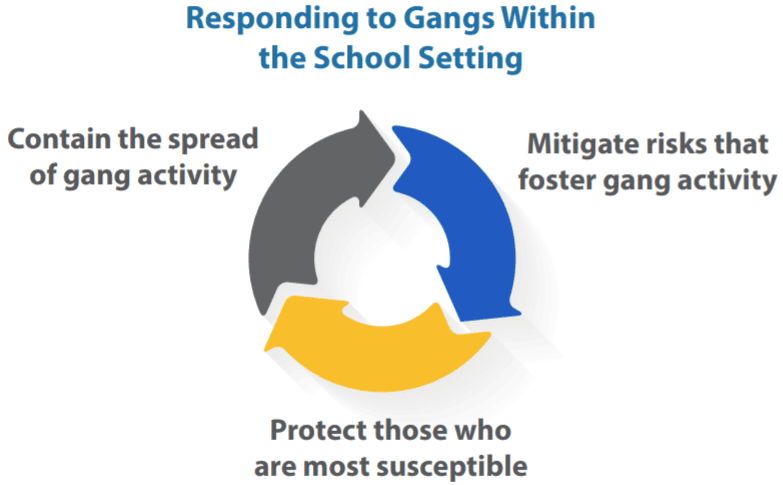
When it comes to schools, the OJJDP recommends three key proactive strategies: prevention, intervention and suppression. It’s these that we will now explore further.

Image Source: National Gang Center report

Prevention strategies:

As with other crimes, the most important strategy to adopt when it comes to youth violence at schools must be steps to prevent such incidents from occurring altogether. Per the OJJDP-National Gang Center report, here are some prevention practices that schools can follow:

  • Consult with local law enforcement to bring in subject matter experts to provide ongoing gang awareness and education for teachers, school personnel, and parents and guardians. As with any training, this should be periodically reviewed, updated and reinforced
  • Provide opportunities to develop relationships between law enforcement officers and students as early as possible, preferably in elementary schools. Bonding and positive relationships with law enforcement officers can influence student choices in the future
  • Implement the evidence-based Gang Resistance Education And Training (G.R.E.A.T.) Program, taught by law enforcement officers in the communities and schools they serve, for fourth through seventh grades
  • Refer parents to the Parents’ Guide to Gangs brochure found on the National Gang Center Website. It provides tips on what to look for and how to respond
  • Utilize mentors who are experienced in working with this population as an added support for students who are at risk of joining gangs
  • Provide alternative activities and after-school programing; include law enforcement programs such as the Police Athletic League (PAL)
  • Develop a safe-passage-to-school program for students who have to traverse rival gang territories to get to school
  • Develop community partnerships to support prevention activities

Intervention strategies:

Despite best efforts from everyone involved, a few students may exhibit some level of engagement in gang-related activities. What kind of gang “disengagement” strategies can schools adopt then to help these students (and to keep others from potential harm)?

  • Per the report, the school can convene a team of administrators, teachers, school-based counselors, mental health specialists, resource officers, outside law enforcement, vetted gang intervention specialists, and representatives from agencies that have responsibilities for gang involved youth (for instance, probation and parole). Everyone has a different perspective and can contribute his or her own professional expertise. The team can focus on the most difficult gang-involved students by collectively monitoring their behaviors and by providing case management, referral to services in and out of the school environment, and constant follow-up
  • Have a plan for confronting/addressing students involved in gang-related activities. The report reminds schools to always consider the safety of its students and staff while drawing up this plan
  • Get to know those students who are suspected of gang involvement. Determine each student’s level of involvement and commitment as a member or associate (For example, is the student deep in the gang, or does the student have a loose affiliation with gang members?). This will assist in determining the best individual approach to use. When it comes to such students, the report also recommends that schools track and document their behaviors and progress at school; address concerns of behavior, grades, and attendance; and utilize existing school supports for academic and behavioral issues. It also recommends that schools involve these students’ parents/guardians early and consistently; and be proactive with parents, and allow them to be a part of the solution instead of the problem
  • Establish a rapport with these students; sometimes this is as simple as providing intervention techniques such as mentoring, academic support, and a system of wraparound support services to help students disengage from gang involvement. Sometimes, it may require justice system intervention
  • Be consistent with discipline; hold youth accountable for infractions. Balance consistent discipline and accountability with positive support
  • Use conflict-resolution strategies and other restorative justice practices demonstrated to be effective with gang-involved youth

Suppression strategies:

These are basically strategies that focus on proactive measures to mitigate many of the factors that can contribute to disruptive gang-related behaviors that can pose a threat to the learning environment and the safety and well-being of others. Per the report, they could include:

  • Review district policy and ensure that there is sound policy specific to addressing gang-related incidents
  • Ensure that law enforcement is notified and aware once a student is identified as gang-involved (as a member or associate)
  • Document and follow up on gang-related incidents
  • All school personnel should be consistent with all students in enforcing discipline and consequences for school infractions
  • Use random safety checks by police and school administration to prevent drugs and weapons from getting into campus
  • Practice site security drills to include lockdown procedures
  • Document graffiti, notify law enforcement, and remove immediately. Graffiti tells a story, which can help law enforcement determine whether a threat or incident is about to occur
  • Confiscate gang paraphernalia, and address the matter with students and parents

In the next part of this mini series on youth violence, Biometrica will explore what parents can do to help.

Global Conference Calls For More Protection From Cryptocurrency Crime

By a Biometrica staffer

A two-day global online virtual assets conference — co-organized by INTERPOL, Europol, and the Basel Institute on Governance — concluded with a call to action on better protecting the world’s financial systems by increasing multi-sector cooperation to strengthen cryptocurrency crime investigations.

Discussions at the conference highlighted the fast-evolving fields of decentralized finance and non-fungible tokens (NFTs), regulatory developments affecting anti-money laundering compliance, crypto-enabled fraud and the possibilities that governments have to recover illicit assets even if they are virtual.

With blockchain, bitcoin and other virtual currencies permitting swift, anonymous financial transfers to anywhere in the world, delegates focused on developing law enforcement tools, skillsets, knowledge and resources to prevent such technologies being used to launder illegally gained assets, a Europol statement said.

“Cryptocurrencies are changing the landscape of the criminal underworld, and we need to work together to prevent virtual assets from becoming safe havens for illegal financial transactions,” Ilana de Wild, INTERPOL’s Director of Organized and Emerging Crime said in that statement.

Just last week, Biometrica examined one aspect of money laundering: money mules. In that piece we established that money muling is more complex than the average financial crime. Unlike other crimes where individuals get involved in illegal activities knowing what they’re about to do is wrong, regular people can be unknowingly recruited into a criminal operation via money muling.

Victims of money muling scams are often solicited online by criminals, making it another aspect of the recent spike in cyber attacks and scams that the world has been dealing with.

However, on the other hand, cryptocurrencies can also prove to be a valuable tool for law enforcement and for promoting transparency in finance globally. Digital tokens can be used by regulators, investigators, banks and even nonbank financial institutions (NBFIs) like casinos, or in other words, by anyone who like having an immutable audit trail. Cryptocurrencies were not made for the “bad guys,” but like any other tool, whether good or bad depends on the intentions of the user who wields it.

The 5th Global Conference on Criminal Finances and Cryptocurrencies, hosted virtually betwen Dec. 7-8, brought together over 3,000 people from law enforcement, public and private sectors, policy institutions and academia from 130 countries under a virtual roof to explore trends, strategies and tactics in tackling crimes involving virtual assets.

Day two of the conference was restricted to law enforcement circles and saw speakers sharing their experiences in national and regional cryptocurrency investigations, demonstrating new methodologies for exploring criminal flows and operations in dark markets and decentralized money laundering scams. The fundamental importance of a clear, harmonized regulatory global framework to prevent money laundering was also emphasized.

The conferences closed with the endorsement of a set of recommendations to strengthen skillsets, improve knowledge, boost expertise and encourage best practices for improved illegal assets investigations. The annual event is organized by the Working Group on Criminal Finances and Cryptocurrencies, a tripartite initiative of the Basel Institute on Governance, INTERPOL and Europol established in 2016.

How ‘Red Flag Laws’ Could Stop Shootings Before They Happen

By a Biometrica staffer

Earlier this year, in April, eight people were killed by a 19-year-old at a FedEx facility in Indiana. The shooter’s mother had reported to police over a year earlier, in March 2020, that her son had confided to her that he would attempt “suicide by cop.” As a result, CNN reported at the time of the shooting, a shotgun found at his home was seized, but the eventual shooter was still allowed to legally purchase the assault rifles he would use to carry out his rampage only four months later.

When this detail emerged, it raised questions about whether background checks were completed and how the shooter had accessed those firearms.

One of the most crucial background checks that are run in the U.S. on a daily basis is the kind conducted when someone applies to buy a firearm from a licensed salespoint. Under current law, however, such a background check would only throw up a warning if the person has a relevant criminal record. The system would not catch anyone who has made threats of harming themselves or others, if not for red flag laws.

Extreme risk laws, also known colloquially as “red flag laws,” allow state-level courts to prohibit gun sales or ownership to those who are deemed to be a danger to themselves or to society. According to Everytown for Gun Safety, the gun control group, red flag laws close a “gap” in the current system, which only restricts a person from accessing a firearm if they have been convicted of certain crimes, deemed mentally ill, or subjected to a final domestic violence restraining order.

They work in similar ways to search and arrest warrants, in that police or family members have to present sufficient and relevant evidence to a judge that the individual poses an immediate risk, after which the judge will make a decision. As long as the order is in effect, the person cannot buy or possess firearms, and any that they already own will be confiscated temporarily by law enforcement during the order period.

But why are they so important?

It is because shooters — those who target schools in particular —  tend to telegraph their actions before carrying out a mass casualty attack, as we wrote last month. For instance, reporting since the Nov. 30 shooting at Oxford High School in Michigan has revealed that there were warning signs that may have been missed by teachers and the alleged shooter’s parents in the lead-up to the massacre. 

Connecticut was the first state in the U.S. to enact a red flag law, over two decades ago. Michael Lawlor, the man who helped write that law, told CNN that these laws can be effective tools to get guns out of the hands of risky people in an urgent situation, but rarely have provisions that make it difficult for the individual to buy a gun at a later date. He added that officers in the Indiana FedEx case should have filed a petition with a court to designate the person as “having a violent propensity or mental instability.” This likely would have prevented the shooter from going out and buying those assault rifles later. In Lawler’s opinion, local law enforcement are often not sure how best to use red flag laws. Not only do police have to be trained, those within the legal system, like prosecutors and judges, too have to become intimately familiar with the law.

Currently, 19 states and the District of Columbia have red flag laws in place, most of which were enacted after the 2018 Marjory Stoneman Douglas High School shooting in Parkland, Florida. Recently, the FBI reached a settlement (reportedly worth $127.5 million) with the families of victims and survivors of that attack.

According to the suit, the FBI received a tip that Nikolas Cruz — the man who would eventually plead guilty to the shooting — had bought guns and planned to carry out a school shooting. That information was lost in the system and was never forwarded to the Miami field office. If it had been, agents might have discovered that Cruz “had been expelled a year earlier and had a long history of emotional and behavioral problems.” 

The states that currently have red flag laws are:

  • California
  • Colorado
  • Connecticut
  • Delaware
  • Florida
  • Hawaii
  • Illinois
  • Indiana
  • Maryland
  • Massachusetts
  • Nevada
  • New Jersey
  • New Mexico
  • New York
  • Oregon
  • Rhode Island
  • Vermont
  • Virginia
  • Washington

One of the key difficulties in assessing the efficacy of red flag laws is that we have no way of quantifying how many shootings were actually thwarted because of them. They are also not infallible. As the New York Times pointed out, a gunman was still able to access guns and carry out the shooting at Sandy Hook Elementary School in December 2012 in Connecticut, despite the fact that some said he had shown warning signs beforehand.

Where they are effective is in helping reduce suicides, most of which include firearms and which are the most common ways that guns kill Americans. Research has repeatedly shown that having access to a gun increases suicide risks and that just removing a gun temporarily from a person who is suicidal can cut that risk significantly. Red flag laws are more likely to help such people and their loved ones than to prevent mass casualty shootings.

Violence Against Women Office Awards Grants To 11 Indian Tribal Governments

By a Biometrica staffer

On Wednesday, Dec. 8, the Justice Department’s Office on Violence Against Women (OVW) announced awards to 11 Indian Tribal governments to support them in exercising special domestic violence criminal jurisdiction (SDVCJ). The Violence Against Women Reauthorization Act of 2013 (VAWA 2013) recognized the authority of tribes to exercise SDVCJ over certain defendants, regardless of their Indian or non-Indian status, who commit crimes of domestic violence or dating violence or violate certain protection orders in Indian country.

In July, Biometrica’s Aara Ramesh wrote that the Supreme Court’s unanimous affirmation of the right of tribal law enforcement officers to detain non-Native people who they reasonably suspect to have been involved in a crime on Native land. That affirmation breathed life into the VAWA, which is still pending in front of Congress, but might better protect Indigenous women too. Why is that critical?

Only yesterday, Dec. 8, for example, we wrote about how gender-based violence still disproportionally affects women and girls globally, particularly intimate partner violence or violence perpetrated by family members/relatives according to a research report published by the United Nations Office on Drugs and Crime (UNODC). The data on violence committed against women is shocking. Per that same UNODC report, on average, a woman or girl is killed by someone in her own family every 11 minutes across the world.

When it comes to the U.S., the situation is worse for Native American women. It is widely acknowledged that the incidence of violence experienced by them is much higher than that of other races. Tribal authorities, however, find themselves hamstrung when it comes to punishing violence perpetrated against Native women due to the jurisdictional complexities associated with investigating and prosecuting serious violent crimes committed against Native communities on Native lands by people of other races.

“We heard from tribal leaders that they need access to funds to support the day-to-day costs of SDVCJ, and I’m pleased to announce OVW is issuing eleven awards to implementing tribes to defray these costs,” OVW Principal Deputy Director Allison Randall said in a statement on Wednesday.

OVW’s Tribal Jurisdiction Program was authorized under VAWA 2013 and supports tribes with jurisdiction over Indian country in exercising SDVCJ, the DOJ’s statement said. Tribal Jurisdiction Program funds may be used to strengthen tribal criminal justice systems, provide indigent criminal defense, conduct jury trials and provide services and applicable rights to crime victims.

Costs could include, but are not necessarily limited to, incarceration costs (including medical care) for non-Indian SDVCJ defendants, trial costs for SDVCJ cases, defense counsel costs, costs associated with empaneling a jury for an SDVCJ trial, batterer’s intervention or other pre- or post-conviction supervision or programming costs and related training and technical assistance.

The recipients of Wednesday’s one-year awards under OVW’s Tribal Jurisdiction Program are:

– Chickasaw Nation, Oklahoma
– Eastern Band of Cherokee Indians, North Carolina
– Fort Peck Assiniboine and Sioux Tribes, Montana
– Muscogee (Creek) Nation, Oklahoma
– Nottawaseppi Huron Band of the Potawatomi, Michigan
– Pascua Yaqui Tribe, Arizona
– Port Gamble S’klallam Tribe, Washington
– Pueblo of Santa Clara, New Mexico
– Seminole Nation of Oklahoma
– Cherokee Nation of Oklahoma
– Tulalip Tribes of Washington

The Legislation That Could Solve The Trucker Shortage By Recruiting Older Teens

By a Biometrica staffer

The trucking industry is currently in the midst of a well-publicized driver shortage crisis, which has combined with other factors to exacerbate a supply chain crisis in the U.S. This has prompted some to advocate for a radical shift — allowing young adults between 18 and 21 to apply for commercial driver’s licenses and transport cargo all across the country. Current federal law says that anyone below the age of 21 cannot transport goods across state lines, even though 49 states and the District of Columbia issue commercial driver’s licenses to 18-year-olds (New York is the exception).

According to experts, the trucking industry is “80,000 drivers short of where it needs to be to meet demand projections.” The average age for truckers is around 46 years old, meaning that many are reaching the age of retirement. Unless the industry recruits young people and establishes a steady replacement rate, there is a chance the shortage could worsen, with trucking companies left to fill vacancies and hire over 1 million new drivers over the next ten years.

In line with this, U.S. Senators Todd Young (R–Ind.) and Jon Tester (D–Mont.) in March this year reintroduced the Developing Responsible Individuals for a Vibrant Economy Act (or the DRIVE Safe Act) into Congress. Under the bill, the Department of Transportation would be directed to create an “apprenticeship program” that would help bring more commercial motor vehicle drivers under the age of 21 into the labor market and would allow them to participate in interstate commerce.

The bill mandates that an apprentice complete two probationary periods that include a total of 400 hours on duty, 240 of which “must be driving time in a commercial motor vehicle.” During the period, the apprentice will have to have an experienced commercial vehicle driver in the cab with them. A similar program already exists for military truck drivers.

The biggest concern of opponents to such measures is that of road safety, as statistics have repeatedly shown that teenage drivers tend to be more reckless than adult drivers, and tend to get into more accidents.

The DRIVE Safe Act takes some steps to address this by requiring companies to install safety technology such as active braking collision mitigation systems, video event capturing systems, and a speed governor set at or below 65 miles per hour in the vehicles that will be used by apprentices in the program. Additionally, no one under 21 who is not a part of the program will be allowed to operate a commercial motor vehicle. These training provisions in fact “exceed those for over-21 drivers, potentially making these drivers better trained,” one source says.

For decades now, some in the industry have been saying that the inability to recruit out of high school means that the crucial trucking industry loses potential employees to other “blue-collar” industries like construction and manufacturing. Said American Trucking Associations (ATA) vice president Dave Osiecki in 2015: “We all know the 18- to 21-year-old period is a time where we lose kids coming out of high school that don’t go to college but go to trade schools and into construction and other competing industries.”

Advocates for the Act notched a major victory in President Joe Biden’s infrastructure deal, which was just signed into law a few weeks ago. The provision inside the infrastructure bill establishes the apprenticeship program that the DRIVE Safe Act calls for, requiring Transportation Secretary Pete Buttigieg to set up the program by Jan. 14 of next year. The program is scheduled to last only until 2024, but in that period could certify as many as 25,000 young adults, allowing them to join the trucking workforce much earlier than they otherwise would have been able to. 

There are other contentious measures being debated when it comes to easing the trucker shortage. At the heart of most of these issues, too, is the matter of road safety. One timely discussion ongoing is to do with the federal government’s Covid-19 vaccine mandate for any business that has more than 100 employees.

Separately, some companies have been lobbying since the Obama administration for relaxed driver rest requirements, especially in times of emergency. Currently, the Department of Transportation says that truckers can work only 11 hours in a day and 70 hours a week, with at least one 30-minute break in the first eight hours of their shift. 

Trucking remains one of the industries most pivotal in the U.S. economy, with the industry’s responsibility only having grown since the advent of Covid-19 and shifting consumption patterns that are seeing more people shopping online than ever before. In 2020, it was estimated the industry had 3.36 million employees, 6.8% lower than the 3.5 million noted in 2019. The Bureau of Labor Statistics says the median pay in 2020 was $47,130 per year. It is estimated that long-distance truckers drive around 125,000 miles per year and spend an average of 300 days a year on the road.