Tech Support : support@safience.io

Blog

More Than 1,000 Assaults On Officers In Jan. 6 Capitol Siege: Prosecutors

By a Biometrica staffer

Approximately 1,000 assaults occurred on federal officers during the Jan 6 Capitol insurrection, prosecutors recently said. A court filing highlighted that they had uploaded 2,900 videos from bodycams worn by police, with a total length of around 2,300 hours, The Hill reported.

Federal officers said that there was a lot more relevant footage available, and as many as 7,000 hours of footage could be uploaded in the coming weeks. Over 570 people have been arrested in connection with the Jan. 6 insurrection, in which a mob attempted to violently disrupt the certification of the 2020 election. The Department of Justice has said that 175 individuals have already been charged with assaulting, resisting, or impeding officers.

“Based on a review of the body-worn-camera footage conducted by our Office, the footage displays approximately 1,000 events that may be characterized as assaults on federal officers,” wrote Emily Miller, an assistant U.S. attorney and the Capitol Breach Discovery Coordinator.

Further, the Associated Press has reported that extremist groups, including the Proud Boys and Oath Keepers, have made plans to attend a rally at the Capitol around Sept. 18 to protest the prosecutions that have resulted from January’s riot.

This has led officials to consider whether a larger perimeter fence is needed around the Capitol, as had been done in the aftermath of the January insurrection. The final decision on the fence will be taken by the Police Board.

“After January 6, we made Department-wide changes to the way we gather and share intelligence internally and externally. I am confident the work we are doing now will make sure our officers have what they need to keep everyone safe,” said Capitol Police Chief Tom Manger. He added that officials were “closely monitoring September 18 and we are planning accordingly.”

While planning for the Sept. 18 event is underway, investigations into the January insurrection are moving forward on different fronts. A House committee investigation into the siege has asked telecommunications and social media companies to preserve any communications from Jan. 6 that may have happened between those involved in the violence.

While the committee has not yet asked for these communications, it requested companies to confidentially preserve them for the moment, just in case. A total of 35 technology companies fall under the umbrella of the requests made.

The request included the “content of communications, including all emails, voice messages, text or SMS/MMS messages, videos, photographs, direct messages, address books, contact lists, and other files or other data communications.”

The Federal Bureau of Investigation has also released fresh video of the incident, seeking the public’s help in identifying the individuals captured on camera, a measure that has yielded success with other alleged rioters.

“The FBI is grateful for the tips we have received from the public over the past seven months about violence at the U.S. Capitol on January 6, and we continue to request the public’s help to identify individuals suspected of assaulting members of the media that day,” said Steven M. D’Antuono, Assistant Director in Charge of the FBI’s Washington Field Office.

A History Of The Slot Machine: From Ancient Times To The Iconic Liberty Bell

By a Biometrica staffer

Slot machines are considered to be among the most lucrative games on the casino floor for both players and the house. It was just on Friday, Aug. 27 that we wrote about casinos in Nevada raking in a total of $1.36 billion from patrons in July, the highest single-month revenue from gaming for the state since gambling was legalized back in 1931. One of the main reasons behind this record haul was slot machines. Slots generated more than $873.6 million this July, a 60% increase from the same month in the previous year.

There’s no doubt that slots have become ubiquitous over the years, but the origins of this gambling invention can be traced back to places outside the casino and gaming world. Slot machines as we’ve come to recognize them today go back to the late 19th century, to a time when the earliest prototype of the machines were, in reality, mere novelties. In this first of a two-part history of the slot machine, we take you through its earliest annals, starting with a quick visit to ancient times and ending with the 1950s.

From Roman Egypt To The 20th Century

The invention of the slot machine is closely connected to another mechanical invention: the vending machine. And the first vending machine was invented during ancient times — but the reasons for its invention could not have been more dramatically different than modern times, perhaps naturally so. The world’s first vending machine is thought to have been invented during the 1st century A.D. in Roman Egypt.

It was created by the Roman mathematician and engineer Hero of Alexandria. The purpose was to dispense only a certain amount of holy water, so that the people of the city didn’t take too much of it from the temple. Hero’s device actually allowed people to drop coins into a slot, which, in turn, pushed down a bar to release only a certain amount of holy water so that everyone would get their fair share. From a fundamental perspective, Hero’s ancient vending machine is definitely similar to the vending machines of today, too.

From there, vending machines in the 17th century made their ways to England’s pubs. In early 1600s England, a smaller version of the vending machine was created to dispense sales of tobacco and snuff. While the mechanism of the device itself did not prevent customers from helping themselves to more than they’d paid for, the boxes were usually placed in a prominent position in a pub so that the inn-keeper could keep a close eye.

It was this coin-operated mechanism that further evolved in the 20th century into automatic vending machines, and from there on to coin-operated gambling devices. These early prototypes involved, for instance, a machine that had two toy horses that would race after a coin was inserted into the machine. It ended up being more of a novelty, though, rather than a direct gambling device since patrons could not bet or gamble on the device itself. Instead, these machines would be placed on a bar in a saloon or a similar establishment, and attracted wagering between patrons.

Wagers between patrons in this era would also not necessarily involve money. When it comes to most such machines in the 20th century, the proprietor would pay off winning customers in drinks, cigars, or trade checks that could be exchanged for refreshments. By the end of the 1800s, though, machines that actually paid patrons in coins came into existence. In the very first such machines that were created, coins that were inserted basically dropped onto an internal balance scale, where they may cause it to tip and spill other coins out. Devices that came a bit later had a circular display and a spinning indicator that came to rest on or pointed to a number, color, or picture.

We have to interrupt our story about the slot machine here to say that it was around this time that the coin-operated mechanism was used to create another iconic machine: the jukebox.

Charles Fey & Liberty Bell

A precursor to the modern-day slot machine was created by the company Sittman and Pitt in Brooklyn, New York, according to a San Francisco News report. The machine was incredibly rudimentary, though, and was based on poker. It used five drums with a total of 50 card faces. Players would have to spin the game’s five drums to create a poker hand combination and notch a win. The game proved popular but it was complicated for operators due to the vast number of possible wins, making an automated payout difficult to implement.

That’s when Charles Fey came into the picture. In the modern sense, the first slot machines were invented by this Bavarian-born American inventor. There are doubts about when Fey created his first machine, though. Some accounts say it was created in 1894, while others say it was between 1887-1895. Either way, the credit for bringing the slot machines into the modern era goes to Fey. But he didn’t really set out with a long-held ambition of creating such a device.

Fey had 15 older siblings and, at the age of 14, he began to help out his family, but also feared being drafted into the German army. That, combined with growing tensions between him and his father, led to Fey going to France to work as an instrument maker. Meanwhile, his uncle had made his way to New Jersey in America and so, at the age of 23, Fey decided to join his uncle. Before traveling to New Jersey, though, Fey went to San Francisco and found employment at Electric Works. He and a co-worker then started a company that competed with their employer. It was while working in his own business that he invented the slot machine.

It was roughly in 1898 that Fey built the Card Bell, the first three-reel slot machine with automatic payouts instead of the prevalent five-reel ones of the time. The Card Bell had a handle that set the reels in motion when it was pushed down and playing card suitmarks that lined up to form poker hands. Fey’s machines typically used familiar symbols: diamonds, hearts, spades. In 1899, he created a machine that had two additional symbols: horseshoes and a Liberty Bell and, thus, was born the iconic Liberty Bell slot machine.

On the Liberty Bell machines, if three bells lined up in a row, it signaled the top payout. Tragically, because of the 1906 San Francisco earthquake, only four of the over 100 Liberty Bell machines built by Fey have survived. The Liberty Bell was so popular among saloon patrons in San Francisco that it was quickly copied by Fey’s competitors, like the Mills Novelty Company of Chicago. But by the time San Francisco banned slot machines in 1909, there were said to be more than 3,000 machines in existence. In a bid to circumvent the law, Fey and his competitors went back to the older methods of building machines without coin slots, switching payouts to other surreptitious methods, perhaps through drinks and cigars.

Eventually, because of San Francisco’s ban, most slot machine factories moved, and a huge number of them ended up in Chicago.

From Bells To Fruits In The 21st Century

In the early 1900s, with legal bans still in place on gambling and slot machines, operators devised another way to make their machines acceptable. This was allegedly first done by the Industry Novelty Company in around 1909 by using symbols of fruits on the reels. The fruit symbols were suggestive of various flavors of chewing gum. A few machines that were built then actually did dispense gum.

Industry Novelty’s idea was then copied by the Mills Novelty Company. The Mills Novelty Company also invented the jackpot in around 1916, making certain combinations of the symbols regurgitate all the coins in the machine. In the 1920s, slot machines were popular throughout much of the country. They continued to be popular into the Great Depression years. But with organized crime often controlling the distribution of slot machines, their sales, transportation, and use was once again restricted to private social clubs. Prohibition outside Nevada, which had re-legalized gambling in 1931, was virtually total by 1951. In the 1950s, electromechanical slot machines allowed many new payout schemes, such as 3- and 5-coin multipliers, where the sizes of the payouts are proportional to the number of coins inserted before the handle is pulled.

It was only after World War II that these machines ended up being used at a global level, as governments were attracted to the prospect of tax revenue. In 1988, for instance, slot machines were permitted in French casinos, ending a 50-year ban.

What happened once governments discovered it could be used to generate more in tax revenue? That’s a story for another day, in the second part of our mini series on the slot machine.


2020 Was A Banner Year For People Pointing Lasers At Pilots In Airborne Aircrafts

By a Biometrica staffer

The number of instances of individuals pointing lasers at pilots of aircrafts were at a record high, NBC reported recently. In 2020, the Federal Aviation Administration (FAA) reported 6,852 laser attacks, the most for any year since 2016. This is especially significant since air traffic was low last year thanks to disruptions caused by the Covid-19 pandemic.

The most attacks were reported in the states of California, Texas, and Florida and were most likely to occur on Friday or Saturday nights. The motivation for people using handheld lasers to target pilots is unclear and the practice attracts criminal charges and a $11,000 fine. Already, $120,000 worth of fines have been levied in this regard this year alone, the FAA says.

Earlier this month, Roger Floyd Hendricks of Rincon, Georgia, was sentenced to 18 months in prison after pleading guilty to pointing lasers at airplanes approaching Savannah-Hilton Head International Airport, WTOC reported. This was a result of a Feb. 2020 investigation conducted by the FAA and the Federal Bureau of Investigations (FBI). There had been three reported instances of lasers being pointed at pilots landing at the Savannah-Hilton Head International Airport, and in one of them the pilot was able to help pinpoint the location of origin of the laser. In May, Hendricks pled guilty to the laser attack.

“Hendricks needlessly threatened the safety of the passengers and crew of a commercial aircraft. It is important for the public to understand that pointing any laser, even a small one, at an aircraft can obscure the pilot’s view and jeopardize the safe operations of the aircraft,” said Chris Hacker, Special Agent in Charge of FBI Atlanta in a statement. “Hopefully this sentencing will send a message that the FBI will not tolerate those engaging in this dangerous behavior and that they will be aggressively investigated and prosecuted to the full extent of the law.”

Earlier, in January 2020, Charlie Chapman Jr. was arrested for pointing lasers at pilots at Sarasota-Bradenton International Airport. In this instance, the pilots were flying Cessna Skyhawk planes while practicing takeoffs and landings, the Washington Post reported. 

Later on the same night, a pilot of a United Airbus A320 reported a laser attack and police dispatched a helicopter to a warehouse yard near the airport. That helicopter pilot was also subjected to a laser attack before Chapman Jr. was apprehended. Chapman Jr. was charged with aggravated assault on an officer, pointing a laser at pilot with and without injury, and resisting arrest without violence.

But what exactly makes lasers so deadly?

“Our nightmare scenario here is getting a pilot – either one or two pilots, however many there are in the cockpit – so flash-blinded that he or she can’t land the airplane, can’t even see to fly it,” ABC’s aviation consultant and airplane pilot John Nance said in 2015. “You wouldn’t think of a little green laser as having the power to bring down an airplane full of people, but if you get the eyes of pilots flash-blinded at the wrong moment, you can do that – and you could end up killing 400 people.”

This year has been a particularly challenging one for professionals working in the aviation sector and the threats have not all been external.

So far in 2021, the FAA has recorded 3,900 incidents of unruly passenger behaviour, a massive leap from the 150 to 200 cases reported in an average year. This included 2,867 cases involving refusals to comply with the federal mask mandate on planes, NBC News reported. The 34 most serious cases are facing more than $500,000 in fines, taking the 2021 tally of fines handed out past the $1 million mark.

Aviation psychologist Erin Bowen said that the increase in incidences of unruly behaviour could be traced to the Covid-19 situation, which clearly made airport experiences and flying stressful.

“Before you step on the plan you have people who are already anxious,” Bowen told the Dallas Morning News. “You’ve got all these factors coming together, including the airport experience, which is designed to dehumanize and augment stress.”

Hate Crime Reports In 2020 Soared To Highest Level In Over A Decade: FBI Data

By a Biometrica staffer

The number of hate crime incidents reported in 2020 were the highest it’s been in more than a decade, the Federal Bureau of Investigation’s (FBI) 2020 Hate Crime Statistics data, published on Monday, Aug. 30, showed, CBS News reported. In 2020, there were 7,759 hate crime incidents reported in total. That’s a more than 6% increase from 2019 and the highest number of such incidents recorded since 2008. In 2008, there were 7,783 incidents in total, the CBS report adds.

Before 2020’s data was published, 2019 held the record for the year with the highest level of reported hate crime incidents.

There were 7,554 single-bias hate incidents involving 10,528 victims reported to the FBI in 2020. An additional 205 incidents fueled by multiple biases and involving 333 victims were also recorded in the total count. The FBI relies on information that is voluntarily reported by local law enforcement agencies for its Hate Crimes Statistics report. In 2020, the Bureau said it received data from 15,136 law enforcement agencies out of 18,623. However, some advocates say hate crimes are under-reported and that the FBI’s data only accounts for a portion of actual incidents.

Of the total reported incidents, 61.9% of victims were targeted because of the offenders’ race/ethnicity/ancestry bias. Of the remainder:

  • 20.5% were victimized because of the offenders’ sexual-orientation bias
  • 13.4% were targeted because of the offenders’ religious bias
  • 2.5% were targeted because of the offenders’ gender identity bias
  • 1% were victimized because of the offenders’ disability bias
  • 0.7% were victimized because of the offenders’ gender bias

Of the 7,426 hate crime offenses classified as crimes against persons in 2020:

  •  53.4% were for intimidation
  • 27.6% were for simple assault
  • 18.1% were for aggravated assault
  • 22 murders and 19 rapes were reported as hate crimes
  • The remaining 27 hate crime offenses were reported under the category “other”

Of the 2,913 hate crime offenses classified as crimes against property, most (76.4%) were acts of destruction/damage/vandalism. Robbery, burglary, larceny-theft, motor vehicle theft, arson, and other offenses accounted for the remaining 23.6% of crimes against property.

“Last year saw a 6.1% increase in hate crime reports, and in particular, hate crimes motivated by race, ethnicity and ancestry, and by gender identity. These numbers confirm what we have already seen and heard from communities, advocates and law enforcement agencies around the country. And these numbers do not account for the many hate crimes that go unreported,” Attorney General Merrick B. Garland said in a statement.

Image Source: Screengrab from the FBI’s 2020 Hate Crime Statistics press release

Anti-Black And Anti-Asian Prejudice

The number of incidents nationwide against people belonging to the Asian and Black communities rose sharply in 2020, with reported hate crime incidents targeting the former up by a steep 70% when compared with 2019.

The number of hate crime incidents reported that were anti-Black or African American in nature soared nearly 40% in 2020 to 2,755. Those 2,755 incidents, in turn, account for over 35% of the total hate crime incident reports for 2020. In 2019, anti-Black or African American hate crime incidents reported made up around 27% of the total hate crime incidents reported.

“These statistics show a rise in hate crimes committed against Black and African-Americans, already the group most often victimized. Notably, they show a rise in hate crimes committed against members of the Asian-American Pacific Islander community. This also confirms what we have seen and heard through our work and from our partners,” Attorney General Garland said in the statement.

Earlier this month, Biometrica wrote about the increase in hate crime incidents targeting the Asian community.

In that piece, we reported that national coalition Stop AAPI Hate said it received 9,081 reports of hate incidents committed against the Asian American and Pacific Islander (AAPI) community since the Covid-19 pandemic began, i.e., between March 2020 and June 30, 2021. The total number of such incidents this year, at 4,533 through the first six months, appears poised to overtake last year’s entire total of 4,548 hate incidents that were reported to Stop AAPI Hate.

AAPI victims have faced everything from taunts to outright assaults after the pandemic began and the virus was first reported in China. It was a tenuous association between these two facts that led to people of AAPI descent being at the receiving end of hate. Lawmakers, activists, and community groups have pushed back against the wave of attacks, the Associated Press said in its report on the Stop AAPI Hate numbers.

There have been countless social media campaigns, bystander training sessions, and public rallies. The bipartisan Covid-19 Hate Crimes Act was signed into law by President Joe Biden in May, with the express aim of curtailing a dramatic rise in hate crimes against the AAPI community.

Even in June, we wrote about how reports of hate crime events and offenses in California were at a 12-year high, characterized by particularly pronounced anti-Black and anti-Asian prejudice. According to that data, reports of overall bias-related events increased 31% in 2020, up to 1,330 from 2019’s 1,015. The last time it was this high was in 2008, when 1,397 events were reported. 

When it comes to religious bias, Jewish Americans remain the community most often targeted even per the new 2020 numbers. The community appeared to be particularly under attack during mid-2020, likely as a fallout of the violence that had broken out between Israel and Hamas in May.

“These hate crimes and other bias-related incidents instill fear across entire communities and undermine the principles upon which our democracy stands. All people in this country should be able to live without fear of being attacked or harassed because of where they are from, what they look like, whom they love or how they worship,” Attorney General Garland said.

DEA, State Department Bump Up Reward For Chinese Kingpin Of Illicit Fentanyl Trade In US

By a Biometrica staffer

The U.S. Drug Enforcement Administration (DEA) has bumped up to $5 million the reward for information that might lead to the apprehension of Jian Zhang, a man believed to be a key figure in illegal fentanyl trafficking in the U.S.

Zhang, a citizen of the People’s Republic of China, is the owner of Zaron Bio-Tech in Shandong Province, China. In the past, he has used the internet to advertise the sale of illicit controlled substances, according to the DEA. Zhang produced and sold fentanyl and fentanyl analogues in the US and Canada, according to a 2017 federal indictment from the U.S. Attorney’s Office District of North Dakota.

An operation by the DEA and Homeland Security Investigations found that Zhang’s organization, from early 2013 on, sent thousands of orders of fentanyl, fentanyl analogues, other illicit drugs, pill presses, stamps, and dies used to shape fentanyl and fentanyl analogues into pills to customers in America through the mail or international parcel delivery services.

The consumption of these substances resulted in the overdose deaths of four individuals in North Dakota, Oregon, North Carolina, and New Jersey, as well as serious bodily injuries to five additional individuals.

“This investigation is an outstanding example of the commitment that DEA has to working with our domestic and international law enforcement partners to dismantle these drug trafficking organizations throughout the world, and emphasizes our dedication to keeping our communities safe and healthy,” said La Verne Hibbert, DEA Miami Field Division Acting Special Agent in Charge.

In Sept. 2017, Zhang, five Canadian citizens, two residents of Florida, and a resident of New Jersey were indicted for conspiracy to distribute fentanyl and fentanyl analogues in the U. S. The Centers for Disease Control & Prevention (CDC) estimated that in 2016 alone, 20,000 fatalities resulted from fentanyl consumption in the U. S.

The investigation conducted at the time revealed that fentanyl and fentanyl analogues were coming into the U. S. in numerous ways, including highly pure shipments of fentanyl from factories in China sent directly to U.S. customers who purchased it on the internet.

“This case began when local police officers responded to what has become an all-too familiar tragedy in the United States: the heroin and fentanyl overdose of two young adults, one who survived and another who did not,” said ICE Acting Deputy Director Edge back in 2017.

In 2018, the U.S. Department of the Treasury’s Office of Foreign Assets Control (OFAC) identified Zhang as a Significant Foreign Narcotics Trafficker pursuant to the Foreign Narcotics Kingpin Designation Act (Kingpin Act).

Penalties for violations of the Kingpin Act range from civil penalties of up to $1,466,485 per violation to more severe criminal penalties. The latter category for corporate officers may include up to 30 years in prison and fines of up to $5 million. Criminal fines for corporations may reach $10 million. 

As a result of Zhang being designated thus, any assets in which he or his organization had an interest in the United States or in the possession or control of U.S. persons were mandated by law to be blocked and reported to OFAC.

Zhang is not the first Chinese national to be indicted in fentanyl related cases. In 2017, federal grand juries in the Southern District of Mississippi and the District of North Dakota returned indictments against Xiaobing Yan, who operated websites selling acetyl fentanyl and other deadly fentanyl analogues directly to U.S. customers in multiple cities across the country.

Yan also operated at least two chemical plants in China that were capable of producing ton quantities of fentanyl and fentanyl analogues, Immigration and Customs Enforcement (ICE) said. Yan monitored legislation and law enforcement activities in the United States and China, modifying the chemical structure of the fentanyl analogues he produced to evade prosecution in the United States.

Fentanyl is one of the most profitable and deadliest narcotics, responsible for killing more people than heroin and prescription pills, because of the high risk of overdosing on the potent substance, Bloomberg reported. 

In July, the U.S. government reported that drug overdose deaths last year, in the midst of the Covid-19 pandemic, soared nearly 30% to a record number of around 93,000. That’s a massive spike from 2019’s 72,000 drug overdose deaths, provisional data for 2020 published by the Centers for Disease Control and Prevention (CDC) shows. Across the country, prescription painkillers once drove the drug overdose epidemic. But they were soon replaced, first by heroin and then by fentanyl, and in some states methamphetamine too.

A report by Congressional Research Service in Jan. 2021 found that fentanyl had killed more Americans in the preceding 12 months than any other opioid. The report also pressed China to impose domestic control on fentanyl analogues produced in the country for export.

Historically, more than $135m has been paid out by government agencies for information leading to the arrest and/or conviction of wanted criminals, the Department of State, said.

Drug Overdose Deaths: The Lethal Supply Behind A Worsening National Epidemic

By Deepti Govind

In July, the U.S. government reported that drug overdose deaths last year, in the midst of the Covid-19 pandemic, soared nearly 30% to a record number of around 93,000. That’s a massive spike from 2019’s 72,000 drug overdose deaths, provisional data for 2020 published by the Centers for Disease Control and Prevention (CDC) shows. The Substance Abuse and Mental Health Services Administration’s (SAMHSA) National Helpline corroborates that evidence. The helpline said it received 833,598 calls in 2020, a 27% increase from 2019.

Every state has reported a spike, or an increase, in overdose deaths or other problems during the pandemic, the American Medical Association (AMA) said in an issue brief published early August. All signs appear to be pointing to the fact that the country’s drug overdose epidemic is worsening.

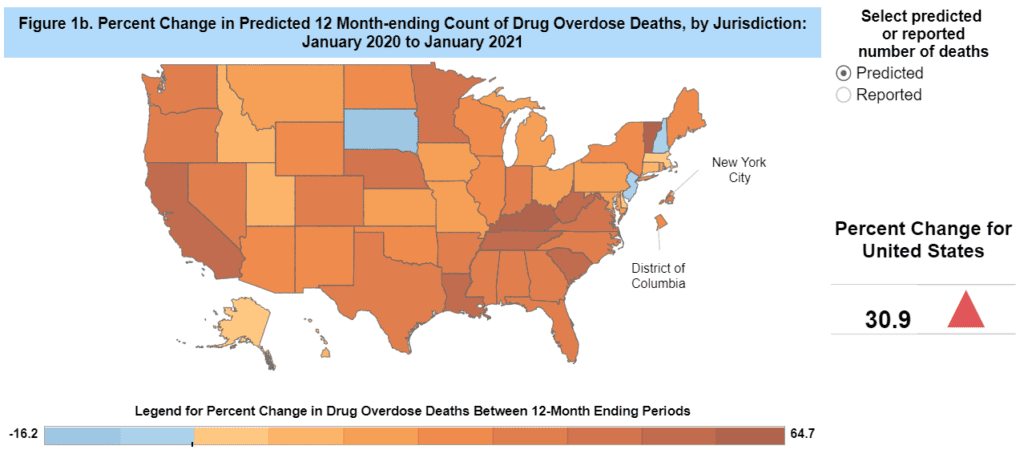
There were fewer than 7,200 total U.S. overdose deaths reported in 1970, when a heroin epidemic was raging in U.S. cities, per the CDC, the Associated Press said. There were about 9,000 in 1988, around the height of the crack epidemic. In 2020, though, drug overdoses increased in all but two states: New Hampshire and South Dakota. Kentucky’s overdose count rose 54% in 2020. There were also large increases in South Carolina, West Virginia, and California. Vermont had the largest percentage jump — about 58% — which was smaller in terms of actual numbers.

To be sure, just last Thursday, local media reported that drug overdose and alcohol-related deaths reached all-time highs in 2020 in New Mexico, a state that already has a history of struggling with some of the highest nationwide death rates for these addictions. In New Mexico alone, more than 43,000 people have died from drugs and alcohol abuse over the past 30 years, a report presented to the Legislative Finance Committee showed, according to local media.

In Kentucky, it is younger people who are increasingly becoming part of the tragic statistic. The state’s overdose fatality report showed that young Kentuckians experienced the highest increase in drug overdose deaths last year, local media in that state reported. There was an overall increase in mortality, across age groups, but what’s particularly worrying is that the overall deaths nearly doubled (i.e., a 90% increase) when it comes to those aged 15-24.

Even in state prisons and jails, overdose is one cause of death that has spiked dramatically, NPR said, based on analysis of data published by the Bureau of Justice Statistics (BJS) in July. Given the lag in BJS data — its latest numbers only go up to 2018 — its likely that the trend may have continued well into 2020, during Covid-19.

Meanwhile in New Mexico, things appear to be only getting more aggravated with a rise in cases of overdoses from drugs like fentanyl and methamphetamine.

Image Source: Screengrab from CDC’s National Center for Health Statistics‘ provisional data on drug overdose deaths

Poison In The Supply Chain

Fentanyl, in particular, is a dangerously powerful opioid that is sometimes misused by even mixing it with other drugs like heroin, methamphetamine, or cocaine to further increase its potency. It was developed to treat intense pain from ailments like cancer but is increasingly being sold illicitly. And it’s not just New Mexico that’s seeing a shift to drugs like fentanyl and methamphetamine. Across the country, prescription painkillers once drove the drug overdose epidemic. But they were soon replaced, first by heroin and then by fentanyl, and in some states methamphetamine too.

The Covid-19 pandemic worsened things by isolating those with drug addictions and by making treatment that much harder to get, with lockdowns and other restrictions in place through much of 2020. But, the real driving factor behind the surge is “an increasingly poisoned drug supply,” Shannon Monnat, an associate professor of sociology at Syracuse University who researches geographic patterns in overdoses told the Associated Press. “Nearly all of this increase is fentanyl contamination in some way. Heroin is contaminated. Cocaine is contaminated. Methamphetamine is contaminated,” Monnat added per the Associated Press article.

Even the AMA’s issue brief calls attention to the type of drugs in the supply chain. One prevailing theme is the fact that the epidemic now is driven by illicit fentanyl, fentanyl analogs, methamphetamine, and cocaine, often in combination or in adulterated forms, the AMA says. Overdoses related to prescription opioids and heroin remain high, with those drugs being increasingly adulterated with illicit fentanyl, it continues.

Added to the mix now is an increase in the supply of illicit benzodiazepine, a class of psychoactive drugs that are prescribed to treat conditions like anxiety, insomnia, and seizures. Benzodiazepine-involved overdose deaths had decreased during 2017–2019. But, from 2019 to 2020, benzodiazepine overdose visits per 100,000 emergency department visits increased (23.7%), both with (34.4%) and without (21.0%) opioid co-involvement, the CDC said in its Morbidity and Mortality Weekly Report last week.

Between April–June 2019 and April–June 2020, prescription and illicit benzodiazepine-involved overdose deaths increased 21.8% and 519.6%, respectively. During January–June 2020, 92.7% of benzodiazepine-involved deaths also involved opioids, and 66.7% involved illicitly manufactured fentanyls, the CDC adds.

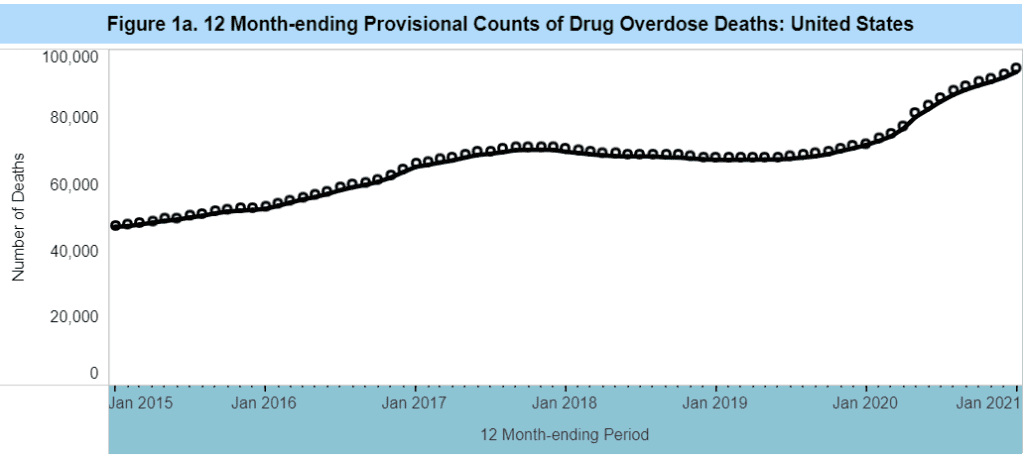
With the proliferation of fentanyl, some experts do not expect any substantial decline in drug overdose deaths this year either, the Associated Press report says. National figures are not yet available for 2021, but there is data emerging from some states that seems to support this pessimism. Rhode Island, for example, reported 34 overdose deaths in January and 37 in February — the most for those months in the state in at least five years. According to the CDC, there were 72,124 number of reported drug overdose deaths nationwide in the 12 months ending in January 2020. Provisional data for a similar period ending January 2021 shows 94,134 reported deaths.

“Every overdose death is tragic. It’s tragic because it’s seemingly preventable. It’s tragic because it almost always takes someone who is too young to die,” Mike Abrams is president and CEO of the Ohio Hospital Association wrote in an opinion piece on USA Today. His brother, Randy Abrams, died of a fentanyl overdose in March 2019. Mike Abrams’ opinion piece comes in the run up to International Overdose Awareness Day, which happens to be on Tuesday, Aug. 31.

Image Source: Screengrab from CDC’s National Center for Health Statistics‘ provisional data on drug overdose deaths

SAMHSA’s National Helpline: 1-800-662-HELP (4357) is a free, confidential, 24/7, 365-day-a-year treatment referral and information service (in English and Spanish) for individuals and families facing mental and/or substance use disorders.

You can also find additional resources on SAMHSA’s website here.

Hurricane Ida Lashes LA, Moves Along Energy-Critical Gulf Coast

By a Biometrica staffer

On Sunday, Aug. 29, the 16th anniversary of Hurricane Katrina, President Joe Biden declared a major disaster state in Louisiana as Hurricane Ida, a Category 4 hurricane with winds of up to 150 mph, made landfall in the state, leaving wreckage in its wake. The Federal Emergency Management Agency (FEMA) is already on-ground, helping local officials with their response.

There has been one death reported so far as a result of the storm, which began to move inland along the Gulf Coast, according to the National Hurricane Centre. President Biden has also spoken to governors of other Gulf Coast states and has coordinated with electric utilities companies, reports say.

“We’ve pre-positioned food, water, generators and other supplies in the area. Power restoration and mobile communications support teams are also en route,” President Biden said at a briefing with FEMA. “We’ve also closely coordinated with the electric utilities to restore power as soon as possible.”

More than 800,000 people across Louisiana are without power. City officials said that the only power in New Orleans was coming from generators. Aside from loss of life and damage to property, the energy sector is being severely affected by the hurricane.

Energy companies in the Gulf of Mexico slashed crude oil production by 91%, or 1.65 million barrels, according to the Interior Department’s Bureau of Safety and Environmental Enforcement, NBC said. The cuts were even more severe than those put in place ahead of Katrina, when 153 million barrels a day were taken offline.

At least 290 facilities were evacuated and 11 drill vessels were relocated so that they would not be in the path of the hurricane. The Louisiana Offshore Oil Port, the largest privately owned crude terminal in the country also stopped production ahead of the storm

Hospitals in Southern Louisiana, already struggling to deal with the caseload of patients as a result of the fourth surge of the Covid-19 pandemic, have been put under further pressure by Ida, Associated Press reported.

“All patients and staff are fine at this time without injury; although, our hospital has sustained significant damage,” Karen Collins, CEO of Lady of the Sea General Hospital in Lafourche Parish, near where Ida made landfall, said. 

More than 2,400 patients were in Louisiana hospitals as a result of Covid-19 and the state was “in a very dangerous place with our hospitals,” Gov. John Bel Edwards told Associated Press. “I hate to say it this way, but we have a lot of people on ventilators today and they don’t work without electricity,” he added.

Several hospitals in the region reported roof damage and partial disruption of generators. Hospitals had tested generators in advance and had back up fuel in place to last at least 10 days, officials said.

The impending arrival of Ida also forced casinos in the Gulf Coast region to close on Saturday, Aug. 28. Belle of Baton Rouge, the Hollywood Casino Baton Rouge, and L’Auberge Casino and Hotel, all riverboat casinos, had closed before the hurricane hit. Reports from various establishments detailed how storm surges were causing flooding, and how sandbags and tarps placed at entrances were not able to stem the flow.

FEMA, the point agency for the federal government, working with others who provide goods used in relief efforts, is expected to have a large volume of freight that needs to reach destinations in a timely and urgent manner. Relief efforts are counting on the trucking industry to take center stage and help move things forward, FreightWaves said. 

Already, the Federal Motor Carrier Safety Administration (FMCSA) issued a waiver of the “Hours of Service” rule for the six states of Alabama, Arkansas, Louisiana, Mississippi, Tennessee and Texas. The waiver was applicable to truck drivers “providing direct assistance supporting emergency relief efforts transportation supplies, goods, equipment and fuel” to the affected states, according to FreightWaves.

Congratulations, You’ve Won The Lottery… Scam?

By a Biometrica staffer

Winning the lottery is normally associated with excitement and happiness. And, let’s be honest, it’s something many of us have wished would happen to us and make us wealthier overnight. Yet, it’s wise to not let that dream cloud judgement, especially if someone calls you out of the blue and says you’ve won a sweepstakes, or lottery, or a prize… despite you never having bought a ticket or registered for one. Lottery and sweepstakes scams are some of the most common frauds that take place in the country. And sometimes, they can take a terribly dark turn.

Take for example, a lottery scam in a Texas suburb in 2019: A scammer promised a retired couple a fictitious payout if they continued to send him money for fees and taxes. While lottery scams typically end when the scammers get some money out of it, this one turned into a romance scam when the scammer’s constant calls created a bond between him and the 70-year-old woman, who may have been suffering from dementia. It didn’t end there either, though. The scammer “promised” the elderly woman a beautiful life together on the sandy beaches of Jamaica, where he was based. The catch? He demanded that the woman kill her husband, sell their home, and flee to Jamaica.

Luckily, that particular sinister scam was interrupted by an agent from the United States Postal Inspection Service, which had been monitoring a trail of cash making its way from the U.S. to the scammer in Jamaica and traced it to the couple in Texas. In this piece, we examine the warning signs of a lottery scam, how scammers normally try to con people using this kind of a scam, tips to identify real sweepstakes, and how to report lottery scams.

Warning Signs

As we mentioned earlier, scammers are also entirely aware that most everyone dreams of winning a lot of money. That gives plenty of room and chances for them to pull off a scam. But the good news is there are warning signs that you can look for to do your part to ensure you don’t get scammed.

Here are some key ones, according to the Federal Trade Commission (FTC) and a district Office of the Attorney General’s websites:

  • One of the biggest warning signs is that you are asked to pay money to get your prize. Genuine prizes are, by definition, free. So if someone tells you to pay a fee for “taxes,” “shipping and handling charges,” or “processing fees” to get your prize, you’re probably dealing with a scammer. If anyone asks you to pay by wiring money, sending cash, or paying with gift cards or cryptocurrency to get your prize, don’t do it. Scammers use these kind of payment methods more than others since it’s hard to track who the money went to and since it’s almost impossible to get your money back.
  • Another major sign is if the lottery or sweepstake involved says you need to pay to increase your odds of winning. That’s a definite no-no and is, in fact, illegal. Only a scammer will do that.
  • Do not give anyone your financial information. If someone says you need to give them these details to claim your prize, don’t. There’s no reason ever to give any stranger your bank account or credit card number, especially to claim a prize or a sweepstake. If they insist on this information, it could very well be a scam.
  • If you receive a notice or call from a person claiming to work with the federal government or a “Federal Sweepstakes Board,” be wary. The federal government does not oversee sweepstakes, and no federal government agency will contact you to ask for money in order to claim a prize.
  • Let’s say you did not enter a lottery, but you receive a notice or call from a person claiming to work for a Lottery and Charitable Games Control Board, or a similar entity, and they ask you for personal information. Do not divulge anything to them, as it may be a scam. Similarly, if you receive a notice or call informing you that you have won a lottery in another country — and one you have never been to or have no business in, especially — that’s most likely a scam too.

More On Scammers’ Modi Operandi

Scammers sometimes know just what to say to make sure people give them their money. Here are some ways in which they trick you into thinking you’ve won money, per the FTC:

  • They claim that they are from the government and try to look official. The government won’t call you to demand money so you can collect a prize.
  • They might pretend to be from well-known companies that run real sweepstakes, or use names of organizations you recognize. Always contact the real company directly to find out the truth.
  • Scammers may send you a message to get your personal information. You might be told that you won a gift card or a discount code to a local store. Or the message may say you won something expensive, like an iPad or a new car from your local dealership. Scammers hope you’ll respond with your personal information or click on links that can then take your personal information.
  • They may make it seem like you’re the only person who won a prize.
  • Scammers may also, as we said earlier, claim that you’ve won a foreign lottery, or even that you can buy tickets for one.
  • They pressure you to act “immediately,” by saying it’s a limited time offer that needs to be acted on right away.
  • Some scammers also send people a fake check, and ask you to send some of the money back.

Tips To Identify Genuine Prizes

On the contrary, there are some signs that can tell you a lottery or prize or sweepstake is real:

  • A real sweepstake is free and by chance, and won’t ask you to pay to buy something to enter, or to increase chances of your winning
  • If you sign up for a contest or a drawing, you’re likely to get promotional mail, telemarketing calls, or spam. You are not likely to get a random, out of the blue call just to say you’ve won big.
  • Sweepstakes that are genuine cannot claim you’re a winner unless you’ve actually won a prize, and if they send you a fake check in their mailing, it has to clearly say it’s non-negotiable and has no cash value.

Finally, what do you do if you actually got scammed and paid a scammer money under this type of a fraud? You can:

You can learn more about how to get your money back if you’ve been lottery scammed here.

Nevada Casinos Rake In Record Monthly Revenue Of $1.36B

By a Biometrica staffer

July was a bumper month for gaming in Nevada, with casinos taking a total of $1.36 billion from patrons. This was the highest single-month revenue from gaming for the state since gambling was legalized back in 1931.

The record haul was thanks in main to slot machines, the Nevada Gaming Control Board revealed. According to Casino.org slots generated more than $873.6 million, a 60% increase from the same month in the previous year.

Table games also did well, registering 131% increase for the month, year-on-year, taking in $486.2 million.

Among table games, Baccarat was the leader, bringing in $160.1 million. This was linked to the return of international travelers after the lifting of restrictions put in place by global governments to tackle the Covid-19 pandemic. Traditionally, Baccarat is a favored game among visitors from Asia.

There was also a 428.6% rise in revenue from sports betting pools, bringing in $33.3 million in July, in comparison to the same month in 2019. The volume of sports betting for July was $409.9 million, ensuring that both wins and volumes bet in July were records.

July was the fifth consecutive month in which Nevada took in earnings of at least $1 billion. July broke the $1.23 billion record set in May, earlier this year.

The only time a similar streak has ever occurred before was the period spanning December 2007 to April 2008, according to Michael Lawton, a senior research analyst with the Nevada Gaming Control Board.

“July was a perfect storm for gaming win in terms of special events (at Allegiant Stadium), the month having five weekends, Resorts World’s first full month of operations, and a very unusual baccarat month (high hold and increased play from international guests),” Lawton was quoted as saying by CDC Gaming. “This, of course, is in addition to the contributing factors we have discussed in previous months, which include demand, return of leisure travel, and healthy consumers due to stimulus.”

The state’s gains were typified by the earnings of the Las Vegas Strip, which received a major boost from the opening of Resorts World Las Vegas and Allegiant Stadium.

The two venues, and a host of others on the Strip, ensured that 3.3 million patrons accessed facilities in July, a record since the Covid-19 pandemic began.

The Strip accounted for $793.7 million in gaming revenue in July, a 46.5% increase from July 2019, when it was $541.8 million.

The July records were set before a government regulation came into place that mandated the compulsory wearing of masks at gaming locations, but operators believe that this will not significantly affect earnings in August and going forward.

The record high in July does not come as too much of a surprise as trackers had predicted that 2021 would be a good year for gaming. 

It was the easing of Covid-19 related restrictions, rising vaccination rates, an increasingly optimistic economic outlook, and, of course, pent-up consumer demand that helped the casino industry, American Gaming Association (AGA) said on Aug. 10, when it published its latest Commercial Gaming Revenue Tracker. 

Only recently, when data came in from across the country for revenues for April–June 2021, Biometrica reported that 17 of 25 states showed a rise in traditional gaming revenues for Q2 2021.

Particularly significant gains were made in New Orleans, which also enjoyed a prosperous July, with revenue at gambling establishments hitting $52.1 million, an increase of nearly 46% when compared to the same period last year.

Granted, the comparisons with last year were relatively easy given occupancy was capped at 50% in July 2020 during the early months of the Covid-19 pandemic, so as to stem the spread of the disease. The capacity restrictions have since been eased.

Even so, revenue numbers coming out of the casino and gaming industry this year have largely been strong, despite the renewed surge in Covid-19 cases, mostly of the more contagious delta variant. This shows that there is, probably, headroom for more growth ahead, depending on how the pandemic pans out.

President Biden Urges Industry CEOs To ‘Raise The Bar’ On Cybersecurity

By a Biometrica staffer

President Joe Biden met with chief executive officers (CEOs) from several companies including Apple, Google, and JP Morgan Chase at the White House on Wednesday, Aug. 25, and urged them to play their part in stepping up cybersecurity measures.

“The reality is most of our critical infrastructure is owned and operated by the private sector, and the federal government can’t meet this challenge alone,” Biden was quoted as saying by the Washington Post. “You have the power, capacity and responsibility, I believe, to raise the bar on cybersecurity. Ultimately we’ve got a lot of work to do.”

The summit was held, in part, to stress the challenges posed by cybersecurity threats in the context of national and economic security. The government announced that it would be working with the private sector to assess the security of existing software and to enable companies to build more secure technology in future.

“Summits like this are messaging opportunities more than policymaking opportunities,” said Emily Harding, a senior fellow at the Center for Strategic and International Studies. The summit is believed to be a stepping stone towards passing more effective legislation to deal with cybersecurity.

“We are in a cyberwar,” Hadi Partovi, CEO of Code.org, an education nonprofit, said. “Nobody’s declared war, but attacks are happening everyday. I felt optimistic that the set of folks who came together have a commitment to work together, whether it’s with government or their competitors.”

The summit comes on the back of major cybersecurity breaches that have affected the private sector and government agencies in the recent past. In a 2014 breach, JP Morgan revealed that more than 76 million households and 7 million small businesses were affected by an attack of its computer systems.

A recent Washington Post investigation also found that Apple’s iPhone technology was vulnerable to attacks by spyware from Israel’s NSO Group. Even more recently, T-Mobile was the victim of a data breach that left the personal information of 40 million people exposed.

At the summit, Microsoft committed to investing $20 billion over a five-year period to strengthen cybersecurity measures and Google announced it would be investing $10 billion over the same time frame towards the same cause, the Associated Press reported.

Just last month, we reported on how experts and lawmakers across the country were sounding the alarm over what seems to be a cyber free-for-all on American businesses, infrastructure systems, healthcare systems and industries. President Joe Biden brought the subject up with the Russian government, and various intelligence agencies have issued advisories on how to prepare for, prevent, and deal with cyberattacks. In July, the White House ramped up pressure on critical infrastructure companies to improve resilience against cyberattacks.

Earlier this month, Congress passed a bipartisan infrastructure bill that also included measures regulating the cryptocurrency industry. The bill was approved 69 to 30 in the Senate and is now pending before the House. Although a broad infrastructure bill, it included measures that impact cybersecurity.

The bill requires individuals and companies handling cryptocurrency to report gross proceeds to the Internal Revenue Service along with names and addresses of all those involved in transactions. This will enable the capture of billions of dollars of revenue from cryptocurrencies that are currently believed to be outside the tax net.

However, experts have warned that an unintentional consequence of more regulation of cryptocurrency could force illegal operators into markets where the U.S. has no jurisdiction or reach, thereby serving to exacerbate the threat to individuals, companies, and agencies.