Tech Support : support@safience.io

Blog

How To Dispose Of Unused Or Expired Medicines The Right Way

By a Biometrica staffer

In 2019, 9.7 million people misused prescription pain relievers, 4.9 million people misused prescription stimulants, and 5.9 million people misused prescription tranquilizers or sedatives. A majority of those misused prescription drugs were obtained from family and friends, often from the home medicine cabinet, the 2019 National Survey on Drug Use and Health found. These alarming numbers are part of a crucial public safety and public health issue, one that several organizations including the Drug Enforcement Administration (DEA), the Food and Drug Administration (FDA), and the Environmental Protection Agency (EPA), along with local law enforcement and pharmacies, strive to address.

Often, unused prescription drugs end up in the wrong hands, and can result in dangerous or tragic situations. The DEA says the good news is thousands of people from across the country are already safely and anonymously turning in a record amount of unused or expired prescription drugs. In this piece, we give you a broad overview of the various ways to dispose off unused or expired medicines while clearing out your medicine cabinet.

Take Back Sites

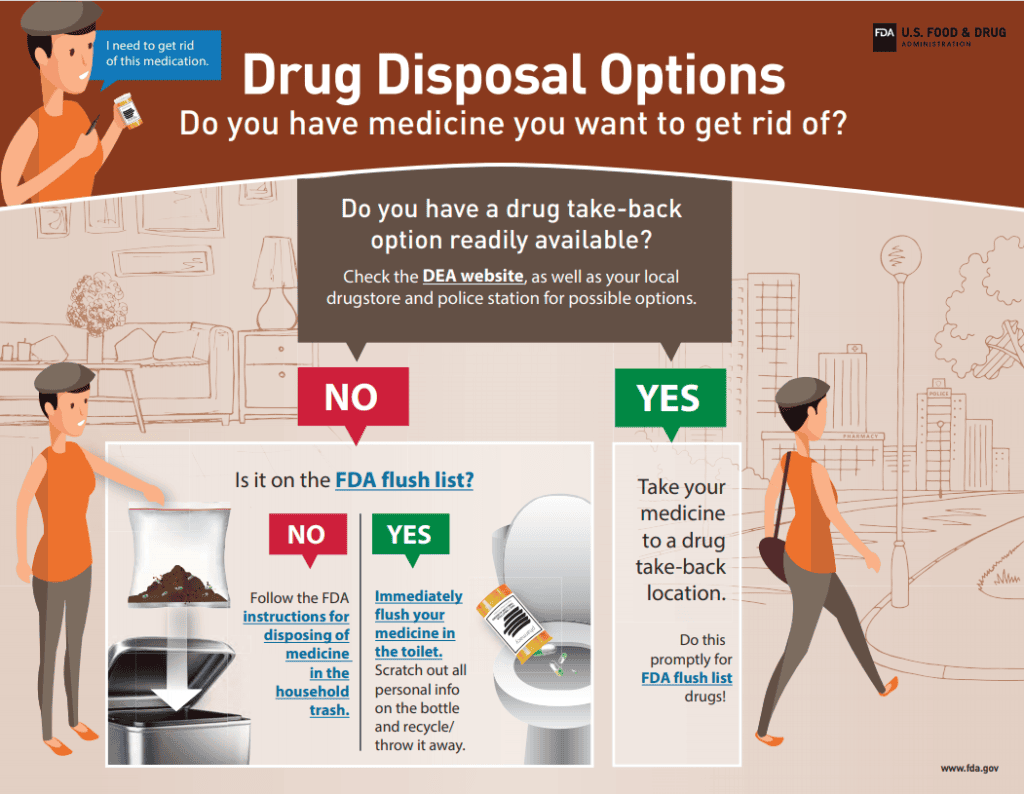
The best way, by far, to safely dispose of most types of unused or expired drugs is to take it to a “drug take-back site,” location, or program. This method applies to both prescription and non-prescription (for instance, over the counter) medicines. There are typically two types of take-back options:

  • Permanent collection sites: Some facilities and businesses are registered with the DEA to collect your unused or expired medicines. These collection sites safely and securely gather and dispose of your unused or expired medicines, including those that contain controlled substances. Some examples of authorized collection sites could be retail, hospital, or clinic pharmacies; and/or law enforcement facilities. They may offer onsite medicine drop-off boxes; mail-back programs; or other in-home disposal methods to assist you in safely disposing of your unused or expired medicines.
    You can find a location closest to you here, or call the DEA Diversion Control Division Registration Call Center at 1-800-882-9539 for more information.
  • Periodic take-back events like the DEA’s National Prescription Drug Take Back Day: During these events, temporary drug collection sites are set up in communities nationwide for safe disposal of prescription drugs. Local law enforcement agencies may also sponsor medicine take-back events in your community, and local waste management authorities could be contacted to learn about such events in your area.
Image Source: FDA’s Disposal of unused medicines page

The Flush List

Let’s say you cannot go to a drug take back site, or can’t find one near you, or missed a take back event in your area. What can you do then? There are ways to dispose of medicines the right way even at home.

The first step is to check if the particular medicine you are trying to dispose of is on the FDA’s Flush List. These are medicines that, for safety reasons, come with specific instructions to immediately flush down the toilet, but only if a drug take-back option is not readily available of course. What kind of medicines are on the Flush List? Those that are:

  • sought-after for their misuse and/or abuse potential
  • can result in death from one dose if inappropriately taken

If children, adults, or pets in your home accidentally or intentionally ingest, touch, misuse, or abuse a medicine on the Flush List, they can suffer serious consequences including death. An example of a medicine on the flush list is the fentanyl transdermal system (also known as a fentanyl patch), which contains an opioid.

In case there’s no drug take-back option, or you can’t get to one for some reason, flushing medicines on the Flush List helps keep everyone in your home safe by making sure these powerful and potentially dangerous medicines (when used inappropriately) are not accidentally or intentionally ingested, touched, misused, or abused, the FDA says. It’s equally important, however, to remember not to flush medicines that are not on the Flush List.

There are concerns that flushing down medicines at homes results in small levels of drugs possibly being found in surface water, such as rivers and lakes, and in drinking water supplies. The FDA and the EPA say they take the concerns of dispersing certain medicines into the environment seriously. But they have not yet found signs of environmental effects caused by flushing recommended drugs. In fact, the FDA says it published a paper to assess this concern, finding negligible risk of environmental effects caused by flushing recommended drugs.

Disposing Non-Flush List Medicines In The Trash

If the medicine you are trying to dispose of is not on the Flush List, does not come with any disposal instructions, and you don’t have/are unable to go to a drug take back site, what can you do?

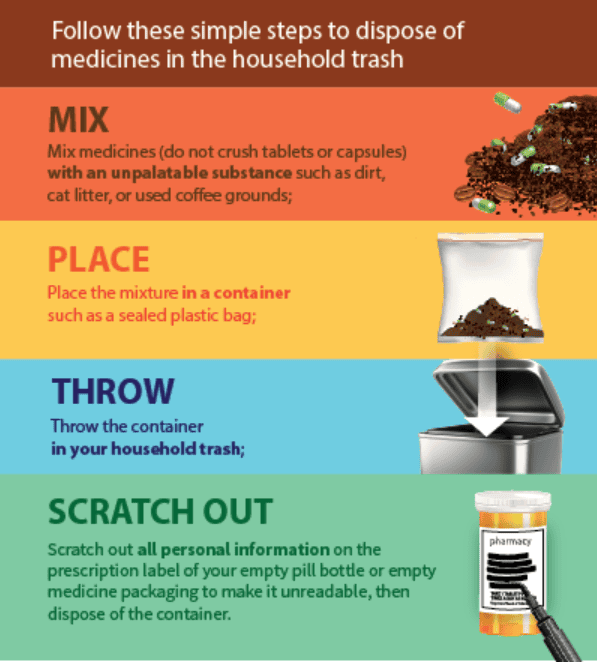
The FDA recommends following these steps:

  • Mix medicines (liquid or pills; do not crush tablets or capsules) with an unappealing substance such as dirt, cat litter, or used coffee grounds
  • Place the mixture in a container such as a sealed plastic bag
  • Throw away the container in your trash at home
  • Delete all personal information on the prescription label of empty medicine bottles or medicine packaging, then trash or recycle the empty bottle or packaging.

You can read the EPA’s guidelines to dispose of medicines at home in the proper manner here.

Image Source: FDA

Disposing Needles & Syringes

Finally, how does one correctly get rid of needles and syringes? The FDA recommends a two-step process:

  • Place all needles and other sharps in a sharps disposal container immediately after they have been used. Keep these containers out of reach of children and pets. Do not overfill a sharps disposal container as you will increase the risk of an accidental needle-stick injury. When the container is about three-quarters full, follow your community guidelines for getting rid of the container. Do not reuse sharps disposal containers.
  • Sharps disposal guidelines and programs vary depending on where you live. Check with your local trash removal services or health department to see which of the following disposal methods are available in your area. It could be drop boxes or supervised collection sites at places such as doctors’ offices, hospitals, pharmacies, health departments, medical waste facilities, and/or police and fire stations. You may be able to mail certain FDA-cleared sharps disposal containers to a collection site for proper disposal, usually for a fee. You could also use a household hazardous waste collection site, or your community may provide special waste pick-up services that send trained special waste handlers to collect sharps disposal containers from your home, usually for a fee.

For more information specific to your state, you can call Safe Needle Disposal at 1-800-643-1643 or e-mail info@safeneedledisposal.org. 

If you have further questions about safe drug disposal, you may be able to find answers in the FDA’s FAQ section here.

2020 Was Critical In The Evolution Of Islamic State And Al Qaeda, Particularly Online: Europol

By a Biometrica staffer

Two weeks ago, Europol published its third annual report on Online Jihadist Propaganda. One of the key findings of that report was that 2020 was a critical moment in the evolution of Islamic State and Al Qaeda and both jihadist terror groups had to adapt to shifting realities to survive and stay relevant. But, just because these terror groups had to deal with the same challenges as the rest of us in the year of the Covid-19 pandemic, it does not by any means indicate that the threats the world faces from them has shrunk. On the contrary, the risk of online jihadist propaganda being translated into offline violence remains high, Europol says in its report.

Propaganda from both Islamic State (IS) and Al Qaeda continues to call for lone actor attacks by individuals who have no physical connections to either group. Why does that matter? In another report published June, for instance, the Europol noted that the number of completed jihadist attacks in Europe (EU, Switzerland, and the UK) in 2020 more than doubled in comparison with the number in the EU (including the UK) in 2019. The one common factor between all the completed jihadist terror attacks was they were carried out by lone actors, while disrupted plots mainly involved multiple suspects.

Even in its June report, the Europol had repeatedly stressed that the Covid-19 pandemic altered just one key aspect of terrorists’ modi operandi, and that was a shift in much of the communication between members and supporters of these groups to online channels. In today’s piece, we examine some of the main findings of the Europol’s 2020 review of online jihadist terrorism — prepared by the European Counter Terrorism Centre’s European Union Internet Referral Unit (EU IRU) — when it comes to IS and Al Qaeda.

Islamic State’s 2020 In Brief

IS entered 2020 at a time when it was dealing with new leadership and rampant insurgent activity in its traditional heartlands, while also endeavoring to maintain its unparalleled global reach. The group is currently focused on attempting a resurgence in Iraq and expanding its international presence by further empowering its global network of affiliates. Online productions by the group showed a spike in activity in the self-proclaimed IS provinces of Diyala, Kirkuk, Anbar, North Baghdad and Salahuddin in Iraq.

The threat posed by IS still looms large as it continues to direct a dispersed network of affiliates that stand ready to answer its call, both online and offline, the Europol report says. The jihadist terror group’s new leader, Abu Ibrahim al-Hashimi al-Qurashi, appears to be even more elusive than his predecessor, the report adds. He is yet to appear in propaganda or to release an audio statement, and his vision for the group has been imparted by IS spokesperson Abu Hamza al-Qurashi, who has delivered three audio speeches in 2020.

In one of the audio speeches, the IS spokesperson stressed that while the group had been declared defeated by two U.S. presidents, it was in reality expanding to many new countries and regions. The group’s propaganda has highlighted the importance of Africa, in particular, to the overall IS ‘project.’ It capitalized on the military advances of affiliated local insurgencies in Africa to show it still can seize and retain territory.

Freeing of prisoners remained a matter of priority for IS. For instance, in late 2020 IS launched a new campaign called “Answer the call,” whose aim was to free Muslim prisoners worldwide. IS provinces around the world responded to that by launching a string of attacks against various targets. Notably, among those, was its Central Africa province. IS Central Africa fighters reportedly freed hundreds of prisoners following a raid on the Kangbayi prison in Beni, in the Democratic Republic of the Congo.

The jihadist group’s “Answer the call” media campaign was a “source of inspiration for IS supporters and supporting media outlets,” Europol says. Supporters used hashtags related to the campaign to disseminate their Supporter-Generated Content (SGC) productions on platforms like Telegram and others.

When it comes to its online presence, IS has been successful mainly because of its supporter (or munasir) networks. These have offset limited media production capabilities since its military defeat and territorial loss in Iraq and Syria, which, in turn, led to the loss of infrastructure and personnel. As a result, official IS propaganda continued to dwindle in 2020. 

The jihadist group’s online presence suffered a setback when EU Member States and Europol coordinated an action targeting its online networks in November 2019. The action dealt a blow to its highly organized propaganda distribution and authentication processes that characterized IS’s networks on Telegram, which has “provided a stable home for the group’s media arm since 2016,” Europol says. Since the action was undertaken, IS media outlets and its online supporters have tried to rebuild their networks on Telegram, while decentralizing their presence across multiple online platforms, including Rocket.Chat, Hoop Messenger, Tam Tam, Element (formerly Riot), and Conversations.im.

Lately, the group and its supporters have also ramped up their circumvention measures in a bid to regain digital ground on Telegram and other mainstream platforms. The disruption of its networks also led to a rebranding effect for IS, with supporters starting to dilute the IS brand image in favor of less recognizable textual and visual features to avoid detection. IS-aligned media outlets that specialize in cybersecurity, privacy, and encrypted communications remained committed to their mission of providing online security awareness to IS supporters. One media outlet even started a virtual weekly meeting to provide answers on technical and security-related questions.

How Al Qaeda Evolved In 2020

Al Qaeda, responsible for the 9/11 attacks, was a highly hierarchical, centralized organization, whose leadership exuded authority and projected a unity of purpose across its branches, the Europol report says. But nearly 20 years since 9/11, its overall strategy now involves devolving operational decision-making from the core to its regional affiliates while the overarching goals are still set by the group’s central leadership. It’s delegation strategy, though, has led to some of its affiliates acting independently to pursue their local interests, which at times may be even at odds with its guidance.

Through 2020, Al Qaeda had to deal with a series of blows and losses of significant leaders. That aside, it has been able to construct a new narrative around a rejection of brutality and a prohibition on killing innocent Muslims. The result? It has now portrayed itself as “less extremist” jihadist organization, in contrast with IS.

The action taken by EU Member States and Europol against IS in November 2019 had an impact on Al Qaeda’s online presence too. With IS adopting a multi-platform approach to propaganda dissemination, Al Qaeda had followed suit by expanding its presence too on alternative platforms. Official Al Qaeda and supporting media outlets boast of an active presence on Geo News, a self-hosted instance of the open source communication platform Rocket.Chat. The terrorist group also became early adopters of a new Twitter-like platform called Chirpwire.

Thabat News Agency, a media outlet, also surfaced in 2020 as one that reported on Al Qaeda and its affiliates’ battlefield operations. Combining “a sleek graphic style with savvy use of hashtags,” the media outlet gradually diversified its propaganda products to include a weekly magazine. The magazine, Europol says, appears to mimic IS’s al-Naba’ digital newsletter. Thabat News Agency also launched several versions of an Android app that was advertised as “the strongest and fastest jihadi news service.”

Even as IS and Al Qaeda fight to stay relevant, they are still on a collision course as their “rivalry is likely to further intensify and play out on the battlefield as well as online,” Europol says. AQ and IS continue to strive for online resilience and to show high levels of adaptability to online environments made more hostile by joint disruption efforts, it adds.

The latest point of contention between the two appears to be Al Qaeda’s perceived willingness to engage in negotiations with local governments of countries in which it has a presence, a leaf it appears to have taken from the Taliban’s playbook. Meanwhile, lightning-fast changes in Afghanistan with the rise of the Taliban are making President Joe Biden’s administration confront the prospect of a resurgent Al Qaeda, just when the U.S. is trying to stem violent extremism at home and cyberattacks from Russia and China.

You can access the full Europol report here.

The Indian Child Welfare Act: Why It Remains Crucial 43 Years On

By Deepti Govind

In the late 1960s, a New York-based attorney named Bertram Hirsch was sent to North Dakota to assist with a custody dispute case on behalf of the Spirit Lake Tribe. At that point, Hirsch was employed by the Association on American Indian Affairs (AAIA). He arrived at Devils Lake in 1967, originally under the impression that he was helping out in just one individual case: that of a Native grandmother who had lost custody of her six-year-old grandson. The grandmother had not been accused of abuse or neglect. Hirsch told Vox the only allegation against the grandmother was that “she was too old,” at 62 years to take care of her grandson. Hirsch and the Spirit Lake Tribe successfully fought that case, but it proved to be just the beginning of a longer saga.

The AAIA and Hirsch began to wonder how many other families may be going through something similar, and so began researching; first in North Dakota and then across the United States. The AAIA completed two studies on the subject, in 1969 and 1974, and unearthed some alarming statistics. They found that 25–35% of all Indian children had been separated from their families and placed in foster homes, adoptive homes, or institutions, a large number of whom even had living, able, and willing relatives to take them in. Of those placements, an overwhelming 90% were in non-Native (or non-Indian) homes. Thus, the Indian Child Welfare Act (ICWA) was enacted in 1978.

Another important historic fact that must be recalled at this point is America’s boarding schools for Indigenous children, a system that was very much active well into the 1960s. In June, Secretary Deb Haaland had announced that the Department of Interior (DOI), under the supervision of the Assistant Secretary for Indian Affairs, will conduct a thorough analysis of the records it kept between 1819 and 1969 relating to the residential school system, focusing, in particular, on cemeteries and potential burial sites.

Over the 150-plus-year lifespan of the residential school system, the DOI says that hundreds of thousands of children were taken from their families, though the exact numbers remain unclear. According to some estimates, by 1900, there were around 20,000 Indigenous children in boarding schools. A quarter of a century later, that number had virtually tripled, to around 60,000, with around roughly 83% of Indian school-age children attending boarding schools by 1926.

The ICWA, however, has also received its share of criticism, including from adoption advocates, and there have been several attempts to dismantle it in court. Why exactly was the ICWA created, why have some tried to get it repealed, and why is it still an all-crucial piece of legislation that protects not just the Native American way of life but also the sovereignty of tribes? We attempt to answer those questions in this piece.

Why The ICWA Was Passed

“For Native Americans, the fate of their continued existence as discrete cultures is inextricably intertwined with the future of their children and the viability of their extended family, clan, and tribal networks,” the National Criminal Justice Reference Service (NCJRS), whose content and services have since been moved to the Office of Justice Programs (OJP) website, said in a model guide on the ICWA, as part of a cultural and legal education program. As we mentioned earlier, in the late 1960s, research revealed that there was widespread unwarranted removal of Indian children from their homes.

Research by groups like the AAIA aside, Congressional studies and hearings were also conducted into the matter. Those found that failure to recognize tribal sovereignty, ignorance of Indian culture and child-rearing traditions, and the cultural biases of state court judges, attorneys, and social service personnel were directly responsible for the high removal rates of Indian children from their families and tribes. In fact, before Congress enacted ICWA, “some tribes faced certain extinction because non-Indian judges, attorneys; and social service personnel did not understand — and in many cases refused to recognize or give legal standing to — traditional Indian child-rearing roles and practices,” the NCJRS model guide says.

The ICWA was passed to address the “wholesale separation of Indian children from their families,” the Bureau of Indian Affairs (BIA) said in its FAQ on the Final Rule about the ICWA in 2016. The 2016 rule was passed to implement the original ICWA by incorporating child welfare best practices and to promote uniformity in State ICWA proceedings, while still considering the unique circumstances of each child. Congress recognized that it is in the best interest of the child to maintain tribal connections and that children are vital to tribes’ continued existence.

What Does The ICWA Do?

The ICWA governs state child custody proceedings in various ways. According to the Final Rule of 2016, some of them include:

  • By recognizing Tribal jurisdiction over decisions for their Indian children
  • By establishing minimum federal standards for the removal of Indian children from their families
  • By establishing preferences for placement of Indian children with extended family or other Tribal families
  • By instituting protections to ensure that birth parents’ voluntary relinquishments of their children are truly voluntary

It’s important to note that the ICWA does not prevent adoption of an Indian child to a non-Indian family. It provides procedures “for identifying an Indian child early on and involving the child’s Tribal nation in the process to ensure that everything has been done to keep the Indian family whole, and cultural connections intact,” the AAIA explains. Studies have shown that Indigenous children adopted to non-Indigenous families fair worse psychologically than white peers, and have higher rates of suicide, depression, and alcoholism, the AAIA continues. Involving the Tribal nation in the placement or adoption is crucial to provide culturally appropriate services to support the child and family.

“ICWA requires that: the state must inquire into the enrollment status of a Tribal child, provide Tribes and parents notice in child welfare proceedings, and ensure that Tribes are given the opportunity to intervene in the proceedings or transfer jurisdiction to the Tribal court. The party removing a child or terminating parental rights must provide active efforts to prevent the breakup of an Indian family and present testimony of a qualified expert witness supporting such a decision before placing an Indian child in foster care or terminating the parental rights over an Indian child,” AAIA says.

Challenges To The ICWA’s Constituionality

Per the AAIA, the ICWA is constantly being litigated, with state courts of appeal interpreting the law across the country at a rate of once every other day. Many tribes do not have the capacity to take on these matters, it adds. Much of the disagreement with ICWA stems from the fact that the law has not been understood well, according to many of its proponents. There’s still no data reporting requirements in place for the ICWA, and its compliance has been viewed as optional, some say. On the other hand, some adoption advocates and non-Indigenous foster and adoptive parents believe that it delays, or sometimes even derails, well-intentioned adoptions that they say could be in the best interest of the child involved.

The most recent, and well-known, attempt to repeal the constitutionality of the ICWA came in 2017. A 10-month-old Navajo and Cherokee boy was placed in the home of a white, evangelical couple in Fort Worth, Texas in 2016. He had been taken from his Navajo mother who left the reservation and was living in Texas as a result of her drug use. The foster couple, Jennifer and Chad Brackeen, wanted to adopt the boy but were hampered in their plans when, under the ICWA’s provisions, the Navajo tribe found a Native family unrelated to the boy to take him in.

That led to a lawsuit: Brackeen v. Bernhardt, which pit Texas, Indiana, Louisiana, and a coalition of conservative legal groups against the federal government, hundreds of Tribal nations, 21 states’ attorneys general, Native American civil rights groups, and child welfare organizations, a Pew Trusts article from 2019 said. The plaintiffs, who included several families interested in adopting Indigenous children and a non-Native biological parent who wanted her American Indian child to be adopted by a non-Native family, argued that the law is race-based and violates the Equal Protection Clause of the U.S. Constitution.

The Brackeens have since been allowed to formally adopt the boy after the plans to send him to another tribe fell through. But, on Aug. 9, 2019 the Fifth Circuit Court of Appeals upheld the constitutionality of the ICWA, overturning a 2018 decision issued by the Northern District Court of Texas in Brackeen v. Bernhardt. The district court had ruled that the ICWA and the related 2016 Final Rule were unconstitutional based on a conclusion that ICWA’s definition of “Indian Child” was a race-based classification subject to strict scrutiny review. 

Tribal nations and other defendants in the case countered that “Indian” is a political, rather than a racial, designation — a classification that the Supreme Court agreed with. In the 1974 case, Morton v. Mancari, the Supreme Court declared an employment preference for Indians in the Federal Bureau of Indian Affairs to be “political rather than racial in nature.” The Fifth Circuit Court of Appeals agreed and held that the definition of an “Indian Child” is a political classification.

But some say that the Fifth Circuit also chipped away at key provisions of the law, and that it could very well be reviewed by the Supreme Court.

Why The ICWA Still Matters To Indigenous People

Even today, nationwide, American Indian and Alaska Native children are placed into foster care at a rate 2.7 times greater than their proportion of the general population, the AAIA says. But this disproportionate representation is not happening because there are higher reports of abuse or neglect in American Indian communities. Those numbers are consistent, in fact, with other populations, the AAIA adds.

Then there is the fact that the ICWA was partially passed in response to the trauma of the family separation policy that saw tens of thousands of Indigenous children being taken away from their homes to boarding schools, as we mentioned earlier. Much of that “inter-generational impact” has not yet been fully assessed even, and is the reason behind Secretary Haaland announcing the “comprehensive review” of the residential school system. The system’s aim was to assimilate Indigenous children into white, Christian society, and dissuade them from practicing their traditions, languages, rituals, and cultures, which were seen as “barbaric” and “uncivilized.” 

Under the system, parents were not allowed to visit their children at these schools, Secretary Haaland detailed in June. Many students have reported suffering prolonged abuse and injury, and countless more were buried in unmarked graves when they died. Sometimes families were not even informed of a child’s passing and did not receive their remains. They were left without answers or closure, as they did not know their child’s final resting place, nor could they perform the rituals necessary in their belief system to bring closure and peace to the deceased.

There’s also limited understanding, even today, of the way the Native American family system works among the non-Indigenous communities. For instance, Indigenous communities place a lot of importance on the role an extended family plays in the upbringing of children. The term “grandmother,” as another example, is used to refer to not just older women who are actually related to a child by the typical definition of the term, but could be used to describe any elder female family member, and even some who may not be related to the child at all.

Proponents of the ICWA fear that overturning, or even diluting, it could end up putting more Indigenous children in foster care and, in turn, lead to many more being adopted out of their Native communities. Then there’s the fact that when it comes to Indigenous people, it is not a question of race, like we mentioned earlier too, but a matter of politics and of the United States’ obligation to protect Tribal nations.

As several Native American tribes responding to the Fifth Circuit verdict put it: “As we review the latest decision from the Fifth Circuit, our tribes remain committed to fighting for the Indian Child Welfare Act and ensuring that all of its provisions are upheld. While the decision is long, we are pleased to see the Court upheld important aspects of ICWA. We appreciate the law’s overwhelming support across the political spectrum and will consider all of our options to ensure we never go back to the days when Indian children were ripped away from their families and stripped of their heritage. It is deeply troubling that the attacks on this critical law continue, but we are prepared to continue our work to defend ICWA.”

Evictions May Cause Crime Spike; Communities Working To Disrupt Cycle Of Violence — A Quick Look At Crime And Firearms

By a Biometrica staffer

This past weekend, Chicago police noted six shooting-related deaths and at least 39 injuries in the city over the four-day period beginning in the evening of Friday, Aug. 20, and ending early in the morning on Monday, Aug. 23. Waking up to a litany of violent crimes and gun deaths every Monday morning has become a weary routine and surprisingly commonplace for many. 

The country, law enforcement, and elected officials have been grappling with a recent spike in gun-related offenses and violent crime, not all of which is attributable to the seasonal spike recorded every summer. The good news is that fresh research seems to suggest there has been a reduction in the rates of criminal offenses like robberies, residential burglaries, larceny, non-residential burglaries and drug offenses this year, compared to 2020.

However, a permanent reduction in such violent offenses is far from a reality, with that same study finding that although the growth in the homicide rate between the first and second quarter of 2021 slowed in comparison to the same time last year, the number of murders did actually still increase.

Much of the violence seems like it could be tied to easing of Covid-19 pandemic restrictions, as well as the financial and general societal instability many Americans are currently experiencing, as a result of the pandemic.

In fact, a sharp, unexpected spike in homicide rates in Los Angeles, after almost a decade of record-low rates, can be chalked up to the pandemic, new data suggests. There have been 239 murders reported in the city so far this year (as of Aug. 14, compared to 355 in 2020 and 256 in 2019. In fact, the murder rate in 2019 was one of the lowest the city has ever seen in the last five decades.

The upward trend began last year, when the homicide rate rose 34% — the largest increase in the figure in five years — and data so far this year shows that has only continued.

Experts have chalked up this nationwide rise in killings to “psychological strain and economic hardship” that resulted from the pandemic, while law enforcement officials say it could also be due to a forced release of inmates from jails and prisons to reduce overcrowding.

Meanwhile, a new study released by a research team at Rutgers University–Camden found a link between high evacuation rates in some Philadelphia neighborhoods and high rates of crime, homicide, and burglary. Dan Semenza, the professor behind the study, which looked at the eleven-year period between 2006 and 2016, says that evictions cause financial and medical turmoil for families, and “often drives them into worse conditions than where they were living before.” 

He added that destabilization caused by transience in a neighborhood affects the community at large, which in turn can drive up crime. Given the timeframe of the research, the study naturally did not consider Covid-19 and associated evictions, which Semenza said is likely to have had a compounding effect on the problem that his team had already noted before the pandemic hit.

He said, “With violent crime spiking in many cities, including Philadelphia, more evictions may cause further disruption on top of the already harmful effects of the pandemic.”

For context, the Centers for Disease Control and Prevention (CDC) instituted a federal moratorium nationwide on evictions last September,, to prevent overcrowding in public spaces and the spread of the virus. The policy expired on July 31, following which the Biden administration unilaterally renewed it until October, albeit while also limiting its applicability to areas deemed to have particularly high infection rates. 

Now, the matter is before the Supreme Court once again, after the justices ruled 5–4 in June to reject a landlords group’s bid to strike it down. At the time, however, they indicated that Congress would have to pass legislation to extend the moratorium, something that has not yet happened.

As federal, state, local, and Tribal governments work to pass legislation to address the gun violence epidemic, more communities around the country are doing what they can to mitigate violence in their surroundings.

For instance, this past weekend, on Saturday, Aug. 21, organizers in Roanoke held a gun buyback event, during which they collected 91 unwanted firearms and handed out $14,000 in grocery gift cards in return. Nineteen of the firearms were handed over by their owners without a gift card exchange.

The collection included rifles, revolvers, shotguns, and semi-automatic pistols. The plan is for each of the catalogued weapons to be destroyed. The event was co-sponsored by a number of local non-profits, as well as the city police and the Roanoke Gun Violence Prevention Commission. There have been over 40 people wounded or killed by gun violence so far this year in Roanoke.

On the other hand, community organizers in Connecticut scored a landmark win when Governor Ned Lamont officially signed into law a bill that would allow Medicaid funds to be used in addressing gun violence and other such crimes. The new law will allow cash-strapped community-based violence prevention services to apply for and receive state and federal Medicaid funds. These programs are typically based in hospitals and involve trained experts and professionals intervening in the aftermath of shootings to interrupt and disrupt the cycle of violence and retaliation from escalating.

The state recently also passed another piece of legislation aimed at curbing gun violence that will allow family members or medical professionals to apply for a “risk warrant” or “risk protection order,”  which would trigger off a law enforcement investigation into whether a given person in possession of a firearm or ammunition is a danger to themselves or others.

Biometrica has written extensively about the ongoing and worsening gun violence epidemic, ranging from the federal government’s initiatives targeting a reduction in such crimes and New York’s own plan, to bloody holiday weekends over the Fourth of July and the first-ever official Juneteenth celebration.

The Gaps That Insufficient Data Has Left In America’s Criminal Justice System

By a Biometrica staffer

Earlier this year, the Measures for Justice (MFJ) project released a comprehensive report that looked at data collection — or lack thereof — in the criminal justice system in 20 states across the country. What the organization found was a “staggering” and gaping chasm between the data needed to craft effective policy and what is actually available on the ground.

The MFJ report looked at over 1,200 counties with centralized data systems. The organization says its report is “the most complete measurement of state criminal court systems to date.” What it found was a distinct lack of information and gaps in the data available, which, in turn, has serious implications for policy-making and reform.

Some of the problems faced when trying to conduct research into the system, as detailed by MFJ, are incomplete, missing, or inconsistent data. This could even include handwriting that is impossible to read. Just as one example, the MFJ report says that in Alabama, “the fields reflecting bond amount and payment were missing for approximately 99% of cases.”

It is well known that the justice system in the U.S. is “sprawling.” A majority of experts also say its infrastructure and data architecture is “antiquated and crumbling.” Per some estimates, the average spending on criminal justice by states and the federal government has grown almost 400% over the last two decades, making it one of the largest line-items in any budget.

There is, however, little information on how that money is being used or what the most pressing needs are. People get lost in the system, and it is virtually impossible to track a case from inception to resolution. Sometimes, MFJ says, it can feel like venturing into a “landscape of unknowns.” As a result, the system is perceived as “opaque, impenetrable, and, in a way, immovable.”

Against this context, it is important to consider why collecting data effectively and transparently is important.

Earlier this year, we wrote about how the Federal Bureau of Investigations (FBI) was retiring the Summary Reporting System (SRS) after 90 years, replacing it with the National Incident-Based Reporting System (NIBRS). The new system is intended to “improve the overall quality of crime data collected by law enforcement,” and also collate more robust information about the arrests. In 2019, the FBI said it received data from 14,993 of the 18,671 law enforcement agencies in the country.

As of today, over halfway through 2021, however, the latest criminal data is still from 2019. In fact, the 2019 data was released nearly a full year later. This creates a policy lag and puts law enforcement, governments, and the criminal justice system as a whole on the back foot. Legislating on old data leaves the system one step behind. For instance, going off the 2019 data today would make the Covid-19 pandemic a total nonentity. Data, advocates say, has to be accessible in real-time to be truly useful.

The advantages of data-driven policy are well established and manifold. When it comes to policy that affects things like people’s access to healthcare, road safety, firearms regulations, policing, etc., it simply isn’t enough to trust one’s “gut” or go off intuition.

For policy to be truly effective and for us, as a society, to be able to truly establish whether a given policy has achieved its goals or is doing more harm than good, data is crucial. It is just as important when it comes to oversight, as well. Using data to drive policy can identify areas of dire need that may otherwise slip under the radar. 

The ways it can help include in response planning, as analyzing data allows law enforcement to understand which methods work best in which situations. It also enables crime prevention and risk assessment through trend and pattern identification, and enhances cross-border and inter-agency cooperation and collaboration.

Experts seem to agree that there is a need for objective data that could lead to “consistent and compelling” evidence about what policies are working and what aren’t. There are some politically controversial reforms like the elimination of cash bail that would benefit from having more data to understand what the best solution is in any case.

There are some statistics that are considered particularly vital when it comes to data collection in the criminal justice system. For instance, a breakdown of sex, gender, race, and age. This data needs to be collected across different stages of an individual moving through the system, from arrests and incarceration to pre-trial, post-bail, conviction, release, etc. Most times, not only is this data not made public due to legislation or administrative issues, the MFJ report says, but some districts don’t even collect the data.

All of this also builds to a highly worrying problem — a lack of transparency. This, in turn, severely complicates efforts to make effective and just policy, which also then makes it difficult to engender trust in the system and in any proposed reforms.

The MFJ report calls for more data to be made public and to foster quality research, within, of course, fundamental constitutional privacy and protection parameters. It says that such systems need to be implemented through legislation and that higher collection standards need to be enforced. The first step would be to conduct a comprehensive review of the data that each county or state does have so that the gaps can be identified.

The data must be accessible to communities and practitioners, both in terms of allowing them to collect it and allowing them to access and analyze it. This involves the whole system, from civil society, to police officers, prosecutors, and court personnel. It is only through this, MFJ says, that people can have faith in their justice system and the system itself can work for the greater good of the people it serves.

New Orleans Casino Revenue Soars 46% In July, Statewide Revenue Up 25%

By a Biometrica staffer

In July, revenue at gambling establishments in the New Orleans area hit $52.1 million, an increase of nearly 46% when compared to the same period last year. Revenue for all of Louisiana’s riverboat casinos, land casinos, and racinos was at almost $222 million last month, up nearly 25% from July 2020, according to data from the Louisiana Gaming Control Board.

When it comes to individual casinos, Harrah’s New Orleans was the big winner, with a whopping 98.1% increase in revenue from $13 million last July to $25.7 million in the same period this year, nola.com reported.

Granted, the comparisons with last year were relatively easy given occupancy was capped at 50% in July 2020 during the early months of the Covid-19 pandemic to stem the spread of the disease. The capacity restrictions have since been eased.

Even so, revenue numbers coming out of the casino and gaming industry this year have largely been strong, despite the new surge in Covid-19 cases, mostly of the more contagious delta variant. This shows that there is, probably, headroom for more growth ahead, depending on how the pandemic pans out.

In New Orleans, too, the number of visitors to the city has not yet fully rebounded, a spokeswoman for a tourism promotion organization called New Orleans & Company told the Associated Press. Louisiana has also been a “hot spot” of the new surge in infections, with hospitalizations repeatedly hitting record highs.

Earlier this month, the city also began mandating everyone who enters bars, restaurants, music clubs, and even the Superdome to show proof of vaccination or a recent negative coronavirus test. New Orleans also requires masks to be worn in stores and other indoor venues.

To be sure, there’s been positive news aplenty in the gaming and casino space, and not just in terms of commercial gaming. In Connecticut, the state’s two tribal casinos are showing a rebound in slot machine revenues due to an influx in visitors over the summer as restrictions due to Covid-19 eased, the Associated Press reported.

The state’s two tribal casinos, Mohegan Sun and Foxwoods Resort Casino, had closed for more than three months during the height of the pandemic. The two tribal casinos give the state of Connecticut 25% of their slot machine revenues. In July, Mohegan sent the state nearly $12.5 million while Foxwoods provided $9.1 million.

Tribal gaming revenue appears to be up sharply after the pandemic-led decline in Oklahoma, too, Tulsa World reported. At the first Oklahoma Indian Gaming Association (OIGA) conference held in two years, it was announced that the tribal gaming industry in Oklahoma generated a record-setting $167 million in revenue for the state the last fiscal year through exclusivity fees. 

Meanwhile, in Las Vegas, a four-story retail space located on two acres is soon going to be added to the Strip as tourists return, Casino.org said.

Over the last couple of weeks, the American Gaming Association (AGA) and various states have been releasing their casino and gaming revenue figures for April–June 2021. According to the AGA’s tracker, 17 out of 25 states saw a rise in traditional gaming revenue in Q2 2021, compared to the Q2 2019 pre-pandemic benchmark. In certain states, “spend levels remain well above pre-pandemic levels,” the AGA said.

Extortion Scams Targeting Families Who Share Missing Person Posts Are On The Rise

By a Biometrica staffer

The Federal Bureau of Investigation (FBI) issued a warning in May asking the public to be wary of scammers looking to extort family members of missing persons who share details on social media. The goal of these missing persons posts is, obviously, to crowdsource information and increase the chances of recovery. But, unfortunately, scammers are notorious for making use of any opportunity to rob people of their money, and a family that’s frantically looking for a missing member can be a vulnerable target.

There were 89,637 active missing person records in the National Crime Information Center’s (NCIC) Missing Person File as of Dec. 31, 2020, the FBI said in a report earlier this year. Juveniles under the age of 18 accounted for 34% of those records. If the definition of a juvenile is taken to mean those under the age of 21, then that ratio increases to 43%. In many of these cases, there may be a worried and anxious family member doing everything they can think of to help find their loved one.

In today’s digital era, the first step of that often involves sharing details of the missing person online across social media platforms. Many of us have probably seen such posts and stories shared on social media platforms, and most likely more than once.

When such posts are shared, a few unscrupulous individuals use it to gather information about the missing person, and research details of the disappearance and the missing person’s family. They obtain telephone numbers of the family members on social media and use third-party calling or messaging apps to call to make ransom demands. The demand usually ranges from $5,000 to $10,000, with $7,000 being a common amount, the FBI public service announcement says.

Generally, if it is a missing persons scam, there is no proof of life offered, according to the FBI’s investigations so far. But, in one instance, the Bureau said an accomplice of a fraudster made phone calls to family members claiming to be the missing person. The investigations also discovered that another aspect of the modi operandi of the missing persons scams was that the callers often claim the missing person is ill or injured, adding to the urgency of the situation and putting additional pressure on family members to pay the ransom.

For instance, in August 2020, a mother reported her 13-year-old daughter as missing. The family used social media to ask for assistance and posted a personal telephone number, which individuals claiming to have kidnapped the daughter used to contact the mother, demanding ransom. The girl had not been abducted and eventually returned home on her own.

Since the Covid-19 pandemic began, law enforcement has received several reports of scammers targeting families who have posted on social media about a missing family member, the FBI says. Although, to be sure, scammers used social media to identify victims even before the pandemic. What exacerbated the issue after Covid-19 hit was the stay-at-home orders and the general uncertainty caused by the pandemic, especially about the well-being of families. But this “trend” of scamming families of missing persons who post details on social media has been on the rise for the past three years now, the FBI added.

What, perhaps, is different when organizations like the National Center for Missing & Exploited Children (NCMEC) get involved and share photos of missing kids on their Twitter handle, website, and elsewhere, is that there’s nothing much for scammers to build on. They don’t have direct access to the family of the missing person, which they might if the family members themselves share a publicly viewable post on social media otherwise.

Does that mean families should not post details about missing members at all on social media? That’s not what we are saying. It is important from the perspective of the family’s mental well-being that they share missing persons posts and, of course, from a logical standpoint, the more the eyes on the ground, the better the chances of a recovery. Even the FBI’s warning only says it seeks to “increase awareness of criminal actor targeting schemes before families share details regarding a missing person on social media or social network platforms.”

That said, what can be done if you believe you or someone you know is the target or the victim of such an extortion attempt?

  • Step one has to be to report it to your local law enforcement agency or your local FBI field office (contact information can be found at www.fbi.gov)
  • You can also file a complaint online with the FBI’s Internet Crime Complaint Center at www.IC3.gov
  • The FBI encourages victims to keep all original documentation, emails, text messages, and logs of communication with the subject. Do not delete anything before law enforcement is able to review it
  • Also, ensure you tell law enforcement everything about the online encounters. It may be embarrassing as the parent or missing person, but it is necessary to find the offender
  • While reporting online scams, give law enforcement descriptive responses. The form should also contain:
    – Name and/or username of the subject
    – Email addresses and telephone numbers used by the subject
    – Websites used by the subject
    – Description of all interaction with the subject

Meanwhile, the pandemic has led to unexpected “trends” when it comes to missing children. In May, we reported about how after Covid-19, there appeared to be a rising trend of kids being abducted during vehicle thefts after being left alone in vehicles. At that point, NCMEC data showed that in 40 such cases an AMBER Alert was issued. The AMBER Alert Program is a voluntary partnership between broadcasters, transportation agencies, law enforcement, and the wireless industry to activate an urgent bulletin in the most serious child abduction cases.

The problem of missing persons worsens when it comes to people of color and Indigenous groups. In 2019, children of color made up more than 40% of all missing person reports in the U.S. More specifically, African American children accounted for almost 37% of all reports on missing children under the age of 18. President Joe Biden declared May 5, 2021, Missing and Murdered Indigenous Persons Awareness Day, calling attention to the “disproportionately high number of missing or murdered Indigenous people.” Several pieces of legislation have been enacted recently in an attempt to stem this crisis.

It’s important to note, in conclusion, that while law enforcement can find it extremely helpful to have as much information as possible when it comes to missing persons cases to conduct their investigations more efficiently, it is not required in order to receive assistance in the first place. Especially when it comes to missing kids, helping local law enforcement find them — and fast — is one of the FBI’s most important jobs. After all, these cases are sensitive in nature, and to paraphrase the FBI’s words, a missing person is never forgotten no matter how long they’ve been gone.

OK Indian Gaming Sends Record Fees To State; LA and NC Closer To Sports Betting Reality — An Industry Round-Up

By a Biometrica staffer

Over the last couple of weeks, the American Gaming Association (AGA) and various states have been releasing their casino and gaming revenue figures for April–June 2021. According to the AGA’s tracker, 17 out of 25 states saw a rise in traditional gaming revenue in Q2 2021, compared to the Q2 2019 pre-pandemic benchmark. In certain states, “spend levels remain well above pre-pandemic levels,” the AGA said.

In addition, 17 out of 25 states also set quarterly gaming revenue records last quarter. This included Indiana, Louisiana, Maryland, Missouri, Nevada, New York, Ohio, and Pennsylvania, all of which were among the top-ten highest-grossing states in all of 2019.

Here’s is a round-up of some of the latest news out of the gaming world.

Source: The American Gaming Association

At the first Oklahoma Indian Gaming Association (OIGA) conference held in two years, it was announced that the tribal gaming industry in Oklahoma generated a record-setting $167 million in revenue for the state the last fiscal year through exclusivity fees. 

Attendees considered this a strong indicator of the industry’s bounce-back after all tribal casinos in the state were forced to shut down last March due to the pandemic. Nearly every one of Oklahoma’s 39 tribes have some type of gaming facility, including bingo halls and full-fledged casinos with slot machines and table games. 

Between 2020 and 2021, the revenues earned by the state increased by more than 35%. The state’s tribal-owned casinos are a major source of revenue, both for the tribes and for the state, who rely on this money to provide essential services. Under the compact approved in 2004, the state takes a 4–6% cut of all revenue collected through machines, and a 10% cut from table games earnings.

Meanwhile, lawmakers and industry leaders in the state are also calling for the legalization of sports betting, arguing that right now Oklahoma is losing valuable dollars to neighbouring states, foreign entities, or to the black market. Matthew Morgan of the OIGA said that illegal betting is cutting off a source of revenue for the tribes. Currently, four states that border Oklahoma have legal sports betting in some avatar.

The Louisiana Gaming Control Board on Thursday, Aug. 19, approved emergency rules to kick-start sports betting in the state as early as mid-September, just in time for the latest NFL season to begin. Per these emergency rules, some of the state’s Big 20 riverboat and land-based casinos and racetracks will be allowed to start applying for licenses as early as next week, though it will likely take a few weeks for the applications to be approved.

The emergency measure was taken due to complaints from the state’s casino operators that they were losing out on revenue to neighboring Mississippi, where sports betting has been legal for two years now. 

Similarly, North Carolina also took a significant step in legalizing online and in-person wagers on professional, college, electronic, and amateur sports yesterday, Aug. 19. The State Senate passed SB 688 in a largely bipartisan 26–19 vote, and sent the bill to the House for approval.

Supporters say that the bill will bring in significant amounts of money that will be directed towards education and other social-benefit programs. Much like in other states, there is a feeling among lawmakers and casino operators that illegal gambling on sports is already occurring within the state, and that by legalizing sports betting, the state would be able to regulate the activity and direct resources to areas in dire need. Some estimates suggest that revenue from sports betting could be anywhere between $8 million and  $24 million annually.

Massachusetts’ two resort casinos and only slots parlor brought in $95.74 million in July, the state’s gaming commission announced this week. The revenue earned by the state from taxes and fees resulted in a record figure of $27 million. Industry watchers say that going off historic monthly averages, if the pace is maintained, the state could see as much as $259.5 million in average annual gaming revenue this year. Since 

Separately, after the Gaming Commission last month reported a tenfold increase in the number of complaints they were getting about the absence of poker in the state’s casinos, the MGM Springfield has announced that it will bring back poker to its floors by Q4 this year. 

Due to Covid-19 restrictions, last year the Commission had banned poker to limit the spread of the virus. Massachusetts casinos kept that ban in place after rules were eased earlier this year. MGM Springfield said, however, that their poker capacity will be reduced to around 10–12 tables instead of the previous 28, keeping the safety of patrons in mind.

Ban The Box — Balancing Incarceration And Re-Entry, With Public Safety And Child Protection

By a Biometrica staffer

In 1998, Hawai’i became the first U.S. state to pass a “Ban the Box” law. The law prohibited both public and private organizations from enquiring about a person’s criminal record in the early stages of the hiring process. Studies have shown that the measure has been successful in the years since, with some calling it “one of the nation’s most robust” Ban the Box laws.

A number of states, cities, and localities rushed to implement such laws in the aftermath of the Hawai’i decision. Currently, around 36 states and the District of Columbia have Ban the Box policies in place; in 14 of those, the law applies to private employers as well. But over the last few years, the discourse has centered around whether Ban the Box policies are actually effective or whether they might, in fact, be doing more harm than good.

In today’s piece, we take a look at the Ban the Box movement, what some of the arguments about it are, why it is important to allow formerly incarcerated people a shot at employment, and yet be cognizant of public and workplace safety.

Ban the Box laws, when thought out and implemented well, are effective in offering protection to employees and giving the formally incarcerated an opportunity for re-entry. However, background checks are essential for many reasons including public safety, workplace safety, child and vulnerable or at-risk adult protection, asset protection, employer liability and reputation, and also critical infrastructure protection in both the virtual and the physical world.

Can Ban the Box laws and background checks co-exist? Yes, they can, and can be used best with access to real-time data.

History Of Ban The Box

Usually, an employer — private or public — has the right to run a background check on a prospective or current employee. They generally tend to seek out the person’s signed, written permission to do so, to protect themselves against litigation.

Of particular concern to employers is a person’s criminal arrest or conviction record, mainly because there is a chance that if a formerly incarcerated individual commits a crime while on the job, the employer can be held legally responsible due to a reasonable belief that they should have known the history of the person they hired.

Companies may also be worried about what damage it might do to their public image if it is found out that they have hired an ex-prisoner. As public image is linked quite strongly to profit, this serves as a disincentivizing mechanism for them.

Ban the Box legislation was conceived to give all qualified individuals a fair shot at a job, based on their merits. The name of the campaign comes from the question frequently on job applications where a person has to tick a box if they have a criminal record. Banning the box does not stop an employer from enquiring about a criminal record; what it does is ensure that they cannot do so until a certain stage in the hiring process (what that stage is varies from state to state). Usually, these laws are only applicable to the public sector, though, as mentioned above, some states have extended it to the private sector.

It was also envisioned as a way to limit racial discrimination in hiring processes. Obviously, legally, an employer is not allowed to discriminate on the basis of race, gender, religion, etc. while hiring or in deciding who is subjected to a background check. Statistically, people of color have been incarcerated at a much higher rate than white people, meaning that a criminal record — no matter how minor the offense may have been — is more likely to disqualify a person of color rather than a white person.

In fact, some studies have shown that even with all factors except race being ceteris paribus, people with “white sounding names” on their resumes are more likely to get a call-back than those without. This is discounting criminal history, but even if that is included, researchers have found that black men without a criminal record are less likely to get a job interview than white men with a criminal record.

It is against this context that Ban the Box policies were first thought of.

However, some of this is already in existence and has been under the purview of the Equal Employment Opportunity Commission (EEOC). Anytime an individual’s background information is used to make an employment decision, state laws come into play, along with federal laws that protect applicants and employees from discrimination. Compliance includes making sure there is no discrimination based on race, color, national origin, sex, or religion; disability; genetic information (including family medical history); and age (40 or older). 

What does this mean? It means you cannot check criminal background for certain employees only, and everyone is entitled to be treated equally under the law, which the EEOC enforces. Do note that while the EEOC has no direct relevance to the use of criminal records in employment-related decisions, it enforces Title VII of the Civil Rights Act, which is what prohibits employment discrimination based on race, color, religion, sex, or national origin. 

Why It Matters 

The American phenomenon of mass incarceration is hardly unknown. What may be surprising to many is the sheer volume of Americans who have any kind of criminal record, be that an arrest or conviction. For instance:

  • Per the NAACP, over 2.2 million people are currently incarcerated in jails or prisons nationwide.
  • Historically, around 95% of those incarcerated are eventually let out of prison or jail. Per some estimates, around 600,000 people are released from prisons every year.
  • Around one in every 3 American adults have a criminal record of some kind. The NAACP says this is roughly equivalent to the number of Americans who have a four-year college degree.
  • Around 33–36.5 million American children have at least one parent with a criminal record of some kind.
  • Almost 50% of Black men and 40% of white men are arrested by the time they turn 23 years old.
  • People of color account for around 39% of the U.S. population, but make up around 60% of the population of federal and state prisons.

Before we look at what this means in terms of re-entry and Ban the Box, it’s important to mention that these statistics also underscore why background checks are crucial from a public safety, workplace safety, and children and vulnerable or at-risk adult safety perspective.

In order to truly understand why the Ban the Box movement began, it’s important to understand all the challenges that formerly incarcerated individuals face when they re-enter society. Possessing a criminal record limits what economic resources and support mechanisms a person has access to, including things like affordable or public housing, education, food assistance, and employment.

That last category is probably the most insurmountable and crucial one, experts say. The science seems to overwhelmingly indicate that the most effective way to keep someone out of prison once they’ve been released is by improving their access to a stable job.

It bodes well for society too, cutting down the economic burden the taxpayers would have to bear if someone gets re-incarcerated and boosting income and payroll tax revenue. The GDP loss the country sees due to people with criminal records not getting jobs can be anywhere between $78 to $87 billion a year, some economic experts suggest. There is also evidence that minimizing the risk of re-incarceration and recidivism can lower crime rates and reduce dependence on social welfare programs.

But the truth is that even if the formerly incarcerated person is motivated and eager to work, looking to turn their lives around, it is often impossible for them to find a job.

  • Per some estimates, the unemployment rate for formerly incarcerated people is over one in every four (27%).
  • Somewhere around two-thirds of all people with criminal records do not have a job a year after they are released, according to studies.
  • When they do have a job, it is usually low-paying, with few benefits, which impacts their ability to support themselves and their families, and increases their risk of recidivism. A simple $3/hour difference in wages two months after release could, in fact, double the risk of recidivism.
  • NAACP says that an existing criminal record reduces by half the likelihood of a person even getting a callback or job offer once they submit an application.

For many, a criminal record can be a factor that permanently disqualifies them from ever having economic security, stability, and mobility. Even if the offense is a minor marijuana possession charge or an arrest that does not lead to a conviction, if asked, a job applicant is obligated to reveal that to their potential employer.

That said, the EEOC does have guidelines on arrest records. Enforcement Guidance on the Consideration of Arrest and Conviction Records in Employment Decisions under Title VII of the Civil Rights Act states the following: “The fact of an arrest does not establish that criminal conduct has occurred, and an exclusion based on an arrest, in itself, is not job related and consistent with business necessity. However, an employer may make an employment decision based on the conduct underlying an arrest if the conduct makes the individual unfit for the position in question.”

What does that mean? Although an arrest record standing alone may not be used to deny an employment opportunity, an employer may make an employment decision based on the conduct underlying the arrest if the conduct makes the individual unfit for the position in question. The conduct, not the arrest, is relevant for employment purposes. If, after an internal investigation, the applicant or employee is determined to have appeared to have done whatever he was arrested for and that conduct is job-related, adverse action would generally be justified.

Per the Prison Policy Initiative, the number one predictor of recidivism is poverty. For many, it seems inevitable that they return to crime or drug use in such circumstances. The numbers around this, too, are alarming:

  • Around three-fourths of all released prisoners are rearrested within five years, according to some.
  • The Prison Policy Initiative estimates that on average, an individual on probation has to comply with 18–20 regulations and requirements each day, on penalty of being sent back to jail if they fail to do so.
  • Per a Bureau of Justice Statistics report that looked at recidivism rates across 34 states between 2012 and 2017, 62% of those released from prison in 2012 were rearrested within 3 years and 71% within 5 years.
  • Younger prisoners were more likely to reoffend — of those aged 24 and younger when they were released in 2012, 81% were arrested within 5 years. For those aged 25–39 and over 40 it was 74% and 61% respectively.
  • Along racial lines, re-arrest rates for Black, Hispanic, and white prisoners one year after release were found to be roughly the same, at 38%, 39%, and 35%, respectively. Five years later, however, the gap increased to 74%, 67%, and 70%, respectively.

So Does Ban The Box Work?

Generally, studies have shown that Ban the Box policies have been effective in opening up job opportunities for people with a criminal record. Some have even found that such guidelines actively encourage employers to hire previously convicted or incarcerated individuals.

There is a belief that Ban the Box policies are popular because they’re not very costly to put into place and because they give employers a feeling that they are actively working to help a disadvantaged population.

One of the biggest criticisms of Ban the Box laws, however, is that they actually act counterintuitively. Though they aim to reduce discrimination by making it illegal for employers to ask about criminal records, they also leave the door open for them to be liable if that employee later commits a crime, prompting employers to engage in “statistical” discrimination and racial profiling. Then there is the fact that in certain circumstances, the kind of arrest record a person has may, in fact, make them unfit for the position in question as we mentioned in the previous section. For example someone who has been arrested multiple times, or on multiple counts, for possession of child sexual abuse material (CSAM) is not the best candidate for the position of a home healthcare service provider or nanny for a child.

Even so, there could be added factors at play including an unconscious bias and that’s what the Ban the Box proponents are looking to address. That is, left to their own assumptions, employers may look at racialized incarceration rates and believe that statistically it is more likely that a Black or Hispanic person has a criminal background they say. Studies have shown this to be the case — as mentioned previously, employers have proven to be more likely to unknowingly hire a white man with a record than a Black man without one.

It is important, however, to stress that using race as an indicator or signal of a concrete criminal record is racial profiling. Whether this is overtly stated or not, statistical discrimination and racial profiling are still illegal.

According to proponents of Ban the Box policies, though, the existence of such phenomena does not mean the law as a whole is useless and has been ineffective. Some studies have successfully demonstrated that there is not much evidence that the positive effects engendered by Ban the Box have been met with a subsequent increase in racial profiling.

Others say that racial discrimination is systematic and a society-wide problem that exists with or without Ban the Box. The problem, according to one member of the group that began the Ban the Box movement, is not the policy itself, but rather the fact that employers seem to find loopholes, maybe inadvertently, to continue discrimination. Thus, the solution according to such stakeholders is not to get rid of these policies but to augment them with other legislation.

Some have drawn comparisons between racial and gender discrimination to better explain this — the solution to gender bias is not to remove discrimination laws. Legally, a company cannot explicitly turn down a woman for a role because she might get pregnant later, nor can health insurance companies set different premium rates based on gender disparities in health needs. 

There are many suggestions as to what can be done to improve access to employment for released prisoners.

  • Reviewing and reforming processes related to expunging and sealing records
  • Holistically supporting reentering prisoners from day one. Currently, they receive minimal preparation before release and insufficient support outside. The first month post release is extremely crucial, studies show, with them being highly vulnerable to homelessness and/or recidivism at that point.
  • Allowing applicants to review and correct/explain (if applicable) their background checks.
  • Allowing applicants to prove that they have been rehabilitated or have served their sentences, such as through certificates demonstrating compliance with terms of release or incarceration, support letters from the community, or testimony from parole officers.
  • Financially incentivizing employers to hire people with criminal records.
  • Setting some sort of measurable gold standard for gauging rehabilitation.

The most pressing and crucial measure, however, is more robust data collection and analysis. Right now, despite Ban the Box laws having existed for over two decades, there is no central database with criminal records, employment rates, and recidivism rates. Armed with concrete, conclusive, comprehensive numbers, policy experts and academicians will be able to better study the full extent of the implementation of Ban the Box laws and will be able to accurately assess their impact.

Ban the Box laws cannot exist in a vacuum, though. With everything from gun violence to hate crimes and child sexual abuse cases on the rise across the nation, especially since the onset of the Covid-19 pandemic, public safety, child safety and the safety of the vulnerable has never been more crucial. Background checks using real-time data is definitely a key way to prevent more crimes from occurring. And both Ban the Box and background checks have to co-exist in order to improve overall public safety while giving the incarcerated a chance at a livelihood.

You can find an in-progress, state-specific list of specific background check rules and guidelines here.


Healthcare Systems Across Nation Continue To Be Disrupted By Ransomware Attacks

By a Biometrica staffer

Nearly half of all hospital executives said their systems were either forced or proactively shutdown in the last six months due to ransomware attacks, a study by IPSOS, sponsored by Philips and CyberMDX, published last week found. Of the survey’s 130 respondents with an average of 15 years of experience in their respective fields, large hospitals reported an average shutdown time of 6.2 hours at a cost of $21,500 per hour. Mid-size hospitals, which have borne the brunt of these cyberattacks, averaged nearly 10 hours of shutdown time at more than double the cost or $45,700 per hour.

After pipelines, other critical infrastructure companies, and education systems, there’s been an increasing trend of cybercriminals using ransomware to launch attacks against healthcare systems. Just last month, Biometrica wrote about this trend, which still appears to be going strong. On Tuesday, Aug. 17 Ars Technica reported that dozens of hospitals and clinics in West Virginia and Ohio are canceling surgeries and diverting ambulances after a ransomware attack knocked out staff access to IT systems across virtually all operations.

The facilities are owned by Memorial Health System, which represents 64 clinics and hospitals. Early on Sunday, Aug. 14, the chain experienced a ransomware attack that hampered three of its hospitals’ activities and disrupted their ability to operate normally. Those hospitals are Marietta Memorial, Selby General, and Sistersville General in the Marietta-Parkersburg metropolitan area in West Virginia and Ohio, the Ars Technica post adds.

The chain is expecting a week long IT system outage from the attack, Becker’s Hospital Review reported. A spokesperson from Memorial Health System told Becker’s that it is negotiating a solution with hackers, in concert with the Federal Bureau of Investigation (FBI). There has been no evidence so far that any patient or employee data has been leaked or released, the report added.

Only on Wednesday, Aug. 18, Georgia-based healthcare system St. Joseph’s/Candler said it had restored its IT network, two months after a ransomware attack. St. Joseph’s/Candler had shut down its IT systems and switched to backup operation methods, including paper documentation, after discovering “suspicious network activity” on June 17. Last week, the system announced that it found the hacker gained access to its network between Dec. 18, 2020, and June 17, 2021. In other words, the hacker had access to the health system’s network six months before the strike happened, or was reported.

While St. Joseph’s/Candler did not cancel any surgeries or procedures because of the attack, the incident temporarily disrupted telephone communications and hit computer systems, making certain files inaccessible. Cancer patients also were asked to verify their appointments for a period of time, Becker’s Hospital Review reported.

There have been several other instances in the recent past of hospitals and healthcare systems becoming victims of ransomware attacks. In many of these cases, the repercussions weren’t limited to the virtual world, nor were they instances wherein it was only the company involved that had to face the fallout.

One ransomware attack on a national chain nearly brought Las Vegas hospitals to their knees, another in Oregon abruptly shut down alerts tied to patient monitors tracking vital signs, while in New York, one county’s only trauma center briefly closed to ambulances, the Wall Street Journal reported in June.

In June, the Department of Health & Human Services (HHS) said in a report that, of a total of 82 ransomware incidents so far this year worldwide, 60% of them impacted the United States health sector.

Worryingly, despite continuing attacks, cybersecurity investment is not a high priority for healthcare organizations, the IPSOS-Philips-CyberMDX study published last week found. More than 60% of hospital IT teams have “other” spending priorities, and less than 11% say cybersecurity is a high priority spend, the study added. There’s also a talent shortage in the cybersecurity space and an over-100-day lag when it comes to filling jobs.

To be sure, the healthcare system is not alone in facing a sharp spike in ransomware attacks and data breaches. Just yesterday, i.e., Aug. 18, T-Mobile confirmed that the personal information of millions of current and prospective customers was compromised in a recent “highly sophisticated cyberattack,” ABC News reported. On the same day, a report by the Office of the Inspector General found that U.S. Census Bureau computer servers were exploited last year during a cybersecurity attack.

But given the nature of the business they’re in, cyberattacks in the healthcare industry perhaps require more urgent resolutions. “With new threat vectors emerging every day, healthcare organizations are facing an unprecedented level of challenges to their security. Hospitals have a lot at stake — from revenue loss, to reputational damage, and most importantly patient safety,” Azi Cohen, CEO of CyberMDX, said last week in a statement.