Tech Support : support@safience.io

Blog

Wrestling With The Shrouded Legacy Of America’s Boarding Schools For Indigenous Children

By Aara Ramesh

Last week on June 22, Secretary of the Interior Deb Haaland announced the “Federal Indian Boarding School Initiative,” at a conference of the National Congress of American Indians, the country’s largest coalition of Indigenous Peoples. The Initiative will undertake a “comprehensive review of the troubled legacy of federal boarding school policies.”

The Department of Interior (DOI) will now, under the supervision of the Assistant Secretary for Indian Affairs, conduct a thorough analysis of the records it kept between 1819 and 1969 relating to the residential school system, focusing, in particular, on cemeteries and potential burial sites.

In an op-ed for the Washington Post dated June 11, Secretary Haaland said that the recent discovery of hundreds of unmarked graves belonging to Indigenous children at the sites of former residential schools in Canada, and her own history with the system, had prompted her to examine more closely America’s entanglement with Indian boarding schools, the extent of which might still be unknown to most non-Indigenous people.

Haaland is the first Native American to serve as a cabinet secretary and is herself a member of the Pueblo of Laguna, in addition to being a 35th generation New Mexican. She has her own history with the residential school system, with her maternal grandparents having been removed from their homes and sent to such schools between the ages of 8 and 13.

In a memo, Secretary Haaland said that the aim of the new initiative is to “shed light” on the “unspoken traumas” and “inter-generational impact” of the policies. She acknowledged that the process would be “long and difficult,” as well as “painful,” but acknowledging the past is necessary in helping Native Americans receive some closure so that they can heal and move forward.

The DOI has been historically tasked with monitoring and looking after the country’s Indigenous population. The DOI is responsible for honoring the federal government’s treaties with the 574 federally recognized Indian tribes and Native Alaskan villages. Secretary Haaland said that as the primary force behind the management of these schools, the DOI is “uniquely positioned to assist in the effort to recover the histories of these institutions.” 

“Kill The Indian, Save The Man”

The roots of the Indian boarding school system lie in the belief that early European settlers had regarding the cultures and practices of Indigenous Peoples. As America began expanding westward and encountering more tribes, the federal government began to note what it called the “Indian problem.”

The aim of the residential school system was to assimilate Indigenous children into white, Christian society, and dissuade them from practicing their traditions, languages, rituals, and cultures, which were seen as “barbaric” and “uncivilized.” Buoyed by the encouragement of churches, the federal government decided to use education to deal with the “Indian problem,” removing children from their cultures and communities entirely. Separated children were then relocated to residential facilities where “their American Indian, Alaska Native, and Native Hawaiian identities, languages, and beliefs were to be forcibly suppressed.”

In 1819, Congress implemented the Civilization Funds Act, to prevent “the further decline and final extinction of the Indian tribes” and to “[introduce] among them the habits and arts of civilization,” by “persons of good moral character.” In 1824, the Bureau of Indian Affairs (BIA) was established in the War Department to oversee the distribution of the resources in the Civilization Fund.

The first boarding school established in the U.S. was a vocational one around 1859 on the Yakima Indian Reservation, in the state of Washington. By 1900, the BIA was in charge of the education of all Indigenous children. They ran day and boarding schools on reservation land, but also oversaw residential institutions off reservations. The schools were largely government-funded and church-run for most of their history.

The National Native American Boarding School Healing Coalition (NABS) has identified around 367 boarding schools for Indians across 30 states (mostly in the West) that existed between 1870 and 1970, though that number is not concrete. NABS has only been able to find records for 38% of those 367 schools.

Over the 150-plus-year lifespan of the system, the DOI says that hundreds of thousands of children were taken from their families, though the exact numbers remain unclear. According to some estimates, by 1900, there were around 20,000 Indigenous children in boarding schools. A quarter of a century later, that number had virtually tripled, to around 60,000, with around roughly 83% of Indian school-age children attending boarding schools by 1926. Some studies have shown that around 25%–35% of all Native children were removed from their families and communities, a large number of whom even had living, able, and willing relatives to take them in.

Under the system, parents were not allowed to visit their children at these schools, Secretary Haaland details in her memo. Many students have reported suffering prolonged abuse and injury, and countless more were buried in unmarked graves when they died. Sometimes families were not even informed of a child’s passing and did not receive their remains. They were left without answers or closure, as they did not know their child’s final resting place, nor could they perform the rituals necessary in their belief system to bring closure and peace to the deceased.

The Indian Child Welfare Act (ICWA) of 1978 was implemented as a response to trauma of the family separation policy to “protect the best interests of Indian children and to promote the stability and security of Indian tribes and families” (25 U.S.C. § 1902). It governs and mandates how courts must act in cases that involve the custody status of Indigenous children.

The long-term effects of this system are readily apparent. Secretary Haaland highlighted that many of the former students of these schools carried the memories and trauma they suffered to their homes when they returned, in turn influencing subsequent generations. In addition, there had also been a substantial loss of languages and valuable cultural resources and practices.

Today, there are still at least 73 Native American schools active, with 15 of those being residential. They are run by the Bureau of Indian Education and are aimed at providing quality education, empowering youth to help their communities, and enabling the next generation to preserve and carry on their spirituality, languages, and cultures.

The DOI’s Plans

The aforementioned discoveries in Canada and Secretary Haaland’s announcement have reignited the debate on how America should handle its past relations with and policies towards Indigenous Peoples.

The Federal Indian Boarding School Initiative as outlined by the DOI has three main steps with the broader aim of investigating the long-term impact of the schools, exactly how many children died, and, if possible, under what circumstances they died and were buried.

The first step will be to identify and collect records and information related to DOI’s role in the boarding school program from 1919 to 1969. The program will also be tasked with identifying sites where Indigenous students might have been buried by authorities.

DOI officials will work with consultants, stakeholders, and experts to determine the tribal affiliations of any remains found, so that the children can be laid to rest in a manner consistent with their ancestral heritage. These groups will also be consulted on how to best use the information found, how to protect and preserve the burial sites, and how to best respect the deceased, their families, and the community at large.

The final step will be the submission of a report to Secretary Haaland detailing the findings by April 1, 2022.

NABS came out in support of the DOI’s initiative, calling it “the first major federal investigation into the U.S. government’s Indian boarding school policy.” However, it also renewed calls for Congress to establish a federal “Truth and Healing Commission” to fully investigate the practices and consequences of residential boarding schools.

“The legacy of Indian boarding schools remains, manifesting itself in Indigenous communities through intergenerational trauma, cycles of violence and abuse, disappearance, premature deaths, and other undocumented bodily and mental impacts,” Secretary Haaland said. “Many who survived the ordeal returned home changed in unimaginable ways, and their experiences still resonate across the generations. The work outlined above will shed light on the scope of that impact.”

‘A Missing Kid Is Never Forgotten. No Matter How Long They’ve Been Gone’: How The FBI Handles Missing Children Cases

By Deepti Govind

Child abductions are, thankfully, rare in the United States, the Federal Bureau of Investigation (FBI) said in its “Inside the FBI” podcast on May 25, Missing Children’s Day. But when it does happen, the statistics tell a terrifying story: Half of all kids who are taken and murdered are killed within an hour of the abduction occurring. Within three hours, that number jumps to 76%, the agency says. After 24 hours, that number becomes a horrific near-90%. It’s only obvious then that when it comes to finding a missing child, it’s always a race against time for law enforcement agencies.

Helping local law enforcement find missing children, and find them fast, is one of the FBI’s most important jobs. The Bureau has published two podcasts so far in its “Missing Children’s Cases” series. We give you a rundown of those podcasts in today’s feature story, including looking at myths about missing children’s cases and tips on keeping your families safe, plus an overview of the Bureau’s Child Abduction Rapid Deployment (CARD) Team, and what to do if your child goes missing, according to the National Center For Missing & Exploited Children (NCMEC).

According to the FBI’s National Crime Information Center (NCIC), there were 421,394 entries for children under the age of 18 who were reported missing in the United States in 2019. May 25 is observed as National Missing Children’s Day in honor of one such child who went missing on the day, back in 1979. That year, 6-year-old Etan Patz left his house to go to school. But, tragically, he never even made it to his bus. It would be decades later that the FBI and others would learn that he was kidnapped and murdered that same day. In 1983, President Ronald Reagan declared May 25 National Missing Children’s Day in Etan Patz’s memory. International Missing Children’s Day is also observed on the same day.

Busting Myths And Useful Tips From The FBI

The 24-hour rule is a myth!

When it comes to missing kids, one of the biggest and most dangerous myths that the FBI works to dispel is the notion that the Bureau won’t get involved in a case until after 24 hours have passed since a child went missing, Monica Grover from the FBI’s Office of Public Affairs says on the episode from May 25.

Podcast source: Inside the FBI

Another myth is that the FBI can only investigate kidnappings if the child is thought to have been taken across state lines. That’s not true either.

Like Special Agent Jim Granozio, a member of the FBI’s Charlotte Field Office CARD Team says on the podcast: “As soon as a child isn’t where they’re supposed to be, we want to know. And we want to help.” There’s no need to show interstate travel, no need for an AMBER Alert, and no need to even show any evidence of an abduction. The mysterious disappearance of a child, which simply means that a child is just not where they’re supposed to be, is enough for the FBI to get involved, and at a very early stage, Granozio adds.

The AMBER Alert Program is a voluntary partnership between broadcasters, transportation agencies, law enforcement agencies, and the wireless industry to activate an urgent bulletin in the most serious child abduction cases. The acronym stands for America’s Missing: Broadcast Emergency Response. It began in 1996, when Dallas-Fort Worth broadcasters teamed up with local police. It was created as a legacy to honor 9-year-old Amber Hagerman, who was kidnapped while riding her bicycle in Arlington, Texas, and was then brutally murdered.

As a parent or a caregiver, one other important myth you need to know about is that the “stranger danger” mantra is not enough. Strangers rarely kidnap kids. Less than 1% of all kids that go missing are true stranger abductions, the FBI says. In many cases, it is a known abduction, and can even be done by relatives. These days, an increasing amount of danger to children also comes from the internet. It’s become a common strategy for perpetrators to meet children online first and then lure them away, which is easier than outright kidnapping a child because predators can “groom” a child to go to the kidnapper themselves.

What is online grooming? In the context of sexual abuse and exploitation, grooming (or “sexual grooming”) is the act of befriending and influencing a child, and sometimes the child’s family as well, for the purpose of preparing the child for sexual activity. Online grooming is the same process, but over the Internet. It refers to the use of digital technologies to establish or build a relationship with a child in order to facilitate either non-contact (online) or contact (offline) sexual interaction with that child. It can happen through email, instant messaging apps, social networking sites, chatrooms, online gaming sites, photo sharing sites, and dating apps, which can be accessed through personal computers and laptops, tablets, and mobile phones. You read more about this topic in a guest piece from our archives, published in 2017, when online grooming was not a particularly well-known term.

What are some tips the FBI offers for parents and caregivers when it comes to protecting kids, especially online?

First off, Special Agent Granozio says it’s important for parents to get involved, know what their kids are doing online and who they are talking to. Be your child’s resource to vent out frustrations and life’s issues, so there’s no room for someone online to make that connection. “Know what they’re doing, know who they’re talking to. Know who their friends are and know who they’re communicating with,” he says. But parents need to be prepared for the unthinkable, too, he adds. That can be a scary thought for any parent, but it’s always better to be prepared.

One way the FBI recommends is to have your child’s photos and physical descriptions at hand and stored. It can be a time saver — and, as we established at the start of this piece, the first hour after a kidnapping is critical. The FBI offers an app that can help parents do this: the Child ID app. This technology lets you store photos and physical descriptions of your child directly on your device. If your child ever goes missing, you can use the app to quickly send their information to the authorities. Granozio says he keeps the app on his phone for his own children.

So during that all-crucial first hour, parents don’t have to spend time searching for a current photo of their child to give the police. They can help them get to work instantly with the click of a button, which will then email the information and photo to the responding law enforcement agency, so they can have it handy for any missing person flyers, or to send out the local and state law enforcement who are responding. The FBI says it does not store or collect the photos or information you enter into the app. The data lives on your device unless you choose to email it to law enforcement in an emergency.

FBI’s CARD Team

When a child goes missing, it impacts the whole community. So, the Bureau has an additional investigative asset that can be called upon for these time-sensitive cases: the CARD team. It was created in 2006, and, in a post from May 2014, the FBI said the team had been deployed more than 100 times for approximately 108 victims, both domestically and — when requested — abroad. 

The team, which is currently made up of 75 agents, analysts, and other Bureau personnel from across the country, teaches local law enforcement officers how to respond to child abductions. When a child goes missing, law enforcement can contact their local FBI office and ask for assistance from the team. It is, effectively, a tool for local law enforcement.

Once state and local authorities ask the CARD team for help on a case, the team gets to work, learning everything they can about that missing child first. Some of their questions are standard ones, like how old the child is and whether they have ever run away from home before. Other questions may be less obvious, like who they have been talking with online and whether it looks like they took their phone or their toothbrush.

Some of the tactics used by the CARD team include canvassing the area; interviewing family, friends, and neighbors; looking at what the child was doing online around the time they vanished; and using publicity tools to spread the word to the community. Even if authorities have reason to believe that the child wasn’t kidnapped, the CARD team will still provide assistance, the FBI’s Agent Grover says. Children under 13 years old are less likely to run away, but older children, whether they’ve run away or been abducted, are vulnerable to human trafficking and other threats.

CARD team investigators are seasoned veterans in cases involving crimes committed against children — especially child abductions — and have received extensive training, the FBI says on its website. While some local law enforcement agencies may only work one or two child abduction cases a year, CARD team agents work these kinds of cases all the time, keeping their unique skill-set honed. They often deploy to the abduction site with FBI behavioral analysis experts and technical specialists in tow. CARD team agents also work closely with National Center for the Analysis of Violent Crime coordinators, members of the regional FBI-led Child Exploitation Task Forces, and representatives from the Violent Crimes Against Children Section at the FBI Headquarters.

The public can often help the FBI piece together missing links, and any piece of information may prove to be critical to a case. In its second missing children podcast, published on June 22, the FBI delves into some longtime missing children’s cases and explains how the public could help bring the children home.

Podcast source: Inside the FBI

What To Do If Your Child Is Missing

The NCMEC publishes a detailed, downloadable checklist of what actions a family can take in the initial stages of a child going missing. 

Here are a few pointers based on that:

  • Immediately call your local law enforcement agency
  • Search through closets, piles of laundry, in and under beds, inside large appliances, vehicles, and anywhere else that a child might crawl or hide first if your child is missing from home
  • Notify the store manager or security office if your child cannot be found when in a store. Then immediately call your local law enforcement agency. Many stores have a Code Adam plan of action in place
  • When you call law enforcement, you need to provide them with a list of details, which is where the aforementioned Child ID app by the FBI comes in handy.

You can reach NCMEC with any questions at 1-800-THE-LOST(1-800-843-5678).

It’s also important to mention, at this juncture, that NCMEC’s analysis of data on the missing children reported to it between 2016-2020, when compared with recent census data, indicates that Black and Native American children are disproportionately represented among missing children. Of the children reported missing, 31% were Black, while only 14% of the overall U.S. population is Black; 1.5% of the children reported missing to NCMEC were Native American, but only 0.8% of the total population is Native American, NCMEC said in a blog on June 24. This is, in part, due to the systemic and historical inequities that people of color, Native American and Indigenous communities face in society, it adds. You can read Biometrica’s older pieces on these topics here and here.

Every child matters. Period.

Special Agent Granozio sums it up beautifully on the FBI podcast: “I’ve done a lot of things with the FBI. I’ve traveled to Afghanistan, to Iraq. I’ve been to Nigeria. I’ve been in critical situations all over the country, but nothing has put me more in the arena, if you will, than working a missing child case. The command post of a missing child case is like no other location I’ve ever been to. The stress, the camaraderie, the work that is involved is like nothing else I’ve ever done in the FBI. And when you have the ability to go out and save a child and bring them home alive, it’s something that stays with you and creates a little tattoo on your heart, if you will.”

The FBI urges everyone to visit fbi.gov/missing2021 and look at the faces of the kids the Bureau is still searching for. You may spot a child you recognize.

Texas Supreme Court Says Facebook Can Be Held Liable For Child Sex Trafficking On Its Platform

By a Biometrica staffer

In a move likely may have a far-reaching ripple effect, on Friday, June 25, the Texas Supreme Court ruled that Facebook can be held responsible for its users engaging in illegal sex trafficking activities on the site, regardless of protections offered to the company in regards to free speech rights, saying that the internet is not a “lawless no-man’s-land.”

The three plaintiffs in the case sued the tech giant in 2018, alleging that when they were teenagers, adult men used Facebook and Instagram as a way to contact them, groom them, and then lure them into sex work. The victims — two of whom were 15 years old and one of whom was 14 at the time they were targeted — told the court that they were prostituted, raped, and beaten by a series of “clients.”

The charges filed included negligence and product liability. The defense said that Facebook provided a “point of first contact” between traffickers and young, vulnerable victims. It also alleged that the company profits from remaining silent, because it does not want to waste potential advertising space on public service announcements, cautions, or warnings directed at its 2 billion-plus user base. The plaintiffs also said that the platform lent child predators and traffickers credibility, and that Facebook gave them “an unrestricted platform to stalk, exploit, recruit, groom, and extort children into the sex trade.”

In response, Facebook had argued for the case to be dismissed as it is shielded from liability by Section 230 of the Communications Decency Act of 1996 (CDA). In its ruling, the Texas Supreme Court rejected this claim and said the company must face the victims in court. 

The extremely consequential Section 230 has long protected internet companies from litigation, arguing that as online platforms do not own or publish the content on their sites, they cannot be held liable — in criminal or civil courts — for what its users do, including in regards to hate speech and illegal activities like child trafficking and prostitution.

In 2018, the U.S. Congress, on bipartisan lines, passed the Fight Online Sex Trafficking Act (FOSTA), which became law in April that year. FOSTA — and its Senate counterpart, the Stop Enabling Sex Traffickers Act (SESTA) — was designed to close the Section 230 loophole by making companies liable if they knowingly facilitate, assist, or support in any way those who violate federal and state anti-sex trafficking laws. This puts the onus on the companies to crack down on any trafficking activity on their platforms.

In the Texas ruling last week, Justice Blacklock cited FOSTA-SESTA in disqualifying Facebook’s primary argument of its immunity from litigation. The opinion said that Section 230 prevents companies from being held accountable for the “words or actions of their users,” but does not preclude them being liable for “their own misdeeds,” especially in cases of human trafficking. Justice Blacklock added that the court does not believe that states are “powerless to impose liability on websites that knowingly or intentionally participate in the evil of online human trafficking.”

According to a lead lawyer for the plaintiffs, this is the first time that Facebook has cited its immunity under Section 230 and then lost.

According to the Human Trafficking Institute, between 2000 and 2020, 30% of human trafficking victims were recruited online, while 81% of criminal human trafficking cases involved online solicitation. Facebook, Instagram, and Snapchat were the largest targets for traffickers, with 59% of online victim recruitment taking place on Facebook.

Just last week, the U.S. Government Accountability Office (GAO) released an audit of FOSTA and how it had been used in prosecuting internet companies for the trafficking crimes committed on their platforms. The GAO found that the law had barely been used since it went into effect in April 2018, despite the high hopes proponents had for its power and scope in deterring and apprehending human traffickers.

This ruling from the Supreme Court in Texas, however, could mark a changing point in the ongoing struggle between those advocating for for stricter anti-trafficking regulations, and those arguing that Section 230 was crucial in protecting free speech and shaping the current avatar of the internet.

Some legal experts said that though this verdict would only set precedent in Texas, it being a first-of-its-kind could lead to it being cited in more cases in the future. Further, Facebook has the right to appeal this decision to the U.S. Supreme Court, but in doing so could risk giving SCOTUS the opportunity to restrict Section 230 more than Congress did in 2018, which could seriously impact all internet companies.

If Facebook is found to be liable for enabling sex trafficking in this face, it could be a signal for other online platforms to review and reform their policies to make it safer for children online. It could also lead the companies to be stricter against unrestricted, unregulated free speech, by highlighting the risk of being sued and the financial consequences of that.

In response to the Texas verdict, Facebook said that it is deliberating its next move, adding, “Sex trafficking is abhorrent and not allowed on Facebook. We will continue our fight against the spread of this content and the predators who engage in it.”

Flying This Summer? Here’s A Quick Look At How The TSA And FBI Keep You Safe

By a Biometrica staffer

Since the start of this year, the Federal Aviation Administration (FAA) has received around 3,100 reports of unruly behavior by passengers, including about 2,350 reports of passengers refusing to comply with the federal mask mandate. In January, the FAA issued an edict directing a strict, zero-tolerance policy for unruly and dangerous behavior from passengers. It said that there had been a disturbing increase in instances of airline passengers disrupting flights with threatening or violent behavior. Those incidents not only stemmed from passenger refusals to wear masks, but also from the violence at the U.S. Capitol on Jan. 6, it said.

The FAA has historically handled unruly passengers using a variety of methods ranging from warnings and counseling to civil penalties. Under its new zero-tolerance policy, which it had said would be effective until March 30, the FAA said that going forward it wouldn’t address such cases with warnings or counseling. Instead, it will pursue legal action against any passenger that assaults, threatens, intimidates, or interferes with airline crew. In a normal year, the FAA has identified a violation of federal rules and taken enforcement action in as many as 150 cases. But this year, of the roughly 3,100 cases reported, it has so far identified potential violations of federal rules in 465 cases. Enforcement action has been initiated in 57 of those, CNN reported last week.

In most cases, unruly passengers have luckily not turned out to be individuals who are suspected of engaging in terror activities. Of course, even so, these incidents do disrupt flights and end up being public safety risks. For instance, one passenger reportedly “tried to open the cockpit door, repeatedly refused to comply with crew members’ instructions, and physically assaulted a flight attendant by striking him in the face and pushing him to the floor,” the CNN article says, citing the FAA. Even though flight attendants and another flyer restrained that unruly passenger, he “freed himself from one of the handcuffs and struck the flight attendant in the face a second time.”

“We are hearing from flight attendants who are saying I’m concerned about going to work now,” Sara Nelson of the Association of Flight Attendants labor union told CNN. To be sure, any kind of disruption on a flight could very quickly escalate and become a matter of public safety and security. The Transportation Security Administration (TSA), which functions in tandem with the U.S. Department of Homeland Security (DHS) to handle all travel-related security, has even said it will resume self-defense training for crew members of flights in early July. This is in direct response to the spike in the number of unruly passenger incidents on flights. The TSA pointed to two recent incidents where passengers assaulted Transportation Security Officers, or TSOs, during the screening process.

With Covid-19 restrictions easing, and travel getting back to normal, the number of passengers flying is only bound to increase. But as crowds increase in public spaces, so do threats to public safety that many-a-time are prevented or dealt with quietly by law enforcement agencies. For instance, there’s a correlation between the number of people that are out in the warmer months of the year and the habitual summer spike in crime in the U.S. Similarly, just because much of the world was closed to travel during 2020, it doesn’t mean terror groups were not active, as a recent Europol report showed.

We thought it was only apt in this context to give you a quick overview of the kind of screening measures employed in the United States to prevent threats to aviation security. Of all the agencies, it is the TSA that manages the day-to-day security operations on the ground, in tandem with the FBI when it comes to identifying potential terror incidents. So, in today’s piece, we take a brief look at the security measures that the TSA and the FBI handle when it comes to aviation.

The TSA’s Screening Measures

The single biggest event that had the most profound impact on aviation safety in the U.S. came in 2001, of course. In the immediate aftermath of 9/11, for the first time in U.S. aviation history, the FAA put a ground stop on all traffic. “In the overnight hours of September 11, members of FAA’s Flight Standards Service developed an initial lead identifying the names of potential hijackers and provided those names to the FBI. The tragic events of this day radically changed the FAA,” it says on its website.

On November 19, 2001, then-president George W. Bush signed the Aviation and Transportation Security Act, which among other provisions, established a new agency responsible for aviation security — the TSA, within the Department of Transportation (DOT). The FAA remained responsible for aviation security until Feb. 13, 2002, when the TSA took over those responsibilities. But the FAA is still accountable for certain aspects of aviation safety within the DOT. Read our piece from April on the FAA’s responsibilities and how the agency conducts background checks within its own systems to prevent any possible internal threats here.

The TSA’s security measures begin long before passengers even arrive at the airport. It works closely with the intelligence and law enforcement communities to share information. Additional security measures are in place from the time a passenger gets to the airport until they reach their destination. As part of its security process, everything gets screened, from carry-on and checked-in baggage to passengers. (We won’t go into detail about that today, but you can read what the TSA says on each of those here.) The screening processes are meant to prevent prohibited items and other threats to transportation security from entering the airport. Then, of course, there’s also the help that the TSA solicits from the public at large when screening goods and monitoring suspicious activity at airports. It encourages the public to report unattended bags or packages; individuals in possession of a threatening item; persons trying to enter a restricted area; or similar suspicious activities at airports, train stations, bus stops, and ports as part of the DHS’ If You See Something, Say Something program.

Terror Screening Program & The No Fly List

This is where the FBI and the aviation industry’s No Fly List come in. The No Fly List is a small subset of the government’s Terrorist Screening Database, also called the “terrorist watchlist,” that contains the identity information of known or suspected terrorists. This database is maintained by the FBI’s Terrorist Screening Center. The TSA is among the government agencies that screen individuals using information from the Terrorist Screening Database. The TSA implements the No Fly List through its Secure Flight program. Individuals on the No Fly List are prevented from boarding an aircraft when flying within, to, from, and over the United States.

The FBI’s Terrorist Screening Center was also a result of the 9/11 attacks. It was created in 2003 to fulfill the then government’s mandate that federal executive departments and agencies share terrorism information with those in the counterterrorism community responsible for protecting the homeland. The watchlist is a single database that contains sensitive national security and law enforcement information concerning the identities of those who are known or reasonably suspected of being involved in terrorist activities. The Terrorist Screening Center uses the watchlist to support front-line screening agencies in positively identifying known or suspected terrorists who are attempting to obtain visas, enter the country, board an aircraft, or engage in other activities.

Landmark Anti-Sex Trafficking Law From 2018 Barely Used: Accountability Watchdog

By Aara Ramesh

A landmark law intended to radically alter the landscape of sex trafficking online has had a limited impact in the three years since it was enacted, according to a recent report released by the U.S. Government Accountability Office (GAO).

Earlier this week, the GAO published a mandatory analysis of how frequently and in what criminal and civil cases the Allow States and Victims to Fight Online Sex Trafficking Act (FOSTA) of 2017 has been applied since it became law in 2018.

FOSTA was introduced to the House of Representatives in April 2017 and incorporated into its body a Senate version of the same legislation, the Stop Enabling Sex Traffickers Act of 2017 (SESTA). It was passed by the House in a bipartisan 388–25 vote in February 2019 and sailed through the Senate without any amendments in a 97–2 vote in March that year. President Donald J. Trump signed the bill — known popularly as FOSTA-SESTA — on April 11, 2018, officially making it law.

According to its proponents, the law is meant to tackle a loophole in the Communications Decency Act (CDA) of 1996. Section 230, the provision in question, has been hailed by some as the most consequential piece of legislation that has passed Congress in recent memory, with many believing it is responsible for the formation of the internet as we know it today.

Section 230, in saying online companies were not the publishers or owners of the content posted on their sites, gave these enterprises immunity from criminal prosecution and civil suits for anything transmitted through the platform, allowing many websites such as Facebook, Reddit, YouTube, and Amazon to become bastions of free speech. FOSTA-SESTA amended Section 230 to make it illegal for these companies to knowingly facilitate, assist, or support in any way those who violate federal and state anti-sex trafficking laws. It opens internet companies up to litigation if they are aware of and do not act against sex trafficking crimes committed by their users on their platform.

FOSTA-SESTA was supposed to be a turning point in the fight against sex trafficking. However, according to the GAO’s report, it has not been used much in either criminal or civil suits. For its analysis, the GAO reviewed relevant federal criminal cases from 2014 to 2020, as well as some of the platforms that operate in the online commercial sex market. They also interviewed officials from the Department of Justice (DOJ) and third-party experts.

Over the period, the DOJ brought 11 criminal cases against the owners of websites in the sex market but, as of March 2021, had applied FOSTA-SESTA in only one case (against owner of cityxguide.com), in which restitution was not sought and which is still pending in court. As of March 2021, only one individual had used FOSTA-SESTA in civil litigation, but the court eventually granted the defendants’ motion to dismiss and did not award the claimant any damages.

When asked why prosecutors have not used FOSTA-SESTA more, DOJ officials said that the law is still new and untested, and they are more likely to win cases against such companies through other criminal statutes, like those governing racketeering, money laundering, etc. In fact, DOJ officials seized Backpage.com, the site that prompted the introduction of FOSTA-SESTA in the first place, before the law was even enacted. The same appears to be true for why so few civil attorneys have cited the law, given that other statutes are more likely to yield victory and because civil cases are easier to win if there has already been a successful criminal prosecution under that law.

FOSTA-SESTA also cannot be applied retroactively to offenses committed before 2018. Further, it is hard to gather evidence that conclusively proves that the company knew about the crimes conducted on its site. In addition, sex trafficking is often an international crime, meaning that efforts to tackle it need to be broader as well.

In fact, according to the officials and experts interviewed by the GAO, changes that came in the aftermath of the removal of Backpage.com has made tracking sex trafficking crimes a little more difficult, though it is not easy to distinguish between the effects caused by Backpage.com’s downfall and by the implementation of FOSTA-SESTA.

FBI officials told the GAO that the removal of Backpage.com complicated efforts to identify and locate victims and perpetrators of sex trafficking, given that they were familiar with the site and that the owners used to be quite responsive to information requests. Following its removal, the online market for sex fragmented, with some moving to sites hosted abroad, while users moved to legitimate social media platforms like Instagram and Snapchat.

Overseas companies are difficult to work with as they are less likely than U.S.-based ones to supply information to law enforcement when asked. They are also more likely to obscure their records and financial transactions. On the other hand, the social media sites preferred by users nowadays allow criminals a degree of  “pseudo anonymity,” through the creation of false identities. They also benefit from features like solid encryption, and mechanisms that delete content after the recipient has viewed it. It is hard to narrow in on sex trafficking in particular amidst the millions of other legitimate users populating the platform, officials said.

At the time FOSTA-SESTA was introduced, it was lauded by advocates as an effective deterrent for child traffickers, who often hid activities exploiting children among the prostitution ads sites like Craigslist and Backpage.com allowed. The National Center for Missing and Exploited Children (NCMEC) supported the bill when it was introduced and are still strong proponents of it, saying that it has worked well in confronting potential child and sex traffickers.

Though they had initially opposed the law, eventually companies such as Facebook, IBM, Oracle, and HP came around to supporting it. Google, on the other hand, strongly opposed it, saying that it would severely limit Section 230 of the CDA, which fueled the meteoric growth of the internet. 

The Internet Association, a trade group representing “leading global internet companies  on matters of public policy,” opposed the law in 2017, saying it was “overly broad” and would actually be counterproductive in mitigating sex trafficking, both on an official and a private-sector level. They also said it would have serious implications for free speech.

Others in the disparate coalition of the law’s opponents include sex trafficking survivors and victims, and proponents of legalized sex work. The latter group, in particular, say that research has shown that the internet actually makes sex work safer by enabling greater precautions, autonomy, and background screenings of clients.

The consensus of opponents seems to be that FOSTA-SESTA criminalizes and further puts at risk marginalized communities such as sex workers, by not distinguishing between consensual and non-consensual sex work, while also failing to live up to its promise of making it easier to prosecute trafficking crimes.

A lawsuit has been filed against the DOJ challenging FOSTA by a group that includes three nonprofits — the Woodhull Freedom Foundation, which champions the right to sexual freedom; the Human Rights Watch; and the Internet Archive.

At the same time, pro-sex work activists who opposed FOSTA-SESTA have recently been making inroads with lawmakers on Capitol Hill, including by securing funding for their lobbying efforts, and by meeting with top officials in Congress.

Biden-Harris Administration Launches Comprehensive Strategy To Combat The Gun Violence Epidemic

By a Biometrica staffer

President Joe Biden has repeatedly said that the United States is experiencing an epidemic of gun violence. On Wednesday, June 23, his administration unveiled an extremely detailed plan to combat this epidemic. The Biden-Harris Comprehensive Strategy to Prevent and Respond to Gun Crime and Ensure Public Safety appears to cover everything from stemming the flow of firearms used to commit crimes and supporting local law enforcement officers with tools and resources, to helping formerly incarcerated individuals successfully reenter society. In today’s piece, we break down the White House factsheet on the strategy for you.

https://twitter.com/WhiteHouse/status/1407804676104466434
Source: The White House Twitter account

But, before we go there, here’s a quick look at the prevailing gun violence situation in the country. In its fact sheet, the White House spoke about an increase in violence over the past year and a half. It added that homicides rose 30%, and gun assaults rose 8% in large cities in 2020. The number of homicides in the first quarter of 2021 was 24% higher than the number of homicides in the first quarter of 2020, and 49% higher than in the first quarter of 2019. Black and brown Americans are disproportionately harmed by the direct and indirect consequences of gun violence.

There’s no doubt that the United States has been experiencing a surge in gun violence this year. There’s been a spate of mass shootings, including some prominent ones in Colorado and Indianapolis, and two separate ones in California, to name but a few. Waking up on Mondays to news of a violence-ridden weekend is becoming all too familiar in the U.S., tragically so. There have been 296 mass shootings so far this year, according to the Gun Violence Archive (GVA). In comparison, there were 417 such incidents in all of 2019, and 610 in 2020, which was the highest in several years according to GVA data.

A mass shooting incident is defined by the GVA as one where four or more people are shot at, regardless of whether they are killed or injured, excluding the shooter. However, some consider a mass shooting as one where four or more have been killed. 

https://twitter.com/GunDeaths/status/1407468798559412229?s=20
Source: Gun Violence Archive’s Twitter account

Mass shootings are but one category of gun crime that the country has been witnessing. Just last Thursday, for instance, a two-year-old boy was shot dead and his nine-year-old brother was seriously injured while they were traveling on Interstate 75 in Detroit with their family. The little boy’s father said he saw a man holding a gun in a passing car. There are many such cases of gun violence that don’t qualify as mass shootings, but are just as devastating.

Summers are typically the toughest months for law enforcement agencies across the United States due to a seasonal surge in crimes. With more people out in warmer weather, particularly this year as Covid-19 restrictions ease, and an unrelenting increase in gun violence, law enforcement officers (LEOs) have already expressed concern over combating this year’s habitual spike. The Biden-Harris strategy aims, in part, to prepare for this year’s summer spike.

The Strategy In Brief

The new strategy aims to:

  • Stem the flow of firearms used to commit violence, including by holding rogue firearms dealers accountable for violating federal laws
  • Support local law enforcement with federal tools and resources to help address summer violent crime
  • Invest in evidence-based community violence interventions
  • Expand summer programming, employment opportunities, and other services and supports for teenagers and young adults
  • Help formerly incarcerated individuals successfully reenter their communities.

As we mentioned at the start of the piece, the White House factsheet is detailed and comprehensive. But, if you want a quick takeaway, here are some key points you need to know about the strategy:

  • It creates zero tolerance for rogue gun dealers who willfully violate the law, and allows the Bureau of Alcohol, Tobacco, Firearms and Explosives (ATF) to revoke licenses of such dealers the very first time that they commit such a violation. The ATF will notify every firearms dealer whose license is revoked about how to lawfully transfer any remaining inventory, as well as the potential criminal consequences of continuing to engage in the business of buying and selling guns without a license.
  • The Biden-Harris administration is also calling on Congress to increase funding for the ATF to hire more personnel so they can boost the number of inspections and enforcement actions taken against dealers in violation of federal law.
  • Meanwhile, the ATF itself is also taking steps to help, including coordinating better with state and local officials who have on-ground knowledge of dealers who are supplying firearms that end up at crime scenes. It will also publicly post more detailed information about inspection findings and enforcement actions. For the first time, this publicly posted data will be disaggregated to show the number of inspections conducted in each field division, the number of inspections that identified violations, and actions taken by ATF to implement the wilful-violation policy.
  • On Tuesday, June 22, as part of the administration’s strategy to combat the gun violence epidemic, the Department of Justice (DOJ) said it would launch five cross-jurisdictional firearms trafficking strike forces within the next 30 days to help reduce violent crime led by designated U.S. Attorneys who, in turn, will coordinate with the ATF. Through these strike forces, the DOJ plans to address illegal gun trafficking in significant firearms trafficking corridors that channel guns into New York, Chicago, Los Angeles, the San Francisco Bay Area, and Washington, D.C.
  • Biden continues to call on Congress to repeal the Protection of Lawful Commerce in Arms Act (PLCAA), which gives gun dealers and manufacturers special immunity from certain liability for their products. He also strongly urged the Senate to ban assault weapons and high-capacity magazines, and pass the three House-approved bipartisan pieces of legislation that would strengthen the gun background check system.
  • To deal with the habitual summer crime spike in particular, various law enforcement agencies are taking measures as part of the DOJ’s Comprehensive Strategy for Reducing Violent Crime, which it announced in May.
    The Federal Bureau of Investigation (FBI) is making cutting-edge analytical resources available to state and local LEOs, the ATF is embedding with local homicide units and expanding the reach of one of its ballistic information tools, while the Drug Enforcement Administration (DEA) is helping other law enforcement bodies disrupt the activities of the most violent drug trafficking gangs, and the United States Marshals Service is conducting fugitive sweeps throughout the country.
  • The White House factsheet goes into several details on funding for the measures related to the strategy. For instance, the the Treasury Department said communities experiencing a surge in gun violence as a result of the pandemic may use the American Rescue Plan’s $350 billion in state and local funding for certain purposes. Last month, the Treasury Department also said the ARP’s $350 billion fund could be used to invest in evidence-based community violence interventions (CVI). We will go into some detail about CVIs later on in this piece.
    Applications for the Justice Department’s FY21 $276 million Byrne Justice Assistance Grant program are open now. Byrne JAG provides critical support to state and territory, local, and tribal governments across a range of program areas. The president is also seeking a $300 million increase for the Community Oriented Policing Services (COPS) Hiring program in his recent budget request. These funds will advance community policing and give police the resources they need to keep their communities safe.
    On June 21, the Department of Labor awarded $85.5 million to help formerly incarcerated adults and young people in 28 communities transition out of the criminal justice system and connect with quality jobs. We will also go into some detail about other steps that the administration plans to take to help formerly incarcerated individuals later on in this piece.

“We know that the lion’s share of violent crime reduction work is shouldered by our state, local, tribal and territorial law enforcement partners. Core to our strategy is targeted support of the critical work that you will be doing in the weeks and months ahead. Every one of our U.S. Attorney’s Offices is working with its local partners to establish an immediate plan to address the spike in violent crime that typically occurs during the summer. And the law enforcement components of the department are making enhanced resources available to help prevent and disrupt violent crime and to focus on the most dangerous, most violent offenders,” Attorney General Merrick B. Garland said in his remarks on the administration’s strategy.

The Administration and other law enforcement agencies had already taken some steps to address gun violence previously. Key among those are:

  •  In April, Biden had announced an initial set of measures to tackle gun crimes, including one to help stop the proliferation of “ghost guns.” What are ghost guns? Self-assembled firearms with parts that do not include serial numbers. As they’re handmade, they do not require background checks and the acquisition of a ghost gun skirts federal gun laws.
  • On June 7, the DOJ issued model legislation for states to use as a blueprint to create their own extreme risk protection order (or ERPO) gun removal laws — sometimes called “red flag” laws. Red flag laws allow family members or LEOs to petition for a court order temporarily banning people in crisis from accessing firearms if they present a danger to themselves or others. By allowing family members or LEOs to intervene and to petition for these orders before warning signs turn into tragedy, ERPOs can save lives, the DOJ said. 
    For instance, the San Jose shooter is reported to have had a past filled with red flags including a history of alcohol abuse, sexual assault and rage against his coworkers.
  • On the same day, i.e., June 7, the DOJ had also issued a notice of proposed rule-making that makes it clear that when individuals use accessories to convert pistols into short-barreled rifles, they must comply with heightened regulations on those “dangerous and easily concealable weapons.”

However, even as the Administration and law enforcement agencies have been trying to find ways to combat the gun violence epidemic, some states have passed laws that make it easier to carry firearms in public including Texas, South Carolina, Louisiana, Tennessee, Utah, and Montana. Just yesterday, June 23, the Wisconsin Senate sent a constitutionally questionable bill to Gov. Tony Evers that attempts to prevent federal gun laws from having any effect in the state. The State Senate passed Assembly Bill 293, meant to exempt firearms in Wisconsin from federal gun laws and regulations, on a voice vote. Similar measures have been found unconstitutional in other states because state laws can’t override federal ones. 

Excerpts From The Fact Sheet: Community Violence Interventions

CVI programs have been shown to reduce violence by as much as 60%, the Administration’s factsheet states. These programs are effective because they leverage trusted messengers who work directly with individuals most likely to commit gun violence, intervene in conflicts, and connect people to social, health and wellness, and economic services to reduce the likelihood of violence as an answer to conflict. The Administration will convene and support a CVI Collaborative of 15 jurisdictions that are committing to use a portion of their ARP funding or other public funding to increase investment in their CVI infrastructure. Those jurisdictions are:

  • Atlanta, GA
  • Austin, TX
  • Baltimore, MD
  • Baton Rouge, LA
  • Chicago, IL
  • Detroit, MI
  • King County, WA
  • Los Angeles, CA
  • Memphis, TN
  • Minneapolis & St. Paul, MN
  • Newark, NJ
  • Philadelphia, PA
  • Rapid City, SD
  • St. Louis, MO
  • Washington, D.C.

Over the next 18 months, the Administration will convene meetings with officials from these communities, facilitate peer-to-peer learning, and provide technical assistance. It will also convene the first CVI Webinar Series event on June 23. The webinar series will bring together subject matter experts to discuss immediate steps communities and local organizations can take to reduce violence. The Administration is continuing to seek a historic $5.2 billion investment in new grant funding for CVI programs through the American Jobs Plan and its FY22 discretionary budget request, the White House fact sheet says.

On June 10, the Department of Labor awarded $89 million through its YouthBuild program to provide pre-apprenticeship opportunities for young people ages 16-24. Young people are disproportionately likely to be involved in gun violence, either as perpetrators or victims. But youth employment programs, including summer jobs programs, can reduce their involvement in violence by as much as 35% or 45%, the factsheet says. Also on June 10, the Department of Labor awarded $20 million through its Workforce Pathways for Youth program to expand workforce development activities that serve youth ages 14–21 during non-school hours.

Excerpts From The Factsheet: Helping The Formerly Incarcerated Re-Enter Society

Formerly incarcerated individuals face an uphill climb in landing a job. Many employers are reluctant to hire them out of stigma, fear, or concern that they lack the skills needed for the job. But employment is a key to formerly incarcerated individuals’ successful reentry into their communities.

The Office of Personnel Management (OPM) will evaluate the existence of any barriers faced by formerly incarcerated persons in accessing federal employment and consider whether the federal government should take further action as appropriate, including creating a new “Schedule A” excepted service hiring authority for formerly incarcerated persons. This Schedule A hiring authority would allow federal agencies to hire qualified individuals for any job opening through the non-competitive, excepted service hiring process.

OPM will also publish proposed regulations to implement the Fair Chance to Compete for Jobs Act of 2019’s “ban the box” policy. The Fair Chance Act prohibits federal employers and federal contractors in all three branches of government from inquiring into arrest and conviction history until they have made a conditional job offer.

The DOJ plans to post an application next month for a formerly incarcerated individual to work at DOJ as a Second Chance Act visiting fellow. This is a unique opportunity to draw on the expertise of a formerly incarcerated person as a policy advocate, legal or social services provider, or academic focusing on the successful reintegration of people returning home to their communities after incarceration. The fellow will develop innovative strategies that build upon and improve DOJ’s investments in reentry and reintegration. 

The Department of Labor and the Treasury Department will help employers leverage the Work Opportunity Tax Credit (WOTC), which includes incentivizes to hire formerly incarcerated individuals. Under WOTC, employers can receive up to a $2,400 credit against federal income taxes for hiring a person within one year of their conviction or release from prison for a felony offense. Within 90 days, the Departments will issue guidance, provide technical assistance to state workforce agencies, and release materials on ways employers can leverage this tax credit and other resources, such as the Federal Bonding Program and the American Rescue Plan’s Employee Retention Credit (ERC). 

HUD Secretary Marcia L. Fudge is issuing a letter outlining actions that HUD is taking to improve public safety by addressing the housing needs of returning citizens, including through the recently awarded 70,000 emergency housing vouchers funded by the American Rescue Plan. The letter clarifies that returning citizens that are at-risk of homelessness are among the eligible populations for these emergency housing vouchers.

Besieged Maverick John McAfee Found Dead Just Hours After Spain Authorized His Extradition To The US

By Aara Ramesh

In the late evening of Wednesday, June 23, John David McAfee, whose name is virtually synonymous with anti-virus software world over, was found unresponsive in his cell in a prison near Barcelona. He was being held there pending extradition to the U.S. on charges of tax evasion and commodities and securities fraud. Medical personnel at the scene failed to resuscitate him. The matter is being investigated but Spanish officials say all signs point to McAfee having taken his own life, with some media reporting that he had hanged himself. He was 75 years old.

To say he had a reputation for being unconventional would be doing a disservice to how truly eccentric McAfee appeared to be to many. Following the announcement of his passing by his lawyer, traditional and social media alike flooded with tributes, analyses, remembrances, and obituaries. Variously described as a “magnate,” “tycoon,” “myth,” “larger-than-life,” and “legend,” McAfee was notorious for his escapades, extremely Libertarian views, and his singular quirks.

Born in Gloucestershire, England, at the tail-end of World War II in 1945, McAfee spent most of his life in Roanoke, Virginia, in the U.S, with his parents, a road surveyor and a bank teller. McAfee characterised his parents’ marriage as “unhappy,” and said his father was a heavy drinker who was physically abusive towards both his wife and son. The senior McAfee shot himself when his son was only 15.

McAfee rose to fame three and a half decades ago in 1987, when he started his software enterprise in Santa Clara, California. In 1992, the value of his founder’s stock soared to $80 million when McAfee Associates went public. Just two years later, however, he resigned from his eponymous company, just as it was in its ascendancy.

McAfee lost most of his fortune in 2008 during the Great Recession and by 2010 his net worth had fallen from a peak of $100 million to a mere $4 million. His next steps can only be described as nomadic. In 2008, he moved to the Central American country of Belize in search of a more affordable lifestyle. Meanwhile, computing giant Intel bought McAfee Associates for roughly $7.7 billion in 2010.

McAfee’s first public brush with the law came in 2012, when local law enforcement raided his Belize home, suspecting that it was a front for a methamphetamine manufacturing lab. When they arrived there, they found McAfee in bed with a sixteen-year-old girl.

In the process of executing the raid, police shot his dog, and seized his passport and legal weapons. He was detained only a short while before the charges of unlicensed drug manufacturing and unlicensed weapons possession were dropped.

Things only got worse for McAfee from there. Later in 2012, his much-publicized, long-standing feud with a neighbor threw him into the spotlight once more when he was named a person of interest in that man’s death. McAfee and Gregory Faull had clashed for some time over the former being unruly, hosting multiple parties, not taming his nine loud dogs, and bringing home underage girls. Faull was found by a maid dead, with a bullet wound to his head.

McAfee fled Belize before he could be arrested, but was eventually caught in December 2012 when he tried to enter Guatemala. His petition for political asylum, citing that authorities were trying to “silence” him, was dismissed. His back-up strategy, however, worked: he was deported to Miami after he faked two heart-attacks while in Guatemalan prison, to avoid being sent to Belize.

He lived briefly in Montreal with his wife before moving to Tennessee, where he was arrested in 2015 for driving under the influence and possessing a firearm while under the influence. That same year, McAfee created the “Cyber Party” and ran for president, before switching to the Libertarian Party. He did not win the nomination.

As he became more outspoken in his views and more eccentric in his business ventures, the company he once founded that still bore his name scurried to distance itself from him. It tried rebranding itself as “Intel Security,” but failed. In 2016, Intel sold its majority stake in the firm and the McAfee name was restored to the company once more.

In 2019, John McAfee was ordered by a Florida court to pay Faull’s estate $25 million in a wrongful death claim. That same year, he and some associates were also detained in the Dominican Republic on suspicions that the yacht they were traveling on had on board high-caliber weapons, ammunition, and military-style gear.

However, the troubles that would eventually see him charged by the Department of Justice (DOJ) for various financial crimes began in earnest when McAfee tweeted that he had not filed tax returns for eight years.

In 2020, while in exile, McAfee ran for president on the Libertarian ticket once more. But his endeavor was cut short when, in October last year, he was apprehended at the Barcelona airport, just as he was about to leave for Turkey, on the behest of the United States government.

His homeland was seeking to extradite him after an unsealed indictment accused him of tax evasion and willfully failing to file his tax returns in Tennessee between 2014 and 2018. He had supposedly not reported the substantial income he made from touting cryptocurrencies, engaging in consulting work, speaking at various venues, and selling the rights to his story for a documentary.

According to the June 2020 indictment, over this four-year period, McAfee funneled his earnings into bank accounts and cryptocurrency exchange accounts that were in the names of nominees. He also allegedly concealed assets such as property and a yacht under the names of others. His bill was over $4 million. In addition to lengthy prison terms, he was also facing a period of supervised release, fines, restitution, and various other monetary penalties. The DOJ took pains to highlight that John McAfee had not received any income from nor was he in any way still connected to the company McAfee.

Then in March, while McAfee was fighting his extradition, he was further charged with conspiring to commit commodities and securities fraud, conspiracy to commit securities and touting fraud, wire fraud conspiracy and substantive wire fraud, and money laundering conspiracy offenses. The freshly unsealed indictment resulted from two schemes in which McAfee and his associates falsely promoted cryptocurrencies to investors. 

Prosecutors specifically called out tweets sent to McAfee’s followers — numbering in the hundreds of thousands — that explicitly misrepresented information to encourage the purchase of various cryptocurrencies, which they called “scalping.” The people they victimized by the “pump-and-dump” scheme lost around $13 million to McAfee and his team between December 2017 and October 2018.

McAfee told Spanish authorities deliberating whether to extradite him or not that he was facing “political persecution” in the U.S. for his views on taxation, for criticizing the IRS, and for opposing fiat currency, which angered central bankers and other officials. 

On Monday, June 21, the Spanish National Court dismissed those statements as meritless and approved his extradition to the U.S. to face the 2016–2018 charges only, which could have sent him to prison for up to 30 years. The court’s ruling was announced on Wednesday, just a few short hours before McAfee’s body was discovered.

Though authorities have said signs suggest he committed suicide, in recent months, McAfee’s tweets raised some concerns about his state of mind. Spanish authorities are also investigating whether there were video cameras present in the cell that may have captured his last moments.

“This is again the US government trying to erase John McAfee,” a lawyer of the deceased said to the media after the news broke of his passing.

Regardless, the self-described “wealthy eccentric” will be remembered as a “fighter,” according to that lawyer, who also said that “in the minds of everyone who knew [McAfee], he will always be a fighter.”

McAfee is survived by his wife Janice.

Find a comprehensive but not complete timeline of John McAfee’s various brushes with the law across the U.S., Central America, the Caribbean, and Europe here.

Like The Rest Of The World, Terror Groups Moved Online In 2020: Europol

By Deepti Govind

Despite the Covid-19 pandemic leading to travel bans and restrictions world over in 2020, a new Europol report shows that in the European Union (EU), at least, terrorists were still very much active during the year. Like the rest of the world, all they did was switch most of their communication and planning to online channels from offline.

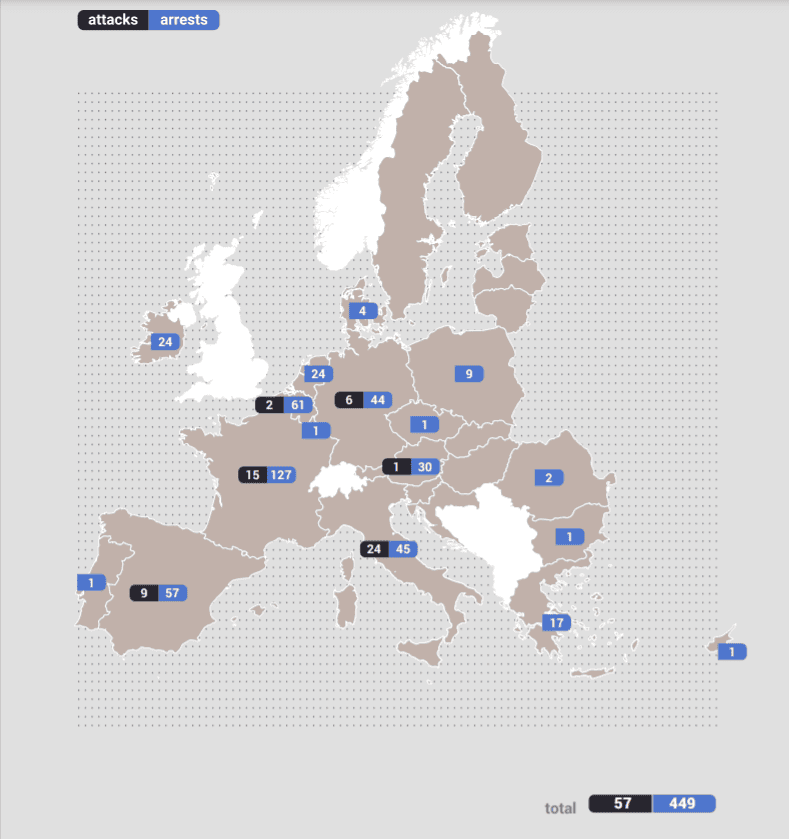
The number of attacks, though, appear to have stayed largely stable compared with previous years. In total, EU Member States reported 57 attacks in 2020, while the UK reported 62 such incidents and Switzerland reported two. That number (121) is higher than 2019’s combined total of 119, but lower than 2018’s total of 129 incidents.

In the EU, 21 people died as a result of terrorist attacks and at least 54 people were injured in 2020. The deaths were the result of one right-wing terrorist attack (in which nine people were killed) and six jihadist terrorist attacks (during which 12 people were killed). In the UK, three people lost their lives in a jihadist-inspired terrorist attack. One person died in the attacks in Switzerland. With the exception of the targeted assassination of a school teacher on 16 October 2020 in France, the victims in these terrorist attacks appear to have been selected at random, as perceived representatives of populations that the perpetrators intended to harm on ideological grounds, the report says.

In total, 449 individuals were arrested on suspicion of terrorism-related offences in the EU, while 185 were arrested in the UK. The number of terrorism-related arrests in 2020 was significantly lower than in previous years. This decrease, however, is not necessarily linked to decreased terrorist activities. The UK, in fact, cautioned that the decline in terrorism-related arrests and convictions can also be attributed to the operational changes necessary under the government restrictions imposed in March 2020 because of the pandemic.

Image Source: Europol Terrorism Situation and Trend Report 2021

The number of completed jihadist attacks in Europe (EU, Switzerland, and the UK) in 2020 more than doubled in comparison with the number in the EU (including the UK) in 2019. However, it’s not immediately clear if that jump is linked to the effects of the pandemic, the report said. Another important point to note is that all completed jihadist terrorist attacks were carried out by lone actors, while disrupted plots mainly involved multiple suspects. Lone attacks were also incited by the jihadist terror group Islamic State (IS) and the al-Qaeda network. Except for the attack in Vienna, in which firearms were used, the modi operandi typically involved rudimentary methods (stabbing, vehicle ramming, and arson).

What’s both interesting and alarming is that the pandemic did not fundamentally modify terrorists’ core modi operandi, but there was one shift that the report repeatedly stressed: Much of the communication among terror groups appears to have shifted online due to the pandemic. Europol’s comprehensive 113-page report covers various aspects of terror group activity during the year of the pandemic. But in today’s piece, we examine in detail just the overall impact of the pandemic on terrorism and extremism per the report.

First, how does the EU define terrorism?

Terrorist offenses are certain intentional acts, which, given their nature or context, may seriously damage a country or an international organization when committed with the aim of:

  • seriously intimidating a population;
  • unduly compelling a government or international organization to perform or abstain from performing any act; or
  • seriously destabilizing or destroying the fundamental political, constitutional, economic, or social structures of a country or an international organization.

That is the definition according to EU Directive 2017/541 on combating terrorism, which all EU Member States were obliged to transpose into their respective national legislation by 8 September 2018.

Covid-19 And Terrorism In Europe

To begin with, terrorists and extremists of several different ideological persuasions tried to mold the pandemic into their own longstanding narratives. For instance, IS said the pandemic was a punishment from God for his enemies, inciting the group’s followers to perpetrate attacks to take advantage of the increased vulnerability of anti-IS coalition countries.

“Al-Qaeda interpreted the spread of the pandemic in Muslim-majority countries as a sign that people had abandoned true Islam, and appealed to Muslims to seek God’s mercy by liberating Muslim prisoners, providing for people in need, and supporting jihadist groups. Both IS and al-Qaeda pointed to the withdrawal of Western troops as an opportunity. Right-wing extremists exploited Covid-19 to support their narratives of accelerationism and conspiracy theories featuring anti-Semitism, and anti-immigration and anti-Islam rhetoric. Left-wing and anarchist extremists also incorporated criticism of government measures to combat the pandemic into their narratives,” the report says.

Of course, the most important question on everyone’s minds is whether terror groups tried to use the Covid-19 virus as a bioweapon. Thankfully, Europol says no such attempts were reported in the EU. Although some people have discussed weaponizing the virus, most often technical information does not have the appropriate scientific background, it says. Ways of using it indirectly were discussed among terror groups, including methods like close contact, airborne or fomite transmission, shipping of contaminated products, and even distributing poisoned masks to the public on the streets.

EU Member States voiced concern about possible security-related effects of the pandemic for several reasons, some of which were:

  • A risk that the situation created by the pandemic could be an additional stress factor for radicalized individuals with mental health issues.
  • That, in turn, could cause lone actors to turn to violence sooner than they would have otherwise done.
  • Specifically, certain aspects of the pandemic could, by itself, contribute to self-radicalization. Those include factors like social isolation from family and peers, fear of falling ill, increased time spent online or at home with radicalizing influences, reduced job security and subsequent financial difficulties, dissatisfaction with the measures to stop the spread of the pandemic, and misinformation online, especially on social media platforms.
  • While movement and travel restrictions due to the pandemic probably ended up becoming a self-radicalization factor, it also meant reduced chances for intervention with individuals having fewer points of contact with government bodies in areas such as education, healthcare, social welfare, and law enforcement.
  • Another fallout of the pandemic and its ensuing social and economic crises has been the polarization of society. Attitudes have hardened and there’s a general increase in acceptance of intimidation, including calls to commit violent acts. Expressions of social dissatisfaction increased, both online and offline, with social media playing a facilitating and mobilizing role, as well as the proliferation of disinformation and conspiracy theories.
  • The polarized climate, in turn, has created opportunities for extremist groups to reach audiences beyond their traditional supporter circles.
Image Source: Europol Terrorism Situation and Trend Report 2021

Online Propaganda Is An Increasing Worry

Not only did many terror and extremist groups move their workstations online, they also tried to take advantage of the fact that the rest of us have also been spending an increased amount of time online during the pandemic. With a large amount of disinformation actively disseminated online, extremists and terrorists have exploited social dissatisfaction to reach out and propagate their ideologies. Virtual communities have become increasingly prominent in the dissemination of extremist and terrorist propaganda.

Since the Telegram takedown in late 2019, for instance, jihadists have been struggling to find new dissemination channels, the report says. As a result, jihadist propaganda has become dispersed across a variety of platforms. Online communities are playing an increased role in the propagation of right-wing extremism. In recent years, such communities have coalesced around white supremacist or neo-Nazi views and shared language. 

Take the example of a man who was active in anti-government and conspiracy theorist circles online and who was arrested in the Netherlands in early June 2020. He was a leading figure in an online group with 12,500 followers on Facebook and was also active in various Telegram groups. In statements probably targeting the measures to combat Covid-19, he allegedly referred to the need for “citizens’ arrests” of Members of Parliament and staff working at the Dutch Rijksinstituut voor Volksgezondheid en Milieu (RIVM, National Institute for Public Health and the Environment).

Violent acts by individuals opposed to the Dutch government’s anti-Covid-19 policies included attacks on a city hall with stones and fireworks, daubing of Covid-19 testing locations, and intimidation of personnel. Threats to journalists also increased. In Poland, extremist circles employed new recruitment strategies that involved enhancing their popularity among social groups that are not typically interested in their ideology.

Right-wing propaganda is mainly disseminated online and gaming platforms have been increasingly used for spreading extremist and terrorist narratives, Europol said. Suspects linked to online communities with different degrees of organization are also increasingly younger, some are just minors at the time of arrest. The attacker who killed nine people in February 2020 in Hanau, Germany was motivated by xenophobic and racist ideology. He had his own website, which he used to propagate his de-humanizing views, Europol says.

“The latest report from Europol on the EU terrorism situation illustrates that in the year of the COVID pandemic, the risk of online radicalisation has increased. This is particularly true for right-wing terrorism. I discussed this trend in Lisbon today (22 June) with US Secretary for Homeland Security Alejandro Mayorkas at the EU-US JHA. We are committed to tackling this growing threat,” Ylva Johansson, European Commissioner for Home Affairs said in a statement.

There were also arson attacks on telecommunication towers in various European countries linked to Covid-19, the report adds. Conspiracy theories suggesting a connection between Covid-19 and the roll-out of 5G technology were the origin of these extremist incidents. In the Netherlands, 30 telecom towers were set alight from April 2020. Seven suspects were arrested, but no link seemed to exist between the various incidents of arson, and there were no indications of any common organization, coordination, leadership, or even an overarching ideological motivation. The incidents seemed to be fueled by conspiracy theories, but some may also have been carried out by copycats, inspired by previous incidents of arson and the media coverage they received.

“The online domain plays a crucial role in enabling the spread of terrorist and extremist propaganda. In a world that has become considerably more digital, targeting the propagation of hatred and violent ideologies spread online is an imperative. By sharing information in real time and using the latest technological advances within a strong data protection framework, we can further enhance the way we fight terrorism together. Ultimately, law enforcement’s main goal is to target violent extremism and radicalisation to save lives and minimise the violent attacks against our society and our democratic system,” Catherine De Bolle, Executive Director of Europol said.

Given the comprehensive nature of the Europol report, this is the first in a series of pieces we will be doing based on its findings.

Black And Indigenous People Are More Likely To Be Killed In Traffic Accidents Than Other Racial Groups

By Aara Ramesh

On Tuesday, June 22, the Governors Highway Safety Association (GHSA) released a report showing that Black and Indigenous people are disproportionately dying in traffic accidents, according to an analysis of federal data. This comes on the heels of a different report published earlier this month by the National Highway Traffic Safety Administration (NHTSA), which found that U.S. traffic deaths in 2020 rose 7.2% to 38,680 (compared to 2019), despite the fact that lockdowns meant that Americans drove 13% fewer miles last year.

The GHSA, a non-profit that works with highway safety offices, said that its latest report is the first comprehensive analysis on the subject of racial disparities in traffic fatalities in more than a decade. In the course of the study, the group looked at data from the National Center for Health Statistics and Fatality Analysis Reporting System (FARS) from 2015 to 2019 with the aim of understanding racism in enforcement and racial equity in safety when it comes to traffic accidents.

According to the GHSA, what it found is a “significant health disparity” and “a chronic public health issue in minority communities.”

Per the report, American Indian/Alaskan Native populations had a substantially higher per-capita rate of traffic fatalities (including total, pedestrian, and bicyclist deaths), compared to other racial groups, with Black persons coming in second. Excluding the motorcycle driver deaths and passenger deaths categories, white people were found to have generally lower traffic fatality deaths than Black, Indigenous, and other People of Color (BIPOC).

The national average is 58.1 traffic fatalities per 100,000 people. When broken down by race and ethnicity, the disparity is even more stark. For Native Americans and Alaskan Natives, the rate is 145.6. For Black people, it is 68.5.

According to the latest figures from the NHTSA, pedestrian deaths among Black people skyrocketed 23% in 2020, the highest of any of the racial groups. The figure jumped by 11% among American Indians. Between 2005 and 2019, the gap between overall traffic deaths among Black and white people widened, jumping 16% for the former and dropping by 27.8%.

According to Smart Growth America, over the last decade, the overall, nationwide number of people hit and killed by drivers increased 45%. The rate of Black people being hit and killed was 82% and was an eye-watering 221% for American Indian and Alaskan Native people, as compared to white, non-Hispanic Americans.

Though traffic infrastructure, road planning and design, vehicle safety, and awareness have improved greatly since the 1970s, many believe that low-income communities have been left behind.

Urban planning and transportation experts have pointed to a number of factors that could explain why BIPOC are overrepresented in traffic fatality figures. For instance, Black people are more likely to live in cities, which — the NHTSA has noted — suffer higher rates of traffic accidents than rural areas.

Within cities, low-income areas have traditionally received less investment in roadway infrastructure, traffic enforcement, community engagement, and traffic safety education. They tend to have fewer functional traffic lights, crosswalks, and warning signs; and are more likely to have uneven roads and sidewalks, and more ongoing construction, etc., all of which seriously impact road safety. These low-income areas are largely (though not exclusively) populated by BIPOC

The national initiative to improve the Interstate Highway System half a century ago ensured that busy thoroughfares were built predominantly through low-income neighborhoods. The high-speed nature of these highways makes it more dangerous for those who live in these areas.

Experts also say that BIPOC people may not be able to afford vehicles and so are overrepresented among pedestrians. Smart Growth America found that people walking in lower-income neighborhoods are killed far more often than those in richer areas. In its early June report the NHTSA said that in 2020 drivers had displayed a greater propensity for risky behavior like speeding, due to the roads being empty as a result of the lockdowns.

Further, there are suggestions that the high pedestrian deaths figures are an indication of the fact that BIPOC communities, particularly Black people, were disproportionately represented among essential workers and could less afford to stay at home or work from home during the lockdowns.

Looking at it even more broadly, public health infrastructure and access to medical care tends to be of poorer quality in low-income neighborhoods. According to the GHSA, this means that though the severity of accidents may be comparable across different socioeconomic areas, the outcomes of these crashes can vary significantly and be more deadly for poor people, as a result of slower response times and the inadequate medical care available.

It is not easy to detangle this racial disparity in fatality statistics without looking at the underlying problems that disproportionately affect BIPOC people, especially socioeconomic status, which has implications for where people live, where they work, how they get to work, and how much has been invested in their neighborhoods.

The various organizations and agencies working to improve road safety have suggested a number of actionable solutions. They include:

  • Treating disparities from traffic fatalities as a public health issue.
  • Enhancing infrastructure investment and safety planning initiatives in underserved/poorer areas.
  • Implementing best practices and lessons learned from confronting other racialized challenges (like mental health and poverty) in traffic safety measures.
  • Investing in R&D to develop capabilities to predict and prevent traffic accidents.
  • Working with local organizations and BIPOC leaders to design more effective, customised safety education campaigns.

Secretary of Transportation Pete Buttigieg responded to these statistics by saying, “Last year’s traffic fatality rates and the racial disparities reflected in them are unacceptable. This reflects broader patterns of inequity in our country — and it underscores the urgent work we must undertake as a nation to make our roads safer for every American.” He highlighted that President Joe Biden’s stalled American Jobs Plan earmarks $20 billion for road safety initiatives, half of which will go to making streets safer and reducing accidents.

The California Assault Weapon Ban Legal Battle: Appeals Court Puts Overturn Of Ban On Hold

By a Biometrica staffer

On Monday, June 21, a federal appeals court decided to put a judge’s decision to overturn California’s 30-year-old ban on assaults weapons on hold. However, the legal battle is expected to continue for months and could eventually end up being decided by the U.S. Supreme Court. A three-judge panel of the U.S. 9th Circuit Court of Appeals issued a stay on U.S. District Judge Roger T. Benitez’s June 4 decision in a brief order, The Los Angeles Times reported.

The 9th Circuit Court was acting on an appeal filed by Attorney General Rob Bonta on June 10. It said the case had been put on hold pending decisions in other gun cases that are now before the court. That means the current ban on assault weapons in California will continue to be in effect while appellate proceedings press on, Bonta said in a tweet.

The 9th Circuit order said the law would remain in effect until it ruled in another case that also challenged California’s assault weapon regulations claiming it violates the Second Amendment. That case, in turn, has been put on hold pending a ruling in a lawsuit over California’s ban on large-capacity magazines. An 11-judge 9th Circuit “en banc” panel is scheduled to hear arguments in that case today, and the ruling is likely to determine the future of the state’s assault weapons ban. 

On June 4, Benitez ruled that he state’s definition of illegal military-style rifles unlawfully deprives law-abiding Californians of weapons commonly allowed in most other states and by the Supreme Court. In his introduction to the ruling, he wrote: “Like the Swiss Army knife, the popular AR-15 rifle is a perfect combination of home defense weapon and homeland defense equipment. Good for both home and battle.” Governor Gavin Newsom, who condemned the decision after it came out, said the Swiss Army knife comparison “completely undermines the credibility of this decision and is a slap in the face to the families who’ve lost loved ones to this weapon,” Associated Press reported on June 6.

Benitez also was the judge who struck down the voter-approved 2016 ban on large-capacity magazines (i.e., those that can hold more than 10 bullets). A three-judge 9th Circuit panel upheld his 2017 decision on that matter, but the state successfully sought review by a larger en banc panel. Gov. Gavin Newsom authored the ballot measure banning the magazines when he was the state’s lieutenant governor, the Los Angeles Times report says. The state also is appealing Benitez’s decision in April 2020 to block a 2019 California law requiring background checks for anyone buying ammunition.

California’s firearms laws are said to be among the strictest in the nation. The state is one of seven, and Washington D.C., that ban assault weapons. Twenty-two states, led by Arizona, which is under the 9th Circuit’s jurisdiction, asked the appeals court to uphold the order against California’s law: Alabama, Alaska, Arkansas, Georgia, Idaho, Indiana, Kansas, Kentucky, Louisiana, Mississippi, Missouri, Montana, Nebraska, Ohio, Oklahoma, South Carolina, Tennessee, Texas, Utah, West Virginia, and Wyoming.

The Firearms Policy Coalition criticized the 9th Circuit’s decision saying: “The Ninth Circuit put Judge Benitez’s incredibly detailed, historically accurate, and legally sound decision and judgment—and your rights—on ice.” After Benitez’s June 4 ruling that issued a permanent injunction against enforcement of the law (staying it for 30 days to give Bonta time to appeal), a gun control advocacy group had termed his ruling alarming. “Too many families across the nation have lost loved ones in shootings carried out with assault weapons. They can attest to the reality that these weapons are not like ‘Swiss Army knives’ nor are mass shootings only a ‘very small’ problem,” Robyn Thomas, executive director of the Giffords Law Center to Prevent Gun Violence said, according to Associated Press.

What exactly does the law say?

Cal. Pen. Code § 30600 regulates the manufacture and transfer of two kinds of firearms: those that are classified as assault weapons and a specific type of rifle, the .50 Browning Machine Gun. The law in this section states: “Any person who, within this state, manufactures or causes to be manufactured, distributes, transports, or imports into the state, keeps for sale, or offers or exposes for sale, or who gives or lends any assault weapon or any .50 BMG rifle, except as provided by this chapter, is guilty of a felony, and upon conviction shall be punished by imprisonment pursuant to subdivision (h) of Section 1170 for four, six, or eight years.”

But it is Cal. Pen. Code § 30605 that specifically deals with assault weapons. It states: “(a) Any person who, within this state, possesses any assault weapon, except as provided in this chapter, shall be punished by imprisonment in a county jail for a period not exceeding one year, or by imprisonment pursuant to subdivision (h) of Section 1170. (b) Notwithstanding subdivision (a), a first violation of these provisions is punishable by a fine not exceeding five hundred dollars ($500) if the person was found in possession of no more than two firearms in compliance with Section 30945 and the person meets all of the following conditions.” (You can find the full list of conditions through the link in the section cited above.)

How does the law define an assault weapon? It is mainly based on how the weapon is configured and can have several characteristics. Assault weapons can include, but are not limited to, semi-automatic rifles, firearms that are compatible with various attachments like flash suppressors, folding/telescoping stocks, or grenade launchers, and those that can be fixed with detachable magazines or have a fixed magazine that can hold over 10 rounds. The Penal Code itself also provides a non-exhaustive list of 70 specific weapons that are designated as assault rifles.

They are generally viewed as more dangerous than other firearms and are disproportionately used in crimes and mass shootings, and against law enforcement, resulting in more casualties, the state attorney general’s office argued while appealing Benitez ruling. The state also said that the ban had not prevented law-abiding citizens in the state from acquiring a range of firearms for lawful purposes, including self-defense. That was evident from a surge in sales of more than 1.16 million other types of pistols, rifles and shotguns in the last year — more than a third of them to likely first-time buyers, it said in a court filing.

Meanwhile, in Texas, where a new law will allow residents over the age of 21 to carry handguns without a license or training from Sep. 1, both law enforcement officers and pawnshop owners are expressing concern over inexperienced gun owners.