On Monday, April 12, erstwhile and disgraced Hollywood mogul Harvey Weinstein made his appearance via video conference along with his attorneys at an extradition hearing. He was secretly indicted by a grand jury in Los Angeles a couple of weeks ago, Fox News first reported on April 11. At the hearing on Monday in connection with that indictment, his lawyers Mark Werksman and Norman Effman argued against him being extradited to L.A. for “humanitarian reasons.”
Effman claims Weinstein is technically blind and has major dental issues, TMZ reported. He’s allegedly lost four teeth and is in danger of losing more. Prison officials in New York, where he is already serving out a 23-year sentence for rape and sexual assault, have scheduled two medical procedures for Weinstein, his lawyer added — one for his sight and one for his teeth, according to the TMZ report.
The 69-year-old appeared by video from the Wende correctional facility, near Buffalo, before a judge on the Erie county court. Effman asked that his client be arraigned on the indictment virtually in New York rather than extradited so he could get necessary medical treatment, according to a report in The Guardian. He added that Weinstein, a diabetic, is “almost technically blind at this point”, and also suffers from cardiac and back problems.
Wearing a burgundy colored outfit, the Oscar-winning producer himself was seen on camera sitting in a stark conference room from the maximum security prison, according to a report by Deadline. He used a walker, but smiled while chatting with his attorneys before the hearing, Variety reported. He answered a few simple questions from the judge but otherwise did not participate in the proceeding.
Weinstein, who was first accused by women of sexual harassment in 2017, faces 11 counts in the California indictment, including for rape and sexual battery involving fire incidents that allegedly took place between 2004 and 2013. If convicted, he faces up to 140 years behind bars, the Fox News report added.
According to legal experts, by getting an indictment, LA prosecutors can streamline the proceedings and are able to go straight to trial, rather than doing it under a criminal complaint that would then require a preliminary hearing, the Fox News report added. Once Weinstein is brought to L.A., prosecutors would have 120 days to bring him to trial, according to the Variety report.
He was convicted in New York city in February 2020 and later sentenced to 23 years in prison. It was seen as a landmark moment in the #MeToo movement against the sexual abuse and harassment of women.
Dozens of women have come forward with allegations of sexual misconduct, including rape, against him since the first allegations surfaced in 2017. Weinstein has constantly denied any wrongdoing, and has vowed to clear his name.
Earlier this month, his lawyers launched the long-anticipated appeal against his conviction, arguing the judge made errors that denied his right to a fair trial, the BBC reported. For a full timeline of the Weinstein scandal from the BBC, click here.
The judge set the next hearing for his extradition to L.A. to April 30, so for now Weinstein will remain in prison in New York. If Judge Kenneth Case approves the extradition request — which is typically a formality — Weinstein would then be able to appeal to Gov. Andrew Cuomo, who will have 30 days to decide whether to intervene, the Variety report said. Effman’s request that his client be arraigned on the indictment virtually was denied, Variety added in its report.
The April 9 release of lapel video and dash cam footage has shed fresh light on the fatal shooting of Darian Jarrott, a New Mexico State Police Officer in February 2021.
Jarrott was shot and killed in the line of duty. In 2021, he was one of 15 officers killed by gunfire, in the line of duty, while four others died of assault, two by stabbing, and seven by vehicular assault.
In all, a total of 91 officers lost their lives in the line of duty between January 1 and March 31.
On Friday, April 11, Sgt. Jim Smith, an Iowa State Patrol Trooper, was shot and killed when he tried to enter the home of a man who had assaulted another police officer earlier.
Michael Lang, who was charged with murder over the death of Sgt. Smith, is being held on $1M cash bond.
In the New Mexico incident, Jarrott initiated a traffic stop on a white Chevrolet pickup on Interstate 10 eastbound, near mile marker 102 east of Deming, New Mexico.
During the stop, Jarrott asked the occupant of the vehicle, Omar Felix Cueva, to exit the vehicle. As he did so and walked towards the back of the vehicle Cueva fired one shot at Jarrot using an AR-15 rifle.
Officer Jarrott ducked and fell on his back and Cueva than fired several rounds at him. As he moved to the front of the truck Cueva shot Jarrott point blank in the back of the head, killing him.
A Homeland Security Investigations (HSI) agent arrived on scene and notified New Mexico State Police dispatch that an officer was down.
Cueva’s vehicle was next flagged traveling east on Interstate 10 near mile marker 116. Here, Cueva pulled over and fired at two officers and evaded capture even as officers returned fire.
At this point, the Las Cruces Police Department, the Dona Ana County Sheriff’s Office, and U.S. Border Patrol joined New Mexico State Police in their pursuit of Cueva.
Near the Picacho exit on Interstate 10, (near mile marker 135), NMSP officers successfully utilized tire deflation devices on Cueva’s pickup, but he continued to flee, even as officers engaged him with gunfire.
Near mile marker 140 LCPD Officer Adrian De La Garza utilized a Pursuit Intervention Technique but before the vehicle came to a stop, Cueva exited, with a firearm, and shot at multiple rounds in the direction of officers and deputies.
Three officers returned fire and Cueva was struck multiple times. In the process, Officer De La Garza was struck by gunfire and had to be airlifted to a trauma hospital in Texas where he was treated and later released for non-life-threatening injuries.
Officers rendered aid to Cueva until emergency medical personnel arrived on scene. Cueva sustained fatal injuries and was pronounced deceased on scene by the Office of Medical Investigator.
“We appreciate the public’s support during this difficult time,” said Robert Thornton Chief of the New Mexico State Police. “We will honor Officer Jarrott’s sacrifice by continuing to serve and protect the citizens of New Mexico.”
Officer Jarrott began his career as a Transportation Inspector with NMDPS. He was certified as a law enforcement officer in December of 2014 and worked with the former Motor Transportation Division of NMDPS. In July of 2015, he was sworn in as a New Mexico State Police officer where he served until the day of the shooting. Officer Jarrott leaves behind 3 small children and was expecting his fourth child this year.
The incident occurred on Feb. 4, and officer Jarrott was laid to rest on Feb. 12.
State Police lapel and dashcam footage reveals more details about what led up to the shooting that killed Officer Darian Jarrott. https://t.co/8BBaEC8qIF
If you thought child marriage was a problem that only developing countries faced, think again. It is an equally real, and worrisome, problem in the U.S. too.
Read this: Nearly 300,000 minors, under age 18, were legally married in the U.S. between 2000 and 2018, a study by the organization Unchained At Last published this month found. Between 2000 and 2018, 232,474 children were married based on actual data, plus another 64,559 based on estimates. A few were as young as 10, though nearly all (around 96%) were age 16 or 17.
Most were girls wed to adult men an average of four years older, the study found. Whereas, when boys were married, the average spousal age difference was less than half of the age difference for girls, at 1.5 years. Some 60,000 marriages since 2000 occurred at an age or spousal age difference that should have been considered a sex crime.
Unlike in countries where child marriage is illegal but persists anyway, the problem in the U.S. is the laws themselves. Most U.S. states still allow marriage before 18, and the four states that banned it did so only in the last three years. Several states allow teenagers as young as 16 to marry with parental consent, according to an article on the Cornell Law School website. Some even allow children two years younger than that to marry.
Unchained was founded in 2011 by a forced marriage survivor, with a mission of providing free legal and social services to help individuals in the U.S. to escape forced marriages. When it was founded, child marriage was legal in all 50 states in the U.S. Ever since Unchained was created, the organization found that an increasing number of girls, under age 18, were reaching out to Unchained to plead for the same help that its own founder had needed as a child.
Alaska and North Carolina have the lowest minimum age for marriage set by statute, according to an article in WRAL.com: 14 years old. The article also talks of Sherry Johnson’s story. Johnson was married off by her mother when she was just 11 to her 20-year old rapist. She had been raped several times before her age even hit the double digits, and became pregnant at the age of 10 by a senior member of her church.
Lawyers cannot represent minors. But Johnson finally found an attorney who was willing to help her get her a divorce, which was finalized when she was only 17 years old, and had already given birth to six children. She is now an advocate for raising the age for child marriage with a focus on North Carolina, the WRAL.com article says.
Other anti-child marriage advocates in the U.S. have similar backgrounds that prompted them to take up for this cause. For instance, Dawn Tyree, who now works with organizations like Unchained, was also married when she was 13 and became pregnant. She was molested by a family friend, who became her husband after the pregnancy was discovered, according to an article in News Channel 10. By the time Tyree was 15, she was somehow raising herself and her two children. She also faced issues when it came to getting a divorce because she was only emancipated, and not a full adult.
Over the last five years, half of the states have enacted reforms to end or limit child marriage. North Carolina’s is being reconsidered now through House Bill 41 and Senate Bill 35 to raise the age to get married to 18. Researchers in North Carolina reviewed marriage license applications in 50 counties around the state over almost two decades, from 2000 to 2019. The researchers found more than 4,000 minors had applied to be married, the WRAL.com article adds.
Lawmakers in Kansas too are considering a proposal to raise the minimum age for marriage in the state to 18, according to an article by KSN in March 2021. The age of consent in the state is already 18, but a teenager can marry even at the age of 16 with parental consent. Children that are 15-years old can marry with judicial approval. Between the years 2000 and 2010, 2500 minors were married in the state.
While things appear to be improving, there are also cases that suggest a whole lot more has to be done. For example, a Brooklyn rabbi is under investigation for allegedly arranging marriages between children as young as 15 years old. This happened as recently as last month, according to a post on Jewish Exponent. In New York state, one must be 18 years old to marry, though a 17-year-old can marry with a court’s permission.
Rabbi Yoel Roth, and the school he runs, Yeshiva Tiferes Hatorah in Williamsburg, are now the subject of investigations by the New York Police Department and the Administration for Children’s Services, the Forward reported. Roth believes that boys should be married off at a young age to prevent them from masturbating, the article added. Former followers of Roth said he arranged marriages without permission from the parents of the bride and groom, and often does not allow parents to decide the date of the wedding, or even to know the age of their child’s future spouse.
Data Source: Unchained At Last’s April 2021 report on child marriage
Status Of Minimum Age For Marriage Globally
Of course, child marriage is not just an American problem.
Globally, around 21% of young women are married before their 18th birthday, the UNICEF says. A whopping 12 million girls under 18 are married off each year. If that’s not a shocking enough statistic, consider this: 650 million girls and women alive today were married as children, according to the UNICEF, based on data updated until March 2020. The practice is most prevalent in sub-Saharan Africa, where 37% of young women are married before the age of 18.
A 2016 study by the Pew Research Center found that at least 117 countries allow children to marry, based on analysis of data on 198 countries and territories from the U.S. State Department and United Nations. Most countries (153 of 198) require that people who want to marry be adults, i.e. 18 years or older. But many of these same nations also have some kind of exemption to this requirement, the Pew Research study says.
For instance, in Australia, if a person is at least 18, with judicial approval their spouse can be as young as 16, the study adds. And in many other countries, such as Iraq, Jamaica and Uruguay, children can marry with parental permission. Sudan has the largest gender gap: Girls can marry at 10 and boys can marry at 15 or puberty without parental or judicial permission. And six countries do not specify a minimum age for marriage: Equatorial Guinea, Gambia, Saudi Arabia, Somalia, South Sudan and Yemen. The Pew Research list of minimum age across countries from the study can be found here.
Another important statistic to be noted is that for about one-in-five countries, there are different minimum age requirements for men and women. In 37 of these 38 countries, the minimum for girls is the lower of the two. Then there are religion-based differences in terms of minimum age requirement, the Pew Research study found. For example, in the Philippines, couples must be 21 to marry without permission, unless they are Muslim; Muslim boys can marry at 15 and Muslim girls can marry at puberty. And in Tanzania, Muslim and Hindu girls can marry at 12 as long as the marriage is not consummated until the girl reaches the age of 15.
Of the over two dozen countries that require one or both spouses be older than 18, roughly half of these nations (14 of 27) are in the Asia-Pacific region. For instance, China requires men to be 22 and women to be 20 and, in Singapore, couples under the age of 21 must have special permission to wed. In India, Prime Minister Narendra Modi created a task force last year to examine a proposal to increase the age of marriage of women from 18 to 21, which would make it the same legal age for women to marry as it is currently for men.
Impact Of The Pandemic On Child Marriage
Before the COVID-19 pandemic, more than 100 million girls were expected to marry before their eighteenth birthday in the next decade. Now, up to 10 million more girls will be at risk of becoming child brides as a result of the pandemic, according to the UNICEF.
School closures, economic stress, service disruptions, pregnancy, and parental deaths due to the pandemic are putting the most vulnerable girls at increased risk of child marriage, the organization said. In the last ten years, the proportion of young women globally who were married as children had decreased by 15%, from nearly one-in-four to one-in-five, the equivalent of some 25 million marriages averted, a gain that is now under threat, the UNICEF added in another press release.
Girls who marry in childhood face immediate and lifelong consequences, the release adds. They are more likely to experience domestic violence and less likely to remain in school. Child marriage increases the risk of early and unplanned pregnancy, in turn, increasing the risk of maternal complications and mortality. The practice can also isolate girls from family and friends and exclude them from participating in their communities, taking a heavy toll on their mental health and well-being.
“Pandemic-related travel restrictions and physical distancing make it difficult for girls to access the health care, social services and community support that protect them from child marriage, unwanted pregnancy and gender-based violence. As schools remain closed, girls are more likely to drop out of education and not return. Job losses and increased economic insecurity may also force families to marry their daughters to ease financial burdens,” the UNICEF said.
In East Africa’s Malawi, for instance, child marriage rates have almost doubled during the pandemic, according to a Telegraph report. From April to June this year, the national youth helpline recorded 669 child marriages, up by 83% on last year, according to its director, MacBain Mkandawire. His organization, Yoneco, runs the helpline on behalf of the government, Telegraph said.
Nepal has it extremely difficult too, at the moment, according to a New York Times report. Interlocking problems particular to the country make it tough for many young women to avoid early marriage, even though the legal marriage age is 20. Its economy relies on remittances and tourism, both of which the pandemic has devastated. In India also the pandemic led to a more than 33% increase in the number of child marriages between the months of June and October 2020 as compared with 2019, an RTI application to the Union Ministry of Women and Child Development showed, according to an article in The Wire.
Policymakers should be deeply concerned about child marriage – including at age 16 or 17 – for three main reasons, says the Unchained report from this month. The reasons are: Child marriage can easily be forced marriage, and doesn’t give the children getting married any legal rights they need to navigate through the contract of marriage. It is also a human rights abuse that destroys the lives of many American girls. Although, the study points out here that there’s much less known about the impact of child marriage on boys since most of the children who marry in the U.S. are girls, and the research is also focused on girls. Finally, the third reason to do away with child marriage according to the Unchained study is that it really undermines statutory rape laws. Sex with a child, which would be considered rape otherwise, becomes legal within the realms of child marriage in most states and under federal law.
According to an October 2019 report from the Consumer Financial Protection Bureau (CFPB), there were 1,954 background screening companies operating in the United States in that year, with a total revenue of about $3.2 billion. According to the report, 32.1% of revenue was estimated to come from prospective tenant reports, and the remainder from employers. Criminal record check services accounted for 36.5% of industry revenue, credit check services account for 46.4%, while reference check services for 17.1%.
A June 2018 survey of employers, conducted by HR.com and commissioned by what was then the National Association of Professional Background Screeners (NAPBS) and is now the Professional Background Screening Association (PBSA), found that 95% of employers surveyed stated they conduct one or more types of background screening; 94% of those employers that conducted background screening include some form of criminal history check in their reports.
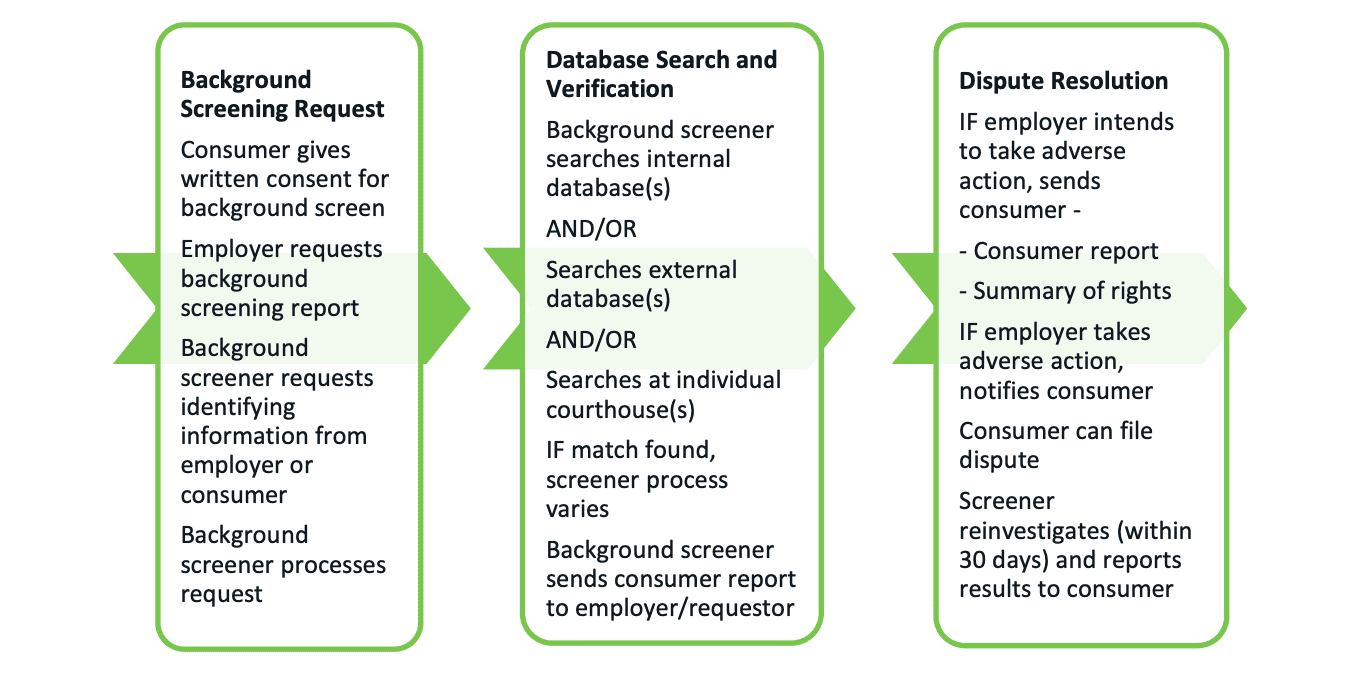
But are the organizations conducting background checks considered Consumer Reporting Agencies? According to the FTC, which, along with the CFPB enforces actions under the Fair Credit Reporting Act (FCRA), “even if you don’t think of your company as a consumer reporting agency, it may be one if it provides information about people to employers for use in hiring or other employment decisions.” So, when is your company a Consumer Reporting Agency (or a CRA)?
Before we can answer that question, it’s probably important to define two things:
What is a consumer report; and
What is a Consumer Reporting Agency?
The term “Consumer Reporting Agency” is a reference to “any person which, for monetary fees, dues, or on a cooperative nonprofit basis, regularly engages in whole or in part in the practice of assembling or evaluating consumer credit information or other information on consumers for the purpose of furnishing consumer reports to third parties,” and that uses any means or facility of interstate commerce for the purpose of preparing or furnishing those consumer reports. It’s important to note here that the term “person” — with relation to consumer reporting agencies — can denote an individual, or signify a partnership, corporation, trust, estate, cooperative, association, government or governmental subdivision or agency, or other entity.
The term “consumer report” really refers to any communication, whether oral, written, or in some other form, provided by one company to another organization, generally for the purpose of determining an individual’s — called the “consumer” — eligibility for a certain permissible purpose.
According to 15 U.S. Code § 1681b, in general, for a report to be furnished legally, these permissible purposes must reflect one of the following criteria:
First, that the report is in response to the order of a court having jurisdiction to issue such an order, or a subpoena issued in connection with proceedings before a Federal grand jury. Second, it is in accordance with the written instructions of the consumer to whom it relates.
Then, the report must be furnished to a person (individual or organization), which it has reason to believe —
intends to use the information in connection with a credit transaction involving the consumer and involving an extension of credit to, or review or collection of an account of, the consumer; or
intends to use the information for employment purposes; or
intends to use the information in connection with the underwriting of insurance involving the consumer; or
intends to use the information in connection with a determination of the consumer’s eligibility for a license or other benefit granted by a governmental instrumentality required by law to consider an applicant’s financial responsibility or status; or
intends to use the information, as a potential investor or servicer, or current insurer, in connection with a valuation of, or an assessment of the credit or prepayment risks associated with, an existing credit obligation; or
otherwise has a legitimate business need for the information in connection with a business transaction that is initiated by the consumer; or to review an account to determine whether the consumer continues to meet the terms of the account.
The permissible criteria could also include furnishing a report
to the executive departments and agencies in connection with the issuance of government-sponsored and individually billed travel charge cards; or
in response to a request by the head of a state or local child support enforcement agency (or state or local government authorized by the head of such agency), if the person making the request certifies to the CRA that
the consumer report is needed for the purpose of establishing an individual’s capacity to make child support payments, determine the appropriate level of such payments, or enforce a child support order, award, agreement, or judgment; or
the parentage of the consumer for the child to which the obligation relates has been established or acknowledged by the consumer in accordance with State laws under which the obligation arises (if required by those laws); and
the consumer report will be kept confidential, will be used solely for a purpose described (in a) above, and will not be used in connection with any other civil, administrative, or criminal proceeding, or for any other purpose.
A report can also be furnished to an agency administering a State plan under section 654 of title 42 for use to set an initial or modified child support award.
In addition, a report is permitted to be provided to the Federal Deposit Insurance Corporation or the National Credit Union Administration as part of its preparation for its appointment or as part of its exercise of powers, as conservator, receiver, or liquidating agent for an insured depository institution or insured credit union under the Federal Deposit Insurance Act [12 U.S.C. 1811 et seq.] or the Federal Credit Union Act [12 U.S.C. 1751 et seq.], or other applicable Federal or State law, or in connection with the resolution or liquidation of a failed or failing insured depository institution or insured credit union, as applicable.
The Reason Matters
So, basically, background screening reports are “consumer reports” under the FCRA when they serve as a factor in determining a person’s eligibility for employment, credit, insurance, housing, or other permissible purposes and they include information “bearing on a consumer’s credit worthiness, credit standing, credit capacity, character, general reputation, personal characteristics, or mode of living.”
In the main, all companies that sell or provide consumer reports are “consumer reporting agencies” under the Fair Credit Reporting Act. If you believe that your employment background screening company is a consumer reporting agency under the FCRA, what does the law require you to do? It’s pretty detailed but fairly clear.
Follow reasonable procedures to assure accuracy.
Among other things, the FCRA requires you to establish and follow “reasonable procedures to assure maximum possible accuracy of the information concerning the individual about whom the report relates.” Certain practices may be indicators that a background screening company isn’t following reasonable procedures. For example, if a report lists criminal convictions for people other than the applicant or employee — for instance, a person with a middle name or date of birth different from the applicant’s — that raises FCRA compliance concerns. Other indications that a company’s procedures might not be reasonable include screening reports with multiple entries for the same offense or that list criminal records that have been expunged or otherwise sealed.
Get certifications from your clients.
As detailed above, consumer reporting agencies may provide consumer reports only to those with a specific permissible purpose, like employment. The FTC makes it clear that organizations providing consumer reports have to verify that their clients are legitimate and requires them to certify that they will use the reports only for employment purposes. In addition, the FCRA mandates that job applicants and employees have the right to know that information about them is being reported to employers or potential employers.
According to the FTC, a background checking company must, therefore, get certifications from their clients attesting that:
The employer notified the applicant and got the applicant’s written permission to get a background report; and
The employer will comply with the FCRA’s requirements; and
The employer won’t discriminate against the applicant or employee, or otherwise misuse the information in violation of federal or state equal opportunity laws or regulations.
Provide your clients with information about the FCRA.
The FCRA gives consumers certain rights that must be complied with, including providing access to consumer files when they ask for them, conducting a reasonable investigation when they dispute the accuracy of information, and giving them written notice of the results of investigations. The FTC states that it is a “violation of the FCRA not to respond in a timely way to consumers’ inquiries and disputes.” Another FCRA violation? “Creating unreasonable obstacles for consumers trying to exercise their rights under the FCRA.”
What if background screening reports include public record information?
The FCRA has special provisions if reports contain public record information — for example, courthouse records — and are used for employment purposes. Broadly speaking, if an organization includes public record information in the reports they provided for employment purposes, the law gives them two options:
1) Notify the person who is the subject of the report when public record information is being reported; or
2) Maintain what the FCRA calls “strict procedures” designed to ensure that reported public record data is complete and up to date.
For instance, under the FCRA, a CRA generally may not report records of arrests that did not result in entry of a judgment of conviction, where the arrests occurred more than seven years ago. However, the FCRA also does clarify that items of public record relating to arrests, indictments and convictions are considered up to date if the CRA reports the current public record status of the item at the time of the report. For example, the FTC has issued guidance that if a CRA reports an indictment, it must also report any dismissal or acquittal available on the public record as of the date of the report.
Similarly, if a CRA reports a conviction, it must report a reversal that has occurred on appeal. Because the requirement to report complete and up-to-date information is item-specific, the report has to include the current, complete, and up-to-date public record status of each individual item reported. While the FTC has not indicated that a company has an obligation to continually update reports that it has already provided, the report should be up to date at the time it is provided.
With Biometrica, for instance, as we carry real-time data, which is updated on an hourly basis, our records match the most current available public records for an arrest. We also update all law enforcement updates to the case as it moves through the system, when law enforcement updates the case concerned. Any report provided is always current and updated at the time and date the report is provided.
You can see more on Biometrica’s FCRA guidance here.
Do note that Biometrica, while being a technology (SaaS and data) company, is an associate member of the PBSA and has a PI license.
President Joe Biden’s announcement of six actions impacting gun regulation on April 8, following three mass shooting incidents earlier in the year, met with sharp reactions.
As expected, the NRA was strongly critical of Biden’s announcements. “Let’s be clear as we’re watching this Biden circus,” the NRA said on Twitter. “These actions could require Americans to surrender lawful property, push states to expand confiscation orders, and put a gun control lobbyist to head ATF. Biden is dismantling the 2nd Amendment. It’s time to STAND and FIGHT!”
Texas Governor Greg Abbott was also sharp in his reaction. “Biden is threatening our 2nd Amendment rights. He just announced a new liberal power grab to take away our guns,” Abbott wrote on Twitter. “We will NOT allow this in TX. It’s time to get legislation making TX a 2nd Amendment Sanctuary State passed and to my desk for signing.”
Kristi Noem, the Governor of South Dakota, was equally strident. “Biden claims that his actions won’t infringe on the 2nd Amendment. That’s false,” she wrote on Twitter. “Taking away guns with Red Flag laws is an infringement. Placing new limits on firearms sales is an infringement. Curbing ammo purchases is an infringement. ‘Shall NOT be infringed.’ #2A”
The President and his administration may also be confronting a potentially insurmountable question over what rules should govern private sales and transfers, including those between friends and extended family, as they seek Republican votes, according to an AP news report.
Biden’s announcements were followed by a spate of gun-related, but unconnected, news reports. Biometrica rounds up some of them below.
Employee Kills One, Wounds Five At Texas Cabinet Business
Larry Winston Bollin, 27, of Iola, opened fire at the Texas cabinet making company where he worked, killing one person and injuring five. He also wounded a state trooper before he was arrested and booked into the Brazos County Detention Center in Bryan late on April 8.
Bollin was charged with murder and being held on a $1 million bond. He was an employee at the Kent Moore Cabinets outlet where the incident occurred, police chief Eric Burke said.
The attack happened around 2.30 p.m. and by the time law enforcement reached the location the suspect had fled, AP reported.
During the hunt for the suspect, he shot and wounded a state trooper, who was hospitalized in serious but stable condition, the Texas Department of Public Safety said on Twitter.
Of the others shot, two were in critical condition while three were stable but serious. The police arrested the suspect in Bedias, a small community 25 miles north of Bryan.
Bryan, which is the seat of Brazos County is about 100 miles northwest of Houston.
Officials did not immediately ascribe any motive for the attack.
“I have been working closely with the Texas Department of Public Safety and the Texas Rangers as they assist local law enforcement on a swift response to this criminal act,” said Texas Governor Greg Abbott “Their efforts led to the arrest of the shooting suspect.”
Rapper Among 24 Arrested In Mississippi Interstate Shooting
Meanwhile, police arrested 24, including rapper Big Boogie, over an interstate shooting in Mississippi.
Tate County 911 received a report of a shooting on Interstate 55 near Coldwater just before 1pm on April 8 according to Fox News.
Shots were fired from multiple vehicles and at least one gunshot victim remained at the scene when law enforcement arrived.
According to Senatobia’s Assistant Chief of Police, four vehicles were impounded from the scene, and approximately 21 suspects were taken to Panola County Jail or elsewhere.
This is the second time Big Boogie has been involved in a gunshot related incident. He was performing when shots were fired at rap concert in Mississippi in 2020.
Shooters Parents Testify In Sutherland Springs Church Shooting Civil Trial
The parents of Sutherland Springs church shooter Devin Kelley testified on April 8 in the civil trial against the United States government.
This was the first time the public has heard from Kelley’s parents since the November 2017 shooting that left 26 people dead, KSAT reported.
Michael Kelley was emotional as he recalled his final phone conversation with his son, Devin Kelley.
“He said, ‘Dad I f—ed up and killed a bunch of people in a church,’” Michael Kelley testified. “The last thing he told me was that he loved me.”
Devin Kelley, who was court martialled from the US Air Force, used an AR 556 rifle, firing more than 500 rounds, in the church shooting.
The bench trial, in which there is no jury and U.S. District Xaiver Judge Rodriguez will decide if the US government is liable in the shooting, was expected to last weeks.
Shock And Horror Follow Shooting By EX-NFL Player That Left Six Dead
On April 8, Phillip Adams, 32, a former NFL defensive back, died by suicide after he shot Dr. Robert Lesslie, 70, his wife, Barbara Lesslie, 69, their grandchildren Adah Lesslie, 9, and Noah Lesslie, 5, and James Lewis, 38.
“There’s nothing about this, right now, that makes sense to any of us,” Sheriff Kevin Tolson of the New York County Sheriff’s Office was quoted as saying by NBC.
Adams suffered a horrific ankle injury in which the joint was snapped, following which he was cut from the 49ers in 2010. He also twice suffered concussion injuries subsequently.
“I think the football messed him up,” Alonzo Adams, who was identified as Phillip’s father was quoted as saying by WCNC.
All I can say is we pray for the family,” Alonzo Adams said. “He used to be my doctor a long time ago. I know they were good folks down there. We’re going to keep them in our prayers.”
On Thursday morning, speaking from the Rose Garden and flanked by Vice President Kamala Harris and Attorney General Merrick Garland and less than 24 hours after yet another mass shooting, this time in South Carolina, President Joe Biden announced an initial set of measures to take on what he called “an epidemic” of gun violence. The proposed action includes two significant ones that have already riled the NRA. The first is that the Justice Department (DOJ), will, within 30 days, issue a proposed rule to help stop the proliferation of “ghost guns.”
Ghost guns are self-assembled firearms with parts that do not include serial numbers. As they’re handmade, they do not require background checks and the acquisition of a ghost gun skirts federal gun laws. When you buy a gun from a licensed dealer, that gun, or more specifically, its receiver, is made by a licensed manufacturer, and is marked. It has a serial number that can be traced, which is invaluable for tracking crimes. The intention of the rule would be to require that components in gun-assembling kits have serial numbers that would allow them to be traced and for the kits (receivers) to be legally classified as firearms.
In addition, the DOJ will also issue a proposed rule to make clear that when a device is marketed as a stabilizing brace, it will be subject to the requirements of the National Firearms Act. The alleged shooter in the Boulder mass shooting in March reportedly used a pistol with an arm brace, which can make a firearm more stable and accurate while still being concealable. A brace is a modification to a pistol that can effectively turn it into a short-barreled rifle by stabilizing the shooter’s arm.
The DOJ will also publish model “red flag” legislation for states. Red flag laws allow family members or law enforcement to petition for a court order temporarily barring people in crisis from accessing firearms if they present a danger to themselves or others.
Separately, President Biden will nominate David Chipman to serve as Director of the Bureau of Alcohol, Tobacco, and Firearms. The ATF has not had a confirmed director since 2015. Chipman served at the ATF for 25 years, before moving on to be a prominent gun safety advocate, and a senior policy adviser at Giffords, a gun safety group set up by former Arizona Rep. Gabrielle Giffords, after she was seriously injured in a 2011 mass shooting.
Expectations Before Biden’s Press Conference
The measures Biden announced were expected to be twofold, before he spoke today. The administration was expected to look at curbing the proliferation of ghost guns, or firearms that lack serial numbers. In some cases these guns could be constructed at home from kits. In addition, there was to be regulation of stabilizing braces, which allow pistols to be used more like rifles.
“ATF is really the key agency that enforces our nation’s gun laws,” Shannon Watts, founder of Moms Demand Action, told npr. “And it has to have a confirmed director in order to do so, and in order to do the very best job it can. But it hasn’t had a confirmed director since 2015.”
While specific details on the proposals were not yet available before the press conference, the Justice Department is set to formalize the proposals within 30 days.
House Republican leader Kevin McCarthy sharply criticized the proposals. “President Biden plans to announce his attempts to trample over our constitutional 2A rights by executive fiat,” McCarthy wrote on Twitter. “He is soft on crime, but infringes on the rights of law-abiding citizens. I won’t stand for it. And neither will House Republicans. Follow the Constitution!”
Meanwhile, in California, Assemblyman Marc Levine has proposed a new tax on the sale of guns and ammunition in the state. The proposed legislation will place a $25 excise tax on retailers for the sale of new weapons, and an as yet undetermined tax on ammunition that will be used to to boost funding for violence prevention programs, the Los Angeles Times reported.
“Gun violence will not end on its own,” Levine told the Assembly Public Safety Committee during a hearing on April 6. “We must take responsible action to end the public health crisis that is gun violence in our state, in our nation.”
The panel voted 5 to 2 approving the legislation, which comes in response to the recent mass shootings in Orange, California, about 30 miles southeast of Los Angeles, in Boulder, Colorado, and in Atlanta. The legislation still needs approval from the full Assembly.
Advocates for gun owners called the tax unconstitutional. “This legislation will make it even more difficult and expensive for law-abiding individuals, especially those living in underserved, high-crime communities, to protect themselves and their families,” said Daniel Reid, western regional director for the NRA Institute for Legislative Action.
Reid said that any such tax should be collected from the public at large, and not only from gun owners. “To put it on gun owners is unconscionable,” he added.
In Nevada, Assembly Bill 286, which will regulate the purchase of ghost guns, got support from Nevada Moms Demand Action and Students Demand Action, 3News reported. The bill will have to pass both chambers of legislature before it reaches the desk of Governor Steve Sisolak.
In Arizona, on March 6, Governor Doug Ducey signed legislation that aims to prohibit police and sheriffs from enforcing federal gun laws that violate the 2nd Amendment. Those backing the legislation said that it would protect against potential overreach from President Biden’s new measures while critics said it would undermine the rule of law, AP reported.
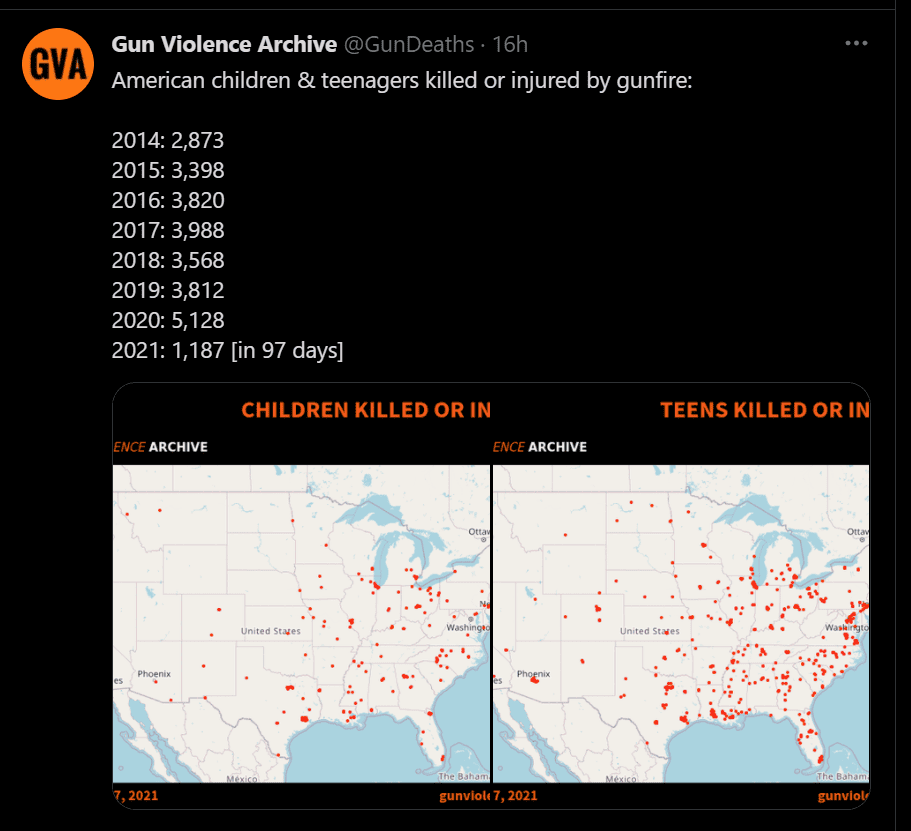
While there were fewer mass shooting incidents (those where at least four people, not counting the shooter, were killed), the Covid-19 pandemic period was one in which there was no slow down in gun-related deaths. In 2020, nearly 20,000 lives were lost to gun violence, according to the Gun Violence Archive. This was the highest number of any year in the last 20 years. The report said that in 2020, an additional 24,000 people died by suicide using a gun.
The next highest year of gun deaths was 2017, but in that year 3,600 fewer people succumbed, The Washington Post reported. The number of injuries caused by guns was also much higher, 40,000 in 2020, compared to 32,000 in 2017.
“The GCA and NFA generally regulate “firearms” and not individual components and, as such, ATF does not classify unregulated components or accessories alone. However, components or accessories can affect the overall classification of a firearm because: (1) How a component or accessory is actually used may be relevant in assessing the manufacturer’s or maker’s intent with respect to the design of a firearm; or (2) the design of a component or accessory may result in a firearm falling within a particular statutory definition. Stabilizing braces are one such component or accessory that ATF has encountered,” the Congressional Research Service said in a February 2021 report.
Image Source: Tweet by the Gun Violence Archive on April 7, a nonprofit that reports American gun violence incidents in near real-time.
Ghost Guns And Stabilizing Braces
What is a ghost gun?
Essentially, ghost guns are self-assembled firearms with parts that do not include serial numbers. As they’re handmade, they do not require background checks and the acquisition of a ghost gun skirts federal gun laws. When you buy a gun from a licensed dealer, and that gun, or more specifically, its receiver, is made by a licensed manufacturer, it is marked. It has a serial number that can be traced, which is invaluable when you’re tracking crimes.
A ghost gun is made from untraceable parts but those parts can be bought separately in stores, or online, and can be put together to make pretty much any gun, including an AR-15.
As things stand, federal gun law regulates aspects of parts, basically the receiver or the frame of the gun, which is considered the actual firearm itself. This “receiver” contains parts of a firearm — like the hammer, bolt, breechblock, firing pin and extractor — that are instrumental in allowing a gun to actually fire.
Under the Gun Control Act, manufacturers are required to mark it with the maker’s name, the serial number (the unique identifier), the model and the caliber. If a gun has multiple receiver parts, like in an AR-15, the lower receiver is considered the legal firearm and is marked. As an unfinished receiver is basically still a piece of metal, it is not considered a firearm and is easily available. To finish it, you have to drill holes into that piece of metal, make a couple of other modifications, combine it with other parts, and that’s basically it. You have a firearm.
Unfinished receivers (also called “blanks”) are unregulated and typically sold to gun enthusiasts. They’ve been used in mass shootings before. You can look this up but I think one was used in the shooting in Santa Monica College, and another ghost gun was used by a 16 year old who shot fell students in Saugus. (Link to both shootings, should be available) 3D printed receivers are also available, including for the AR-15.
What is a stabilizing brace?
It’s basically a modification to a pistol that can effectively turn it into a short-barreled rifle by stabilizing the shooter’s arm. It was reportedly used in the Boulder shooting, allowing the shooter to turn his semiautomatic pistol into a more lethal weapon. The idea behind the reported Biden proposal will be to regulate the braces so they come under the ambit of the National Firearms Act, which regulates sawed off shotguns and other semiautomatic and automatic rifles.
A Mississippi businessman was indicted January 12, 2021 for hoarding and price gouging PPE. Many who heard of such practices have found them distasteful, but did not realize they were actually illegal too. So does that mean there ought to be a law banning it? Yes, there already is one. In fact, these laws go back several decades. Though updated over the years, one of the laws the businessman broke was originally passed as part of the Defense Production Act of 1950 (50 U.S.C. § 4512). Others stretch back even further (18 U.S.C. § 371).
Although what we’re going through right now feels new, in a way it’s not. We’ve been through disasters, emergencies, shortages, and diseases before. We have suffered from people pulling this kind of scheme in times of need before. We’ve passed laws to address this already, but because it’s been so long since the last time something like this happened, many have forgotten, or never learned in the first place that this was a crime.
Ignorance of the law, however, is not a defense. We are responsible for following the law, regardless of whether or not we bother to learn it. It’s not clear whether this businessman knew that what he was doing was illegal, but it is clear that he knew he was endangering people and price gouging during desperate times.
Kenneth Bryan Ritchey Ritchey is accused of having people acquire all N-95 masks they could at normal retail prices ranging from $0.97 to $6.00 per mask, so that he could later resell them for up to $25.00 per mask. He purposefully created a situation in which no one could buy the masks elsewhere because he already had.
Many of us have seen this type of thing happen before with non-critical products, such as collectors items with sentimental value. This is different from that because under Executive order 13909 PPE was declared to meet the criteria for “critical strategic materials.” In other words that means:
“(1) that such material is a scarce and critical material essential to the national defense, and (2) that the requirements of the national defense for such material cannot otherwise be met without creating a significant dislocation of the normal distribution of such material in the civilian market to such a degree as to create appreciable hardship.”
(50 U.S.C. § 4511).
This alone would be enough to get Ritchey into trouble with the law, but he made his situation worse by targeting V.A. hospitals for the expensive resales. Because of that he has now also been indicted under 18 U.S.C. § 371 and § 1349 for conspiring to defraud the United States.
If convicted, Ritchey would have been forced to forfeit all property and proceeds he got through this scheme, and could have faced fines and up to 5 years in prison for conspiracy to defraud the government, and fines and up to 1 year in prison for his violation of the Defense Production Act. (18 U.S.C. § 371 and 50 U.S.C. § 4513).
Ritchey wisely decided to plead guilty. As a result of the plea deal Ritchey will pay about $60,000 in restitution to the V.A. hospital he had price gouged. He will also still have to pay court costs and the fines specified under the laws he’s broken. In addition, the PPE in question was taken into the Attorney General’s office and distributed to first responders and healthcare workers.
To combat such crimes, the Department of Justice created the COVID-19 Hoarding and Price Gouging Task Force after former President Donald Trump issued an Executive Order pursuant to section 102 of the Defense Production Act, which prohibits hoarding of designated items.
The Secretary of the Department of Health And Human Services (HHS) even issued a notice designating certain categories of supplies that must not be hoarded. Those include:
Personal protective equipment (PPE), including masks, shields and gloves
Respirators
Ventilators
Drug product with active ingredient chloroquine phosphate or hydroxychloroquine HCl
If you have information on hoarding or price gouging of critical supplies, you can report it without leaving your home to the National Center for Disaster Fraud by calling the National Hotline at (866) 720-5721 or by submitting the NCDF Web Complaint Form.
The writer is a lawyer and a coder, and a member of the Arizona bar.
They meet in an unusual and rather unexpected setting — at a religious gathering. She takes her time and recounts to the judge in her child protection case what her father has done to her. The judge asks if she has told her advocate. In other places and to other people, her younger brother recounts what she has done to him as well. And yet, they both remain in the family unit with their parents. She is then about nine.
The court finally determines that she should be placed elsewhere, and her parents should have limited access.
The first placement is a self-contained treatment facility with dormitories and a school, and counsellors on staff. She has become so highly sexualized that she cannot stay in class without masturbating. The counselor recommends that she should be allowed to go to the restroom to relieve herself. The theory is that she should idealize a proper story to accompany the masturbation. She should visualize herself dressed in a bridal gown waiting on her husband.
For a year, her advocate requested a change of location.
The next placement center had a reward system in place that allowed two girls to live in apartments on the property after being awarded a particular number of points. At 12, she was allowed to live in one of these apartments. This center with the apartments was out in the country along the I-35.
And then, suddenly, she was taken from this placement to a small-town foster home that held 10 girls. The girls were encouraged to get jobs after school, handle their money, and get their driver’s licenses. At all these placements, she received counselling, schooling, medical care, and all that living requires — clothes, linens, cooking basics, chores, etc.
While at this placement, she attached herself to a young man in town with whom she decided to start a family. Because she was 17 by this time, she could leave the foster care system.
She had her first child with this man. By the time I lost touch with her, she had given birth to four babies, by four different fathers, and was living on the street in a city. She was then 22.
She was the first and longest running CASA case I had. After she left care, I was the advocate for her children.
Every Case Is Different
The other cases were not as hard, but each had its own complexities. I have had teenaged girls who ran from placements, decided to move in with older men, became violent and destructive in homes, did drugs, along with those that never relied on anyone but themselves.
But then there are others. I also had a case of five siblings that were fostered and adopted by a young couple who could not have children. The couple, in turn, were supported by a church filled with children and an extended family. Two of the children my first child birthed were adopted by their fathers. One was adopted by the father’s family.
Source: U.S. Department of Health and Human Services, Administration for Children and Families, Administration on Children, Youth and Families, Children’s Bureau. These are estimates for Fiscal Year 2019, based on data as of June 23, 2020.
It’s A Painful, Complex Process
In 2019, approximately 424,000 children were in the foster care system in the United States. Of these, 158,258, or 63%, were there because of neglect, 34% because of a parental drug problem, 13% because of physical abuse, 7% because of parental incarceration, and 4% because of sexual abuse. Some had more than one cause listed as a reason for their removal from parental custody, which is why these numbers won’t make up a neat 100%.
The median age of these children was 7.7 years, but nearly one-third, or 31%, were under the age of three.
What is it like to be in foster care? What is the goal? When I was working with children, the goal was to stabilize the child’s life as soon as possible. The best case was that the child and parents would heal and be reunited. All parties would get counseling. The state set a limit of 18 months for parents to be able to support the family, provide a safe home, and get through any court-ordered requirements.
Why do courts want to send children back when possible? Because while a child is in care, nothing is stable. They are with people they don’t know. They are not allowed to be with a parent without a supervisor. They feel they have to tell people why they are not with their parents, but they really aren’t sure … and they are embarrassed and guilty. They think it is their fault that they are separated. They want to go back to their parents. When they see their parents, it is a stiff reunion in a strange room, with strange, stock furnishings, and a stranger watching. They do not have their own things at the placement.
Source: U.S. Department of Health and Human Services, Administration for Children and Families, Administration on Children, Youth and Families, Children’s Bureau. These are estimates for Fiscal Year 2019, based on data as of June 23, 2020.
Then they are told they can no longer see their parents. They are wards of the State. The State will determine where they live, who they see, what classes they take. In a normal setting, the parents give permission for going to birthday parties, for sleepovers. Now, even parents of “friends” need to pass a background check in order for the “friends” to visit. Granted, the State is responsible for the wellbeing of children, but if it is embarrassing for a child’s parents to ask what the friends’ parents do or where they live, imagine having to ask them to pass a background check! And how long does it take to set up the check and get the results?
One more thing. A child protection case worker and a CASA can also, typically, see a child in their school environment. A child can be pulled out of classes for these meetings. These are children who are usually behind in school. And their classmates know why they are being called out. Another source of embarrassment.
What’s the answer? Texas is under orders to get more foster parents and homes and have better systems in place. According to data sourced from the Department of Health and Human Services’s Children’s Bureau, for fiscal year 2018, 63,271 children in Texas were found to be victims of maltreatment, of which 42% of victims were found to be below the age of three. Only 56% received post response services, while the average time from the receipt of a report to the initiation of services was 59 days.
But the solution is not as easy as setting up tents. People need to have a calling to be a foster parent. They need to have training. They need to be able to support themselves and the children. The foster parent will need to have flexible enough schedules to take a child to all their counseling and medical appointments. They will need to take continuing education classes and be able to go to court monthly and meet with the child protection case worker and the CASA regularly. They will also need to take the children to meet with the case worker and advocate weekly.
After a year of isolation during the pandemic, unfortunately, cases have increased. There is also little doubt that cases have gone unreported because children have not left their homes. They have not seen by teachers and others in weeks.
The system has no answers. Not quite yet at least.
Note: Court Appointed Special Advocates (CASA) and Guardian Ad Litems (GAL) are appointed by courts to gather information and advocate in the best interests of children who have been abused, neglected or exploited. They are required to also keep the child’s wishes in mind while doing this. According to the NationalCASA/GAL Association, there are more than 93,000 volunteers nationwide, serving in 49 states and the District of Columbia.
(The writer served her local CASA organization in Texas, both on the Board and as an advocate, for 21 years. Although she no longer serves directly, she still supports the work. She is a retired mother/stepmother of five and grandmother of 10.)
There were more law enforcement officers who died from suicide than those that died in the line of duty in 2017, 2018 and 2019. There were 168 such deaths in 2017, followed by 172 in 2018, and 228 in 2019 according to Blue H.E.L.P., a nonprofit.
The last three years have seen an increase in reported cases of death by suicide in the law enforcement profession, said Blue H.E.L.P., which is dedicated to acknowledging “the service and sacrifice of law enforcement officers we lost to suicide.” This year, too, kicked off with a tragic reminder of just how vulnerable our law enforcement professionals can be, with the deaths by suicide of Capitol Police Officers Howard Liebengood, and Jeffrey Smith in the aftermath of the Jan. 6 attack on the U.S. Capitol.
As part of the fiscal year (FY) 2020 appropriations process, the Senate report on the appropriations bill expressed that the Congress is “disturbed by increased reports of suicide by current and former law enforcement officers.” And on the Congress’s request, the Department of Justice’s (DOJ) Office of Community Oriented Policing Services (COPS) completed a report on the increase in death by suicide of current and former law enforcement officers.
The COPS was created with the passage of the Violent Crime Control and Law Enforcement Act of 1994 to assist law enforcement agencies in enhancing public safety through the implementation of community policing strategies.
Congress passed the Law Enforcement Suicide Data Collection Act in June 2020, which was a major start to recognizing the magnitude of the problem. And it is a problem. Two studies using the National Violent Death Reporting System (NVDRS) looked at deaths by occupational groups in 2015 and 2016 and found that the rates are higher than many other occupational groups for both male and female officers.
The COPS Report also mentioned that the National Consortium on Preventing Law Enforcement Suicide, created in 2018 with funding from the Bureau of Justice Assistance, “identified a number of knowledge gaps that persist even as greater attention is given to the problem of law enforcement suicide. These gaps include a lack of assessments on the quality of care provided by in-house behavioral health professionals, the role of resilience training in reducing suicide risk, and the role of families as both risk and protective factors.” One major factor in getting help, for law enforcement professionals, is the stigma associated with mental health and wellness.
The report was made public on April 6, and provides a review of peer responder programs, and makes recommendations for establishing evidence-based behavioral health and suicide prevention efforts for both law enforcement and other first responders.
“Officers are the most important resource agencies have, and every effort should be made to protect this investment made in our nation’s safety and security. Healthy officers are necessary to healthy communities. We must do what we can to prevent those thoughts of suicide from becoming actions,” the report says.
Many commentators within law enforcement think even these numbers undercount the true extent of the problem, the report says, adding that the increases Blue H.E.L.P. is reporting may actually be a function of improving awareness of that organization and “the need not to hide these tragic deaths.”
Since 1999, half of all states have seen 30% increases in suicide rates, and all but six had significant increases, the report says. While an increase in officer deaths could be a part of this general societal trend, there are other factors that need to be considered. Those factors include high exposure to stress and trauma, a plethora of other conditions for which officers seem to be at high risk (including post-traumatic stress disorder [PTSD], depression, anxiety, cardiovascular disease, and addiction), and officer access to firearms: All of which suggests that one cannot assume that occupational factors do not matter.
“In the 2010s, suicide was the 10th leading cause of death in the United States. In 2018, more than 48,000 Americans died by suicide, half of those using a firearm. Although some segments of the population have higher rates of suicide than others, no part of our society is immune,” the report said.
Add to this access to firearms and one study that said “suicidal ideation is more prevalent among law enforcement officers than the general population,” and it becomes clear why this report was needed.
“One of the top priorities of the Department of Justice and the COPS Office is the health and wellness of the nation’s law enforcement officers, who put both their physical and mental health on the line every day to keep our communities safe,” said Robert Chapman, Acting Director of the COPS Office. “The Department has committed numerous resources to this effort and will continue to do so.”
Police officers die by their own hands at rates greater than people in other occupations, according to a report compiled by the Police Executive Research Forum in 2019, after at least nine New York City police officers died by suicide that year. That report said officer suicides outpace deaths of law enforcement members killed in shootings and vehicular crashes.
The white paper study, the Ruderman White Paper on Mental Health and Suicide of First Responders, examines a number of factors contributing to mental health issues among first responders and what leads to their elevated rate of suicide. One study included in the white paper found that on average, police officers witness 188 ‘critical incidents’ during their careers. This exposure to trauma can lead to several forms of mental illness.
For example, PTSD and depression rates among firefighters and police officers have been found to be as much as 5 times higher than the rates within the civilian population, which causes these first responders to commit suicide at a considerably higher rate (firefighters: 18/100,000; police officers: 17/100,000; general population 13/100,000). Even when suicide does not occur, untreated mental illness can lead to poor physical health and impaired decision-making.
After a review of current resources and research, the COPS report states that all evidence “constantly circles back to the importance of peer support and behavioral health partnerships.” In addition, the report finds that “Training is also critically important to supporting officer mental health and suicide prevention. Colleagues, supervisors, and managers are all important players in suicide prevention efforts, as they are the ones who may see the signs that an individual is struggling.”
The report stresses that departments that have been successful in lowering suicide rates were typically ones that focused on education and training of individuals in the area, as well as creating support networks such as peer-to-peer programs.
The report also warned that there was still an issue that needed addressing, the fact that the culture within law enforcement meant that a majority of individuals still feared the stigma or consequences when it came to asking for help with mental health challenges.
Peer-led prevention programs, strengthening laws so that officers seeking help are protected, and improving confidentiality within agencies were some of the steps the report recommended in order to strengthening the resources currently in place to deal with these issues.
The report warned that much more needed to be done. “Unfortunately, there is limited analysis on the efficacy of mental health and wellness programs in a police department, resulting in the lack of a clear and concise pathway to preventing officer suicides that result from daily stressors and untreated trauma,” the report said, while laying out the difficulties that existed.
For nearly 20 years, Theodore “Ted” Kaczynski, known to the world as The Unabomber, terrorized Americans, planting bombs at various locations, killing three people and injuring many more.
Kaczynski was eventually captured on April 3, 1996, after his idiosyncratic writing style led investigators to him. It’s been 25 years since that historic capture.
The UNABOM Task Force was led by Terry Turchie of the Federal Bureau of Investigation, and he remembered the words of a creative writing teacher, who had said: No two people write alike.
Kaczynski was active for nearly two decades, but managed to evade arrest because he was meticulous about leaving no evidence behind. He planted his first bomb in a parking lot of the University of Illinois’ Chicago Circle Campus in 1978.
After that, Kaczynski left bombs near computer stores, in university buildings, and even managed to get one on an airplane. Kaczynski also mailed powerful bombs to businesses, executives and university professors. In total, three people died and two dozen were injured by bombs he had placed.
“He was the most careful serial bomber anyone had ever seen,” Special Agent Kathleen Puckett, was quoted as saying by the FBI on the 25th anniversary of Kaczynski’s capture. Puckett worked on the UNABOM Task Force and led efforts to profile the bomber, who eventually turned out to be Kaczynski.
It was Kaczynski’s communications, to victims and to the media, that led law enforcement to his doorstep, a remote cabin in the Lincoln, Montana, wilderness that had no running water or electricity.
“We didn’t have any line to him except the letters he started sending in 1993,” said Puckett. “It was a bonanza of information.”
The communication from Kaczynski gave investigators a window into how his mind worked, the ideas he held dear, topics that he studied and the books that were important to him.
The letters from Kaczynski also gave profilers valuable clues into his education, age and personality.
After the bombings in 1994 and 1995 that claimed lives, Kaczynski sent his manifesto to various outlets, demanding they be published to memorialize his achievements and ideology.
“The writings were very passionate—that there’s no question this man really believes in what he’s writing here. So he probably held these beliefs his entire life,” said Turchie, adding, “Somebody would recognize this.”
A few months after the 35,000-word manifesto was published by the New York Times and the Washington Post, a lawyer representing David Kaczynski got in touch with the FBI.
David Kaczynski provided authorities with a 23-page essay written by Theodore Kaczynski in 1971.
Investigators instantly spotted similarities, with the phrase “sphere of human freedom” catching Turchie’s attention.
In his manifesto Kaczynski had written: “We are going to argue that industrial-technological society cannot be reformed in such a way as to prevent it from progressively narrowing the sphere of human freedom.”
There were several other points of comparison, beginning with the British spelling of the word analyse, rather than the American analyze.
While the writing style finally gave the FBI a suspect, it was other evidence, including research into Kaczynski’s past, that ensured that a warrant to search Kaczynski’s cabin was issued.
The search yielded enough evidence to nail Kaczynski, and included thousands of pages of handwritten notes which included confessions to all 16 bombings.