Tech Support : support@safience.io

Blog

Getting Back To Business: How Casino Ops Are Focusing On Employee And Public Safety

By Michael P. Johnson

Prior to March 2020, when walking through the front doors of any casino resort hotel, whether it was on the Las Vegas Strip, in Atlantic City, or on the Mississippi Coast, you would typically spot a security officer, or two, or three, depending on the size of the resort, but not much else. Someone may have been standing there to check your identification or give you a general look over. Typically, no one really got worried about anything other than whether you were old enough to be in the casino.

Skip ahead a few months, and things have changed drastically. For one, many casino employees recently came off furlough. Some may not have come back at all. If you had once been a regular patron at any casino in the United States, and have only now returned to your local casino, you might notice that your favorite beverage server or bartender is missing, when you go to order a drink. Every dealer may not have made it back due to shortened casino hours. Your blackjack game may not be as great without your normal dealer.

When you walk through the front doors now, you’ll likely be met by someone wanting to take your temperature. They’ll give you a mask to wear should you not have one. Hand sanitizing stations are at your every turn. And if you’re a smoker, it’s a strong possibility that many casinos won’t allow you to light up. You see, you have to keep your mask on at all times, except for sipping a drink. Things have changed.

There have been capacity restrictions on just how many individuals can enter the casino. Where you’re at in the country and how many cases of Covid-19 are in your state depends on what your casino’s capacity restriction falls.

The map below represents casino closings in the U.S. on July 2, 2020.

Capacity restrictions.

Capacity restrictions are interesting. Before the pandemic, you walked in and went straight to a machine or table game. No fuss. An identification check to make sure you’re of age probably occurred at some point, but now, it’s a bit different.

If the casino is busy, let’s say it’s a Friday or Saturday night, you’ll find yourself waiting in line, having your ID taken, scanned, and temperature taken. You’ll then be one of many numbers. At the entrance, once the security officers hit a certain number of people entering the property, they will stop the line. No one else will be able to enter.

Let’s say the casino is set at a 50% capacity restriction. There may be a total of 2,200 slot machines in the building. The executives then make it easy and say only 1,100 people can enter the casino (i.e.50% of the machines). When this occurred, every other machine would be placed out-of-service, so there would be only 1,100 machines in service for the 1,100 people allowed in the casino. As soon as there are people seen leaving the building, only the same number of people would be allowed to enter.

Different states have different rules, as well. For instance, you may have entered a casino in Arkansas and found the capacity restriction was set at 50%. You then drove down the highway a few miles and entered a casino in Mississippi, and the capacity restriction was a little higher, and no one was taking temperatures at the door as you walked in. It all depends on where you were located and the local regulations.

The state of Maryland, just this week, has loosened its restrictions. Only a few weeks ago, Maryland casinos had been following 25% to 50% capacity restrictions. The total gaming revenue for Maryland’s six privately-owned casinos in February was down 16.6% from a year ago.

Every state acts differently, and continues to do so. Some continue to lift their mandates. Others stand firm and continue to be strict.

Lifting mandates.

In several states across the country, governors have begun to lift specific Covid-19 mandates. Texas, Maryland, Connecticut, Mississippi, Arizona, West Virginia, and Wyoming have gone ahead with their plans to lighten the restrictions as more people have been receiving vaccinations and Covid-19 cases have dipped.

Nevada Governor Steve Sisolak announced two weeks ago that all businesses in the state would be allowed to open their doors to patrons at 50% capacity. According to Sisolak, Nevada has moved on from record infection and hospitalization rates, but the numbers are still too elevated for people to let their guard down. Clark County was pretty specific in their requirements.

Covid-19 and vaccinations.

Around the same time, the Scarlet Pearl Casino Resort in southern Mississippi came out and informed everyone that they would be giving their hourly employees $150 for each vaccination shot they received. Should the employee receive a Pfizer or Moderna vaccination, they would be paid $300. If they accept the Johnson & Johnson vaccination, they’d be paid $150.

According to the CEO of the Scarlet Pearl, LuAnn Pappas, should the employee have had their vaccination before this announcement, they would be compensated retroactively. Another interesting aspect of the Scarlet Pearl announcement was that they have partnered with Gulfport’s Memorial Hospital to have an onsite vaccination area on their property. With this, employees at the Scarlet Pearl won’t have to go too far to receive their injections.

Doing what the Scarlet Pearl has done for their employees is essential. Vaccinations have proven to be safe so far, and the side effects mostly minor for the vast majority of the tens of millions who have received the vaccine, yet, many people are still a little hesitant about actually getting vaccinated.

In conclusion, as restrictions are being lifted throughout the country, it’s essential to stay safe. With state governors lifting state mandates but the pandemic still around, casinos are figuring out different ways to prioritize employee and patron safety and yet run a business.

About the writer: Michael P. Johnson is a technology writer from the Greater Memphis Area. Mr. Johnson has almost two decades of experience in the casino industry, utilizing tech daily. You can read more about his work on his website, or reach him at michael@mpjwritesfreelance.com. You can also write to us: marketing@safience.io

Derek Chauvin’s Trial Began Today: Here’s A Quick Overview Of What You Need To Know

By Anand Vasu

On March 29, 12 jurors and two alternates in Minneapolis started to hear opening arguments in the trial of Derek Chauvin. It began with the video of Chauvin kneeling on George Floyd’s neck being shown to the jury.

This comes ten months after the death of African American Floyd at the hands of Chauvin, a White, 19-year-veteran of the Minneapolis Police Department. The officer pressed his knee into Floyd’s neck for several minutes, an incident that went on to cause worldwide uproar. 

Chauvin is charged with second-degree murder, third-degree murder, and manslaughter. The trial, which is expected to last weeks, is being broadcast live. For live updates, you can also take a look at the New York Times website here.

Jury selection took two weeks and those eventually picked admitted that they were aware of the responsibility they were taking on, and said that they knew the world would be watching this trial. 

At a church in the vicinity of where the original incident happened, with Floyd’s family in attendance, the choir sang: “It’s been a long time coming, but I know a change is gonna come.”

Shortly before the service, Philonise Floyd, George Floyd’s brother, said that he was confident that prosecutors from the Minnesota attorney general’s office would see Chauvin convicted. “The video is the proof,” Philonise added.

The defense is likely to lean on medical evidence that will suggest that Floyd’s death was not a murder, and that his death was a result of pre-existing medical conditions and drugs in his system, CBS Minnesota reported.

The medical examiner’s report has found that there were “potentially lethal levels of fentanyl” in Floyd’s body. Fentanyl is an opioid used as pain medication, and in conjunction with other drugs can act as an anesthetic. 

“I think what he is going to hit hard on opening statements is that this case is about cause of death. The cause of death versus use of force,” Joe Tamburino, a criminal defense attorney not affiliated with the case, told CBS Minnesota. “That’s the running battle in this case and I think that’s what he is going to hit hard, which is this is all about cause of death being a natural cause or a cause because of drug use.”

Chauvin faces three charges, of which second-degree murder carries the highest penalty: Imprisonment for up to 40 years. According to state statute, the prosecution will have to prove that Chauvin caused Floyd’s death “while committing or attempting to commit a felony offence.” The felony offence referred to in this case is assault.

Third-degree murder carries a penalty of up to 25 years while second-degree manslaughter carries 10 years. The last charge carried the lowest burden of proof and prosecutors would have to prove that Floyd’s death was caused by Chauvin’s negligence in creating “an unreasonable risk,” and “consciously (taking) chances of causing death or great bodily harm to another.”

State Attorney General Keith Ellison is leading the prosecution while Eric Nelson will appear in Chauvin’s defense. Chauvin’s legal defense is being covered by the Minnesota Police and Peace Officers Association. Despite being fired by Minnesota Police, Chauvin is eligible to have his legal expenses covered.

Hennepin County Judge Peter Cahill is presiding over the trial. Cahill was appointed to the job in 2017 and elected in 2018. 

Four Kinds Of Offenses Made Up Nearly 87% Of Cases In FY 2020: Sentencing Commission Report

By a Biometrica staffer

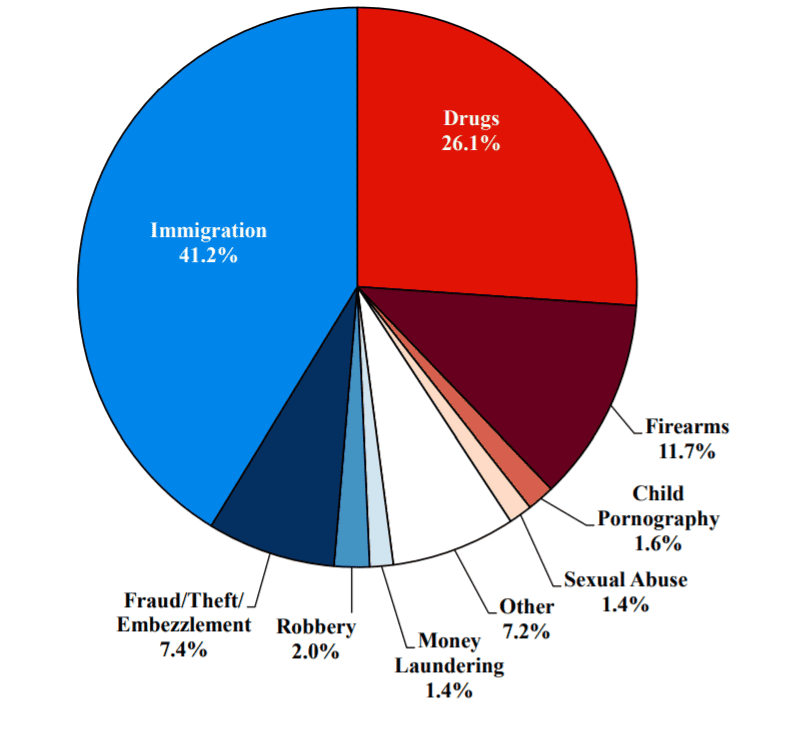
Image Source: Screengrab from the Sentencing Commission’s FY2020 preliminary report showing federal offenders by type of crime

Four types of offenses accounted for 86.4% of all reported cases to the United States Sentencing Commission (called “the Commission” hereon) in fiscal year 2020, according to preliminary data for the period. Of those, immigration cases made up the largest single group of offenses at 41.2%, followed by drugs, firearms, and fraud.

The Commission was created by the Sentencing Reform Act provisions of the Comprehensive Crime Control Act of 1984. It is an independent agency in the Judicial Branch of the federal government.

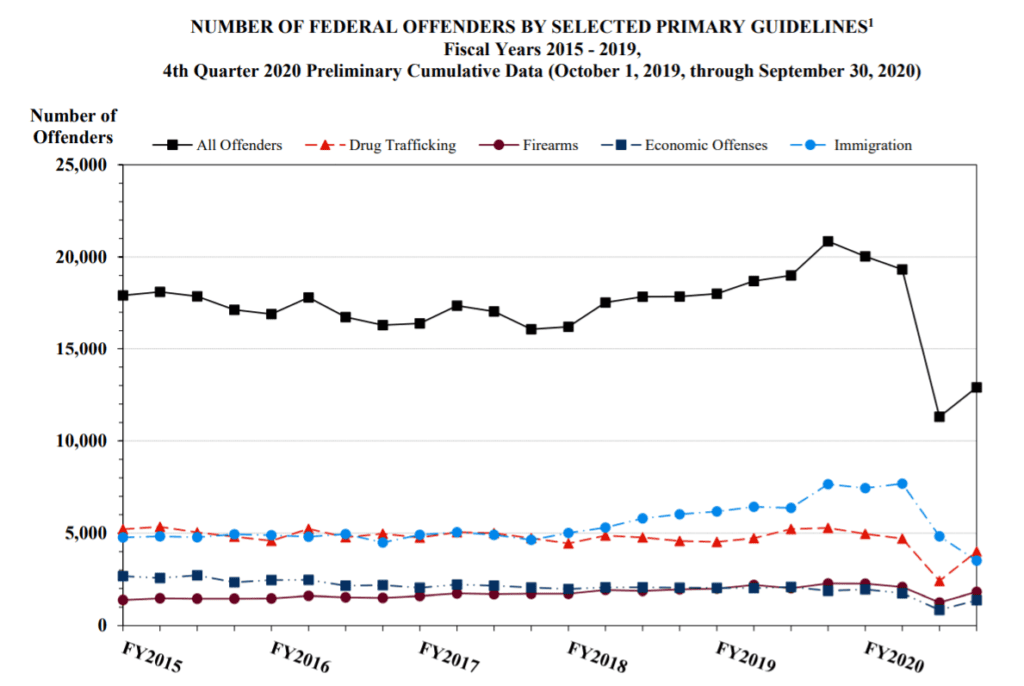
In FY 2020, i.e. data for the year starting Oct. 1, 2019, through Sept. 30, 2020, the courts submitted about 300,000 documents reporting 64,565 felony and Class A misdemeanor cases to the Commission. That’s 11,973 cases less than those reported in FY 2019, reflecting the effects of the Covid-19 pandemic on the work of the courts, the Commission said in its annual report.

Within those four kinds of offenses, immigration offenses accounted for a larger slice of the pie than they did the year before, when they made up 38.4% of all cases.

Image Source: Screengrab from the Commission’s FY2020 preliminary report

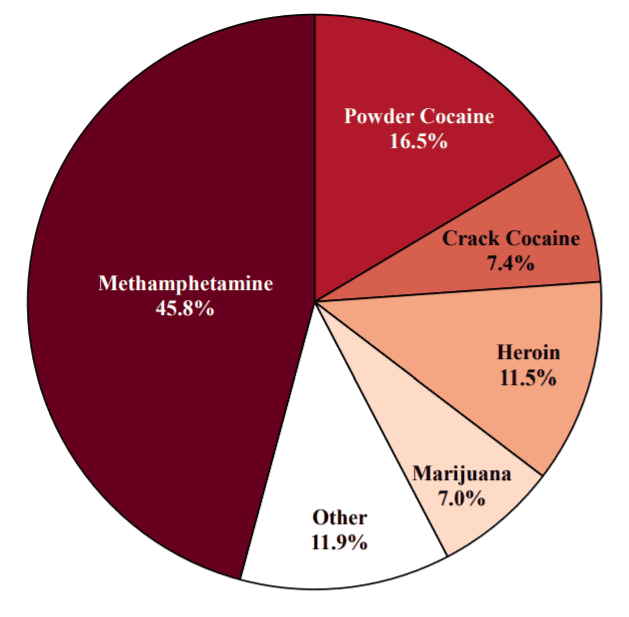
Among drug offenses, those involving methamphetamine were most common, making up 45.7% of all drug cases. Two-thirds (or 66.9%) of drug offenders were convicted of an offense carrying a mandatory minimum penalty, compared to 65.7% of drug offenders in FY 2019.

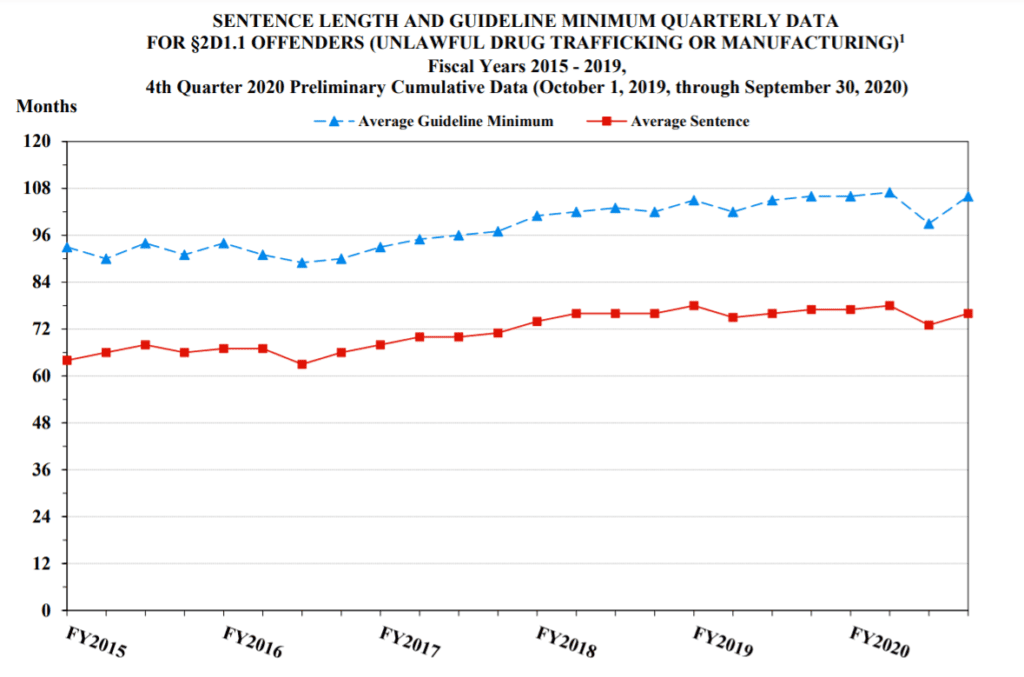
The average length of imprisonment in methamphetamine cases was unchanged from FY 2019 at 95 months (or nearly 8 years). However, the average sentence imposed decreased across the other major drug types: in crack cocaine cases it went to 74 from 78 months, in powder cocaine cases and in heroin cases it went to 66 from 70, and in marijuana cases to 29 from 31.

Image Source: Screengrab from the Sentencing Commission’s FY2020 preliminary report showing the distribution of primary drug type in federal drug cases

Almost three-quarters (or 73.7%) of all offenders received sentences under the Guidelines Manual, in that the sentence was within the applicable guideline range, or was outside the applicable guideline range and the court cited a departure reason from the Guidelines Manual. Just over half of all sentences were within the guideline
range, compared to 51.4% in FY 2019.

The Commission And Its Focus In Recent Years

The Commission consists of up to seven voting members appointed to staggered six-year terms by the President with the advice and consent of the Senate. By statute, at least three of the commissioners shall be federal judges, and no more than four may be members of the same political party. The Attorney General (or the Attorney General’s designee) and the Chairperson of the United States Parole Commission are ex officio members of the Commission.

For FY 2020, the Commission said it received an annual appropriation of $19,670,000 to continue to fulfill statutory duties envisioned by the Sentencing Reform Act of 1984. It did not request program increases for FY 2021. 

It continually releases a substantial amount of new and informative sentencing data, research, and training materials. In June 2020, the Commission launched a new Interactive Data Analyzer. Using this tool, Congress, judges, litigants, the press, and the general public can now easily and independently analyze sentencing data by their state, district or circuit, and can refine their inquiry to data relating to the specific type of crime of interest. The data analyzing tool can be accessed here, although it does not have the new preliminary data yet and only displays data for FY 2019.

In recent years, the Commission has focused on recidivism research to help inform Congress and others on how best to protect public safety while targeting scarce prison resources on the most dangerous offenders. In FY 2020, the Commission released the last in a series of reports that examined in great detail the 25,431 U.S. citizen federal offenders released from prison or placed on probation in 2005, and studied their recidivism over an eight-year follow-up period.

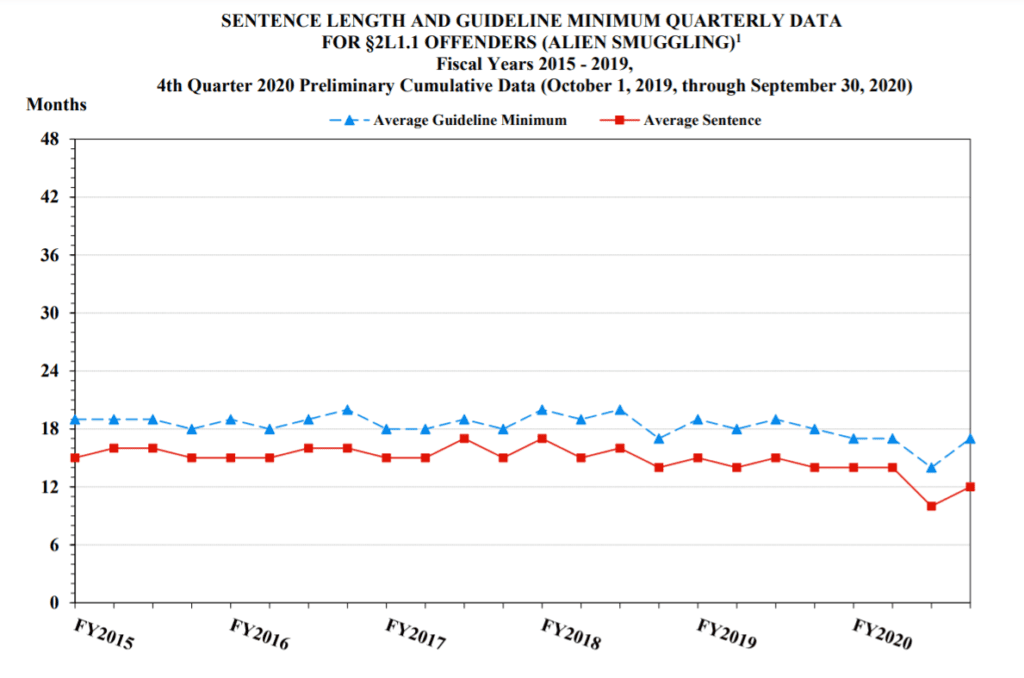
Image Source: Screengrab from the Commission’s FY2020 preliminary report

The last report in the series, Length of Incarceration and Recidivism (April 2020), found that offenders incarcerated longer than 120 months were 30-45% less likely to recidivate than a comparable group who received shorter sentences. At the other end of the spectrum, however, the study could not find sufficiently reliable evidence to conclude that shorter incarceration lengths of 12-24 months have either a criminogenic or deterrent effect.

Also in FY 2020, the Commission released a study on the impact of the retroactive application of its 2014 “Drugs Minus Two” amendment on recidivism. The “Drugs Minus Two” amendment reduced by two the offense levels assigned to each drug quantity in the drug trafficking guideline, and as a result about 31,000 federal offenders received a retroactive sentence reduction of 25 months on average. The Commission compared these offenders with a comparable group who served their full sentences and found no statistical difference in their recidivism rates (roughly 28% for the retroactivity group, and 30% for the full sentence group). 

In FY 2021, the Commission will release another report studying the recidivism of offenders sentenced under the Armed Career Criminal Act. Recidivism research will continue to be a major focus of the Commission in FY 2021, 2022 and beyond, it said in its FY 2020 preliminary data report. 

Image Source: Screengrab from the Commission’s FY2020 preliminary report

Can A Prospective Employer Run A Background Check On You?

By a Biometrica staffer

The short answer, yes. The longer answer is that yes, they can, but for most kinds of background checks, including obtaining a criminal background check report, running a credit check, or information on school transcripts, they need permission from you in writing to do so, on a standalone form. Could they look up other information without checking with you, including and not limited to your social media profiles? Yes, of course, and they typically do, but generally speaking, a responsible employer will get you to sign off on a form in any case, to prevent any whiff of a violation of privacy norms.

Additionally, in addition to federal guidelines on background checks, an employer has to be cognizant of state laws as to when they can run a background check on you and what checks they can run or what questions they can ask. For instance, 36 states and around 150 local jurisdictions have “ban-the-box” laws in place, which do not prevent employers from asking about your arrest or conviction record but do prevent them from asking until a certain stage in the employment process. This could be after the first interview, or only after you receive a conditional offer of employment. This is so a candidate can be assessed first based on his or her qualifications for the role, without any potential bias.

(Note: Do read this excellent piece by the team at the National Employment Law Project for more on this).

Various states and local jurisdictions (cities or counties) also have additional requirements. For instance, employers based in California cannot ask a job applicant about their salary history, though there are a couple of exceptions, for instance, if that history is already public information, or you have volunteered it. In addition, an employer cannot use any applicant’s salary history as a factor in determining either whether to make an offer of employment or what salary to offer.

Can You Refuse To Sign Off On A Background Check Form?

Technically, yes, but that’s a red flag for most employers, and you’re likely not going to be the top candidate. If there’s something in your past, for instance, an arrest or a conviction that a background check may reveal, it’s probably best to bring it up yourself if you’re further down in the process of being hired. Depending on what the arrest (if recent and in dispensation, i.e. the case is pending) or conviction was for, and what role you’re applying to, prospective employers may opt to treat situations on a case-by-case basis. An arrest or conviction for a violation of a fishing license has no bearing on most roles, unless you’re applying for one in a forestry or wildlife service or conservation job. An arrest — if under dispensation — or a conviction for a sex offense in any job where people may be “at risk,” or selling drugs, or aggravated assault is almost always a problem.

Under federal law, arrests that are more than seven years old cannot be included in a consumer report, unless the position has an annual salary of more than $75,000. There is no time limit for conviction records, but then it comes down to state law. Some local jurisdictions, however, have laws that prevent an employer from taking an arrest or conviction into consideration unless it applies to business necessity or job function.

Still, according to the EEOC, an employer may ask you for any kind of background information, “especially during the hiring process.” For example, some employers may ask about your employment history, your education, your criminal record, your financial history, your medical history, or your use of social media, depending on the role you’re applying for and state law regulating that in your state. 

According to the EEOC, “Unless the employer is asking for medical or genetic information, it’s not illegal to ask you questions about your background, or to require a background check. (Employers aren’t allowed to ask for medical information until they offer you a job, and they aren’t allowed to ask for your genetic information — including family medical history — except in very limited circumstances).”

However, when an employer asks about your background, it has to treat you exactly the same as any other individual, regardless of your race, national origin, color, sex, religion, disability, genetic information (including family medical history), or age (40 or older). “For example,” says the EEOC, “an employer is not allowed to ask for extra background information because you are of a certain race or ethnicity.”

What Does EEOC Guidelines Being Applied Equally To Criminal Records Mean?

When an employer treats criminal history information differently for different applicants or employees based on their race or national origin (disparate treatment liability), it will be considered a violation of EEOC guidelines. Further, “an employer’s neutral policy (e.g., excluding applicants from employment based on certain criminal conduct) may disproportionately impact some individuals protected under Title VII, and may violate the law if not job related and consistent with business necessity (disparate impact liability).”

However, compliance with other federal laws and/or regulations that conflict with Title VII is a defense to a charge of discrimination. The EEOC enforces Title VII of the Civil Rights Act of 1964 (Title VII) which prohibits employment discrimination based on race, color, religion, sex, or national origin. You can read more about applicability of this and what the EEOC and FCRA guidance on background checks say here.

What Do You Do If You Think That A Background Check Was Discriminatory?

You could contact the EEOC by visiting its website at www.eeoc.gov, or by calling 800-669-4000 (voice) or 800-669-6820 (TTY). The EEOC is responsible for enforcing federal laws that make it illegal to discriminate against a job applicant or an employee because of the person’s race, color, religion, sex (including pregnancy), national origin, age (40 or older), disability, or genetic information. The EEOC investigates, conciliates, and mediates charges of employment discrimination, and also files lawsuits in the public interest.

Here is more for specific information related to the following:

  • Preemployment medical inquiries: see Preemployment Disability-Related Questions and Medical Examinations at www.eeoc.gov/policy/docs/preemp.html.
  • Medical inquiries during employment: see Questions and Answers: Enforcement Guidance on Disability-Related Inquiries and Medical Examinations of Employees Under the Americans with Disabilities Act (ADA) at www.eeoc.gov/policy/docs/qanda-inquiries.html.
  • Genetic inquiries, including inquiries about family medical history: see Background Information for EEOC Final Rule on Title II of the Genetic Information Nondiscrimination Act of 2008 at www.eeoc.gov/laws/regulations/gina-background.cfm.
  • Using arrest and conviction records to make employment decisions: see Questions and Answers about EEOC’s Enforcement Guidance on the Consideration of Arrest and Conviction Records in Employment Decisions Under Title VII at www.eeoc.gov/laws/guidance/qa_arrest_conviction.cfm.
  • Whether arrest and conviction records act as an automatic bar to all employment: see Reentry Myth Buster: On Hiring/Criminal Records Guidance at csgjusticecenter.org/wp-content/uploads/2012/11/Reentry_Council_Mythbuster_Employment.pdf.

If an employer got your background report without asking your permission, or rejected you without sending you the required notices based on an consumer or investigative report, you could contact the FTC at www.ftc.gov, or by calling 877-FTC-HELP (1-877-382-4357) (voice) or 866-653-4261 (TTY). For further information, see the following links:

Federal Ban On Bump Stocks Put On Hold

By Anand Vasu

The U.S. Supreme Court, on Thursday, March 25, declined to block an initiative banning bump stocks, the modification that allows semi-automatic rifles to fire bullets at nearly the same frequency as fully automatic rifles or machine guns.

Delivered in a one-sentence order, the court’s action means that the regulation will remain in force while challenges to it move forward in the courts. There were no noted dissents.

The bump stock is one in which the standard stock, the part of the rifle which rests against the shoulder, is replaced by one that allows the user to harness the kickback of the rifle to keep firing, while maintaining pressure on the trigger.

With the bump stock, the butt of the rifle recoils onto the shoulder and if the finger was kept pressed on the trigger, the kickback action that results from firing the first bullet results in a back and forth motion. The name is derived from the fact that the stock bumps against the shoulder and returns to its original position.

The Trump administration had sought to restrict the use of the bump stock after it was found that 12 of the rifles used by the Las Vegas gunman in the 2017 massacre of concert-goers that led to 58 deaths were of the bump stock kind. (You can read more on our analysis of the Las Vegas shooting, mass casualty incidents and their investigations, here).

In the aftermath of that incident, the National Rifle Association said it would support tighter restrictions on similarly modified devices. However, the March 24 Supreme Court ruling ensured that the bump stock would continue to be a legal firearm.

It is illegal for private citizens to own a fully automatic firearm that was produced after May 19, 1986, and any fully automatic weapons of an earlier vintage required the owner to possess a federal license.

“The classification of these devices depends on whether they mechanically alter the function of the firearm to fire fully automatic,” Jill Snyder, a special agent in charge at the Bureau of Alcohol, Tobacco, Firearms and Explosives, was quoted as saying by the New York Times. “Bump-fire stocks, while simulating automatic fire, do not actually alter the firearm to fire automatically, making them legal under current federal law.”

In 2019, a regulation came into effect, giving owners 90 days to dispose off or destroy any bump stock weapons they possessed, or hand them over to the Bureau of Alcohol, Tobacco, Firearms and Explosives.

The agency provided detailed instructions on how to dispose of such weapons, with “crushing, melting or shredding,” being the recommended ways of doing so.

At the time, Michael E Hammond, a lawyer with the Gun Owners of America, recommended that all owners followed the regulation but warned that it would be hard to enforce, given that there were likely in excess of 500,000 people who owned bump stocks, and they were unlikely to turn these weapons in.

While the Justice Department initially believed it did not have the authority to ban bump stocks without Congressional intervention, it went ahead with the ban. This was subsequently challenged in a federal trial court in Michigan. 

Gun owners contended that federal law did not provide for the executive branch’s restrictive action, adding that the regulation would mean that weapons worth $100 million would have to be destroyed in the process.

All About The Latest 9th Circuit Ruling On Gun Control

By Charlotte Spencer

On Wednesday, March 24, 2021, there was a key ruling in the long legal battle between gun rights activists and gun control activists in the United States. It won’t be the last ruling on gun regulation by far, but it will get us one step closer to an answer on how the Supreme Court sees the matter, as the losing side has already stated that they will take this to the Supreme Court.

What Led Up To This Case?

The Plaintiff-Appellant in this case, George K. Young Jr., challenged Hawaii’s firearm licensing law, Hawaii Revised Statutes § 134-9(a). This law allows the Chief of Police to grant a license to carry concealed a pistol or revolver and ammunition if:

  • It is an exceptional case AND
  • An applicant shows reason to fear injury to the applicant’s person or property AND
  • The applicant is at least 21 years old AND
  • The applicant is a U.S. citizen or a duly accredited official representative of a foreign nation AND
  • The applicant passes the background check

This law also allows the Chief of Police to grant a license to openly carry a pistol or revolver, and ammunition if:

  • The urgency or the need has been sufficiently indicated AND
  • The applicant is an applicant of good moral character AND
  • The applicant is at least 21 years old AND
  • The applicant is a U.S. citizen AND
  • Is engaged in the protection of life and property AND
  • Is not prohibited under section 134-7 from the ownership or possession of a firearm AND
  • The applicant passes the background check

Young applied for twice, and was denied, a license to openly carry a firearm in 2011 because he failed to prove sufficient urgency or need. Young originally took his case to the District Court, where it was dismissed. See Young v. Hawai‘i, 911 F. Supp. 2d 972 (D. Haw. 2012). He appealed this decision in the 9th Circuit. The 9th Circuit’s decision here is particularly interesting because the 9th Circuit had previously ruled individuals do not have a second amendment right to carry concealed weapons in public in Peruta v. County of San Diego, 824 F.3d 919 (9th Cir. 2016) (en banc). This means that in Wednesday’s ruling, the 9th Circuit was essentially ruling as to whether, in the context of its own previous rulings, individuals have a second amendment right to carry firearms in public at all.

What Exactly Did The 9th Circuit Rule on Wednesday?

The Court ruled against Young, thus, in the context of the previous 9th Circuit ruling in Peruta v. County of San Diego, essentially stating that Young has no second amendment right to carry a firearm in public at all. It’s important to note here that this ruling is specifically on the matter of carrying in public. The words “in public” are never mentioned or implied in the second amendment:

“A well regulated Militia, being necessary to the security of a free State, the right of the people to keep and bear Arms shall not be infringed.”

The 9th Circuit Court did not rule against Young’s second amendment rights. Rather, the Court ruled against Young’s interpretation of his second amendment rights. As the Court put it: “We easily conclude that HRS § 134-9 is facially consistent with the Second Amendment.”

Young also brought up the 14th amendment’s due process clause, but lost this argument as well. He never followed procedures to request a hearing as to the matter under HRS § 91-9, and therefore the 9th Circuit reasoned that, “Young’s claim that § 134-9 lacks an opportunity for appellate review is based on his own speculation.” In other words, the Court won’t speculate as to whether he would have been denied due process had he pursued it.

What Did The Dissent Say?

Four of the eleven judges dissented. The dissent reasoned that HRS § 134-9, and therefore the Court’s enforcement of that law, does in fact conflict with the second amendment. Specifically, they reasoned that the word “bear” as used in the second amendment is synonymous with the word “carry” in HRS § 134-9, and that because of this HRS § 134-9 infringes on that portion of the second amendment.

What is the 9th Circuit, and what states fall under its purview? The United States Courts for the Ninth Circuit consists of the Ninth Circuit Court of Appeals, along with district and bankruptcy courts in the 15 federal judicial districts that comprise the circuit, and associated administrative units that provide various court services. The judicial districts — shaded in purple on the map — include Alaska, Arizona, California (Central, Eastern, Northern, and Southern Districts), Guam, Hawaii, Idaho, Montana, Nevada, Northern Mariana Islands, Oregon and Washington (Eastern and Western Districts).

What Do Gun Control Advocates Say?

Several advocacy groups have been pushing for stricter gun control laws and stricter enforcement of gun control laws in the wake of recent shootings. Shortly after the ruling, Eric Tirschwell, managing director for Everytown Law, the litigation arm of Everytown for Gun Safety gave the L.A. Times a statement emphasizing that the ruling came from “respected appellate judges across the ideological spectrum…” Celebration from other gun control advocates is sure to follow this verdict, but they know that they still have a lot of work ahead. This will certainly not end here. Both sides know that they are gearing up for an eventual meeting in front of the Supreme Court.

What Do Gun Rights Advocates Say?

Soon after the decision the NRA tweeted: “BREAKING: The US Court of Appeals for the 9th Circuit just ruled that THERE IS NO RIGHT TO CARRY – either openly or concealed in public. This ruling impacts RTC laws in AK, HI, CA, AZ, OR, WA, & MT. This was not an NRA case but we are exploring all options to rectify this.” As one can surmise from the all capital letter emphasis, the NRA is objecting to the same thing that the four dissenting judges objected to. In other words, this will likely, at least in large part, eventually be a Supreme Court case focusing on the use of the word “carry” in the Hawaii statute, and the use of the word “bear” in the second amendment.

What Happens Next?

This directly conflicts with rulings of other courts that the 9th Circuit is on equal footing with, which means that when this goes to the Supreme Court they will be choosing between conflicting precedent from different parts of the country. See for example, Moore v. Madigan, 702 F.3d 933, 941 (7th Cir. 2012). The 9th Circuit dissent specifically cited this case in which the 7th Circuit Court ruled that the second amendment right to bear arms extended beyond the home, and that a similar Illinois ban was thus unconstitutional. The losing side has already stated that they will take this to the Supreme Court. In the meantime, until the Supreme Court makes a decision overruling one lower court or another, conflicting rulings stand in their respective jurisdictions.

More On This Subject

This is one of a series of articles we are doing on gun laws. For more on pending legislation see our recent article from Feb. 18 on proposed legislation affecting background checks in the United States, or for the most up to date legislation see congress.gov.

A Note on the Spellings of Hawaii and Hawai’i
See this document from the Department of the Interior for an explanation of the usages of the two different spellings in this article. As this document explains, ‘The name of the state, Hawaii, is not written with an ‘okina between the two “i”, because our Statehood Act in 1959 used the spelling “Hawaii.” An Act of Congress is required to “correct” the name of the state to Hawai‘i. Thus, the name of the state is Hawaii, while the name of the island of the same name is Hawai‘i.’ In our article we have used the spelling of Hawai‘i in instances where the Court has used that spelling.

The writer is a lawyer and a coder, and a member of the Arizona bar. If you have feedback on this article, please write to us at marketing@safience.io.

Searching For Life, And Bringing Closure: A Canine Training Story

By Kacy Robinson

There is nothing more important to a search and rescue handler than his or her canine. We have multiple tools at our disposal depending on the circumstances of the search, but without our canine partners, we are not searchers. Our canine partners are the single greatest tool we have, but they are not simply a tool, they are our greatest asset.

Fifteen years ago, when I first became a search and rescue canine handler, I found myself in a world where my focus shifted to the needs of my partner and the bond we share. Suddenly, my focus was not simply on my training and ensuring my skills were of the highest level, but ensuring that her innate skills were being interpreted properly by me, and were utilized as successfully as possible.

Having been in search and rescue and law enforcement for many years prior, I understood the necessity of honing my professional skills. Suddenly, I was responsible for another individual with needs and a personality who is also of a different species. I had to quickly learn that my needs are not a priority.

When I am in the field searching or training for a search, I must be able to completely trust my canine partner in every situation, and she must trust me fully. Our safety and our lives can depend upon the trust we have for one another. Relying on her abilities and her skills allows us to be successful as a team and to bring resolution in the case we are working on. Likewise, she must rely on me to ensure I place her in situations where she will be safe and can be successful.

FCCC training with Beth, Kathy, Tom and Adam in Tooele
Fide Canem Cold Case, Inc. training with Beth, Kathy, Tom and Adam in Tooele

Canines are not magic. Our jobs would be much easier if they were, but they cannot be successful without us. Canines have innate abilities with scent that allow them to complete search work in ways no human can. The job of the human searcher is to utilize those skills in ways that will result in the greatest success.

This is accomplished in several different ways, one of which is taking all the variables of the search (i.e. terrain, weather, vegetation, missing person, victimology, circumstances of the search, wind speed and direction, etc.) and the other is training for all probable search scenarios.

As a member of Fide Canem Cold Case, Inc. I spend hundreds of hours consulting cases and researching real-world missing persons scenarios. This information is then incorporated into the training we conduct from the very beginning with our new puppies. While every searcher has their own way of training their canine, we believe that best way to train our canines is to enhance and interpret their innate abilities.

Canines are born with the innate ability to scent in phenomenal ways. It has been proven that they can scent a single fingerprint on a pane of glass left in the elements for two weeks. Training a canine for search work means harnessing this ability and interpreting it, all the while not speaking the same language. This means we, as humans, have to learn to read their body language and decipher all those little clues they are giving us. It requires both the canine and the handler to form a bond beyond that is unbreakable. This bond is the most important part of training a search canine.

As most animal lovers understand, our critters provide unconditional love and companionship that is unlike any other relationship we have. Working with a search canine is at an even greater level. Knowing you have to depend upon one another in difficult situations deepens the bond and helps you quickly realize the importance of reading one another. You cannot be successful without that connection.

On average it takes approximately 1,200 solid hours to train a canine for basic search deployment. Further, it takes at least 600 hours per year to maintain deployment status. Basically, this means the canine handler must constantly and consistently be training his or her canine in every situation they could potentially face during a search, and then maintaining that training throughout the life of the canine.

We are often asked how you begin training a canine, and what is important to incorporate into that training. The first part of this answer deals with the type of search dog being trained. There are many different types of canine search training. Some teams only search for missing people who are living. Some train for those who have died. Some do a combination of both. Some teams train to recover evidence. And finally others, like Fide Canem Cold Case, Inc. train for aged missing persons. The focus of the training depends upon the types of searching in which the canine will be involved.

If the search team focuses mainly on live-find searches, the canine will train on live human scent. If you focus mainly on searches for deceased individuals, the canine will train on cadaver scent. If you are involved in both types of searches, you will incorporate both live and cadaver scent into your canine training.

As a member of a cold case team who will also deploy on critical incidents such as disaster recovery and missing children, I train my canines for all human scent. This means my canines must train for and be able to recognize every type of human scent from live to skeletonized. This also means that when conducting training with my canines, I must utilize all these types of scents in a variety of different scenarios that may be faced when deploying on a case.

We prefer to begin training our canines as early as possible. Currently, I am training a new puppy and his work began the day we were introduced. I chose him from his littermates because he was independent and willing to be adventurous on his own, while also being cognizant of the humans around him. I want to ensure he will work independently from me as a handler yet still rely on me for safety and direction when necessary.

From the moment he came into my life, our training commenced. We began with typical obedience commands and working on our bond. Training canines to be intelligently disobedient is my key to having a successful search canine. This means I want to ensure they will listen to me when necessary, but are willing to also ignore me if I am going the wrong direction or leading them away from the area where the scent is located. 

It took almost not finding a victim on search for me to understand the importance of this. Many years ago, I was working with my first search canine, Uintah. We were on our second deployment together searching for an individual who had been missing for ten days. We began the search at the victim’s point last seen (the area where his car was found and he was last known to be). The other canines on the search began leading their handlers toward the city. Uintah began leading me to the highway. We continued our search towards the highway. Uintah was providing indication that she was on scent, so we continued.

When we reached the highway, I glanced at my search map. The highway was the boundary for my search area. However, I noticed there were large drainage pipes under the highway. Thinking the victim may have used the pipes for shelter, I placed Uintah in a sit-stay and began to search the pipes. Uintah broke her sit-stay three times. Each time I would place her back into the sit-stay, she would break and come to my side.

After realizing she was not going to stay, I placed her by my side and we searched the pipes together. We cleared the pipes and found no indication the victim had sheltered there. I then consulted my search map again. As it was the boundary of my area, I attempted to formulate our next steps. In my mind, I was trying to decide whether to double-back into the area where there were more points where the victim could shelter or to return to incident command and await further instructions from our commander.

I placed Uintah back to work with her search command. It was at this point she decided to take action and leave me behind. She knew all along that the victim was on the other side of the highway and the only way we were going to reach him was if she didn’t listen to me but trusted her own instincts and her training.

Without warning, she bolted across the highway. By the time I reached her, she was twenty feet on the other side of the highway with the deceased individual. If she wasn’t willing to leave me behind, we would not have found the missing person. I am forever grateful for the lessons she taught me that day.

Not only did she teach me to allow my canine to have independence and agency to leave me when I would walk away from a victim, but she taught me to trust her, to trust her instincts and that we are partners. As her handler, I must do everything I can to ensure she can be successful, but without her abilities, instincts, and independence, we cannot be successful.

Training for independence can be difficult for us as canine handlers because we want to control for all variables, yet we are often most successful when training our canines to utilize their innate abilities and to trust us to place them into situations where they can be the most successful. This means we must trust them just as they trust us.

Fide Canem — Trust the Dog.

Kacy Robinson with Wahsatch.

Author Bio: Kacy Robinson got her associate of science degree in Criminal Justice at the College of Eastern Utah and followed it up by certifying as a Crime Scene Analyst from the Utah Bureau of Forensic Services Crime Scene Academy. She also has a BA Communications through the University of Utah and an MS in Computer Forensics from the Henry Lee College of Forensic Science at the University of New Haven. While attending, she was the Lead Archivist on the Robert F. Kennedy Assassination Project, and spent twelve years with the oldest and largest search and rescue organization in the state of Utah with her two canine partners, the late Uintah, and Wahsatch, both Golden Retrievers.

In 2017, Kacy and search partner Bret Sayer established Fide Canem Cold Case, Inc., the first search and recovery team focused exclusively on cold case missing persons and evidence recovery. Bret is a Salt Lake City native who has worked in public safety and security for 20 years. As security manager for a major corporation, he oversees a team of more than 50 officers. Bret attended Weber State University in Ogden, Utah, with a focus on Criminology, Forensics, Chemistry and Laws of Evidence. He is a K9 Human Remains (Cadaver) Handler in tandem with Halo, his 6-year-old Black Labrador Retriever, and has been a search and rescue K9 handler for 8 years. He was assigned to be the callout coordinator and law enforcement liaison in deploying and activating search and rescue teams. Kacy and Bret can be reached here.

East L.A. Gang Member, Who Led Firebombing of African American Residences, Gets 16 Years In Prison

By Anand Vasu

Carlos Hernandez, a senior member of a Los Angeles-based Latino street gang called Big Hazard, was sentenced on March 23 to 16 years in federal prison for orchestrating and executing the night-time firebombing of African-American families at the Ramona Gardens Housing Development in Boyle Heights in 2014, in order to force the residents out of their homes. 

Ramona Gardens is a public housing development in the Boyle Heights neighborhood of Los Angeles, operated by the Housing Authority of the City of Los Angeles. 

Hernandez pleaded guilty to five felony counts in 2019, according to a Justice Department release. Judge Snyder, who delivered the sentence, said that she hoped the punishment would send a message to the community that hate crimes would not be tolerated. 

On May 11, 2014, coincidentally Mother’s Day, Hernandez led a gang of eight, all members of Big Hazard, in a plan to firebomb apartments in the complex. 

They specifically targeted homes that were inhabited by African-Americans. Every gang member was assigned a specific role, and provided with a mask to conceal identity, and either a hammer or a lighter to carry out the attack.

They also took precautions to avoid being tracked by law enforcement, choosing a route that evaded CCTV cameras, and stashing their mobile phones before carrying out their action.

The attack was made all the more deadly by the fact that Hernandez armed himself with a semi-automatic handgun.

Once the attackers reached the pre-selected apartments, they broke windows using hammers so that the firebombs had un-obstructed access to the interiors of the homes.

Three of the four apartments into which lit Molotov cocktails were thrown were occupied by African American families.

In one instance, a mother who was sleeping with her infant baby on her chest at the time of the attack just managed to evade being hit by a firebomb, by rolling off the couch with her baby after hearing a window shatter.

All of the defendants involved in the incident were charged in 2016 and have since pleaded guilty to federal hate crime and related offenses.

They also admitted that they participated in the firebombing attacks because of the victims’ race and color and with the intent to force the victims to move away from the federally funded housing complex.

Prior to Hernandez’s sentencing, the others had already received their punishments. Jose Saucedo (aka “Lil Mo”) got 13 years, Josue Garibay (aka “Malo”) got 12 years, Jonathan Portillo (aka “Pelon”) got five years and three months, Francisco Farias (aka “Bones”) got three-and-a-half years, and Edwin Felix (aka “Boogie”) got seven years and eight months.

“The defendant planned, coordinated, and led these racially-motivated attacks that targeted vulnerable families, including grandparents and infants, while they were sleeping peacefully in their own homes,” said Principal Deputy Assistant Attorney General Pamela S. Karlan of the Justice Department’s Civil Rights Division, referring to Hernandez after his sentencing. “The Justice Department will continue to prioritize the prosecution of hate-fueled violence.”

The Big Hazard street gang was ordered to carry out the action by the Mexican Mafia prison gang, Hernandez claimed in court filings. Big Hazard, also known as Hazard Grande, is a Hispanic-American gang that originated in the Boyle Heights neighbourhood in Los Angeles. They dominated the Ramona Heights housing projects which were built during World War II. The gang is known to have s history of violence against African Americans.

All Victims Named In Boulder Shooting, Range In Age From 20 to 65

By Anand Vasu

A gunman opened fire at a King Soopers outlet in Boulder, Colo., at approximately 2.40pm local time on Monday, March 22, killing 10, including police officer Eric Talley, who responded to the incident. Boulder is about 25 miles northwest of Denver.

Shoppers and employees ran for cover, escaping through loading docks and an employee stock area, and took shelter until law enforcement, armed with tactical rifles, could secure the area.

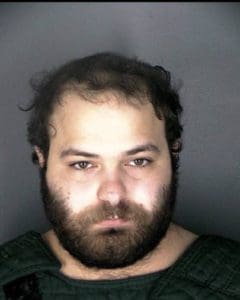
The suspected assailant, identified on Tuesday morning as 21-year-old Ahmad Al Aliwi Alissa from Arvada, a Denver suburb, was charged with 10 counts of first-degree murder.  He was shot and wounded in the incident and taken into custody and has since been stabilized in hospital. Earlier videos showed the suspect, shirtless and with his right leg covered in blood, being escorted from the scene in handcuffs.

The Boulder Police Department later released a booking photo of the alleged shooter.

Ahmad Al Aliwi Alissa, the Boulder shooter, in a booking photo released by Boulder PD.
Ahmad Al Aliwi Alissa, of Arvada.

No motive had been attributed to the killings.

The list of victims is as follows:

Denny Stong, 20

Nevin Stanasic, 23

Rikki Olds, 25

Tralona Bartkowiak, 49

Suzanne Fountain, 59

Teri Leiker, 51

Officer Eric Talley, 51

Kevin Mahoney, 61

Lynn Murray, 62

Jody Waters, 65

“I want to say to the community, I am so sorry this incident happened,” Boulder Police Chief Maris Herold said, barely holding back tears, in a briefing in which she named the assailant and read out the named of victims. “We are going to do everything in our power to make sure this suspect has a thorough trial and we do a thorough investigation.”

At the time of writing this, it was believed that both Ms. Leiker and Ms. Olds were King Soopers’ employees. Local media stated that Ms. Leiker had worked there 31 years, while a statement from Ms. Olds’s aunt stated her niece had been a front-end manager at the supermarket.

Michael Dougherty, Boulder County District Attorney, said that he would work with his team to ensure that justice was served. “I promise you that all of us here will work tirelessly to support you and help you through this process, and also to make sure that the killer is held … fully accountable,” he said.

Homer Talley, the father of the fallen police officer, said his son had been training to be a drone operator so that he would be off the front lines. “He took his job as a police officer very seriously,” Mr. Talley said in a statement. “He had seven children. The youngest is 7 years old. He loved his kids and his family more than anything.”

Kerry Yamaguchi, the Boulder Police Department Commander, added that the intervention of officer Talley, a 11-year patrol veteran, was critical to saving lives. “Without that quick response, we don’t know if there would have been more loss of life,” said Commander Yamaguchi.

People in the supermarket at the time described scenes of chaos and horror. “I thought I was going to die,” Alex Arrelano, who works at the outlet, was quoted as saying by The New York Times. “The shots are getting closer. I’m thinking of my parents, and I was freaking out. We were scared, ’cause, you know, there’s entry points where that individual could show up.” Sarah Moonshadow, a customer at the supermarket, was at the checkout when the shooting happened. “We ducked and I just started counting in between shots, and by the fourth shot I told my son, we have to run,” she said, adding that two shots were fired in her direction as she made it out to safety with her young son.

The FBI was assisting Boulder Police in investigations and the White House said that President Biden had been briefed about developments. Vice President Kamala Harris commented on the shooting in Washington on Tuesday morning, while talking to the media after the ceremonial swearing in of CIA Director William Burns. “It’s absolutely baffling,” said VP Harris. “It’s 10 people going about their day, living their lives, not bothering anybody. A police officer who is performing his duties, and with great courage and heroism.”

Over the years, Colorado has been the scene of several mass shootings that have shaken the community, beginning with the Columbine massacre on April 20, 1999, when two students entered the high school in Littleton, fatally shot a teacher and 12 students, wounded more than 20 others, and then turned their guns on themselves. On July 20, 2012, then 24-year-old James Holmes set off tear gas grenades and fired into the crowd at a multiplex in Aurora during the screening of  “The Dark Knight Rises,” killing 12 and wounding 70.

On Oct. 31, 2015, three people were randomly gunned down on a residential street in downtown Colorado Springs and 28 days later, a Planned Parenthood Clinic in Colorado Springs was the scene of another shooting in which two civilians and a police officer were shot dead.  In 2017 an officer was gunned down in a standoff with a sheriff’s deputy, who had barricaded himself in an apartment.

This was the second mass shooting in the US in a week. Just days ago, eight individuals, six of whom were women of Asian descent, were shot and killed in spas across Atlanta, as rising attacks against Asian-Americans left communities worried.

Beyond The Blue: Felony Killings Of American Law Enforcement, 2019

By Deepti Govind

On Monday, March 22, 51-year-old Boulder Police Officer Eric Talley, a man who waded into ditches to rescue ducklings, a loving father to seven children, and the first officer to respond to reports of an armed man being inside a Boulder supermarket, became another horrific statistic. He became the first officer from the Boulder PD to be killed in the line of duty since 1994, and the sixth on-duty death in the department’s history, according to the National Law Enforcement Officers Memorial Fund. Twenty-one-year-old Ahmad Al Issa, the suspected shooter, went on to kill nine more people, ranging in age from 20 to 65. Three years ago, we had examined the felony killings of American law enforcement, 2016-2017. In the wake of Officer Talley’s death, we revisit those numbers.

In 2019, 56,034 law enforcement officers were assaulted while performing their duties, according to assault data collected by the Federal Bureau of Investigation from 9,457 law enforcement agencies that employed 475,848 officers. The year before that, 58,866 officers were assaulted while on duty, but that data was collected from a larger sample size: 11,788 law enforcement agencies that employed 546,247 officers.

The rate of officer assaults was higher in 2019 than in 2018, despite the smaller sample size. In 2019, the rate was 11.8 per 100 sworn officers, compared with 10.8 per 100 sworn officers for 2018. Nearly 80% of those assaults were done using personal weapons, i.e. hands, fists or feet, while 3.8% were done using firearms, 1.9% with knives or other cutting instruments, and 15.1% with other dangerous weapons.

Of all the officers who were assaulted in 2019, 30.4% were responding to disturbance calls, including family quarrels or bar fights, while 17.1% were attempting other arrests, and 12.8% were handling, transporting, or maintaining custody of prisoners.

This is based on data from the FBI’s Uniform Crime Reporting (UCR) Program on LEOKA (Law Enforcement Officers Killed and Assaulted) for 2019. It focuses just on officers who have died because of injuries received on duty in felonious incidents. This is to separate felonious deaths from accidental ones, or ones where the officer was not on duty, or had not identified himself or herself as law enforcement.

Data Source: Table 1 of the Bureau’s 2019 LEOKA report.
Note: Although the FBI does publish a table listing comparable data across a decade, the sample sizes for the data each year could vary, as mentioned earlier in this piece between 2019 and 2018, for instance.

By any yardstick, when you factor in the rate of assault and injury on duty, being in law enforcement gets catapulted to the top of any “most dangerous jobs in America” list. While being a law enforcement officer isn’t necessarily called the most “dangerous job in America” in terms of numbers, it is probably the only legal peacetime job out there where you wake up and leave for work every morning, knowing someone may intentionally try and kill you that day. And the next. And every single day thereafter. Day in, day out. Week in, week out, year in, year out. Or at least, someone may try their best to do so.

Three years ago, we had examined the felony killings of American law enforcement, 2016-2017. Now we look at the numbers for 2019, the most recent year for which data is available.

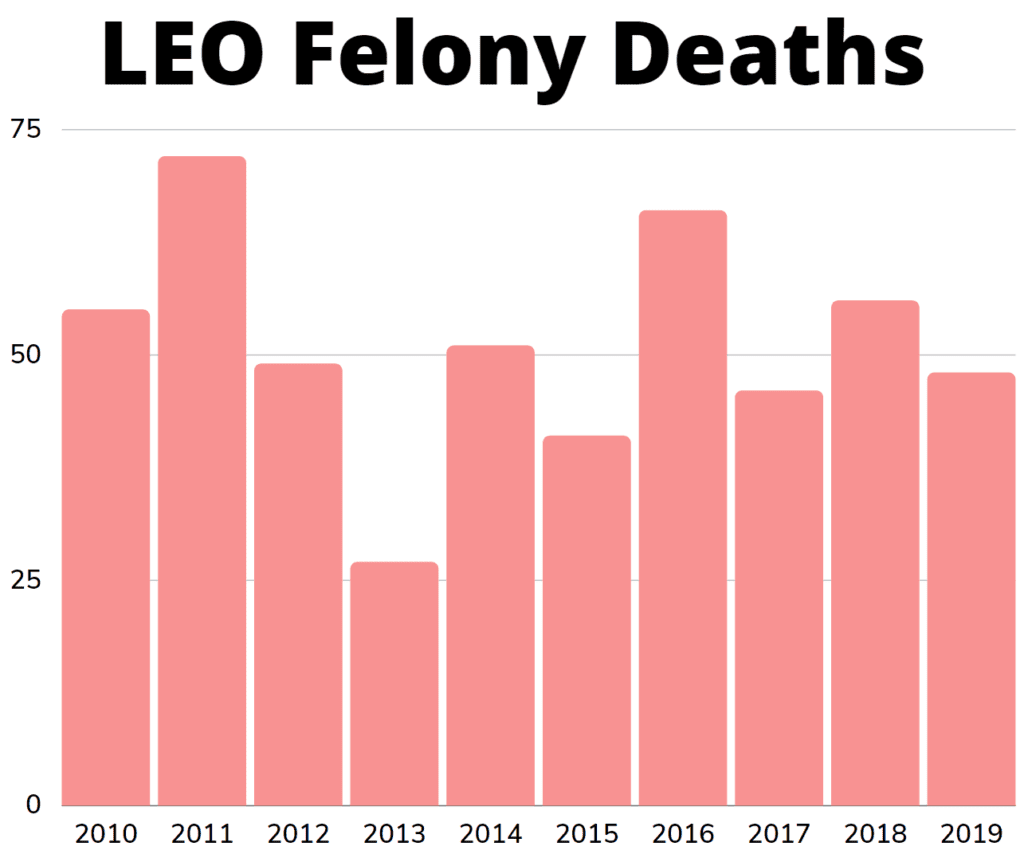
In 2019, 48 law enforcement officers died from injuries incurred in the line of duty during felonious incidents. That compares with 55 in 2018. The law enforcement officers included in the report met certain criteria, such as they had full arrest powers and they ordinarily wore or carried a badge and firearm. By region, 27 officers were feloniously killed in the South, 9 officers in the Midwest, 9 officers in the West, 1 officer in the Northeast, and 2 officers in Puerto Rico.

More law enforcement officers were killed in the line of duty in December than in any other month in 2019 as a result of felonious incidents. More law enforcement officers were also feloniously killed on a Saturday, than on any other day of the week that year. Most of the officers were fatally injured in assaults that happened between 12:01 p.m. and midnight. 

Over a 10-year period, going back to 2010, Monday had the least number of incidents related to officers feloniously killed in the line of duty in terms of percentages, while Wednesday and Saturday were nearly tied for the maximum.

Of the officers who died due to felonious incidents in 2019, 45 were male and 3 were female. When it comes to race, 40 of the victim officers were White, 7 were Black/African American, and 1 was Asian.

Over 60% of the officers feloniously killed last year were wearing body armor at the time of the incidents. Of those, 29 were killed with firearms. Eight were shot in the front upper torso/chest, while 11 died from being shot in either the front, side, or rear of the head.

The first known law enforcement officer believed to have been feloniously killed in the line of duty in the United States of America was a veteran, killed less than a decade after the end of the Revolutionary War he fought in. Columbia County (NY) Sheriff Cornelius Hogeboom was shot on Oct. 22, 1791, as he attempted to serve a writ of ejectment. His alleged murderers, all 10 of them, were all apparently acquitted.

On March 22, a gunman opened fire at a King Soopers outlet in Boulder, Colorado, killing ten people including police officer Eric Talley, who responded to the incident. This is the second mass shooting in the U.S. in under a week, as it comes just six days after another gunman’s deadly shooting spree at massage parlors in the Atlanta area. Among the victims of the massacre in Boulder was Officer Eric Talley, 51, with the Boulder Police Department. Talley had responded to a “barrage” of 911 calls about the shooting, Chief Maris Herold said, according to a New York Times report. 

“He was the first on the scene, and he was fatally shot. My heart goes out to the victims of this incident. And I’m grateful to the police officers that responded. And I am so sorry about the loss of Officer Talley,” Herold said at a news conference at the scene of the shooting, according to the New York Times report.

The Victims & The Offenders: What We Know

In 2019, 49 alleged offenders were identified in connection with the 48 law enforcement officers feloniously killed. The average age among the offenders was 31, and of the 49, only one alleged offender was female.

When it comes to race, most of the alleged offenders were White (28), followed by Black/African American (15), and one Native Hawaiian/Other Pacific Islander. Race was not reported for five of them. Twelve of the alleged offenders were under judicial supervision at the time of the incidents.

Of the alleged offenders for 2019, more than 73% had prior criminal arrests. Even the suspect in the Boulder shooting, a 21-year old from a nearby Denver suburb who used an AR-15 type of assault rifle, was known to the FBI.

The suspect, identified on March 23 as Ahmad Al Aliwi Alissa, of Arvada, has also come in contact with the police in Arvada, Colorado, before. Arvada police had two encounters with him in 2018 — one on a report of third-degree assault, a misdemeanor, and one of criminal mischief. It is not clear if he was convicted of a crime. The suspect’s identity was also known to the FBI because he was linked to another individual under investigation by the bureau, according to law enforcement officials, according to the New York Times report.

The Bureau’s main LEOKA report is based on data collected from non-federal agencies, but it also carries data on federal officers in a separate section. That section shows that in 2019, no federal officers were killed, but a total of 2,136 federal law enforcement officers were assaulted. Of the 2,136 officers who were assaulted, 372 were injured.

In terms of departments, the U.S. Department of the Interior employed 978 of the officers who were assaulted, of which 107 officers were injured. The U.S. Department of Homeland Security employed 733 of the federal officers who were assaulted, and 240 of them were injured. 

Image Source: LEOKA 2019 report