Tech Support : support@safience.io

Blog

Inside BJS’s First Full Year Federal Prisoner Stats Report Since FSA

By a Biometrica staffer

The First Step Act (FSA) of 2018 requires the Bureau of Justice Statistics (BJS) to collect data from the Federal Bureau of Prisons (BOP) through its National Prisoner Statistics program on a number of different topics and to report these data annually.

Through the FSA, the BJS is required to report on specific characteristics of prisoners including marital, veteran, citizenship, and English-speaking status, educational levels, medical conditions, and participation in treatment programs. It also has to report on certain facility-level data like the number of assaults on staff by prisoners, prisoners’ violations of rules that resulted in time-credit reductions, and selected facility characteristics related to accreditation, on-site health care, remote learning, video conferencing, and costs of prisoners’ phone calls.

In February, the BJS published its first full year report under the FSA with statistics it collected for calendar year 2019. Data for 2020 will be available in the second half of this year, it said in the report.

We take a look at some key statistical findings of the report, and also examine the definitions of some federal prison terms.

Highlights Of The Report
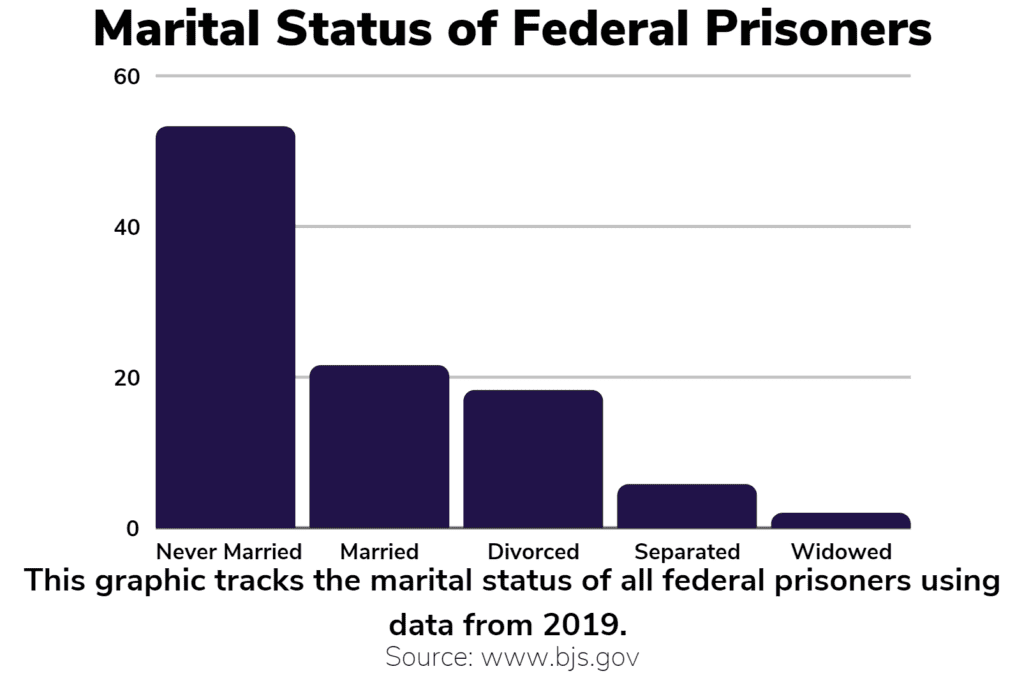
  • The proportion of federal prisoners who were either parents, step-parents or the guardians of a minor child grew to 49% at end-2019 from 45% in end-2018.
  • Out of a total of 31,458 federal prisoners in 2019, 18% were not citizens of the U.S. and 12.6% of them identified English as their second language and not the first. Those numbers were at 18.7% and 13.2% respectively in 2018.
  • A total of 3,791 federal prisoners earned a general-equivalency degree (GED) or other equivalent certificate while in prison. Nearly 30% of prisoners did not have a high-school diploma, or general-equivalency degree, or other equivalent certificate before their BOP imprisonment in 2019, which is similar compared with the previous year.
  • Of the 180 pregnant prisoners in federal custody in 2019, a total of 94 gave birth in custody and 74 were released before giving birth. Of those who gave birth in custody, there were five miscarriages, two abortions, three neonatal deaths, and five pre-term births. There was also one instance of a pregnant prisoner being placed in front-hand restraints for disruptive behavior.
  • All 122 BOP-operated facilities had at least one clinical nurse, certified paramedic, or licensed physician on-site in 2019. While in custody, 116 federal prisoners received medication-assisted treatment for a substance-use disorder.
  • All 122 BOP-operated facilities had video-conferencing capabilities for prisoners to participate in judicial hearings, foreign embassy consultations, reentry-related communications from probation offices, preliminary reentry preparation, disciplinary hearings, and the Institution Hearing Program.
  • During 2019, there were 1,252 physical assaults on BOP staff by federal prisoners, with 18 of the assaults resulting in serious injury to the staff member.

Definitions Of Key Terms

Administrative Maximum (ADX): This is a type of segregated housing unit designed for occupancy by a single person, and is the BOP’s most restricted level of segregated housing. It operates only one facility with ADX units: The United States Penitentiary-Administrative Maximum in Florence, Colorado, which houses the most disruptive and escape-prone prisoners in BOP custody. In 2019, there were 386 incidents of prisoners being placed in administrative maximum.

Challenge Program (CH): This is a BOP drug-treatment program designed for high-security prisoners. It includes violence-prevention components, and a protocol to allow prisoners with severe mental illness to develop everyday life-skills like medication management. It does not include an early release incentive, however, a prisoner who successfully completes the program could earn a decrease in his or her security level, and a transfer to a medium-security facility. At the medium-security facility, the prisoner can then be admitted to the BOP’s Residential Drug Abuse Program.

Medication-assisted Treatment: Treatment of substance-use disorders by a licensed physician who administers or prescribes medication that is approved by the U.S. Food and Drug Administration (FDA), in combination with counseling and behavioral therapies. The three medications approved by the FDA and recognized by the BOP are methadone, buprenorphine, and naltrexone.

Non-Residential Drug Abuse Program: This is a BOP drug-treatment program available to all federal prisoners at every public and private correctional institution. While it does not include an early release incentive, facility wardens are encouraged to allow prisoners who satisfactorily complete the program to be placed in residential reentry centers for the maximum time allowable. In 2019, more than half of the prisoners who participated in it were within 2 years of their release date.

Prohibited Acts: These are actions taken by prisoners held in a BOP-operated or privately operated correctional facility that were against facility rules.
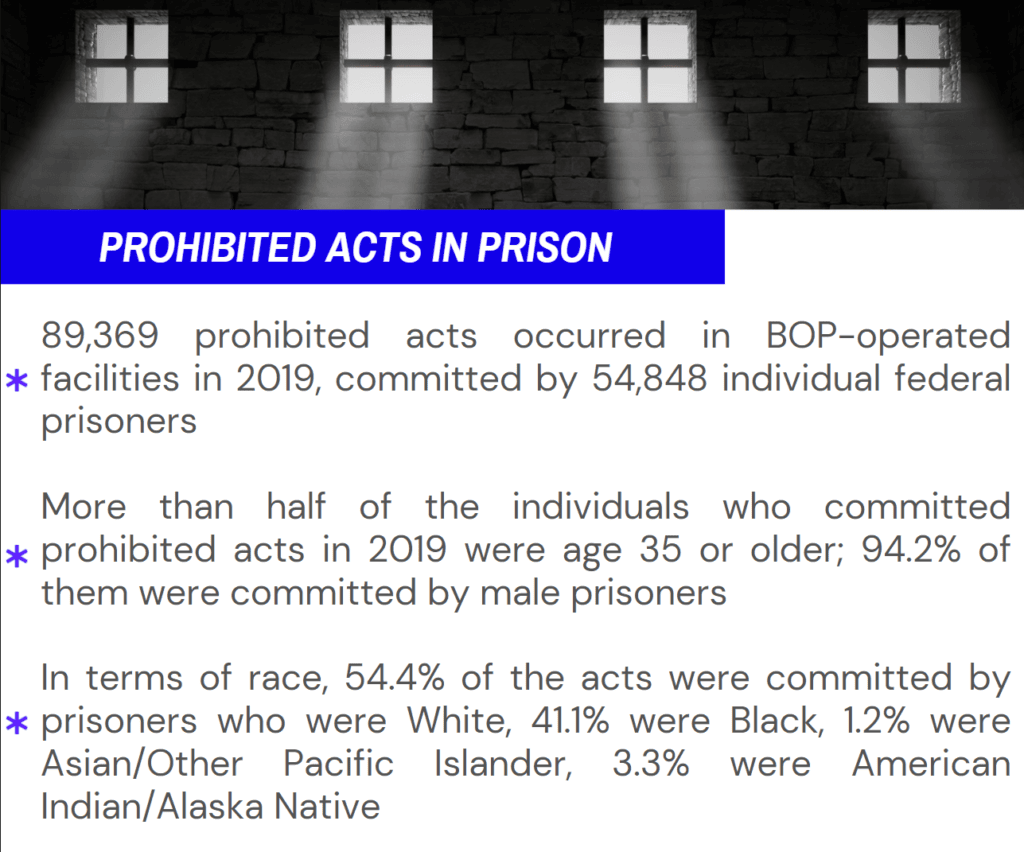
Based on table 5 in the BJS report, on federal prisoners who were cited for prohibited acts that resulted in reductions in rewards, incentives, or time credits by demographic characteristics 2018 and 2019

Residential Drug Abuse Program: This is a BOP drug-treatment program available to prisoners who have been diagnosed with a substance-use disorder, and who volunteer to participate. It separates
participants from the general prison population to live in an isolated unit that removes them from negative peer pressure. Successful completion of this program can yield incentives for participants, including early release if they are eligible. It is intended to be delivered during the last 28 months of the prisoner’s sentence, with the final part being the Community Treatment Services Program.

Special Housing Unit (SHU): This is a segregated housing unit in a BOP-operated facility where certain prisoners are separated from the general prison population. Privately-operated facilities do not have SHUs. Prisoners held in the SHU may be housed alone or with other prisoners. The SHU ensures the safety, security, and orderly operation of correctional facilities and the protection of the public by providing alternative housing assignments for prisoners removed from the general prison population.

Special Management Unit (SMU): This is a segregated housing unit in a BOP-operated facility that holds any sentenced prisoner whose interaction requires greater management to ensure the safety, security, or orderly operation of BOP facilities, or the protection of the public. Each SMU has three program levels that differ by the conditions of confinement and the expected time-frame to complete the program. Typically, prisoners complete the entire SMU program in about 12 months, after which they are placed in the general prison population at another facility. The three program levels are:
SMU level 1 — prisoners have limited interaction and are normally restricted to their assigned cells.
SMU level 2 — prisoners have greater interaction than in level 1. They are normally restricted to their assigned cells but participate in more out-of-cell activities and programming on a case-by-case basis.
SMU level 3 — prisoners interact in a supervised, open setting

Kinds Of Prohibited Acts And Corresponding Sanctions

Some prohibited acts result in low-level sanctions, while others can have more severe consequences. Here’s a look at the acts that qualify as low, moderate and high severity level according to BOP.

Low severity-level:
– malingering
– feigning illness
– abusive or obscene language
– conduct with a visitor in violation of BOP regulations
– unauthorized physical contact
– interference with a staff member’s performance of duties, or engaging in conduct that disrupts the security and orderly running of the facility, if these actions are most like one of the other prohibited acts at the low severity-level.

Moderate severity-level:
– indecent exposure
– misuse of authorized medication
– possession of money in excess of an authorized amount
– loan of property for profit
– possession of anything not authorized for prisoners
– refusal to work or accept a program assignment
– refusal to obey an order from a staff member
– violation of conditions of furlough or a community program
– unexcused absence from work or a program
– failure to perform work as directed
– insolence toward, lying to, or making a false statement to a staff member
– counterfeit, forgery, or reproduction of any document, article of identification, money, or official paper
– participation in an unauthorized meeting or gathering
– presence in an unauthorized area
– failure to follow safety or sanitation regulations
– use of equipment or machinery without staff authorization or contrary to instructions and safety standards
– failure to stand count
– interference with the taking of count
– gambling
– preparing or conducting a gambling pool
– possession of gambling paraphernalia
– unauthorized contact with the public
– exchange of money or anything of value with another prisoner or other person without staff authorization
– destruction, damage, or alteration of governmental or other property valued at $100 or less
– failure to keep one’s person or quarters in accordance with sanitary standards
– possession, manufacture, or loss of a non-hazardous tool, equipment, or contraband
– smoking where prohibited
– fraudulent or deceptive completion of a skills test
– conducting a business
– communication of gang affiliation, participation in gang activities, or possession of gang paraphernalia
– circulation of a petition
– use of mail or a telephone for abuses that do not circumvent monitoring of these communications by staff
– interference with a staff member’s performance of duties or engaging in conduct that disrupts the security and orderly running of the facility, if these actions are most like one of the other prohibited acts at the moderate severity-level.

High severity-level:
– escape from non-secure confinement with subsequent voluntary return to BOP custody within 4 hours
– fighting
– threat of bodily harm
– extortion, blackmail, protection, or demand or receipt of money in return for protection
– engaging in sexual acts
– making sexual proposals or threats
– wearing a disguise or mask
– possession of an unauthorized locking device or lock pick
– destruction, damage, or alteration of a locking mechanism
– adulteration of food or drink
– possession of staff clothing
– engaging in or encouraging a group demonstration or work stoppage
– offer or provision of a bribe to staff
– exchange of money for contraband or some illegal purpose
– destruction, damage, or alteration of governmental property
– theft
– practice or demonstration of martial arts, boxing, wrestling, or drilling, unless authorized by staff
– presence in an unauthorized area with a person of the opposite sex without staff permission
– assault or attempted assault of anyone resulting in less-serious injury
– stalking
– possession of stolen property
– refusal to participate in a required physical examination not related to drug-abuse testing
– tattooing or self-mutilation
– sexual assault involving non-consensual touching without force or threat of force
– use of mail or a telephone for abuses that circumvent monitoring of these communications by staff
– interference with a staff member’s performance of duties or engaging in conduct that disrupts the security and orderly running of the facility, if these actions are most like one of the other prohibited acts at the high severity-level.

Greatest severity-level:
– murder
– assault or armed assault
– escape
– arson that poses a threat to life, poses a threat of bodily harm, or furthers a riot or escape
– possession or manufacture of a firearm or other dangerous instrument that can be used as a weapon
– rioting or encouraging others to riot
– taking hostages
– refusal to take part in drug-abuse testing
– introduction, manufacture, possession, or use of narcotics, drugs not prescribed by medical staff, alcohol, or related paraphernalia
– sexual assault, including non-consensual touching by force or threat of force
– destruction of items during a search
– use of mail or a telephone for an illegal purpose, or to further the commission of any other prohibited act at the greatest severity-level
– interference with a staff member’s performance of duties or engaging in conduct that disrupts the security and orderly running of the facility, if these actions are most like one of the other prohibited acts at the greatest severity-level.
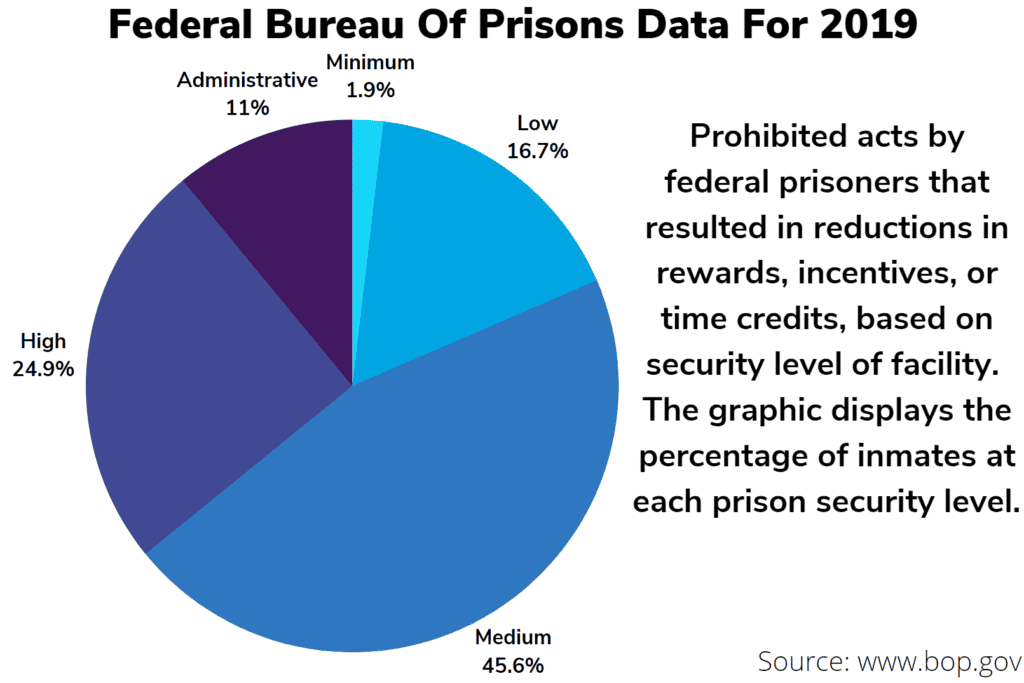
The data in this chart only includes prohibited acts by prisoners in the custody of publicly-operated federal correctional facilities, divided by the kind of security level of the facilities where they occurred. It excludes acts by prisoners held in privately-operated federal correctional facilities.

FBI Releases New Videos Of Capitol Hill Rioters, Seeks Public Help In Identifying Suspects

By a Biometrica staffer

On March 18, the Federal Bureau of Investigation released new information and videos of suspects in the U.S. Capitol Hill riots, and is seeking the public’s help to identify them.

It has been two months since violent extremists breached the U.S. Capitol and committed a litany of federal criminal acts on Jan. 6 2021. The FBI has arrested more than 300 individuals who took part in the Capitol riots, with the assistance of hundreds of thousands of tips from the American people. Of those, more than 65 were arrested for assaulting law enforcement officers. 

Still, some of the most violent offenders are yet to be identified, including the ten seen assaulting officers in the video footage that the FBI released on March 18.

https://youtu.be/yy2OulHlcyc

“The FBI is asking for the public’s help in identifying 10 individuals suspected of being involved in some of the most violent attacks on officers who were protecting the U.S. Capitol and our democratic process on January 6. These individuals are seen on video committing egregious crimes against those who have devoted their lives to protecting the American people,” said Steven M. D’Antuono, assistant director in charge of the FBI’s Washington Field Office.

D’Antuono appealed to the public for help once again. Here are excerpts from the video transcript: “Most recently, your tips helped identify two men involved in discharging a chemical agent that impacted U.S. Capitol Police and D.C. Metropolitan Police officers. Julian Khater and George Tanios were arrested March 14 and charged with conspiring to injure officers, among other charges. Also identified by a tip from the public was Shane Jenkins, who was arrested March 5 and charged with multiple counts, including assaulting officers with a dangerous weapon. These weapons included a metal pipe, a desk drawer, and a flagpole. These are just three of the violent criminals who are no longer on the streets thanks to your tips. But there are many more out there. Today, I am again asking for your help to identify the perpetrators of some of the most egregious assaults on law enforcement officers.” 

If you have any information on the individuals depicted in the videos below, please call 1-800-CALL-FBI or submit a tip online at tips.fbi.gov. Please reference the AFO number when calling or submitting information online. To view photos of additional individuals the FBI is seeking to identify, visit fbi.gov/capitolviolence.

Follow the FBI’s Washington Field Office on Twitter at @FBIWFO for updates.

Russian National Pleads Guilty Of Conspiracy To Introduce Malware Into U.S. Company’s Computer Network

By Anand Vasu

Egor Igorevich Kriuchkov pleaded guilty in federal court on March 18 for conspiring to travel to the U.S. to recruit an employee of a Nevada company into a scheme to introduce malicious software into the company’s computer network.

Kriuchkov, a Russian national, conspired with others to recruit an employee of a large U.S. company to transmit malware provided by the conspirators into the company’s computer network. 

Once the malware was installed, Kriuchkov and his co-conspirators planned to use it to exfiltrate data from the network and then extort the company.

Kruichkov travelled from Russia to California through New York, and, in August 2020, made several trips to Nevada to try and entice the employee to participate in his fraudulent scheme.

Kruichkov promised to pay the employee in Bitcoin once the malware was introduced into the network.

However, the employee reported the advance and the employers in turn contacted the Federal Bureau of Investigation, who thwarted the scheme.

“The swift response of the company and the FBI prevented a major exfiltration of the victim company’s data and stopped the extortion scheme at its inception,” said Acting Assistant Attorney General Nicholas L. McQuaid of the Justice Department’s Criminal Division. “This case highlights the importance of companies coming forward to law enforcement, and the positive results when they do so.”

This is only the latest instance of a Russian individual attempting to use malware as a disruptive tool. In December last year, the Department of Justice offered a reward of $5m for information leading to the arrest or conviction of Maksim V. Yakubets.

It is alleged that Yakubets, known online as aqua, had indulged in a decade-long campaign of hacking that had led to losses to the tune of tens of million dollars. 

Yakubets was part of a network that called itself “Evil Corp,” an organization that had stolen approximately $100 million from businesses and individuals. The organization used a network of money mules to withdraw these fraudulent transactions before banks could catch on, and wire this money to three beneficiaries, minus a small commission, according to this KrebsOnSecurity report.

At the same time, the Justice Department also indicted Igor Turashev for his part in the Bugat malware conspiracy.

Bugat malware was designed to automate the theft of confidential personal and financial information, such as online banking credentials and also facilitated the theft of confidential personal information.

In November last year, U.S. Cyber Command exposed eight new malware samples that were of the ComRAT and Zebrocy families, something that has been used by Russian hackers for years. 

The purpose of making the public aware of these forms of malware was to allow security specialists within organizations to come up with detection mechanisms.

The November 2020 expose was the first time US Cyber Command had officially linked ComRat and Zebrocy malware to the Russian government’s cyber espionage units.

The indictments of Russian nationals for the use of malware was not limited to financial crime, or crimes motivated by profit alone. In 2019, indictments were handed out against six members of the Russian Main Intelligence Directorate (GRU) for engaging in computer intrusions, and attacks intended to support Russian government efforts to undermine or destabilize Ukraine, Georgia; and elections in France.

Perhaps the most infamous instance was the SolarWinds hack of 2020, one of the largest of its kind, targeted against the U.S. government, its agencies, and several other private companies. 

In this attack, some 18,000 users of software produced by SolarWinds were affected and U.S. cyber agencies blamed Moscow for the attacks.

An investigation into the malware used in the attack, conducted by cyber-security company Kaspersky confirmed the allegation by analyzing code used in the attack with code that had been previously deployed by Russian hackers.

Negligent Hiring: It Can Cost Your Company Millions

By Charlotte Spencer

Sometimes the paperwork involved in bringing on a new hire can seem like a mere formality that you don’t want to spend time and money on. Recent court cases, however, demonstrate just how risky it can be to skip over proper background checking and other such formalities. How much can failing to do a sufficient background check on a new hire cost your company? It could potentially cost you millions of dollars.

What Happened?

On February 8, 2011 a wrong-way driver caused a multi-vehicle crash on an interstate highway in Indiana. Mr. Kallis drove northbound in the southbound lanes of I-65 causing other vehicles to slow and swerve to avoid him. Mr. Denton, unable to avoid other vehicles who were slowing and changing course to avoid the wrong-way driver, crashed and was propelled into the middle of the highway. Mr. Denton was badly injured when a semi-truck driven by Mr. Johnson for Universal Am-Can, Ltd. (UACL) rear-ended him, driving him into another vehicle. Although Mr. Johnson was not the cause of the initial accident which caused the chain reaction, he failed to respond to the situation properly, and so caused the injury. Denton alleged that Johnson had failed to keep a proper look out and failed to reduce speed as necessary. Denton ultimately settled with Mr. Kallis’s estate, for the initial accident, which Mr. Kallis caused. He however went on to sue several other parties, including Universal Am-Can, Johnson’s employer, for the role that Johnson played in the subsequent crash. This article focuses on the litigation between the Dentons and Universal Am-Can.

What does this all have to do with background checking potential employees? Due to their failure to properly enforce their own background check policies regarding Mr. Johnson Universal Am-Can recently lost a $54 million verdict in the subsequent lawsuit. That’s not to mention the legal fees they’ve been paying over the past decade since this all started. Universal Am-Can later got plaintiffs to accept a settlement instead of the verdict by offering $36 million in cash in addition to the $7 million they had already paid the plaintiffs before. Although some of this settlement was covered by insurance the majority of it was not.

How Could Universal Am-Can Have Protected Themselves From This?

The key to avoiding such a costly lawsuit is to do sufficient background checks on employees, and then enforce rules barring hiring people with records that raise a concern. In this case, the defendant did a background check, but hired him even though they knew that he had an alarming background and had lied on his application.

At the time of the crash Mr. Johnson was driving on a suspended license, certainly something which proper checking and monitoring of their employees and contractors would have caught. According to the 2015 case, “Plaintiffs alleged the defendants who are party to this appeal either hired Johnson or leased Johnson’s truck and, given Johnson’s license suspensions, tickets and otherwise allegedly checkered driving record, they were also negligent for hiring him or leasing him the truck.” The 2019 case went into even further detail about Johnson’s driving record, including the fact that he had lied about it in several different ways on his job application. It’s important to remember that just asking potential employees about their past is not sufficient, especially when it comes to licensing and safety related issues. Potential employers must verify what the applicant tells them. Amongst the lies the 2019 case lists:

  • Johnson listed two accidents on his application, but in fact had been in four accidents.
  • Johnson listed no moving violations on his application, but in fact had three moving violations.
  • Johnson listed one suspension on his application, but in fact had his license suspended twice.
  • Johnson claimed on his application that he had never been fired by another trucking company, but in fact had been fired by four trucking companies “for reasons that included tailgating a motorist, a felony conviction, too many points on his license, and crashing into a vehicle after refusing to let it merge onto an interstate ramp.” Denton v. Universal Am-Can, Ltd., 2019 IL App (1st) 181525, 146 N.E.3d 103, 438 Ill.Dec. 349 (Ill. App. 2019)
  • Most alarmingly, Johnson’s felony conviction stemmed from a road-rage incident in which he had attacked a car with a tire iron while four women were inside of it because he felt that they were driving too closely with their high beams on.

Although a safety checker with the company caught these lies in time to prevent hiring him, a different employee of the same company later overrode her decision, reasoning that the company needed to accept “marginal drivers” in order to turn a profit. It’s important to note here that the company probably would have suffered the same losses in court had it simply failed to do sufficient background checks. Universal Am-Can lost a $54 million verdict, which they eventually bargained down to $36 million in cash plus a previous $7 million payment, because they had such a bad driver working for them. It probably wouldn’t have mattered much whether they had failed to do a sufficient background check, or whether, as in this case, they did a sufficient background check and then disregarded it. Either is negligence.

Denton v. Universal Am-Can, Ltd.

Want to learn more about this case? This very expensive litigation had been dragging on for years, since a multi-vehicle crash that happened in early 2011. It played out in Illinois (which borders Indiana), where the Dentons are residents and where UACL conducts some of its business. Specifically, see:

for a look at how this litigation went on for almost a decade.

The writer is a lawyer and a coder, and a member of the Arizona bar.

If you have feedback on this article, please write to us at marketing@safience.io.

Internet Crime Resulted In More Than $4 Billion In Losses In 2020

By Anand Vasu

More than $4 billion was lost to Internet Crime in 2020 and nearly 800,000 cases were investigated, the Federal Bureau of Investigation said in its annual Internet Crime Report.

The top three crimes reported in 2020 were phishing scams, non-payment/non-delivery scams, and extortion. In 2020, a new brand of scams exploiting the Covid-19 pandemic emerged, accounting for 28,500 complaints.

The number of investigations into phishing complaints rose from 114,702 in 2019 to 241,342 in 2020. Adjusted losses from phishing and related scams were over $54 million. The only other type of scam that saw such a significant increase was identity theft, for which the corresponding numbers were 16,053 in 2019 to 43,330 in 2020.

The Internet Crime Complaint Center (IC3) is key to the FBI’s cyber mission and provides the public with a trustworthy source for information on cyber criminal activity, and a way for the public to report directly to the Bureau when they suspect they are a victim of cyber crime. IC3 performs multiple functions in combating Internet Crime, starting with the receipt of complaints, to analysis, and referrals of complaints to hosting a remote access database that law enforcement can access.

“The year 2020 will forever be remembered as the year of the Covid-19 pandemic. The global impact was unlike anything seen in recent history, and the virus permeated all aspects of life,” the report said. “Fraudsters took the opportunity to exploit the pandemic to target both business and individuals. In 2020, the IC3 received over 28,500 complaints related to Covid-19.”

“Unfortunately, criminals are very opportunistic. They see a vulnerable population out there that they can prey upon,” said FBI Section Chief Steven Merrill of the Financial Crimes Section.

2020 was also not a good year for those who fell prey to Business Email Compromise (BEC)/ Email Account Compromise (EAC) schemes, which accounted for losses of $1.8 billion. In the last year, the FBI observed more instances of identity theft, which was later used to create bank accounts that received stolen or illegally obtained cryptocurrency.

The Recovery Asset Team, which attempts to freeze transactions that could be fraudulent, reported an 82% success rate in 2020 across 1,303 incidents. An example of this was a $60 million transfer to a Hong Kong company from St Louis. When it was found that this was a fraudulent transaction, the FBI, working with law enforcement in Hong Kong, ensured that the transfer did not reach the recipient, and successfully initiated a recall to the victim.

Tech support fraud, in which a criminal claims to provide customer, security, or technical support or service accounted for losses of $146m, which represented a 171% increase since 2019. The majority of victims in this type of crime were senior citizens — 66% of victims were over 60 years of age — and they represented 84% of losses in this category.

At least two call centers operating out of India that were allegedly pulling off tech support fraud crimes were flagged. In one case trials are pending, while in the second case, three individuals were arrested and incarcerated following an investigation by the Indian Central Bureau of Investigation.

In 2020, the IC3 received 2,474 complaints identified as ransomware with losses of over $29.1 million. Ransomware is a type of malicious software, or malware, that encrypts data on a computer making it unusable. Criminals then threaten to destroy the data, or release it to the public, unless a ransom is paid.

In the 2020 report, California accounts for the most losses, over $621 million and also the most victims  — 69,541, with Florida being the only other state with over 50,000 victims.

Proposed Prison Reform Legislation In 2021

By Charlotte Spencer

Congress has had several new bills proposed so far this year to address the issue of prison reform. Together, they cover the topics of youthful offenders, nonviolent offenders, elderly offenders, Covid-19, solitary confinement, monitoring of electronic communications, re-entry into society, private for profit prisons, and mothers in prison. Here’s a brief look at all the bills.

Covid-19 in Prison

S.312 – COVID–19 Safer Detention Act of 2021

The long title of this bill is “A bill to expand eligibility for and provide judicial review for the Elderly Home Detention Pilot Program, provide for compassionate release based on COVID-19 vulnerability, shorten the waiting period for judicial review during the COVID-19 pandemic, and make other technical corrections.”

This bill has bipartisan support.

To read the full text click here.

H.R. 1072 – COVID–19 in Corrections Data Transparency Act

This bill is the House equivalent to S. 324. It would mandate the Bureau of Prisons, the U.S. Marshals, and state and local correctional facilities to collect data on Covid-19 tests, test results, cases, case outcomes, and vaccinations in correctional facilities. It would also require them to make this data publicly available. It would also require the CDC to issue guidance for correctional facilities.

To read the full text click here.

S. 324 – COVID–19 in Corrections Data Transparency Act

This bill is the Senate equivalent to H.R. 1072. It would mandate the Bureau of Prisons, the U.S. Marshals, and state and local correctional facilities to collect data on Covid-19 tests, test results, cases, case outcomes, and vaccinations in correctional facilities. It would also require them to make this data publicly available. It would also require the CDC to issue guidance for correctional facilities.

To read the full text click here.

S. 328 – Federal Correctional Facilities COVID–19 Response Act

This would mandate Covid-19 testing and vaccination at federal correctional facilities. It would also require the Department of Justice, acting through the Bureau of Prisons and in consultation with the Centers for Disease Control and Prevention, to release updated guidelines on the management of COVID–19 in correctional facilities. It would also address Covid-19 data collection at correctional facilities.

To read the full text click here.

Motherhood in Prison

H.R. 120 – SIMARRA Act (Stop Infant Mortality And Recidivism Reduction Act)

If made law, this would direct the Bureau of Prisons to establish a pilot program for incarcerated women and their children born during incarceration to reside together in a separate prison housing unit. Specifically, an inmate would be eligible to apply for this if she was pregnant at the beginning of her imprisonment and was in the custody of the Federal Bureau of Prisons. An inmate would be allowed to remain in the program for a maximum of 30 months.

To read the full text click here.

S. 341 – Justice for Incarcerated Moms Act

This bill is the Senate equivalent to H.R. 948. This would mandate establishing model programs to optimize maternal health outcomes for pregnant and postpartum individuals in at least six Bureau of Prisons facilities. It would also create a grant program for similar programs in state and local prisons. It would also mandate making reports on such programs.

To read the full text click here.

H.R. 948 – Justice for Incarcerated Moms Act of 2021

This bill is the House equivalent to S. 341. This would mandate establishing model programs to optimize maternal health outcomes for pregnant and postpartum individuals in at least six Bureau of Prisons facilities. It would also create a grant program for similar programs in state and local prisons. It would also mandate making reports on such programs.

To read the full text click here.

Solitary Confinement

H.R. 176 – Restricting the Use of Solitary Confinement Act

This would prohibit placing an inmate in solitary confinement for any reason other than to protect others from a substantial risk of harm. It would also require comprehensive medical and mental health examinations of those placed in solitary confinement. Further, inmates who fall under the category of “vulnerable person” would be placed in a medical or other unit instead of solitary confinement. This would also prohibit denying those in solitary confinement basic needs such as medical care, food, or water. It would also limit the amount of time a person can be put into solitary confinement, and establish procedure for hearings and reviews in which the inmate could contest the solitary confinement.

To read the full text click here.

Youth in Correctional Facilities

H.R. 128 – RAISE Act of 2021

If made law this would provide alternatives to incarceration for youth. It would allow courts to impose lower than minimum sentences on youth if the youth’s offense had been nonviolent, the minimum sentence was not necessary to protect the public, and the minimum sentence would result in substantial injustice to the youth given the nature of the crime and the chances of rehabilitation. All parties would get notice of the court’s intent to do so and a chance to respond before a final decision was made. It would also update specifications concerning home confinement, supervised release, probation, and specialized housing programs for youth accordingly. This would also mandate establishing pilot programs including programs focusing on mentorship, government service, service to abandoned and rescued animals, diversion for high risk youth, diversion for victimized youth, and diversion for youth who serve as primary caretakers for younger children, or ill or impaired adults.

To read the full text click here.

H.R. 961 – Justice for Juveniles Act

This would amend 42 U.S.C. 1997e to create an exemption for prisoners under 22. In other words, although prisoners are usually required to exhaust all administrative remedies before bringing suit for prison conditions, people who are under 22, or who are bringing suit for conditions that occurred before they were 22 would be exempt from this requirement.

To read the full text click here.

Early Release for Older Non-Violent Populations

H.R. 132 – Federal Prison Bureau Nonviolent Offender Relief Act of 2021

This bill would increase the number of nonviolent offenders who are released from prison early. Specifically, prisoners who are at least 45 years old, have never been convicted of a violent crime, and have never violated disciplinary regulations in a violent way would be released once they had served half of their term.

To read the full text click here.

H.R.929 – To provide that the amount of time that an elderly offender must serve before being eligible for placement in home detention is to be reduced by the amount of good time credits earned by the prisoner, and for other purposes.

To read the full text click here.

Other Bills

H.R. 546 – Effective Assistance of Counsel in the Digital Era Act

In general, this would allow for the recording of, and retention of, privileged electronic communications between prisoners and lawyers, but would not allow anyone else to access these without a warrant. In cases where a system for prisoners to send privileged electronic communications to their lawyers does not already exist it would mandate creating one.

This bill has bipartisan support and has passed the house.

To read the full text click here.

H.R. 1315 – To amend title 18, United States Code, to require that Bureau of Prisons help Federal prisoners who are being released to obtain appropriate ID to facilitate their reentry into society at no cost to the prisoner, and for other purposes.

The full text is not available yet.

To read the full text when it becomes available click here.

H.R. 994 – Justice is Not For Sale Act of 2021

This would ban the use of for-profit prisons and detention facilities at the Federal level. It would eliminate all federal contracts for privately run prisons within two years. It would also ban private for-profit prisons at the state level in cases where those businesses were engaged in or affecting interstate commerce. This is because the federal government only has the power to enforce such a law on the state level if interstate commerce somehow comes into play. The Attorney General would still have the power to authorize a waiver for states or local governments who were not able to meet this standard within two years.

To read the full text click here.

The writer is a lawyer and a coder, and a member of the Arizona bar.

If you have feedback on this article, please write to us at marketing@safience.io.

Murder Fuels Spike In Violent Crimes In Q4 2020 Reporting Data From FBI

By a Biometrica Staffer

Image Source: Screengrab from the FBI’s latest quarterly Uniform Crime Report showing the percentage increase/decrease in all violent crimes reported, over four consecutive quarters.

On March 15, the Federal Bureau of Investigation (FBI) published its latest quarterly assessment of crime in the U.S. through its Uniform Crime Report data for the last quarter of the period 2019-2020, i.e. the last quarter of calendar year 2020. This is the first time the Bureau is publishing data under its new reporting system, the National Incident-Based Reporting Program (NIBRS). And the numbers seem to have a worrying story to tell.

At the outset, reports of violent crimes increased 3.3% in the last quarter of 2020 — the highest percentage rise in the year. Violent crime reports include data covering four different kinds of offenses: homicide (murder and non-negligent manslaughter), rape, robbery, and aggravated assault. They’re basically offenses that involve force or the threat of force, according to the Bureau’s definition.*

Image Source: Screengrab from the FBI’s latest quarterly Uniform Crime Report showing the percentage increase/decrease in the number of murders reported, over four consecutive quarters.

Within violent crimes, a worrisome trend is that the rates of reported murders are still high. The rate of reported murders started with a percentage increase of 6.6% in the first quarter of 2019-2020. It spiked 14.8% in the second quarter, jumped to a percentage increase of 20.9% in the third quarter, and stood at 24.7% in the last quarter.

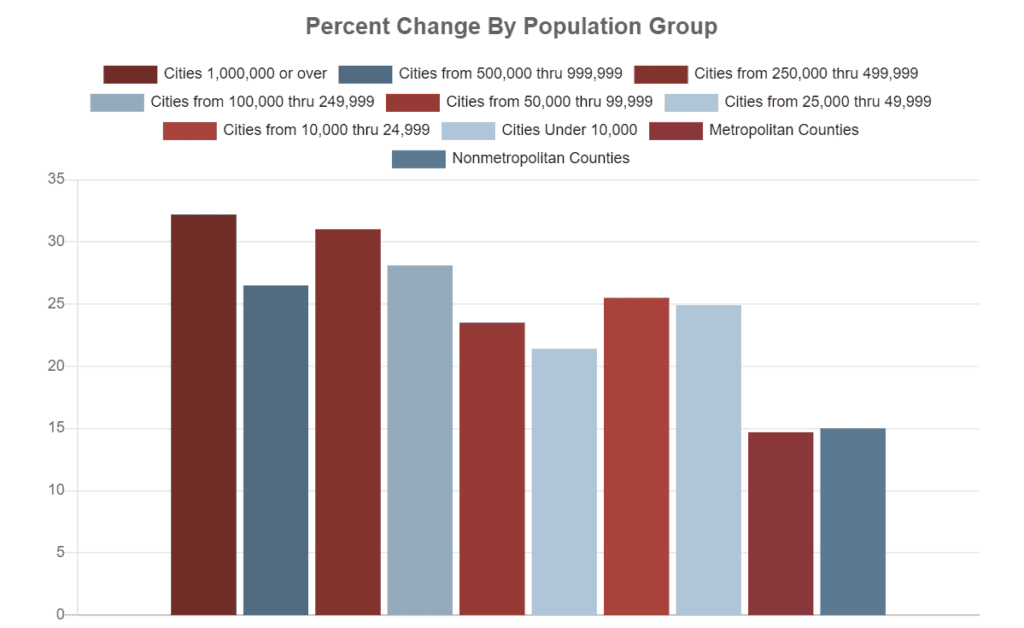
The FBI also reports crimes in terms of percent change by population groups, dividing the nation into cities with a population of 1,000,000 or more, cities with a population from 500,000 through 999,999 and so on. Even based on that division — which creates eight different groups, and two more that are classified as metropolitan counties and non-metropolitan counties — reported murder rates increased on a double-digit basis across all ten groups.

Image Source: Screengrab from the FBI’s latest quarterly Uniform Crime Report of murder rates based on the population of cities

The highest rate of growth within that group was, of course, for cities with a population of 1 million or more at 32.%. But even some smaller divisions, like those with a population of 100,000 through 249,999 and those with a population of 10,000 through 24,999, had rates of increase as high as 28.1% and 25.5% respectively.

Image Source: Screengrab from the FBI’s latest quarterly Uniform Crime Report showing murder reports by region.

The FBI says, for the population estimates used, it computed individual rates of growth from one year to the next for every city/town and country using the most recent decennial population counts and subsequent years’ population estimates from the U.S. Census Bureau. Each agency’s rates of growth were averaged; that average was then applied to the previous year’s Census population estimate to derive the agency’s population estimate for the selected year.

But the Bureau cautions against ranking locations or making comparisons with others. “Since crime is a sociological phenomenon influenced by a variety of factors, the FBI discourages ranking locations or making comparisons as a way of measuring law enforcement effectiveness. Some of this data may not be comparable to previous years because of differing levels of participation over time,” the FBI says on its website.

Quarterly Uniform Crime Report data for the nation are derived from summary (SRS) and incident (NIBRS) reports voluntarily submitted to the FBI. In 2020, the FBI Crime Report for the nation is based on data received from 12,974 of 18,592 law enforcement agencies in the country that year.

Apart from a steadily growing rate of murders reported, the data also showed a similar trend for aggravated assault. Reports of aggravated assault grew at a rate of 3.7% in the first quarter of the year, clocked a growth rate of 4.6% in the second quarter, before jumping 8.3% in the third quarter, and ending the year with a 10.5% rate in the last quarter.

Image Source: Screengrab from the FBI’s latest quarterly Uniform Crime Report showing the percentage increase/decrease in the number of aggravated assaults reported, over four consecutive quarters.

However, the percentage increases of aggravated assault reports are still not as high as those for murder reports. Of the ten population-based divisions by the FBI, only cities with higher populations witnessed double-digit growth rates of aggravated assault reports.

Image Source: Screengrab from FBI’s latest quarterly Uniform Crime Report of aggravated assault rates based on the population of cities

Motor vehicle theft reports also steadily increased through the course of 2020. This offense falls under property crimes, which also includes burglary, arson and larceny-theft. Reports of motor vehicle thefts grew 10.5% in the last quarter, a faster rate than even in the second quarter — when the pandemic was at its initial worst, seemingly — where it clocked a growth rate of 6.2%.

Image Source: Screengrab from FBI’s latest quarterly Uniform Crime Report showing the percentage increase/decrease in the number of motor vehicle thefts reported, over four consecutive quarters.

On Jan. 1, 2021, the National Incident-Based Reporting Program officially replaced the Summary Reporting System as the UCR’s data standard. For a look at the history of the Uniform Crime Reporting Program, its reporting components, and at why the system needed change, read our piece from Feb. 24 here.

* According to the FBI’s footnotes on the data, the year 2020 includes crimes reported to sheriffs’ departments, county police departments, and state police within Metropolitan Statistical Areas. But the figures for rapes reported include only those reported by law enforcement agencies that used the revised Uniform Crime Reporting definition of rape as well as converted data from agencies that reported data for rape, sodomy, and sexual assault with an object via the NIBRS for both years.

** Regions according to the report:

Northeastern Region
Connecticut, Maine, Massachusetts, New Hampshire, Rhode Island, Vermont, New Jersey, New York, Pennsylvania

Midwestern Region
Illinois, Indiana, Michigan, Ohio, Wisconsin, Iowa, Kansas, Minnesota, Missouri, Nebraska, North Dakota, South Dakota

Southern Region
Delaware, District of Columbia, Florida, Georgia, Maryland ,North Carolina, South Carolina, Virginia, West Virginia, Alabama, Kentucky, Mississippi, Tennessee, Arkansas, Louisiana, Oklahoma, Texas

Western Region
Arizona, Colorado, Idaho, Montana, Nevada, New Mexico, Utah, Wyoming, Alaska, California, Hawaii, Oregon, Washington

Nashville Christmas Bomber Acted Alone, FBI Investigation Finds

By Anand Vasu

The Federal Bureau of Investigation found that Anthony Quinn Warner acted alone in the Christmas day bombing in downtown Nashville. Investigations revealed that Warner was motivated by a desire to kill himself, and it was not an act related to terrorism. 

It was also found that Warner chose his location so that it would create an impact, and yet minimized the likelihood of injuring others. 

The wide-ranging investigation involved the recovery of more than 3,000 pounds of evidence from the blast site, combing through more than 2,500 tips, and conducting more than 250 interviews, the FBI said in a release. 

The investigative team took diligent steps to determine the reason or reasons why Warner decided to construct and ultimately detonate his device in downtown Nashville on Dec. 25, 2020. The FBI’s Behavioral Analysis Unit, based in Quantico, Virginia, further assisted the local investigative team in answering this question.

The report found that Warner’s actions were based on his desire to kill himself as a result of certain “stressors” including paranoia, long-held individualized beliefs adopted from several eccentric conspiracy theories.

Warner’s interpersonal relationships were also deteriorating at the time and he had experienced the loss of stabilizing anchors, the investigation found.

He had parked his recreational vehicle at the location he had chosen, and urged residents to evacuate, using a loudspeaker, before playing music and then detonating the bomb. 

At the time, USA Today reported that 41 buildings were damaged and three individuals injured in the explosion.

“The FBI would like to thank the citizens and private sector partners of Nashville, Tennessee, for their support during the response and investigation, especially those who provided tips and volunteered their time and resources,” Douglas Korneski of the FBI Memphis Field Office, said.

“Additionally, the collaborative efforts of all local, state and federal agencies who responded to this incident, and the hundreds of hours dedicated by their men and women, were truly invaluable to this unified effort,” said Korneski. “They exemplified the tireless dedication we’ve come to expect from those who respond to these types of critical incidents.”

While the FBI announced its latest findings, there were other investigations into the incident that are still ongoing. These investigations are looking into whether the Nashville police department could have done more to prevent the incident. 

In the aftermath of the incident a five-member panel, including two police officers, was tasked with checking if there were any lapses on the part of law enforcement in the lead up to the bombing.

The Nashville Council also created a Special Bombing Review Commission to look into possible policy changes that could be made in the aftermath of the incident.

Looking Back: Life In Limbo, The Covid-19 Blues, Change & Resilience As A Casino Employee

By Michael P. Johnson

March 11, 2021, marked the 1st anniversary of Covid-19 being labeled a “pandemic.” A year ago, the casino industry was turned on its ear, having to shut down. Looking back on it now, as a casino professional with a family to think about, it wasn’t easy to wrap your head around it. It wasn’t too long after this time, just one year ago, where we were asked to leave. At first, it was for two weeks, then indefinitely, because no one knew when this pandemic would end.

The map below represents casino closings in the U.S. on March 18, 2020.

It was frightening for a lot of casino professionals. Making sure your family was safe was of the highest priority. Having a wife whose immune system is weakened and a one-year-old daughter put things in perspective for me. Having no contact with anyone was something new to get used to. Making sure our elderly parents were taken care of during a pandemic was something to be concerned about.

After eight weeks of being furloughed, being called back to my casino job was both a blessing and a curse. Many felt the same way. There was a feeling of, “You wanted to go back to work, sure, but at the same time, you were worried about catching Covid-19 and bringing it home to your family.”

You had to be careful, practice social distancing, and wear your mask.

The map below represents casino closings in the U.S. on July 2, 2020. As you can see, from the map above and the one below, in three and a half months, casino openings increased substantially.

When going to the casino for the first time after closing due to a pandemic, you’re going to see some changes. The following list is only some, but probably the most noticeable changes one will see:

  1. Reduced hours of operation – Being open only 20 hours per day has its advantages. For instance, those four hours a day where there are no patrons helps the cleaning crew. They don’t have to clean around people, ask people to move, or bother them.
  • Capacity restrictions – I remember having a limit on how many people could enter the casino. We had a 50% capacity restriction put in place. Since we had 2,000 slot machines on the floor, we allowed 1,000 people in the building. And to make it easier on our security department, we only entered through one of our entrances and kept track of the number of people who entered on a counting device.
  • Hand sanitizing stations – More hand sanitizing stations were located at more casino areas than you could shake a stick at. Besides, hygiene and cleanliness were critical at this point and time.
  • Masks & social distancing – When arriving at the casino, you’ll notice large stickers plastered to the ground and floor where patrons stand in line. These represent where they should stand according to social distancing requirements. Also, anyone wanting to enter the casino must have a mask on their face and worn correctly. If the patron had no mask, they would be provided one.
  • Taking patrons’ temperatures­ – Once you’ve entered the building, you’d be met by someone with a thermometer. Patrons who had a temperature higher than 100.4 degrees would not be allowed entry.
  • Restaurant venues closed – Depending on the state you were in, and the laws brought forth by that particular jurisdiction, many of the casinos’ outlets were closed. For instance, many buffets have not reopened almost a year later due to fear of Covid-19 contamination.
  • Plexiglas dividers between slots & table spots – There was a valiant attempt on the casino’s part to separate patrons as much as possible out of the patron’s safety. When casinos were allowed to reopen, it started with placing every other machine out of service. At some point, entire banks of machines were beginning to open, but with Plexiglas dividers being strategically placed between the machines, so patrons who sat next to one another had less chance of catching the sickness. On the table games, spots were limited to only four people instead of the regular six or seven. There needed to be room for the Plexiglas to be mounted on the table to separate the patrons from themselves and the dealers.

With all of the different restrictions and rules the states and casinos placed on the patrons, some didn’t always return. Throughout the past year, conditions due to Covid-19 have made many want to stay home in fear of sickness. The people who left their homes to avoid cabin fever sometimes failed to take proper precautions. Social distancing and wearing masks took a back seat when they should have been front and center. When made to wear a mask, people were often observed with the covering worn improperly, either underneath their nose, or not at all.

For casinos, this was the worst year ever for their industry. Most casinos have reopened, but strangely enough, some have remained shut down. According to the Las Vegas Review-Journal, 13 remain in the dark, some wanting looser restrictions and more foot traffic before reopening, and some have closed their doors permanently.

As of March 14, 2021, more than 70 casinos have yet to reopen, as per the American Gaming Association.

Even when it comes to capacity, some states are going to 50% only now. For instance, from March 15 onwards, casinos and restaurants in Las Vegas were allowed to increase their capacity to 50% from 35%. In Nevada, gaming properties and other venues were given the green signal to use up to 50% of a room’s capacity, also starting March 15. That is for trade shows, conventions, gambling, and future entertainment.

About the writer: Michael P. Johnson is a technology writer from the Greater Memphis Area. Mr. Johnson has almost two decades of experience in the casino industry, utilizing tech daily. You can read more about his work on his website, or reach him at michael@mpjwritesfreelance.com. You can also write to us: marketing@safience.io

What’s In The New FINRA Report: Spotlight On AML & Cybersecurity

By a Biometrica staffer

The Financial Industry Regulatory Authority (FINRA) published a new report last month with annual insights from its examinations and risk monitoring programs. The report is aimed at helping inform compliance programs at member firms of areas of importance.

“This report is designed to give member firms a single, authoritative source that provides insights derived both from the last year’s examinations and risk assessments and from where we have identified emerging issues for the coming year,” said Bari Havlik, FINRA’s executive vice president for member supervision, according to a post on Compliance Week.

This new report — titled 2021 Report on FINRA’s Examination and Risk Monitoring Program — replaces two of FINRA’s previously published annual reports that provided analysis of prior examination results and highlighted areas the organization planned to review in the coming year.

The report addresses 18 regulatory areas in total under the following four categories: firm operations, communications and sales, market integrity, and financial management, the Compliance Week post said. The importance and relevance of the considerations, findings and effective practices in each of these areas will vary for each member firm, FINRA says in its website on selected highlights from the report.

But in general, there are six key areas that impact compliance programs across a large population of member firms. Here are snippets from those highlights:

  • Regulation Best Interest (Reg BI) and Form CRS (Customer Relationship Summary) – In 2021, FINRA intends to expand the scope of its Reg BI and Form CRS reviews and testing to effect a more comprehensive review of firm processes, practices and conduct. In the Reg BI and Form CRS sections of the report, member firms can review considerations FINRA staff will use when examining a firm for compliance with those aspects. The report also includes a list of previously published considerations and materials— such as its Reg BI Topic Page. 
     
  • Consolidated Audit Trail (CAT) – FINRA is in the early stages of reviewing for compliance with certain CAT obligations; accordingly, exam findings or effective practices are not included in this report but will be provided later when more information is available. In the interim, member firms should review the list of recommended steps provided in the Notice, and the list of considerations and relevant resources provided in the report in assessing the adequacy of their CAT compliance programs.
     
  • Cybersecurity – Member firms’ ongoing and increasing reliance on technology for many customer-facing activities, communications, trading, operations, back-office and compliance programs —especially in our current remote work environment — requires them to address new and existing cybersecurity risks, including risks relating to cybersecurity-enabled fraud and crime. A firm’s cybersecurity program should be reasonably designed and tailored to the firm’s risk profile, business model and scale of operations. Given the increase in remote work and virtual client interactions, combined with an increase in cyber-related crimes, FINRA encourages member firms to review the considerations, observations and effective practices noted in the report, as well as Regulatory Notice 20-13 (FINRA Reminds Firms to Beware of Fraud During the Coronavirus (COVID-19) Pandemic), Report on Selected Cybersecurity Practices – 2018 and Report on Cybersecurity Practices – 2015.
     
  • Communications with the Public – FINRA continues to evaluate member firms for compliance with Rule 2210 (Communications with the Public), which includes principles-based content standards that are designed to apply to ongoing developments in communications technology and practices. In addition, it is increasingly focused on communications relating to certain new products, and how member firms supervise, comply with recordkeeping obligations, and address risks relating to new digital communication channels. This focus includes risks associated with app-based platforms with interactive or “game-like” features that are intended to influence customers, their related forms of marketing, and the appropriateness of the activity that they are approving clients to undertake through those platforms (for example, under FINRA Rule 2360 (Options)).
     
  • Best Execution – FINRA has routinely reviewed member firms for their compliance with best execution obligations under Rule 5310 (Best Execution and Interpositioning) in its examinations. Among other things, FINRA has continued to focus on potential conflicts of interest in order-routing decisions, appropriate policies and procedures for different order and security types, and the sufficiency of member firms’ reviews of execution quality. It also conducted a targeted review of member firms that do not charge commissions for customer transactions (“zero commission” trading) to evaluate the impact that not charging commissions has, or will have, on member firms’ order-routing practices and decisions, and other aspects of member firms’ business.
     
  • Variable Annuities – FINRA continues to evaluate variable annuity exchanges under Rule 2330 (Members’ Responsibilities Regarding Deferred Variable Annuities) and, when applicable, under Reg BI. Additionally, in early 2020, it engaged in an informal review of buyout written supervisory procedures (WSPs), training, and disclosures for member firms whose customers were impacted by a recent announcement from an insurer with sizable variable annuity assets stating it will terminate servicing agreements, cancel certain trail commissions for registered representatives, and provide buyout offers to its variable annuity customers.

While the report goes on, then, to give details about 18 regulatory areas as mentioned earlier, our focus for this piece is on two key topics: Anti-money laundering and cybersecurity. Within these two topics, we bring you snippets from the report that further emphasize effective practices and emerging risks.

Anti-Money Laundering (AML)

The Bank Secrecy Act (BSA) requires firms to monitor for, detect and report suspicious activity conducted or attempted by, at, or through the firms to the U.S. Treasury’s Financial Crimes Enforcement Network (FinCEN). Firms should also be aware of the recently enacted Anti-Money Laundering Act of 2020, which may result in material revisions to the implementing regulations over time. FINRA Rule 3310 (Anti-Money Laundering Compliance Program) requires that members develop and implement a written AML program reasonably designed to comply with the requirements of the BSA and its implementing regulations.

Additionally, FinCEN’s Customer Due Diligence (CDD) rule requires that firms identify beneficial owners of legal entity customers, understand the nature and purpose of customer accounts, and conduct ongoing monitoring of customer accounts to identify and report suspicious transactions and — on a risk basis — update customer information.

Effective Practices

  • Customer Identification Program: Using, on a risk-basis, both documentary (such as drivers licenses or passports) and non-documentary methods (such as using third-party sources) to verify customers’ identities.
  • Monitoring for Fraud During Account Opening: Implementing additional precautions during account opening, including limiting automated approval of multiple accounts opened by a single customer; reviewing account application fields for repetition or commonalities among multiple applications; and using technology to detect indicators of automated scripted attacks in the digital account application process.
  • Bank Account Verification, Restrictions on Fund Transfers and Ongoing Monitoring: Confirming customers’ identities through verbal confirmation, following client verification protocols or using a third-party verification service, such as Early Warning System (EWS); monitoring of outbound money movement requests post-ACH (Automated Clearing House) set-up; restricting fund transfers in certain situations; and conducting ongoing monitoring of accounts.
  • Collaboration With Clearing Firms: Understanding the allocation of responsibilities between clearing and introducing firms for handling ACH transactions; and implementing policies and procedures to comply with those responsibilities.
  • AML Compliance Tests: Confirming annual AML independent tests evaluate the adequacy of firms’ AML compliance programs, review firms’ SAR reporting processes, and include sampling and transaction testing of firms’ monitoring programs.
  • Risk Assessments: Updating risk assessments based on the results of AML independent tests, audits, and changes in size or risk profile of the firms, including their businesses, registered representatives and customer account types; and using AML risk assessments to inform the focus of firms’ independent AML tests.
  • Testing of Transaction Monitoring and Model Validation: Performing regular, ongoing testing and tuning of transaction monitoring models, scenarios and thresholds; and confirming the integrity of transaction monitoring data feeds and validating models (which are more frequently used at large firms).
  • Collaboration with AML Department: Increasing the likelihood that all potentially reportable events are referred to the AML department by establishing a line of communication (such as reporting and escalation processes, awareness and educational programs, regular meetings, policies and procedures, or exception reports) between the AML department and other departments that may observe potentially reportable events (such as registered representatives and client-facing teams, technology, cybersecurity, compliance, operations, trading desks and fraud departments).
  • Training Programs: Designing training programs for each of the roles and responsibilities of the AML department (as well as departments that regularly work with AML) and addressing all AML regulatory and industry developments.

Emerging AML and Other Financial Crime Risks

Microcap and Other Fraud
Some firms continue to engage in fraud, financial crimes and other problematic practices, such as those described in the SEC Staff Bulletin: Risks Associated with Omnibus Accounts Transacting in Low-Priced Securities, which addresses microcap and penny stock activity transacted in omnibus accounts maintained for foreign financial institutions and foreign affiliates of U.S. broker-dealers.

Issuers Based in Restricted Markets
Certain foreign national and foreign entity nominee accounts appear to have been opened solely to invest in the initial public offerings and subsequent aftermarket trading in one or more exchange-listed issuers
based in restricted markets, such as China. FINRA has observed red flags that the owners of the accounts may be acting at the direction of others, multiple accounts being opened using the same foreign bank for the source of funds or multiple accounts with the same employer and same email domain. The trading activity may include multiple similar limit orders being placed by the accounts at the same time, which could be indicative of coordinated and manipulative trading of the issuers’ securities.

Risks Relating to Special Purpose Acquisition Companies (SPACs)
Some firms are engaging in the formation and initial public offerings (IPOs) of SPACs without having adequate WSPs (Written Supervisory Procedures) that would require independently conducting due diligence of SPACs’ sponsors, and procedures that address other potential fraud risks, including but not limited to:
– misrepresentations and omissions in offerings documents and communications with shareholders regarding SPAC acquisition targets, such as the prospects of the target company and its financial condition;
– fees associated with SPAC transactions, including cash and non-cash compensation and compensation earned by affiliates;
– control of funds raised in SPAC offerings; and insider trading (where underwriters and SPAC sponsors may possess and trade around material
non-public information regarding potential SPAC acquisition targets, including private placement offerings with rights of first refusal provided to certain investors prior to the acquisition).

Cybersecurity And Technology Governance

The SEC’s Regulation S-P Rule 30 requires firms to have written policies and procedures that are reasonably designed to safeguard customer records and information. FINRA Rule 4370 (Business Continuity Plans and Emergency Contact Information) also applies to denials of service and other interruptions to members’ operations. In addition to firms’ compliance with SEC regulations, FINRA reminds firms that cybersecurity remains one of the principal operational risks facing broker-dealers, and expects firms to develop reasonably designed cybersecurity programs and controls that are consistent with their risk profile, business model and scale of operations.

Technology-related problems, such as problems in firms’ change- and problem-management practices, can expose firms to operational failures that may compromise firms’ ability to comply with a range of rules and regulations, including FINRA Rules 4370 (Business Continuity Plans and Emergency Contact Information), 3110 (Supervision) and 4511 (General Requirements), as well as Securities Exchange Act of 1934 (Exchange Act) Rules 17a-3 and 17a-4.

Effective Practices

  • Insider Threat and Risk Management – Collaborating across technology, risk, compliance, fraud, and internal investigations/conduct departments to assess key risk areas, monitor access and entitlements, and investigate potential violations of firm rules or policies with regard to data access or data accumulation.
  • Incident Response Planning – Establishing and regularly testing written formal incident response plans that outlined procedures for responding to cybersecurity and information security incidents; and developing frameworks to identify, classify, prioritize, track and close cybersecurity-related incidents.
  • System Patching – Implementing timely application of system security patches to critical firm resources (for example, servers, network routers, desktops, laptops and software systems) to protect non-public client or firm information.
  • Asset Inventory – Creating and keeping current an inventory of critical information technology assets — including hardware, software and data — as well as corresponding cybersecurity controls.
  • Change Management Processes – Implementing change management procedures to document, review, prioritize, test, approve, and manage hardware and software changes, as well as system capacity, in order to protect non-public information and firm services.

Emerging Cybersecurity Risks
FINRA has recently observed increased numbers of cybersecurity- or technology-related incidents at firms, including:
– systemwide outages;
– email and account takeovers;
– fraudulent wire requests;
– imposter websites; and
– ransomware.

It also noted data breaches at some firms, and remains concerned about increased risks for firms that do not implement practices to address phishing emails or require MFA for accessing non-public information.