Tech Support : support@safience.io

Blog

What Do The FCRA And EEOC Guidance On Background Checks Say?

By a Biometrica staffer

Employers of all stripes, private corporations, NGOs, public agencies, schools, colleges, hospitals, delivery services, home health care providers, political campaigns, even religious organizations, use background screening reports to make a determination on potential or current employees, contractors, volunteers or candidates for employment or service, including promotion, reassignment, or retention.

So, what exactly are background checks? According to the Consumer Financial Protection Bureau (CFPB), which, along with the Federal Trade Commission (FTC) enforces the Fair Credit Reporting Act (FCRA), “Background screening reports may include many types of information, including credit history, public records from civil court proceedings — such as bankruptcy filings and other court documents — and information related to employment history. They may also include other public record information on arrests and convictions of individuals.”

The FCRA stipulates guidelines for the inclusion and use of criminal history information. Why is all this relevant? When background checks are run by or through a company in the business of compiling background information, including and not limited to criminal background information, the FCRA needs to be complied with. According to federal guidelines under the FCRA, employee background checks are deemed “consumer reports.” The FCRA does not just regulate credit reports — it also incorporates criminal and civil records, civil lawsuits, educational and other reference checks, and any other information obtained by a consumer reporting agency. The FCRA regulates the collection and use of data obtained through these consumer reports and “promotes the accuracy, fairness, and privacy of information in the files of consumer reporting agencies.”

For instance, take what we do. Because Biometrica’s algorithms amalgamate real-time arrest or conviction data and make that data available to employers for the purposes of their creating pre- and post-employment criminal background reports, Biometrica has to strictly abide by the provisions of the FCRA.

Can Employers Run Background Checks?

Of course. Employers are allowed to run background checks under law. However, anytime an individual’s background information is used to make an employment decision, state laws (that differ vastly) come into play, along with federal laws that protect applicants and employees from discrimination. Compliance includes making sure there is no discrimination based on race, color, national origin, sex, or religion; disability; genetic information (including family medical history); and age (40 or older). What does this mean? It means you cannot check criminal background for certain employees only, and everyone is entitled to be treated equally under the law. These laws are enforced by the Equal Employment Opportunity Commission (EEOC).

Do note that while the EEOC has no direct relevance to the use of criminal records in employment-related decisions, it enforces Title VII of the Civil Rights Act, which is what prohibits employment discrimination based on race, color, religion, sex, or national origin. According to the EEOC, “Having a criminal record is not listed as a protected basis in Title VII. Therefore, whether a covered employer’s reliance on a criminal record to deny employment violates Title VII depends on whether it is part of a claim of employment discrimination based on race, color, religion, sex, or national origin.”

What About Guidelines On Arrests?

Enforcement Guidance on the Consideration of Arrest and Conviction Records in Employment Decisions under Title VII of the Civil Rights Act states the following: “The fact of an arrest does not establish that criminal conduct has occurred, and an exclusion based on an arrest, in itself, is not job related and consistent with business necessity. However, an employer may make an employment decision based on the conduct underlying an arrest if the conduct makes the individual unfit for the position in question.”

This basically means that although an arrest record standing alone may not be used to deny an employment opportunity, an employer may make an employment decision based on the conduct underlying the arrest if the conduct makes the individual unfit for the position in question. The conduct, not the arrest, is relevant for employment purposes. If, after an internal investigation, the applicant or employee is determined to have appeared to have done whatever he was arrested for and that conduct is job-related, adverse action would generally be justified.

In their “Enforcement Guidance on the Consideration of Arrest and Conviction Records in Employment Decisions under Title VII of the Civil Rights Act,” the EEOC provides an interesting example of an employer inquiry into the “Conduct Underlying Arrest” and whether it constitutes a violation of Title VII.

“Andrew, a Latino man, worked as an assistant principal in Elementary School for several years. After several ten and eleven-year-old girls attending the school accused him of touching them inappropriately on the chest, Andrew was arrested and charged with several counts of endangering the welfare of children and sexual abuse. Elementary School has a policy that requires suspension or termination of any employee who the school believes engaged in conduct that impacts the health or safety of the students.”

What happens next? “After learning of the accusations, the school immediately places Andrew on unpaid administrative leave pending an investigation. In the course of its investigation, the school provides Andrew a chance to explain the events and circumstances that led to his arrest. Andrew denies the allegations, saying that he may have brushed up against the girls in the crowded hallways or lunchroom, but that he doesn’t really remember the incidents and does not have regular contact with any of the girls. The school also talks with the girls, and several of them recount touching in crowded situations. The school does not find Andrew’s explanation credible. Based on Andrew’s conduct, the school terminates his employment pursuant to its policy.”

The EEOC guidance continues: “Andrew challenges the policy as discriminatory under Title VII. He asserts that it has a disparate impact based on national origin and that his employer may not suspend or terminate him based solely on an arrest without a conviction because he is innocent until proven guilty. After confirming that an arrest policy would have a disparate impact based on national origin, the EEOC concludes that no discrimination occurred. The school’s policy is linked to conduct that is relevant to the particular jobs at issue, and the exclusion is made based on descriptions of the underlying conduct, not the fact of the arrest. The Commission finds no reasonable cause to believe Title VII was violated.”

On a conviction though, the EEOC is clearer: “A conviction record will usually serve as sufficient evidence that a person engaged in particular conduct. In certain circumstances, however, there may be reasons for an employer not to rely on the conviction record alone when making an employment decision.”

What Is Disparate Impact?

Disparate impact and disparate treatment are both inequitable practices in employment, practices that lead to an adverse impact on an individual or group. Disparate impact is, typically, unintentional — there is no deliberate or planned policy that led to the disparate impact. Remember the part we had mentioned about being careful not to discriminate by checking criminal backgrounds only certain employees and not all? When an employer treats criminal history information differently for different applicants or employees, based on their race or national origin (something called disparate treatment liability), it is considered a violation of EEOC guidelines.

Further, the EEOC states: “An employer’s neutral policy (e.g., excluding applicants from employment based on certain criminal conduct) may disproportionately impact some individuals protected under Title VII, and may violate the law if not job related and consistent with business necessity (disparate impact liability).”

Note: Compliance with other federal laws and/or regulations that conflict with Title VII is a defense to a charge of discrimination under Title VII.

Basically, under EEOC guidelines, arrest records by themselves cannot be used to exclude persons from employment. For instance, if you have the bad luck to have been arrested for not having a fishing license (yes, you do need fishing licenses in many states and could be arrested for fishing without one!), you could reasonably expect that the arrest will not be related to job function unless you’re a wildlife inspector or a park ranger or something similar. However, conduct that appears to point to someone being unsuitable to hold a certain role, like Andrew in the above example, is a basis for exclusion. An arrest may trigger an inquiry into whether the conduct underlying the arrest justifies such action.

What Are Employer Best Practices?

The EEOC guidelines focus on what they call their “Green Factors” — from a 1975 case called Green v. Missouri Pacific Railroad Company — for employers to use to make a determination on how specific criminal conduct may be linked to particular positions. The three Green factors are:

  • The nature and gravity of the offense or conduct;
  • The time that has passed since the offense, conduct and/or completion of the sentence; and
  • The nature of the job held or sought.

The EEOC has also given us some examples of best practices for employers who consider criminal record information when making employment decisions of any kind. These include:

  • Eliminating policies or practices that exclude people from employment based on any criminal record.
  • Train managers, hiring officials, and decisionmakers about Title VII and its prohibition on employment discrimination.
  • Develop a narrowly tailored written policy and procedure for screening applicants and employees for criminal conduct.
    • Identify essential job requirements and the actual circumstances under which the jobs are performed.
    • Determine the specific offenses that may demonstrate unfitness for performing such jobs.
      • Identify the criminal offenses based on all available evidence.
    • Determine the duration of exclusions for criminal conduct based on all available evidence.
      • Include an individualized assessment.
    • Record the justification for the policy and procedures.
    • Note and keep a record of consultations and research considered in crafting the policy and procedures.
  • Train managers, hiring officials, and decisionmakers on how to implement the policy and procedures consistent with Title VII.

Questions about Criminal Records

  • When asking questions about criminal records, limit inquiries to records for which exclusion would be job related for the position in question and consistent with business necessity.

Confidentiality

  • Keep information about applicants’ and employees’ criminal records confidential. Only use it for the purpose for which it was intended.

Written Policies On Employee Arrest or Conviction

Whether or not you expect to have an employee arrested any time in the near future, it probably makes sense to develop a written policy for when an employee is arrested. This helps you take action for non-compliance with the policy. For instance, you could mandate that every employee needs to self-report an arrest to their supervisor and be prepared to face an internal investigation. If someone doesn’t comply, it could be grounds for dismissal.

Biometrica is a technology company that creates software and systems with the intention of minimizing criminality. It has the country’s largest searchable, private, multi-jurisdictional, 100% law enforcement-sourced database of real-time arrests. Please note that Biometrica is FCRA compliant and an associate member of the PBSA.

New Major Interventions To Block Encrypted Communications Of Criminal Networks

By a Biometrica staffer

Authorities in Belgium, France, and the Netherlands have enabled major interventions to block the use of encrypted communications by large-scale organized crime groups. 

Judicial and law enforcement authorities from these countries worked closely with each other, supported by Europol and Eurojust. 

The monitoring of the illegal Sky ECC communication service tool by investigators in the three countries involved provided invaluable insights into hundreds of millions of messages exchanged between criminals.

This action led to the collection of information into more than a hundred large scale criminal operations, preventing potential loss of life. 

During an action on March 9 a large number of arrests were made, as well as numerous house searches and seizures in Belgium and the Netherlands, said a Europol release.

This action was part of an ongoing effort that previously resulted in the de-encryption of the EncroChat communication platform in 2020.

Many users of EncroChat migrated to the Sky ECC platform, but since then authorities have monitored in excess of 70,000 accounts on the new platform.

With Sky ECC communications being accessed, law enforcement agencies in the three countries have been on continuous standby during the last month in order to provide rapid reactions to criminal activity, if required.

Investigations into Sky ECC began when mobile phones seized from criminal suspects in Belgium revealed widespread use of the app. 

Globally, about 170,000 individuals used the Sky ECC app, which is operated from the United States and Canada, using servers based in Europe.

Daily, more than three million messages are exchanged on Sky ECC with about 20% of users being based in Belgium and the Netherlands.

Eurojust has provided advice and support regarding cross-border judicial cooperation and organized 12 coordination meetings to enable this collaboration. 

Eurojust, or the European Union Agency for Criminal Justice Cooperation, is based in the Hague, the Netherlands and was established with the aim of making Europe safer place by coordinating the work of national authorities in investigating and prosecuting transnational crime.

Eurojust has developed an international network that grants prosecutors around the European Union access to more than 50 jurisdictions worldwide. 

The Agency has signed cooperation agreements with a dozen non-EU states, several of which have seconded Liaison Prosecutors to Eurojust to work on cases with their counterparts.

The Eurojust Administration includes case analysts, legal advisors and data experts. The Agency’s premises provide secure meeting facilities with possibilities for interpretation into all EU languages and a meeting room developed for coordination centres, from which joint action days can be monitored and coordinated in real time.

Top Crime, Prison, and Law Enforcement Bills with Most Support in the House in 2021

By Charlotte Spencer

As of March this year, there are already several bills proposed in the area of crime, prison, and law enforcement. These bills cover a wide range of topics including hate crimes, the death penalty, solitary confinement, mental health, parenthood in prison, investigation of police bias, and the Jan. 6 attack on the Capital. Here are the ones, based on the number of co-sponsors, with the most support so far this year.

(Note, this does not include bills and resolutions to award honors and medals.)

H.R.1280 – George Floyd Justice in Policing Act of 2021

The long title of this act is “To hold law enforcement accountable for misconduct in court, improve transparency through data collection, and reform police training and policies.”

This bill has 199 co-sponsors so far and has passed the House.

H.R. 55 – Emmett Till Antilynching Act

This would define lynching as a hate crime and provide for up to life in prison plus fines for violation.

This bill has 160 co-sponsors so far.

H.R. 677 – JUSTICE Act

The official title of this bill is “To improve and reform policing practices, accountability and transparency.” Short titles as introduced for portions of this bill include:

“Breonna Taylor Notification Act of 2021”

“George Floyd and Walter Scott Notification Act”

“Justice for Victims of Lynching Act of 2021” and

“National Criminal Justice Commission Act of 2021”

This bill has 126 co-sponsors so far.

H.R.350 – Domestic Terrorism Prevention Act of 2021

This would create an interagency task force to analyze and combat white supremacist and neo-Nazi infiltration of the uniformed services and federal law enforcement agencies. It would also authorize domestic terrorism components within the Department of Homeland Security, the Department of Justice, and the Federal Bureau of Investigation to monitor, analyze, investigate, and prosecute domestic terrorism. It would also address the nexus between hate crimes and domestic terror.

This bill has 98 co-sponsors so far, including bipartisan support.

H.R. 97 – Federal Death Penalty Abolition Act of 2021

This would abolish the death penalty under federal law, and strike death penalty language from all existing federal laws. It would require resentencing those who had been sentenced to death before its passage.

This bill has 76 co-sponsors so far.

H.R. 262 – Federal Death Penalty Prohibition Act

This would prohibit imposing the death penalty for any violation of federal law. It would require resentencing those who had been sentenced to death before its passage.

This bill has 73 co-sponsors so far.

H.R. 994 – To prohibit the use of for-profit facilities and detention centers, and for other purposes.

Full text of this bill is not available yet. This would ban the use of for profit prisons and detention facilities at the Federal level.

This bill has 35 co-sponsors so far.

H.R. 948 – Justice for Incarcerated Moms Act of 2021

The long title of this bill is “To improve maternal health outcomes for incarcerated individuals, and for other purposes.”

This bill has 33 co-sponsors so far.

H.R. 276 –  Congressional Oversight of Unjust Policing Act

This bill would establish a commission to investigate the Jan. 6 attack on the Capital. The commission would, among other things, investigate whether unconscious bias amongst leadership in law enforcement led to a miscalculation of the risk posed that day. It would also investigate if there were any ties between any members of the capital police and extremist groups.

This bill has 30 co-sponsors so far.

This article was last updated on March 10, 2021. For current cosponsor counts and bill status click here.

The writer is a lawyer and a coder, and a member of the Arizona bar.

If you have feedback on this article, please write to us at marketing@safience.io.

Missouri Man Sentenced To 20 Years For Sexually Explicit Conduct Online

By a Biometrica staffer

Michael David Miller of southwestern Missouri was sentenced on March 9 to 20 years without parole, for using a social media app to contact 12- and 13-year-old girls in Canada and induce them to engage in sexually explicit behavior.

Miller, 40, pleaded guilty on June 2 to the coercion and enticement of a minor. 

On May 23, 2019, law enforcement in Ottawa, Canada, received complaints that a man — later identified as Miller — communicating via snapchat, asked the teenagers to engage in sexually explicit activity, sent videos and images of child pornography and masturbated while on video chat with some of the minors.

Snapchat submitted 25 files of suspected child pornography to law enforcement, which had been sent between Jan. 6 and May 29, 2019, said a Justice Department press release.

Local law enforcement began investigating after Miller was identified. Investigators also received information from an adult woman regarding Miller’s conduct via text messages and video chat through the Duo application. 

Officers executed a search warrant at Miller’s residence on July 18, 2019, during which multiple devices were seized. A forensic examination of those devices found videos and images of child pornography on his laptop computer.

Miller also admitted that he engaged in similar criminal conduct with children in Nebraska and Wisconsin.

This case was prosecuted by Assistant U.S. Attorney Ami Harshad Miller.

The investigation that resulted in the apprehension and prosecution of Michael Miller was conducted under Homeland Security Investigations’ Operation Predator, an international initiative to protect children from sexual predators.

Since the launch of Operation Predator in 2003, HSI has arrested more than 25,000 individuals for crimes against children, including the production and distribution of online child exploitation material, traveling overseas for sex with minors and sex trafficking of children.

HSI lists protecting the public from victimization, and within this the child exploitations investigations program as central to their mission. 

Key goals include identifying and rescuing child victims, identifying and apprehending offenders, preventing transnational child sexual abuse and helping make the Internet a safer place for children.

This case was investigated jointly by U.S. Immigration and Customs Enforcement’s, HSI, the Southwest Missouri Cyber Crime Task Force, the Royal Canadian Mounted Police and the Springfield (Missouri) Police Department.

FBI Releases New Footage Seeking Public Help In IDing Those Who Planted Capitol Hill Pipe Bombs

By Anand Vasu

The Federal Bureau of Investigation has released new footage on March 9 seeking information from the public in identifying a man who placed pipe bombs near the Democratic National Committee (DNC) headquarters and Republican National Committee (RNC) headquarters on the evening of Jan. 5, as a precursor to the storming of the U.S. Capitol.

The bombs were placed as supporters of president Donald Trump stormed the U.S. Capitol and rioted as members of Congress counted the Electoral College votes.

Police believed that the bombs were specifically placed at the security perimeter at Capitol Hill as a diversionary tactic. “Two pipe bombs that were specifically set right off the edge of our perimeter to what I was suspect was to draw resources away,” former Capitol Police Chief Steven Sund was quoted as saying by wusa9.com as he testified before a congressional committee trying to determine what went wrong on Jan. 6.

The FBI is asking the public to watch the videos of this person as a member of the public may recognize their gait, body language, or mannerisms. 

The Bureau also asked public to come forward with information on any suspicious or out of character behavior they may have noticed in acquaintances around the time.

The FBI has already released photos of the individual, including of the individual’s shoes, the devices, and the kitchen timers used in hopes that someone recognizes something familiar about them.

The person who placed these bombs wore a face mask, a grey hooded sweatshirt, and black and light grey Nike Air Max Speed Turf shoes with a yellow logo. They used a backpack to transport each of the devices.

“The American people have provided invaluable assistance in this investigation, and the FBI and our law enforcement partners are very grateful for that cooperation,” said Steven M. D’Antuono, assistant director in charge of the FBI’s Washington Field Office. “We still believe there is someone out there who has information they may not have realized was significant until now. We know it can be a difficult decision to report information about family or friends—but this is about protecting human life. These pipe bombs were viable devices that could have been detonated, resulting in serious injury or death. We need the public’s help to identify the individual responsible for placing these pipe bombs to ensure they will not harm themselves or anyone else.”

Along with the Bureau of Alcohol, Tobacco, Firearms and Explosives the FBI is offering a reward of $100,000 for any information leading to the identification of the person who placed these devices. The reward was originally $50,000 two months ago.

For The National Child Protection Task Force, Technology Holds The Key

By Kevin Metcalf

The community of people that works on child protection is a wonderfully disparate one. There are people in law enforcement, for instance, here in the United States and elsewhere, who have willingly dedicated themselves to seeing the worst of humanity to keep the most vulnerable amongst us safe. There are others in federal, state, local and tribal agencies focused on putting in place policies and systems to give kids a chance at a better future and a safe haven for now. NGOs work to prevent human trafficking or find missing and exploited children, volunteers who give endless hours to kids who will never know what they do. Private sector technologists work with all of us to find new-age solutions to old-world crime; all because there is a need to fill this gap.

We may look different, speak different languages, and have different ways of approaching the issue. Still, we are all bound by a common mission: We imagine a world where children wake up and experience childhood, feel safe wherever they are, and end each day looking forward to tomorrow. We envision a safer world for our children and their children, one where they can wake up without worrying about being beaten, bullied, brutalized, or betrayed in the worst of ways.

Many of us spend each day wondering how we can accomplish this better and faster because it isn’t just essential to save lives; it’s also vital to make sure they’re lived well. Children matter, but so does childhood, and these children can never get that back.

Why Do We Do What We Do?

Let me start at the beginning. It is my great honor and privilege to help lead one such dedicated band of warriors, the hundred-plus men and women who volunteer and partner with the National Child Protection Task Force. The NCPTF exists because our children go missing every day, they get trafficked every day, and they get physically and emotionally abused, groomed, sexually exploited, and sold every day.

And it isn’t getting better, not as yet, not with the pandemic and everyone being virtual. The National Center for Missing & Exploited Children (NCMEC) reported 21.75 million reports to their CyberTipline in 2020, up from about 17 million. The year 2020 saw 37,872 reports of online enticement, compared to 19,174 in 2019.

The CyberTipline, for anyone unaware, is the U.S.’s centralized reporting system for when children are exploited online. Reports made to them range from suspected online enticement for sexual acts, child sex trafficking, and child pornography to extra-familial child sexual molestation, child sex tourism, unsolicited obscene materials sent to a child, and misleading domain names, words, or digital images on the internet. The 21.75 million reports of child sexual exploitation made to the CyberTipline in 2020 included 65.4 million images, videos, and other files. These materials contained suspected child sexual abuse material (CSAM) and other related content. It is a staggering number and a horrific one for our society.

The first reason NCPTF exists is the obvious one. The second reason is more complicated. The short story is that we were needed: There simply wasn’t anyone else out there like what we believed we could be; an organization that could bring together the experience of investigators, the mental skills of analysts trained to look for patterns, and the cutting-edge tools offered by private sector organizations, minus the red tape that often bogs down traditional law enforcement or prosecutorial operations; all motivated to protect our children. At the same time, we demonstrate how to do this more effectively and efficiently so that the rights and privacy of others are protected; we use the least invasive methods possible and ensure protections are set up at each step.

With law enforcement, and I say this as a former federal agent and current prosecutor, you tend to get stuck in these often-self-imposed mental silos — that there’s only one way to do something, only one option to pick, or only one path to take to solve a case. I decided things needed to change, and I had to make it happen. So, four years ago, I began volunteering my own time and using my own money to help people trying to find missing and exploited children. I started putting this together to share my experience; it began as simply that.

At that point, though, none of us had any tools to speak of to track down children that were missing or the people they were communicating with online. We couldn’t afford them personally, and our agencies wouldn’t buy them because, in their view, anything worth buying was always too new and too expensive. However, soon after I began helping other agencies, we managed to recover a 16-year-old girl who was groomed by a sexual predator she met online. He picked her up and took her several states away. We later heard about other dark things in his past; luckily, she survived to fight another day. That incident, it appeared, was a catalyst to much more.

Soon after, we had an AMBER Alert here, in my home state of Arkansas. The investigator we had just helped, located far from me, called to say, “you have an AMBER Alert; what do you need and how can I help?” He jumped on that investigation, and it snowballed from there. Every time we help a law enforcement agency, they want to volunteer with us and help someone else. It makes sense; we’re all stronger together.

The Founding, And A Mission

Increasingly, I was asked to speak at national conferences like the National Cyber Crime Conference in Boston, where I met Kevin Branzetti, and things just clicked. We started talking about approaching cases involving missing, exploited, and trafficked children more effectively, making optimum use of scarce resources, human and otherwise, and harnessing technology’s power to help us fight this war. Every time we talked, there was more we knew we had to do.

Kevin Branzetti and I founded the NCPTF with Robert Liscouski. These are two amazing men who, like me, are passionate about our mission to protect children. We believed that technology held the key to solving the most challenging problems in this shadowy world we all were part of. Robert Liscouski was the United States’ first Assistant Secretary for Infrastructure Protection when the Department of Homeland Security was founded in 2003, in the aftermath of the September 2001 attacks. Among other things, he was responsible for was the design, development, implementation, and oversight of the Office of Infrastructure, which included the National Cyber Security Division — the country’s first coordinated civilian effort to have the U.S. Government and the private sector combine forces to defend the nation’s cyberspace.

Kevin Branzetti is the Director of Intelligence at the Manhattan District Attorney’s Office, assigned to oversee terrorism and cybercrime-related investigations. He had previously retired from the NYPD in 2015 after 22 years of service, the last 12 of which he spent at the Intelligence Bureau, supervising terrorism investigations and counterterrorism programs. In the final six years in Intel, he was the commanding officer of the Cyber Intelligence Unit.

As for me, I’m a former federal agent turned prosecutor with a particular affinity for anything related to the criminal use of computers and mobile devices. That fascination eventually led to my developing a system for working with cellphone-related data in criminal cases, which, in turn, was developed into a mobile device foundational course that focuses on the integration of legally derived information with open-source intelligence (OSINT).  

It just started blowing up from that first meeting. We have law enforcement volunteers from multiple countries and technology partners and volunteers from all over — including the UK, Canada, Australia, Germany, Italy, and France. The idea behind this was to find a way to bring together resources that law enforcement wouldn’t otherwise have, and slowly but surely, we’re doing that.  

But We’re Also Doing Things A Little Differently

What does that mean? First, we decided to focus on runaways, who may often be a low priority for investigators because they’ve chosen to run away instead of being “taken.” And second, we decided to take the battle to child predators by fighting them on their own turf with technology. Child predators are highly adept at leveraging technology to prey on their victims, and we cannot protect our children unless we leverage technology as well. Technology gives us more power to find those who are missing in real-time. We provide law enforcement, especially smaller agencies, with a tech-savvy team of experienced investigators, prosecutors, and technology professionals ready to immediately assist with child abduction, exploitation, and trafficking cases.

Many of the kids who run away may run into danger but are also running away from danger. Take Barbara, our Director of Survivor Advocacy; her mother trafficked her from the age of 8. There is a real subset of parents, caregivers, foster homes, and group homes who feature among the people doing the trafficking or exploiting.

But it could also be this other subset where kids have been groomed online to run away by complete strangers. According to NCMEC, 98% of reported offenders were seemingly unknown to the child offline. Why are they receptive to these strangers? Because they’re running away from physical abuse, they’re running away from sexual abuse, emotional abuse, or something similar. You also have kids who just want to go away — it’s an adventure, and they think it’s going to be better. So, they are groomed, and they run away. However, because they choose to run away, it moves them to the lowest of investigative priorities.

In one of the earlier cases, a girl was being groomed, and she eventually ran away. We managed to get involved, and the information we started accumulating told us traffickers had picked her up. I identified more than a thousand potential victims that this group had been communicating with, and they weren’t just here in the United States; they were children from all over the world. The traffickers would offer, “We can help you with your passport,” or “We can get you an airline ticket” or something, equally enticing, getting children to leave home of their own volition before setting them up to be thoroughly exploited.

According to a November 2019 report called The Invisible Faces of Runaway and Homeless Youth — from the U.S. Department of Justice’s Office of Justice Programs — “On a single night in 2018, 4,093 children under the age of 18 were counted as homeless because they were not part of a family with children or not under the care of a parent or guardian, according to the Annual Homeless Assessment Report from the U.S. Department of Housing and Urban Development. The National Runaway Safeline reports that between 1.6 million and 2.8 million youth run away each year.”

According to NCMEC, in 2019, of the 29,000 missing child cases reported to them, 91% were for endangered runaways, and 77% of these endangered runaways were between 15-17 years old.

The National Runaway Safeline also shared a few statistics on why children ran away:

  • 47% experienced conflicts with parents or guardians at home.
  • 34% of runaways experienced sexual abuse at home (80% of those were girls). 
  • 43% of teens reported physical abuse as one of the main reasons they left home. 

We do what we do because each of these children, desperate, deprived, lonely, or depressed, matters to us. Each NCPTF member, partner, or volunteer is united in a belief that we have a responsibility to make society a better place for everyone, especially our most vulnerable members. Finally, we also want to make sure the system doesn’t hold justice up. Every hour wasted is an hour some child is brutalized and raped. We have to change that.

Author Bio: Kevin Metcalf is a former federal agent turned prosecutor and a co-founder of the National Child Protection Task Force, which brings together recognized experts in fields such as strategic legal applications, OSINT, cellular mapping and analysis, dark web investigations, and cryptocurrency to aid law enforcement agencies everywhere. Kevin has assisted with the recovery of numerous missing and exploited children and the identification and apprehension of sexual predators in multiple states.

If you have feedback on this article, please write to us at marketing@safience.io.

Five Million Counterfeit Toys Worth $19m Seized In Europol Operation

By Anand Vasu

Nearly five million counterfeit toys were seized by Europol as a result of operation LUDUS, which ran from Oct. 19 2020 to Jan. 31 2021, the holiday season and the period in which toy sales are traditionally highest due to gifting demand. 

More than 4,700 inspections were carried out across 24 countries resulting in seizures worth $19m. Eleven fraudsters were arrested and investigations are ongoing.

This was the largest such operation put together to to dismantle the networks that were putting child safety at risk, Europol said in a release.

After the seizure of the counterfeit toys, 44,127 samples were tested in laboratories and 125 judicial cases were opened.

Toy cars, board games and figurines of characters from popular television shows were the most popular items.

While the counterfeit toys seized were very close to the originals they imitated, the risk to children was real because these toys had not been subjected to the kind of tests required to ensure that no harmful materials were used in their production.

Additionally, the packaging of these toys did not come with the warnings that could alert parents to potential risks.

More than 2,800 dolls seized in Italy and 8,000 toy cars confiscated in Belgium posed choking hazards. In Spain some 5,000 plastic toys contained a chemical that could damage the health of children who played with them.

There were also toys seized in other countries that produced decibel levels of sound that could damage the hearing of children.

In Romania, 1175 toys were seized because they failed to include age appropriateness labels, instructions for use or a list of materials they contained.

Europol urged customers buying toys to be wary of items that were unusually cheap or deals that sounded too good to be true as the risk of damaging the health of children who played with them far outweighed any savings that might be made.

“This operation shows yet again that criminals will take advantage of any and every opportunity open to them to make a profit,” said Catherine de Bolle, Europol’s Executive Director. “During the festive period, criminals cash in on the surge in demand of certain toys by selling dangerous toys to unsuspecting shoppers. Thanks to Operation LUDUS, we have successfully taken out of circulation millions of toys which were not only unsafe but ripped off legitimate brands.”

Europol brought all the involved countries around one table and coordinated the operational activities across the globe.

In addition, the agency developed risk indicators which were shared with law enforcement and customs authorities to help them prioritize checks.

During the actual operation, Europol provided a platform for real-time information sharing and cross-checking of intelligence, creating a communication network involving both police and custom authorities.

In addition to the United States, virtually every European country participated in the exercise. Austria, Belgium, Bulgaria, Croatia, Cyprus, Czechia, Denmark, France, Greece, Hungary, Iceland, Ireland, Italy, Latvia, Luxembourg, Netherlands, Norway, Portugal, Romania, Slovak Republic, Slovenia, Spain and the United Kingdom, were all part of the operation.

New To Casino Ops? Here’s A Quick Guide To Dotting Your I’s And Crossing Your T’s When Implementing New Tech

Being a casino operations manager isn’t for just anyone. You need a combination of management skills, an attention to detail, be part regulatory maven, part staffing expert and part magician. One of the hardest jobs on the books is to vet and implement new technology. Having been on both sides of the aisle, on the casino floor and working in casino-focused tech, Andrea McCurry gives us a unique perspective of what you need to bring to the job.

By Andrea McCurry

Very few people who accept a job in casino operations probably have any real idea of the amount of work the job entails on a daily basis — until they’re actually doing it. Revenue projections, head counts, ownership and management concerns all vie for your attention while you juggle staffing headaches, budgetary limitations and updating floor infrastructure. In addition to all of this, operators must ensure that the casino is stocked with the best available products and that the casino floor is both pleasing, compelling, and in our current Covid-19 world, safe enough to lure customers away from the competition and keep them coming back. Unfortunately, that’s not all … the work doesn’t end there.

With all the seemingly endless tasks already in front of you, there’s still the need to review new vendor product offerings that come through your doors. Technology is uber cool and we all have a yearning to have the newest and best out there, however, that’s not always our reality. In my experience, it was not my reality. I worked in tribal casinos and when it came down to it, the technology I was purchasing with my operating budget, if saved could have been reallocated to other uses in neighboring departments for the better good of the facility. I always made sure to gather my team when examining new tech. We would brainstorm together while thinking outside of the box to see if we could dream up multiple uses for the product. When folks think of casino technology they primarily think of computers and software programs, and yes, they are correct, but it is so much more. Casino tech covers a vast range of products, focused on all aspects of operations. Slot machines: reel, video or even skill based, table games; traditional or electronic, financial software; customer facing and internal to the operators which includes cryptocurrency, and player tracking systems, predictive systems and protectionary systems, like our security and surveillance software, VisualCasino.

So how does this all work once you decide on what you need? First, you consider the following questions.

  • Will it improve your bottom line?
  • Will it reduce staffing needs and/or resources?
  • Will it fit into your budget? You know that you’re going to have to build a case for bringing in the new tech, one that will appeal to the general manager and finance officer if your hopes of deploying any new technology are to come to fruition.
  • Is the technology versatile, and can I get other managers interested in utilizing it?

Second, you make the actual presentation. Once you get approval, you then move on to Step 3, which basically entails spending long hours working with the IT Director and team to ensure the new technology is compatible with the current facility infrastructure and then working with the procurement staff to ensure you acquire all equipment necessary to deploy the innovation for use. I worked on lots of tech installation projects over the years and my best advice is to have weekly meetings, which include a representative from all teams that will be touched by the installation and/or implementation and follow up with meeting notes to the entire team. Be sure to include the vendor in your meetings as well. They are the expert on the product and the installation so do not be afraid to lean on them to assist in guiding you through the process. Your success as an operator equates to their success as well. 

After all this, you should be ready to place this new technology on your floor and make tons of money, right? Nope. The reality is, you are not even close.

The Devil Is In The Minutiae: The Fine Print Matters  

Next up is regulatory approval. Regulatory approvals can be a bit of a slippery slope in that each gaming jurisdiction and tribal gaming commissions have lightly different requirements. Be sure to check on the regulations and approvals early on in your project timeline to ensure that you have plenty of time to get required approvals prior to go-live.  

As an innovative operator, you have several more hurdles to clear even after the new technology has been approved internally and with the state or tribal gaming commission. The next step is updating the internal controls and the procedure manual. When new technology is added to our casino floors, it is necessary to produce a system of technical and regulatory standards that govern the product/software’s use.

That means the old manual must become new again in order to meet the requirements of our auditors, regulators and management. It also means that if there is to be any hope of staff buying into the new technology, you have to have a simple, yet detailed enough document that even the newest of employees can understand and follow. More pictures and fewer words seem to work best.

And that’s a tricky thing — auditors will dig through the documents to confirm the product information is valid and reliable, regulators will look closely to ensure the rules and regulations set forth by state and federal authorities are met, and lastly, management will demand a straightforward document that breaks down the product features to include operational guidelines.

The Crux Of The Problem

Many directors and managers put a great deal of effort into convincing their organization of the need for new technology, while assuring the management that the department can pay for the improvements required to deploy the product. Less effort is often applied to ensuring the property can afford the maintenance of the product over the lifetime of the technology, and even less effort is spent developing the internal controls that will accompany the equipment and mandate its operation throughout its life in your facility.

The dreaded manual and internal controls are the highest hurdle in the race and the most important to clear. Yet, ever so often, operators fail in this area. Providing adequate documentation for additions to your floor is the most vital, yet least compelling part of a project. Cutting corners in the documentation area is guaranteed to produce more regulatory and audit flags than answers and will only reduce institutional confidence in your work and the product.

All great competitors realize they can’t win the race without a great deal of training and preparation. The same applies to implementing new technology while providing complete and accurate documentation. It might not be the most glamorous part of the job, but prior planning, outstanding execution and proper documentation will certainly get you over the hurdles and onto the winner’s podium.

If you have feedback on this article, please write to us at marketing@safience.io.

Females Still Account For Around 70% Of All Trafficked Persons

By a Biometrica staffer

Image Source: UNODC, based on the GLOTiP report

One hundred and nineteen. That’s the number of countries across the world that have never had a female leader. Women serve as heads of State or Government in just 21 countries, according to a report by the UN Secretary-General published in December 2020. At the current rate, parity at the pinnacle of power will not be reached for another 130 years, the report goes on to add. One of the several reasons why women aren’t able to achieve leadership parity across the world is violence and harassment.

As more women have gained access to power, violence and harassment against women in public life has seemingly increased, the UN report goes on to say. Over 80% of women parliamentarians interviewed in 2016 had experienced on-the-job psychological violence; one-third had experienced economic violence; a quarter had experienced physical violence; and one-fifth had experienced sexual violence, according to a 2016 report by the Inter-Parliamentary Union.

Transforming the balance of power is essential for promoting and protecting women’s human rights and solving the urgent challenges of the current age … the UN report concludes. There are several areas where women’s rights movements around the world need urgent attention. Today, on International Women’s Day, we focus on one critical aspect – trafficking of women and girls.

Image Source: U.S. National Human Trafficking Hotline report 2019

But first, how does law enforcement define human trafficking? The U.S. Department of State website says: “Human trafficking is a crime involving the exploitation of someone for the purposes of compelled labor or a commercial sex act through the use of force, fraud, or coercion. Where a person younger than 18 is induced to perform a commercial sex act, it is a crime regardless of whether there is any force, fraud, or coercion. Victims can be anyone from around the world or right next door: women and men, adults and children, citizens and noncitizens alike.”

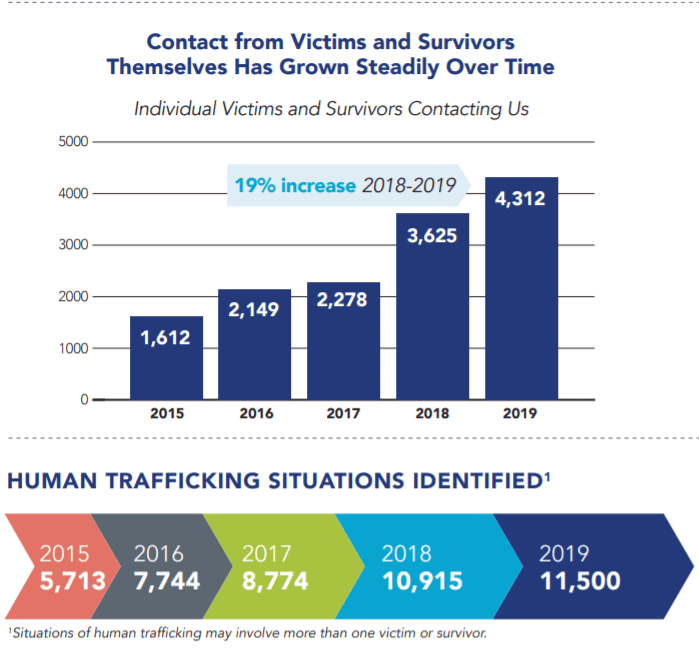
There were 11,500 situations of human trafficking identified through the U.S. National Human Trafficking Hotline in 2019. Of those, there was a near-20% increase in victims and survivors contacting the hotline directly, the 2019 report says. That jump is important because victims and survivors of sex and labor trafficking know their situations
and needs better than anyone.

The report goes on to describe one such call to the hotline by a victim, whose name has been changed and details removed in order to protect her identity: “Vanessa* told the Advocate on the U.S. National Human Trafficking Hotline that she had finally decided it was time to get out. She and several other women were being held in a home and forced to engage in prostitution. If they refused or fought, their trafficker withheld food and water and threatened them with a firearm. Their trafficker had cameras placed throughout the house and monitored them at all times. At the time of her call to the Trafficking Hotline, Vanessa was with a buyer and requested that law enforcement be sent to remove her and the other victims from their situation. The Trafficking Hotline was able to report to trusted contacts who acted quickly and extracted Vanessa and the other women. In the course of their investigation, the Trafficking Hotline’s law enforcement partners determined that Vanessa’s situation was actually part of a larger network based in another city and state.”

Image Source: UN Women’s report on Gender Equality In The Wake Of Covid-19

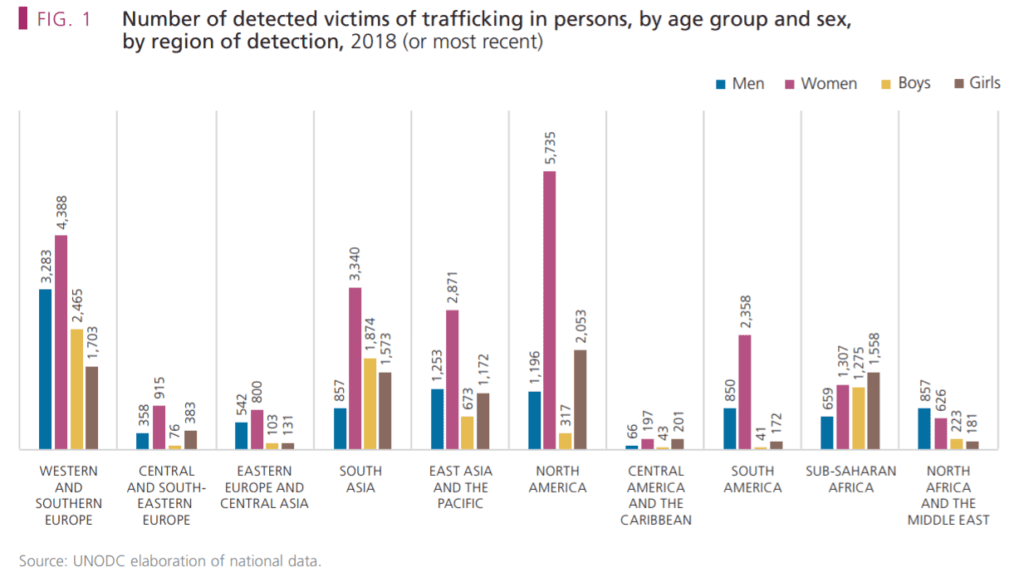
In 2018, for every 10 victims detected globally, about five were adult women and two were girls, the Global Report On Trafficking In Persons 2020 (GLOTiP) says. Trafficked women and girls have to deal with high rates of physical and sexual violence, including homicide and torture, psychological abuse, horrific work and living conditions, and extreme deprivation while in transit, according to the American Psychological Association (APA).

“Variables that contribute to a person’s vulnerability to being trafficked include: membership in a marginalized group; prior victimization and trauma; disabilities; immigrant or refugee status; and family disruption. These may be magnified by globalization, poverty, political instability and war,” the APA adds. Trafficking can lead to serious mental health problems, including anxiety, depression, self-injurious behavior, suicidal ideation and suicide, drug and alcohol addiction, post-traumatic stress disorder (PTSD), dissociative disorders and complex PTSD.

Traffickers target victims who are marginalized or in difficult circumstances. Undocumented migrants and people who are in desperate need of employment are also vulnerable, particularly to trafficking for forced labor.

In Central America and the Caribbean, most of the detected victims in 2018 were girls and women, making up 79% of the total detected trafficking victims in that sub-region, based on the GLOTiP report and its classification. The share of girls as a proportion of the total detected victims remains among the largest percentage of girl victims of trafficking recorded worldwide. In North America, females continue to account for an even larger share of detected victims than in Central America and the Caribbean.

Image Source: UN Women’s report on Gender Equality In The Wake Of Covid-19

Sexual exploitation is the most commonly detected form of trafficking, (at over 70%) and among the highest recorded globally, in the North America, Central America and the Caribbean, the GLOTiP report says.

At a global level, in 2018, most women detected were trafficked for sexual exploitation, whereas the men detected were mainly trafficked for forced labor. However, a significant share of detected men were trafficked for sexual exploitation or for other forms of exploitation. Similarly, roughly 14% of women were trafficked for forced labor.

Victims of trafficking for domestic servitude are exposed to multiple forms of exploitation and violence, including sexual, physical, and psychological abuse that is rarely seen in other forms of trafficking, analysis of court case summaries and literature suggests. Victims of this type of trafficking are usually women.

Covid-19 Pandemic Has Made Things Worse For Female Trafficking Victims

Image Source: UN Women’s report on Gender Equality In The Wake Of Covid-19

The covid-19 pandemic has not helped the situation for women around the world. To begin with, the crisis is likely to increase female poverty, a UN Women report says. Why does that matter for human trafficking? Of the several pre-existing factors traffickers take advantage of, economic need accounted for 51% of cases, according to the United Nations Office on Drugs and Crime’s collection of court case summaries, published in the GLOTiP report.

“As with previous economic crises, the sharp increase in unemployment rates brought about by the COVID-19 pandemic is likely to increase trafficking in persons, particularly from countries experiencing the fastest and most persistent drops in employment. Job seekers from these countries are likely to be more willing to take high risks in the hope of improving their opportunities. The most vulnerable groups, even in wealthy nations, are those suffering the most during the Pandemic Recession. Evidence suggests low earners have been hit the hardest by spiking unemployment. As unemployment rates rise, increasing numbers are likely to be trafficked from the poorest communities to those parts of the world recovering faster,” the GLOTiP report says.

Although, through the pandemic, quite a few global leaders of nations who were women have received widespread public applaud for handling the Covid-19 pandemic in an efficient, effective and empathetic way – a fact that the UN-Secretary General alluded to in his report from December.

The quality, relevance and effectiveness of policymaking and policy implementation increases when power is shared, as recently shown by the critical roles that women have played in responses to the coronavirus disease (COVID-19) pandemic. Women’s organizations are at the forefront of community responses in many countries but struggle because of diminishing funding, increased demands for services, restricted movement and shrinking civic space. The pandemic is rolling back the limited progress made in the past 25 years with regard to women’s empowerment and gender equality, and measures to increase women’s leadership in COVID-19 response and recovery efforts are urgently needed.

Report of the UN-Secretary General |
Follow-up to the Fourth World Conference on Women and to the
twenty-third special session of the General Assembly
Image Source: UN Women’s report on Gender Equality In The Wake Of Covid-19

— IN AN EMERGENCY, PLEASE CALL 911 —

Call the National Human Trafficking Hotline at 1-888-373-7888 to:

GET HELP and connect with a service provider in your area;
REPORT A TIP with information on potential human trafficking activity; or
LEARN MORE by requesting training, technical assistance, or resources.

The National Human Trafficking Hotline is a national, toll-free hotline available to answer calls from anywhere in the country, 24 hours a day, 7 days a week, every day of the year. The Hotline is not a law enforcement or immigration authority and is operated by a nongovernmental organization funded by the Federal government.

Weapons Waved, Fireworks Set Off, As 800 Vehicles Block Interstate Highway For Street Racing

By Anand Vasu

Police in Aurora, Colorado, said the southbound interstate 225 was intentionally blocked by 600 to 800 vehicles while street racing took place and weapons were waved. The incident occurred at night on March 7, according to a report on Fox News Denver. 

In addition, there were reports of fireworks and smoke, police said. The area was eventually cleared but police believed that the street racing action could simply move to another location and were monitoring developments.

This came on the back of a motor accident at the intersection of 120th Avenue and Colorado Boulevard in Thornton. Three men were killed and several others injured as two speeding cars rammed into stationary vehicles art the intersection.

Those killed were believed to have been in the speeding vehicles. 

“I saw video and it was just horrific,” Jenna Hirsch, was quoted as saying by CBS Denver “The crash, huge flames. I heard people got burned alive. It sounded really awful.” 

“It is every single night. It is bad,” Hirsch added. “We moved from downtown Denver to get away from the car noise and gun shots. Living up here has been 100 times worse. I feel like we are calling the cops every weekend to report the street racing that is continuing.”

Thornton police said they were yet to establish a direct connection between street racing and the incident.

Just last month, Colorado Springs City Council members were believed to be in support of an ordinance allowing law enforcement to seize vehicles they believed were connected to crime, in an effort to curb street racing in the region.

Under the proposed legislation, police officers could seize vehicles that were believed to have been used in illegal activity or used to facilitate illegal activity. 

This included including fleeing from police during a traffic stop, gang-related activity, any drive-by crime, street contests or prostitution. The seizures would happen through a civil process.

“What we’re really looking at is a positive way of impacting the behavior here in Colorado Springs,”said David Edmundson, commander of Colorado Springs Police Department’s Sand Creek Division, to The Gazette. 

While parents raised concerns that their vehicles may be used in such activity without their knowledge, resulting in seizures, there were safeguards in place to reduce such cases.

Police would issue a warning letter before seizing the vehicle in cases where the owner is unaware of what it’s is being used for, law enforcement said. If the same car was used in illegal activity a second time, this evidence would be presented to the city attorney to obtain a court order and seize the vehicle.

Law enforcement has said for long that social media was making it easier and easier for street racers to plan events and get together at short notice. While these posts do not give away details about the activity planned, those indulging in these activities understand the coded messages.