As of February 2021, the 117th Congress already has seven bills introduced which, if passed, would change background checking requirements in our country. Five of these bills focus specifically on the subject of background checks involving gun sales.
The For the People Act of 2021, focuses on expanding Americans’ access to the ballot box, but addresses background checking of those who work for election infrastructure vendors. The Stronger Child Abuse Prevention and Treatment Act focuses on reauthorizing and strengthening CAPTA, but addresses background checking of prospective foster and adoptive parents and other adult relatives and non-relatives residing in the household. Here is a brief overview of how these laws could change background checking requirements in the U.S.
H.R.1 – For the People Act of 2021
If passed, the criteria to be considered a “qualified election infrastructure vendor” would include, among other things, that its personnel policies include background checking and cybersecurity training consistent with best practices issued by the Technical Guidelines Development Committee. Read more on the Technical Guidelines Development Committee here.
If passed, this would also create an election security bug bounty program. Participation in the bug bounty program would be optional, but would also require a background check.
If passed this would require the Department of Justice to submit a report to Congress including the following:
The number of firearm transaction denials issued by the National Instant Criminal Background Check System that are referred to the Bureau of Alcohol, Tobacco, Firearms, and Explosives for investigation.
The number of prosecutions resulting from such investigations.
The number of firearms recovered by the Bureau in cases in which such a denial was issued after the firearm was transferred.
If passed this would require the National Criminal Instant Background Check System to:
Notify U.S. Immigration and Customs Enforcement whenever the information available to the system indicates that a person illegally or unlawfully in the United States may be attempting to receive a firearm.
Notify the relevant State and local law enforcement agencies of the same.
The Stronger Child Abuse Prevention and Treatment Act focuses on reauthorizing and strengthening CAPTA, but addresses background checking of prospective foster and adoptive parents and other adult relatives and non-relatives residing in the household.
It would also require the Secretary of HHS to convene a group to study, among other things, “Whether background check requirements under this Act, the Child Care and Development Block Grant Act of 1990 (42 U.S.C. 9858 et seq.), and part E of title IV of the Social Security Act (42 U.S.C. 670 et seq.) are complementary or if there are discrepancies that need to be addressed.”
The full text of this bill is not available yet, but we can gather a certain amount about it from the title. It would require the records of the National Instant Criminal Background Check System to be retained for at least ninety days.
For the full text when it becomes available click here.
H.R. 1006
This bill would close what is known as “the gun-show loophole.” In other words, it would require criminal background checks on all firearms transactions occurring at gun shows. Currently, gun-shows do not fall under the same requirements as other places where people buy guns, meaning it is easier for a person who should not have a gun to get one at a gun show than elsewhere.
For the full text when it becomes available click here.
Separately, on Feb. 9, Carolyn Maloney, House Oversight and Reform Committee Chairwoman, unveiled a legislative package of five bills focused on gun safety.
When David Mamet wrote the screenplay for The Untouchables, he wrote in a dialogue for one of the lead characters that became very popular: “You wanna know how to get Capone? They pull a knife, you pull a gun. He sends one of yours to the hospital, you send one of his to the morgue. That’s the Chicago way! And that’s how you get Capone.”
Yes, these famous lines — uttered by Jimmy Malone, played in an Oscar-winning performance by the late Sean Connery, in conversation with Kevin Costner’s famed Elliot Ness — are purely fictional. But the feeling the lines evoke, overall, is one of awareness of just how serious an issue violent crime had become in Chicago almost a century ago.
That, unfortunately, still holds true, but some things are changing. Last month, the Illinois legislature passed HB 3653 SFA2, known as the Illinois Pretrial Fairness Act, as part of a comprehensive criminal justice reforms package. It was sent to Illinois Gov. J.B. Pritzker on Feb. 4, 2021, and is expected to be signed into law by him.
The act, more than 300 pages long, not only abolishes the controversial cash bond system by 2023 — it would make Illinois the first state to completely eliminate money bail, making sure that people accused of crimes don’t await trial in jail just because they can’t afford bond — but also aims to end mass pretrial incarceration.
Then, at the beginning of February, 2021, the Justice Department confirmed that its violent crime-fighting program — Operation Legend — was canceled, ABC7 Chicago reported. The federal law enforcement program had specifically targeted rising violence in major American cities.
A project of then-Attorney General William Barr, it was named after LeGend Taliferro, a 4-year-old who was murdered while sleeping in his Kansas City home by a bullet meant for someone else, early on the morning of June 29, 2020. Operation Legend was greeted with mixed reactions from local mayors and community groups, ostensibly more because of the politics of it all than any debate over a need to solve the problem of rising violent crime. Everyone agreed about that. Even in Chicago.
In any case, according to the yearend figures for the program in Chicago, 176 people were charged through Operation Legend, including 40 on drug counts and 130 for firearms-related violations.
According to the DOJ, between Operation Legend’s July 8, 2020 launch in Kansas City and subsequent expansion to 8 more cities — Chicago, Albuquerque, Cleveland, Detroit, Milwaukee, St. Louis, Memphis and Indianapolis — federal agencies and local law enforcement had made more than 6,000 arrests overall by December-end. This included approximately 467 arrests for homicide, the seizure of more than 2,600 firearms, more than 32 kilos of heroin, 17-plus kilos of fentanyl, 300-plus kilos of methamphetamine, more than 135 kilos of cocaine, and more than $11 million in drug and other illicit proceeds.
Of the more than 6,000 individuals arrested, around 1,500 were charged with federal offenses, with 815 defendants specifically charged with firearms offenses.
“I say it was very successful across the country, there were approximately 6,000 subjects that were arrested, and we’re talking about the repeat offenders,” Assistant Special Agent in Charge of Chicago’s FBI office, Clifford Swindell, is cited as saying in the ABC7 report.
Do Recent Numbers Tell The Real Story?
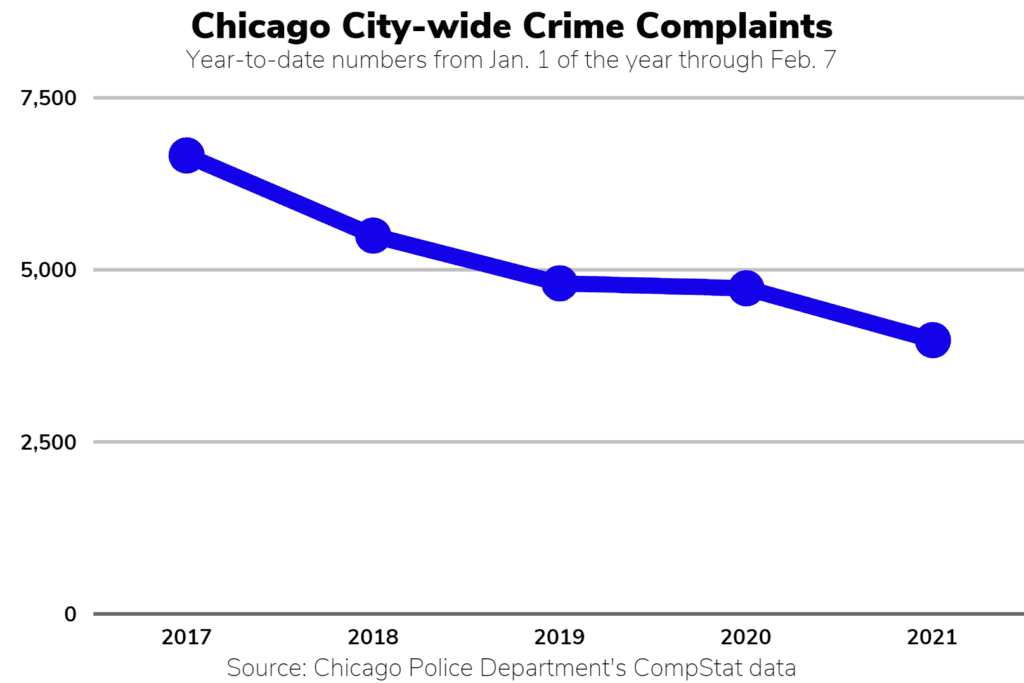
On the face of it, the overall number of crimes do appear to be on the decline in Chicago in recent weeks. Sample the graphic below, which shows that most categories of criminal complaints were down in the city over the week of Feb.1 to Feb. 7, 2021.
Everything from criminal sexual assaults to aggravated battery and motor vehicle theft declined during that week, according to the latest data from the Chicago Police Department’s (CPD) CompStat figures, which are typically updated every Monday. (Yet, data for the week starting Feb. 8 had not been uploaded as the time of writing this article.)
From a five-year, year-to-date, perspective too, things appear to be on the mend. At least, as we mentioned, on the face of it.
The Story Behind The “Good” Numbers May Be Different
The picture changes, though, when the various categories of crime are studied independently, as with reports of shooting incidents, for instance.
Shooting incidents were up 28% on a 28-day basis, leading up to Feb. 7, 2021. In that same 28-day period, motor vehicle thefts also increased by 18% and robbery went up 3%.
Motor vehicle thefts have been on the rise only over the past two years and there has been no clear trend yet for robberies, according to CPD data. But shooting incidents have displayed an alarming upward trend for the past three years now, and that continued into this February.
Chicago’s Bloody Timeline, A Rise, Fall And Rise Again
The 1960s were, perhaps, one of the most crucial decades in the history of Chicago’s violent streak. It was marked by turbulent change and the number of homicides nearly doubled from the start of the decade to its end, according to an excellent Chicago Tribune article from last year, which traced 63 years of murder in the city.
Here’s our quick recap of the Tribune article, but we’d urge you to read it in its entirety: In the 1970s, the city witnessed 970 homicides in one of its bloodiest years ever. A nationwide economic recession and unemployment exacerbated the murder rates, even as “super gangs” competed with each other over the drug markets. The 80s were slightly better than the 90s but overall, homicides still remained high.
With the advent of crack cocaine, homicides soared in the 1990s. Territorial wars among gangs, made worse by the city’s demolition drive of its high-rise public housing projects, which displaced people, was reportedly the main reason for gang violence during this decade. Chicago had the highest number of homicides in the country in the early part of the 2000s, though numbers continued to fall from the highs of the 1990s.
The early part of the next decade, the 2010s, was promising and had some of the lowest homicide totals in decades. But violence exploded in 2016 with 760 killings.The number of homicides has fallen since the 2016 spike, with decreases between 2017 and 2019. But 2020, a year that saw a potent, poisonous mix of the pandemic, rising unemployment, anti-police protests, lockdowns, isolation and mental health issues, was a tough year, once again.
There were 774 murders in the city in 2020, a 50% increase from 506 in 2019, according to an excellent database maintained by the Chicago Sun-Times.
Highest January Murder Rate In Four Years
Although overall crime rates may be falling in Chicago of late, one category is dramatically different when viewed at from a year-to-date perspective — murders. Chicago clocked its highest January murder rate in four years in 2021.
According to the the CPD, January 2021 saw 51 homicides. The Sun-Timesdatabase has that at number at 54, but the CPD count does not include homicides on expressways nor killings committed in self-defense. Either way, it was Chicago’s deadliest January in four years.
That trend appears to have continued into February too so far, with the year-to date murder reports standing at 60 for 2021 versus 43 in 2020 as of Feb. 7, according to CPD data.
Of Untold Murders Of Women, And Reforming Cash Bail
If the last two charts weren’t alarming enough, here are a few more aspects of Chicago’s current crime scenario that just may be. Over the past 20 years, over 50 women have been brutally murdered in the city, a WGN9 report says. Their bodies were left in alleys, vacant lots and abandoned houses.
All of the women were strangled or asphyxiated, with some even dismembered and burned. In 2019, the CPD created a task force, made up of FBI and CPD detectives to review the murdered women’s cases. They solved four cases, but the state’s attorney felt charges could only be sustained in one. The fight for justice for Chicago’s women carries on.
In the meantime, a report by Loyola University’s Don Stemen and David Olson was released. The study intended to show that the city’s controversial limits on the use of cash bail did not end up causing more crime, a major worry for sections of law enforcement and bail-reform skeptics. A piece last week in the City-Journal, a publication of the Manhattan Institute for Policy Research (MI), a free-market think tank, said as much in an article titled, “Yes, Bail Reform in Chicago Has Increased Crime.”
But Cook County Circuit Court Chief Judge Timothy Evans has not agreed. In 2017, Judge Evans required that judges not mandate cash bail unless strong reason existed to do so. It was a move aimed at reducing the number of offenders being held only because they could not afford to get out. Cook County Courts later published a report that said the order had reduced the jail population, without causing crime to rise.
Stemen and Olson’s report showed that bail reform led to the release of roughly 500 defendants who would otherwise have been detained. The report had estimated that, both before and after reform, roughly 17% of released offenders committed a new crime, including 3% who committed a violent offense.
The City-Journal’s contention was that if 500 additional people were released under the order, and the same share (17%) of released individuals reoffended, then the total number of crimes in Chicago would necessarily rise.
There is no question that money bail, as a system, has a worse impact on poor and minority defendants pretrial, and on jail populations generally. But we also have the statistics that show more recent spikes in crime. For instance, a sharp spike in the number of carjacking incidents reported in the city. There was a 17% increase in motor vehicle theft complaints in the 28 days leading up to and through Feb.7, according to CPD data.
Carjackings have been surging in Chicago for more than a year, a post in Block Club Chicago, an online newspaper that reports local and neighborhood news in the city, said on Jan. 22. After a 135% jump in 2020, the trend is continuing with 144 carjackings reported in the first 20 days of 2021, the report added.
The Block Club post also spoke about Stephanie Martin, who had lived in the Calumet Heights neighborhood all her life, but told members of the City Council that she was contemplating moving out of the city. On Dec. 1, 2020, her 31-year-old son was the victim of an attempted carjacking and robbery that left him paralyzed, she said.
And Then, As Always, There Are Guns, And People With Guns
“In response to the COVID-19 pandemic, the law department has temporarily halted the prosecution of gun-registry offenses.”
A spokesperson for Chicago Mayor Lightfoot’s administration to the Chicago Sun-Times, when asked to comment on why the administration nearly always asked judges to dismiss charges in cases involving gun-registry violations
In another recent development, although Chicago requires convicted gun criminals to register and punishes those that fail to comply, it has not been doing so in response to the Covid-19 pandemic according to a Chicago Sun-Times article. The law requires anyone convicted of gun-related violence or illegal gun possession to go to police headquarters yearly and register their home addresses.
The article says its own analysis that found most cases of those failing to comply get dismissed in court — and that’s typically done at the request of lawyers representing City Hall. The gun-offender registry was established under then-Mayor Rahm Emanuel in 2013. The aim was to alert the police to use extra caution when approaching any suspect the police department’s arrest database shows is in the registry.
It was modeled along the lines of similar programs in Baltimore and New York, two other cities with gun offender issues. Baltimore officials had told the Washington Postin 2012 that their gun-offender registry helped reduce crime, with fewer than 5% of the 1,669 people on the list ending up being arrested on new gun charges.
Asked why lawyers for the city nearly always asked judges to dismiss charges in cases involving gun-registry violations, a spokesman for current Mayor Lori Lightfoot’s law department, responding by email told the Sun-Times: “In response to the COVID-19 pandemic, the law department has temporarily halted the prosecution of gun-registry offenses.”
All things considered, there appears to be a mountain-load of work ahead, for the city, its people, its disparate communities, and its agencies, before the Windy City can finally begin to cast off “the Chicago way” image.
In closing, we leave you with this link to a page managed and updated by the fine journalists at the Sun-Times — a database listing details of every single victim who was killed by another person within city limits. In honor of the fallen.
Friendly soccer matches, and matches in table tennis esports and volleyball are the latest events to be targeted by match fixers, sports integrity data company SportRadar said.
The Switzerland based firm, which is the official data provider to the NFL, NBA, MLB, NHL and also the integrity services provider to world soccer governing body FIFA, said that match fixers were diversifying and that there has been a massive spread in the cancer of match-fixing.
The financial fallout of the pandemic left players, referees, coaches and presidents increasingly vulnerable.
The number of highly suspicious games flagged by Sportradar’s systems in 2020 was 526 down from 661 in the previous year, but given that most sporting fixtures were canceled in 2020, the figure represented a dramatic rise in potential corruption.
Soccer teams based in Russia, Brazil, Vietnam, Czech Republic, and Armenia featured repeatedly in suspicious friendly matches. The most recent incident was only two weeks ago during a friendly in Europe, where the referee is suspected of manipulating play to ensure that at least two goals were scored in the first half.
In March 2020, as elite global sports were canceled because of the Covid-19 pandemic, gambler focus turned to the few sports that were still running. These included table tennis in Russia and the Ukraine. In 2019, just one table tennis match was flagged as suspicious by Sportradar. But there were 20 in 2020.
“In the past, match-fixers have targeted those sports and leagues where the profit and turnover are biggest, such as football [soccer], tennis, and basketball. But now they have diversified,” Andreas Krannich, the managing director of Sportradar’s Integrity Services, said. “What the fixers quickly understood is that a lot of sports are now suffering financially as a consequence of Covid-19. And where there is far less money, players, referees, coaches, presidents are increasingly vulnerable.”
Krannich added that sports that enjoyed a smaller audience or in-ground viewership were previously largely ignored by corruptors. These were now targets. “We have extremely good networks in bookmaking around the world, as well as informants from law enforcement, the police, and the match-fixing world,” Krannich said. “And what they were telling us was that match-fixers were running out of money and they were thinking: ‘OK, how can we compensate? How can we make profit out of this situation?’ And what they have done … they’ve diversified,” he added. “We have seen sports that were previously seen as an add-on become more targeted by fixers.”
Sportradar works closely with 80-plus sporting federations globally. Last year, it analyzed 600,000 matches across 26 sports.
On Feb. 1, 2021, the Department of Justice (DOJ) published the first of two issues of their Department of Justice Journal of Federal Law and Practice focused on missing or murdered American Indians and Alaska Natives. This was part of a collaboration between the DOJ’s Missing and Murdered Indigenous Persons (MMIP) Initiative and the Presidential Task Force on Missing and Murdered American Indians and Alaska Natives (Operation Lady Justice).
Operation Lady Justice was a two-year task force established on Nov. 26, 2019, by Executive Order (EO) 13898, with a concentration on two areas: Missing persons cases and cases of murder. Why is this interesting? Because while the two issues are often clubbed together, from a policing perspective, and in terms of data, causes, and law enforcement responses, they’re very different. Missing person cases are not automatically tagged as a criminal investigation and being missing is not always a crime, murder invariably is. What was also interesting was that the Task Force adopted the terminology Missing and Murdered Native Americans or “MMNA” to include American Indian and Alaska Natives of all genders and age groups.
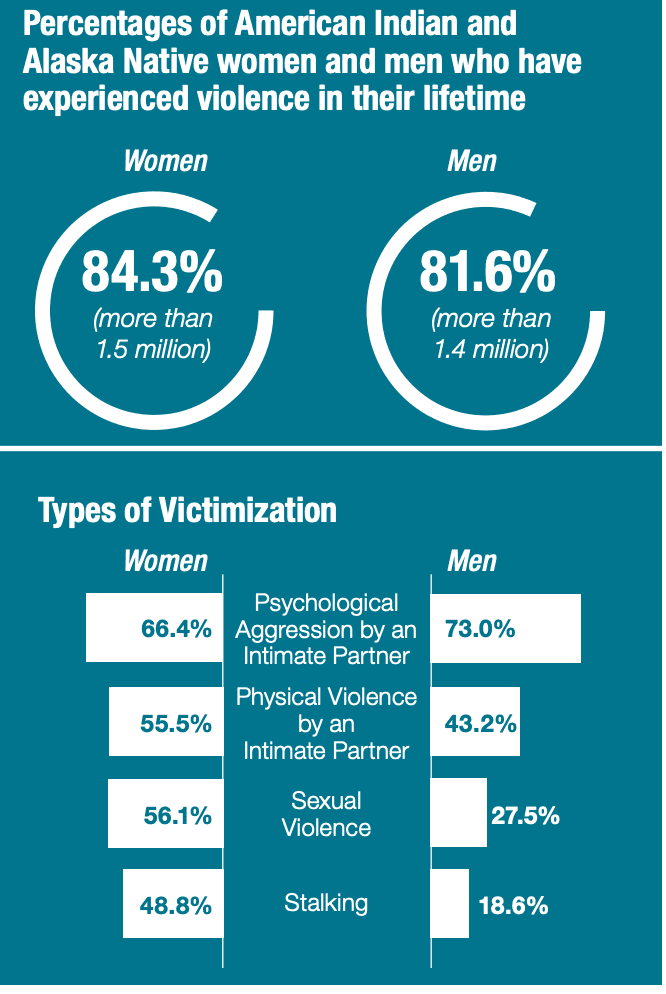
Source: Courtesy NIJ.gov. Percentages of American Indian and Alaska Native people who have experienced violence in their lifetimes.
Why Was This Task Force Needed?
According to the almost 100-year-old Association of Indian Affairs, the country’s oldest nonprofit focused on Indian Country and protecting tribal interests and culture, an astounding 84.3% — four in five — of American Indian and Alaska Native women “have experienced violence in their lifetime” across North America, whether on reservations or in urban areas off tribal land. The stats, and it is generally believed these are widely underreported, are stark, American Indians and Alaska Natives are 2.5 times as likely to experience violent crimes and twice as likely to experience rape or sexual assault crimes compared to all other races.
According to statistics from the DOJ’s National Institute of Justice (NIJ), more than two in five American Indian and Alaska Native female victims reported being physically injured, and almost half reported needing services, including medical care and legal services, which more than a third (38%) were unable to access. In the U.S. and Canada, an average of 40% of the women who were victims of sex trafficking identified as American Indian or Alaskan Native.
And it isn’t just sexual assault or intimate partner violence. Read these two stats: Homicide is reportedly No. 3 on the list of causes of death of American Indian and Alaska Native women between 10 and 24, and the fifth leading cause of death for indigenous women between 25 and 34 years. As of 2017, which is apparently the latest available data, the top three cities with the highest number of Missing and Murdered Indigenous Women & Girls (MMIWG) cases were Seattle; Albuquerque, and Anchorage while the top three states for such cases were New Mexico, Washington, and Arizona. All three states are among the 11 states that are a focus of the DOJ’s new Task Force program.
A June 2019 report from the National Center for Missing & Exploited Children (NCMEC) said that between Jan. 1, 2009 and Dec. 31, 2018, it had assisted with 1,909 cases involving missing Native American children. Of those, a majority (85%) were Endangered Runaway cases, with 12% being Family Abduction cases. A 10-year-analysis by NCMEC of this data indicated that almost 60% of the cases were female, while the mean age of the children that went missing was 14, with one-fourth being between 10-14 years. The report also said that more than a third (35%) of these children had at least one tribal affiliation. The five most common were Cherokee (46 children), Navajo (40 children), Sioux (35 children), Chippewa (33 children) and Alaska Native (31 children).
Behind Blurred Lines: Finding The Causes Of This Epidemic Of Crime
While the causes go back centuries, to sustained and historic systemic discrimination, appalling poverty, federal policy and the inequitable application of laws on tribal lands, this 21st century version of an ongoing crisis has an intriguing, if horrifying twist. A five-part Al Jazeera America project in 2015 on Native American gangs, stated, “Compared with their African-American or white counterparts, Native American gangs and gang members are a relatively new phenomenon, tracing their roots back to the 1980s and ’90s, when city gangs introduced themselves to Indian Country and began recruiting.” The article continued: “The growing threat of Native gangs is not a retelling of cowboys and Indians set against the backdrop of a modern black market. It’s a story about how historical trauma, federal policy and tribal pride have created a new Indian problem: Organized crime.”
The project referred to two telling statistics: Data from 2007, which showed that less than half of Native Americans aged 25 and over had a college or graduate degree. And a damning 2014 Aspen Institute report that asserted that Native American teens experience the highest suicide rate of any population group in the United States.
These facts, coupled with rising drug use across the country, within and beyond tribal lands, have also led to a renewed resolve to tackle a not-so-new problem that is quickly reaching epidemic proportions in Indian country: Human Trafficking. An article in Indian Country Today on Aug. 1, 2016, reported that a Northeastern State University study on methamphetamine use in tribal communities found several disturbing trends. “Organized criminal gangs are targeting casinos in tribal jurisdictions to facilitate drug sales and sex trafficking, and drugs are being trafficked by large non-Native organizations with international ties…”
Just for a perspective on the urgency of this last issue, here are some statistics. According to “The Devastating Impact of Human Trafficking of Native Women on Indian Reservations,” a transcript of the 2013 testimony of Lisa Brunner, of the National Indigenous Women’s Resource Center, to the U.S. Senate, “Native women experience violent victimization at a higher rate than any other [segment of the] U.S. population.”
It also stated: “Congressional findings are that Native American and Alaska Native women are raped [at the rate of] 34.1% — more than one in three will be raped in their lifetime; 64%, more than six in 10, will be physically assaulted. Native women are stalked [at] more than twice the rate of other women. Native women are murdered at more than 10 times the national average. Non-Indians commit 88% of violent crimes against Native women.”
Brunner’s testimony was deeply disturbing. It spoke of the sex trafficking and selling of Native American women for “$20 of heroin,” the predatory economics of “undocumented man-camps” after the fracking boom in North Dakota and Montana, which led, in turn, to a documented increase in multi-faceted criminal incidents; to the underground, unregulated adoption industry that thrives on selling Native American children “to the highest bidder.” In short, it said that unfortunately, human trafficking in Indian country was alive and kicking.
According to the NCMEC report mentioned above, 11% of missing Native American children intaked by them had a reported history of sexual abuse. The types of sexual abuse ranged from child sex trafficking (62% of all cases involving a history of sexual abuse), sexual abuse by a family member (10%), statutory rape (13%), and sexual assault by an acquaintance (4%).
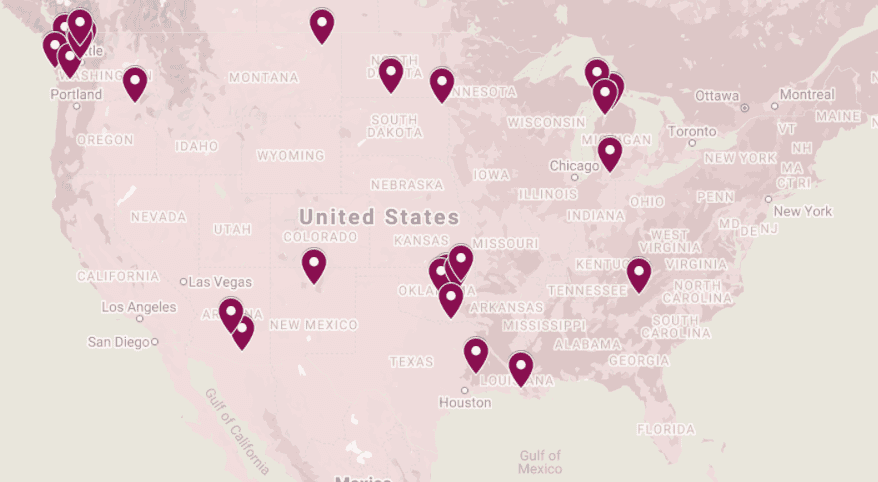
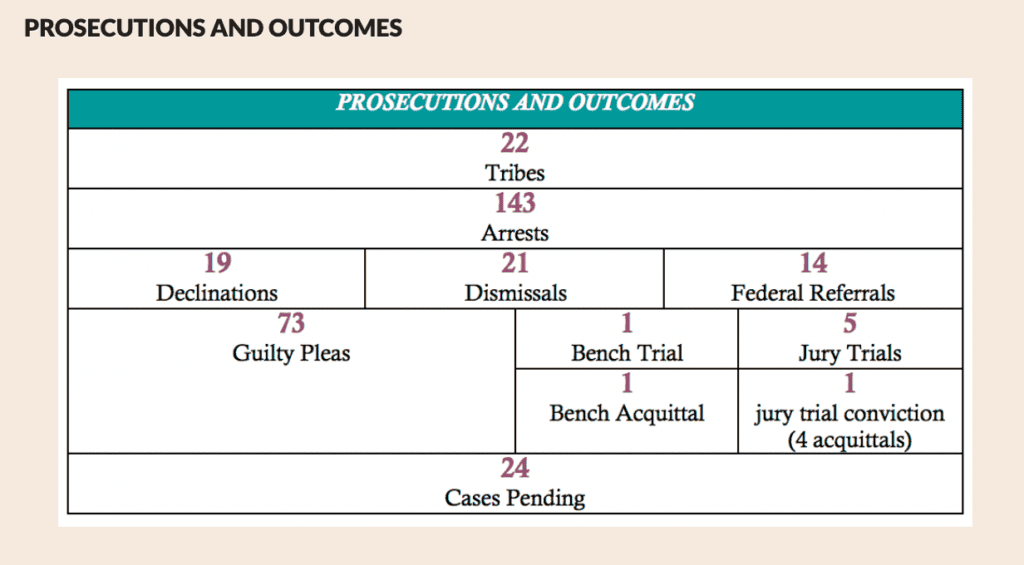
Source: NCAI (left) There are currently 27 Tribes implementing VAWA Special Domestic Violence Criminal Jurisdiction (SDVCJ) across the United States. See the full list here. On right, the total number of prosecutions and outcomes after 5 years of VAWA 13 remained very small. See details here.
There’s Work Being Done But It’s A Long And Complex Road
One of the major problems prior to 2013, and the signing of the Violence Against Women Reauthorization Act of 2013, or “VAWA 2013,” Native Americans could not bring their offenders to justice on tribal land if they were not Indian. VAWA 2013 partially resolved this, at least for victims of domestic violence, when that violence occurs in Indian country, and when the victim is Native American.
Just to provide some context to why this was important: According to a 2018 report from the “Hate in America“ project, a Carnegie-Knight News21 initiative, unlike women of every other racial group, Native American women were far more likely to be sexually assaulted by people not of Native American origin. The report, quoting a study by the University of Delaware and the University of North Carolina, said that more than two-thirds of sexual assaults against indigenous women were committed by white and other non-Native American people, “yet non-native men who assault Native American women on reservations can’t be arrested or prosecuted by tribal authorities under a 1978 Supreme Court decision.”
The NIJ states that “most American Indian and Alaska Native victims have experienced at least one act of violence committed by an interracial perpetrator” — 97% of women and 90% of men — as compared to 35% of American Indian and Alaska native women and 33% of men experiencing one or more acts of violence by an American Indian or Alaska Native perpetrator.
In Oliphant v. Suquamish Indian Tribe, the United States Supreme Court, in a rather controversial 6-2 decision, decided that tribal courts have no criminal jurisdiction over non-Indians. VAWA 2013 recognized tribes’ inherent right to exercise “special domestic violence criminal jurisdiction” (SDVCJ) over certain defendants, who, regardless of their Indian or non-Indian status, committed acts of domestic violence or dating violence or violated protection orders in Indian country.
The problem, though, is that even almost eight years after the passage of VAWA 13, only 27 of 562 federally recognized tribes have become voluntary compliant with implementing VAWA SDVCJ across the United States. And its federal regulations and it requires voluntary compliance. (See map below).
According to a 2017 article by the Indian Law Resource Center (ILRC), one of the reasons for the slow adoption was regulations, “such as providing court appointed council to defendants who cannot afford it at the tribe’s expense, a challenge for tribes with little money.” Another issue? “Tribes must also have juries that are selected from a “fair cross-section” of the public,” which meant they could not exclude non-Indians. According to the ILRC, “while this was practiced by some tribes even prior to the VAWA reauthorization, for others it means changing tribal law.” They gave the example of the Cherokee Nation, which had otherwise met the regulations.
The article quoted Chrissi Nimmo, the assistant Attorney General for the Cherokee Nation since 2008, who said then, “We still have to pass legislation to include non-Indians on our jury. How do we, as an Indian tribe, want to open up our court system to non-Indians? It’s always been Cherokees. How do we carve out this special seating? I don’t have a timeline but to say that we are working on it.” AG Nimmo and the Cherokee Nation did work on it. As of February 2021, they are one of the 27 Tribes implementing VAWA 2013.
You can find the full list of Tribes here.
Source: Courtesy DOJ
Change is Going To Come? One-Year On, A Report from Operation Lady Justice
Where is this all going? In November 2020, a 78-page, one-year OLJ report put together and detailed several suggestions, including those from listening sessions with tribal leaders. These included:
The need for a deep dive into the root causes of missing and murdered American Indian and Alaska Native peoples.
An improvement in interagency collaboration across all agencies.
Full funding for Tribal law enforcement, courts, social services, domestic violence shelters, victim services programs, domestic violence and sexual assault community organizations, and search teams.
A need for publicly available data on missing persons and murder cases.
Increased State and local training on Tribal issues including enforcement of Tribal court orders of protection.
A need to establish a national alert system for adults similar to Amber Alert.
Better Federal communication with families and grassroots organizations.
Tribal notification when a person goes missing.
Programs to address intervention and prevention.
Increased access to the Tribal Access Program, as well as increased availability for Amber, Ashanti, and Silver Alerts in Indian communities
Their focus for this second year of the Task Force, as things stand, is on law enforcement training especially with regard to trauma-informed responses to cases involving missing or murdered American Indians and Alaska Natives; coordinating with state and local law enforcement agencies in areas with large AI/AN populations; assisting Tribal law enforcement agencies with developing formal arrangements with their Federal, State, and local law enforcement partners regarding missing or murdered AI/AN cases; developing a guidebook for families when an adult goes missing on how to engage with and what to expect from law enforcement; and creating a searchable database of resources across DOJ, DOI, and HHS that will assist communities identify training, funding, technical assistance, and other resources.
According to the DOJ, Tribes are taking concerted action to address Missing and Murdered Indigenous Women (MMIW) issues. “The Yakama Nation in southern Washington began accessing the state’s major violent crime database to track the disappearance of tribal members. On the Navajo Nation, the Missing and Murdered Diné Relatives working group is tackling issues like sex trafficking and child abductions in the nation’s largest Tribal jurisdiction. In Montana, the Confederated Salish and Kootenai Tribes are working with state officials to prioritize cases of missing or murdered Tribal citizens.”
The work is ongoing. For us, though, one comment from a “Listening Session” in June 2020, by Renee Bourque, a citizen of the Muscogee (Creek) Nation stood out: “We need more funding for Tribal communities to have training and education, and the ability and funding to develop their own response which best suits their community needs,” she said. “What works on the Fort Berthold reservation is not going to work within the boundaries of the Muscogee Creek Nation. We have to make sure that we allow our Nations to guide these responses that best suit their needs.”
Steven Gazlay, a former 311 Boyz gang member, and Dana Nee, his girlfriend, were arrested on Feb 14. in Madison County, Idaho, according to the Las Vegas Review-Journal.The two were out on bail in Las Vegas when they left.
Nee failed to appear for a schedule videoconference court appearance and Gazlay removed an electronic monitoring ankle bracelet before fleeing. Gazlay has been convicted of eight felonies, including beating a teen with a crowbar and domestic violence, records show.
Gazlay had been a member of the 311 Boyz gang. The 311 Boyz Gang is unlike most others, Las Vegas Metro Police are quoted as saying to the Las Vegas Sun.The gang is made up mostly of white men hailing from middle- to upper-class families in the Las Vegas Valley. A violent group, they often videotaped each other fighting.
Investigators also allege that the gang shares symbols with racist groups, including a name that is purported to mean KKK and the Iron Cross, associated by some to Nazi Germany, the Las Vegas Sun article says.
After being released from prison in 2019 Gazlay and Nee swindled an Arizona lender out of $707,375 in a mortgage scam. A combination of identity theft and falsified documents were used in the scam.
Gazlay is alleged to have used some of the proceeds of the scam on a gambling spree. He has since been banned from Station Casinos in the Las Vegas areas after accumulating losses and then attempting to fraudulently obtain credit.
In the mortgage case, Gazlay and Nee have been indicted on charges of theft, forgery, mortgage lending fraud, and more.
In the 2014 domestic violence court case, Gazlay was accused of using a revolver and threatening to kill his girlfriend, the mother of his three children. He then shot himself in the leg, the Las Vegas Review-Journal reported.
According to that report, Gazlay claimed that his girlfriend was angry that he was cheating on her and therefore shot him. However, Gazlay’s 11-year-old son said that Gazlay shot himself, during the trial.
Earlier, Gazlay was accused of using money from an automobile scam to gamble at the Cosmopolitan of Las Vegas on the Strip, and lost $178,250 in cash and markers.
Olakitan Oluwalade, his cousin Odunayo Baba Oluwalade and Kelly Lamont Williams were arrested after the HSI Intellectual Property Rights Center and the HSI Cyber Crimes Center became aware of a fraudulent replication of the website of Company 1, a biotechnology company based in Cambridge, Massachusetts, that focuses on drug discovery, drug development and vaccine technologies, including a vaccine for Covid-19.
The trio set up a fake website that advertised the availability of a Covid 19 vaccine ahead of time, U.S. Immigration and Customs Enforcement said in a statement. The home page of the fraudulent replication of Company 1’s website, named “Modernatx.shop” was visually similar to the Company 1 website, including the name and trademarked logos for Company 1, and the logo, markings, colors and texts.
On Jan. 11 2021 an undercover HSI agent contacted a number listed on the Fake Domain, which investigators determined was linked to an account on an encrypted messaging application which also allows voice-over-Internet calls and video chats.
The agent received a call in about two hours asking for an email address for further communication. After an exchange of multiple emails the undercover operative received details regarding payment, delivery, and purchase for alleged Company 1 vaccines from a Google e-mail address. The agent was sent a purported invoice for 200 doses of Company 1’s vaccine at $30.00 per dose, for a total of $6,000, with payment terms listed as 50% up front and 50% upon delivery.
Payment was to be sent to a Navy Federal Credit Union account in the name of Kelly Lamont Williams, and the agent transferred a part of the funds. On Jan. 15, 2021, the government seized the Fake Domain and HSI agents executed a search warrant at Williams’s home. Law enforcement subsequently executed search warrants at Olaki’s and Baba’s homes. As a result of these searches, investigators recovered a number of communications between Baba, Olaki and Williams discussing the fraud scheme.
After the search of Williams’ residence agents used a phone seized to send Oluwalade a message asking: “Yo where u want me send the bread?” Baba allegedly replied: “Yea send me some thru zelle and some through cash app.” Both Zelle and Cash App are online payment platforms. Investigators followed up and made the transfers as instructed.
In the affidavit, Olaki allegedly referred Williams to Baba as someone who could assist with the fraud. Williams allegedly agreed to allow the conspirators to use his bank account to deposit the fraud payments in exchange for a cut of the fraud proceeds.
Olaki allegedly was also supposed to receive a part of the fraud proceeds. Several of the recovered communications also indicated that Olaki allegedly applied for and received a fraudulent Covid-19 Economic Injury Disaster Loan funded by the federal government in the summer of 2020.
The Baltimore-based trio were charged with conspiracy to commit wire fraud in connection with a scheme to allegedly sell purported Covid-19 vaccines. The complaint, which was filed on Feb. 9 was unsealed on Feb. 12 following the arrests of those charged.
If convicted, each defendant faces a maximum of 20 years in federal prison for conspiracy to commit wire fraud.
HSI launched Operation Stolen Promise in April 2020 to protect the Homeland from the increasing and evolving threat posed by Covid-19-related fraud and criminal activity.
As of Feb. 9, the agency has seized more than $33 million in illicit proceeds; made 225 arrests; executed 206 search warrants and analyzed more than 74,000 Covid-19 domain names.
Carolyn Maloney, House Oversight and Reform Committee Chairwoman, unveiled a legislative package of five bills focused on gun safety, on Feb. 9.
Maloney introduced the Gun Trafficking Prevention Act, which would make gun trafficking a felony. It would also make straw purchasing — the act of buying a gun for someone who was ineligible to do so themselves — a felony, from a misdemeanor offence.
The Handgun Trigger Safety Act, would incentivize the development of “smart-gun technology” that would only allow authorized gun owners to fire a gun. Maloney also introduced the Firearm Risks Protection Act, which would require gun owners to purchase liability insurance.
The New York Democrat also unveiled the Gunshow Loop Hole Act to require people who buy guns at gun shows to undergo background checks, according to an article in The Hill.
The NICS Review Act will require the FBI retain records of the National Instant Criminal Background Check system for at least 90 days so that the agency and the Bureau of Alcohol, Tobacco, Firearms and Explosives can review records.
The five proposals Maloney put forward were unlikely to have widespread support, The Hill article said. Even assuming the proposals made it past the Democratically controlled House they would need 10 Republican votes to reach the figure of 60 needed to get past the Senate.
Despite the numbers being stacked against her, Maloney was optimistic about the passage of the bills. “We’re particularly positioned well to pass these bills that have been around a long time, and that the American people … overwhelmingly support,” Maloney is cited as saying in the article. “So we have a, we have a very good opportunity.”
The timing of the proposals is key, coming as they do close to the third anniversary of the shooting at Marjory Stoneman Douglass High School in Parkland, Fla. in which 17 people were killed when a gunman opened fire with a semi-automatic rifle. The killing spree was the deadliest high school shooting in the US, with two casualties more than the Columbine High School massacre of 1996 which claimed 15 lives.
Fred Guttenberg, whose daughter Jaime was one of the victims of the Stoneman High shooting, said Maloney’s proposals treated gun violence as public health issue rather than a Second Amendment one. “The reality of gun violence and gun safety is not a second amendment conversation,” Guttenberg said. “It is not, it is a public health conversation.”
The Federal Bureau of Investigation conducted nearly 40 million background checks in 2020, a record number as the country dealt with the coronavirus pandemic, the 2020 election, and protests over racial injustice. The increase in background checks, considered a good indicator of the the trend of actual guns sold, was attributed to the unusual circumstances of the year 2020.
“People feel uncertain,” Adam Winkler, Author of the book “Gunfight: The Battle over the Right to Bear Arms in America,” said according to an article in The Hill. “And when you’re feeling uncertain, and you feel like you’re vulnerable, a firearm is one of the things that you might look to to provide you with protection.”
According to the Gun Violence Archive, more than 43,000 people died of gun violence-related deaths in 2020.
David T Hines of Miami fraudulently obtained $3.9m in Paycheck Protection Program (PPP) loans and used part of these funds to buy himself a Lamborghini Huracan sports car worth $318,000. At the time of his arrest, the car was seized along with $3.4m in bank accounts. Hines, 29, pled guilty to one count of wire fraud and is scheduled to be sentenced on Apr. 14.
Plea documents indicate that in the days and weeks following the disbursement of PPP funds, Hines did not make payroll payments that he claimed on his loan applications. Instead he used the funds to buy luxury jewelry, expensive clothes, pay for visits to resorts in Miami Beach and expenses on dating websites. Hines paid $4,000 to Saks Fifth Avenue. In June, Mr. Hines paid more than $7,000 to the Setai Hotel in Miami Beach, and $8,500 to the jewelry company Graff.
On his applications, Hines claimed to operate four businesses with 70 employees and claimed he had $4m in monthly expenses. Hines received three payments totaling $3,984,557 and submitted requests for funds totaling $13,542,741.
As part of his guilty plea, Hines admitted that he fraudulently sought millions of dollars in PPP loans through applications to an insured financial institution on behalf of different companies. Hines caused to be submitted fraudulent loan applications that made numerous false and misleading statements about the companies’ respective payroll expenses.
“There does not appear to be any business purpose for most, if not all, of these expenses,” Bryan Masmela, a U.S. postal inspector, wrote in an affidavit. Masmela added that was no record of Mr. Hines’s businesses — Unified Relocation Solutions LLC, Promaster Movers Inc., Cash In Holdings LLC and We-Pack Moving LLC — having “any operating websites.”
The Coronavirus Aid, Relief, and Economic Security (CARES) Act is a federal law enacted on March 29, 2020, designed to provide emergency financial assistance to the millions of Americans who are suffering the economic effects caused by the COVID-19 pandemic.
One source of relief provided by the CARES Act was the authorization of up to $349 billion in forgivable loans to small businesses for job retention and certain other expenses, through the PPP. In April 2020, Congress authorized over $300 billion in additional PPP funding, and in December 2020, Congress authorized another $284 billion in additional funding.
The Fraud Section leads the prosecution of schemes that exploit the PPP. In the months since the CARES Act passed, more than 100 defendants have been prosecuted in over 70 criminal cases with $60m being seized.
Yes, you can, and Douglass Mackey, aka Ricky Vaughn, recently found that out the hard way. Most people are aware of the fact that posting certain content online, such as child sexual abuse imagery, or “true threats” can get them in trouble with the law. Many, though, are probably not aware of the particular law that Mr. Mackey ran afoul of. 18 U.S.C. §241 criminalizes conspiring to deprive those in the United States of their rights under law.
If two or more persons conspire to injure, oppress, threaten, or intimidate any person in any State, Territory, Commonwealth, Possession, or District in the free exercise or enjoyment of any right or privilege secured to him by the Constitution or laws of the United States, or because of his having so exercised the same…
18 U.S.C. Sec. 241 Conspiracy against rights (United States Code (2020 Edition))
In other words, if you conspire to do something designed to deprive others in the United States of their rights and privileges under the Constitution, or other U.S. law, you have committed a crime. Most probably don’t think of laws like this when thinking about ways they could get in trouble online, because the law doesn’t specifically focus on or mention online content. In fact, the original law predates the internet. It’s important to remember, however, that if you can get into trouble for doing something offline, you can also get into trouble for doing that thing online.
What right Mr. Mackey specifically is accused of having conspired to deprive others of is the right to vote. In a complaint, available here, the FBI outlined a conspiracy Mr. Mackey engaged in to trick would-be-voters into attempting to submit votes by text and on social media, instead of by official means that would actually be counted in the 2016 election. Text records showed that at least 4,900 people attempted to vote by text at the number specified in the memes, approximately 4,850 of which were attempting to vote for the candidate who Mr. Mackey was attempting to hurt in the vote count.
The complaint does not give a count of how many were also tricked into attempting to vote online, though the text count suggests that it could be a significant number. Mr. Mackey and his co-conspirators were able to predominantly take votes from one candidate by using that candidate’s logo, slogans, and branding in posts, and posting content falsely claiming to be from that campaign. At one point he also posted something falsely claiming that the State Department was coordinating with social media platforms to allow voting online.
If convicted Mr. Mackey and his co-conspirators could face fines and up to 10 years in prison each. This may surprise some, but to understand why this is, consider what would happen if he had pulled a similar scheme offline. If he and his “team,” as he referred to them, had canvassed door to door falsely claiming to be with a rival political campaign, or falsely claiming to be speaking for the State Department, it becomes immediately clear that this could get them into a great deal of trouble. If they had then distributed false information designed to prevent people from voting in a way that would be counted this would certainly get them into trouble. What Mr. Mackey and his “team” failed to realize was that just because their activity was conducted online, this did not make it any less illegal.
Mr. Mackey was arrested January 27, 2021, and was later released on a $50,000 bond. This case is still pending as of the writing of this. For more on this case see the Justice Department’s press release on the matter.
The writer is a lawyer and a coder, and a member of the Arizona bar. The above article only examines the technicality of the application of the law in this case. It does not examine any previous patterns of behavior by Mr. Mackey in the past. Biometrica does not condone racist, anti-Semitic bullying, or any other kind of discriminatory behavior.
If you are working in the United Kingdom and repeatedly fall for real or simulated phishing attacks at work you are in danger of getting sacked, a report from security firm Proofpoint revealed, according to an article on ITProPortal.
The report found that 27% of UK companies said a lack of cybersecurity awareness and resilience against phishing attacks could lead them to dismiss workers. The report was based on a survey of 600 information security professionals.
Companies are taking this hard stance on phishing ion the basis that, if unchecked, this could lead to more serious breaches and lay the foundation for ransomware attacks.
The volume of firms paying two rounds of ransom demands to hackers increased to 1500% year-on-year (YoY), the research report found. Proofpoint found that 67% of adults are unfamiliar with the concept of ransomware, with 36% defining the term incorrectly. More than half of all employees were also found to have allowed friends and family to access their work-issued devices.
“Threat actors worldwide are continuing to target people with agile, relevant, and sophisticated communications—most notably through the email channel, which remains the top threat vector,” Alan LeFort, SVP and GM of Security Awareness Training at Proofpoint, said. “Ensuring users understand how to spot and report attempted cyberattacks is undeniably business-critical, especially as users continue to work remotely– often in a less secured environment. While many organizations say they are delivering security awareness training to their employees, our data shows most are not doing enough.”