Tech Support : support@safience.io

Blog

Cold Case Investigations: Hope, Heartbreak & Bringing Them Home

For first responders and investigators, some of the most compelling cases are not the ones that got away, but the ones that disappeared without a trace. They are the people missing for decades, the bodies that were never found, the searches that began with everyone knowing it would be a recovery mission, not a rescue. Cold Case investigators are a tiny, dedicated band. The living matter to them, but so do the dead, because every case was once someone who was alive and loved, and closure matters to their families.

Kacy Robinson with her Golden Retrievers Uintah and Wahsatch

By Kacy Robinson

I’m often asked, “Why Search and Recovery work?” The majority of those involved with Search and Rescue (SAR), especially canine handlers, find SAR work very fulfilling. They continue the work knowing they are making a difference. They are providing a service to the community and working with their four-legged partners in a way no other work provides. Those who search want to bring a loved one back home to their family and are always hoping the person will be found alive and well.

Search & Recovery work is different. With SAR, you have hope of life; but those of us focused on Recovery understand one basic fact while going into every mission: This victim will not be found alive. Yet, our motivations for continuing our work are similar to those who do SAR, bringing a loved one “home” — often after decades.

As someone who focuses exclusively on Search & Recovery, I feel a deep-rooted need to not provide a semblance of closure, but also solve cases. As a canine handler for a cold case recovery team, my entire focus is on recovering missing persons in cases where law enforcement resources have been exhausted.

Our driving force is the fact that families never lose hope. Families want action, and most importantly, they want someone to care. Every single day, they live in limbo, not knowing what happened to a loved one, hoping and praying for miracles. The focus of Fide Canem Cold Case, Inc. is providing that hope to families, and my goal as a SAR Recovery handler is to fulfill that mission.

Growing up in a law enforcement family, I watched my family assist people in their greatest time of need. I also watched cases grow cold. I lived in a small community where everyone knew everyone, and cold cases touched the lives of all of us. There are always new cases to solve, law enforcement resources are invariably limited and the more immediate, pressing matters receive the most attention. Cold cases, unfortunately, almost always get relegated to a shelf somewhere.

I watched my grandfather deploy with Jeep Patrol, setting out as a hero to save a lost child or a hunter who had not returned home at the appointed time. I watched my father, who was a lieutenant with the local sheriff’s office, spend days searching for a missing infant swept away in a flash flood. I watched my uncle, a chief of police, deploy all his resources into remote locations — only to call them back when the individual was not found, and new cases took precedence.

Back To The Beginning With Bundy

In 1990, I assisted my father, Roy Robinson, then with the Carbon County Sheriff’s Office, on what would become my first search, one that engendered a lifelong passion for cold case work. In January 1989, mere days before serial killer Ted Bundy was executed in a Florida Prison, Salt Lake County Sheriff’s Detective Dennis Couch spent 90 minutes with him, to ask about a number of his Utah victims. Nancy Wilcox, 16, who vanished on Oct. 3, 1974; Melissa Smith, 17, abducted and later found murdered on Oct. 27, 1974; Laura Ann Aime, 17, kidnapped on Oct. 31, 1974, found murdered on Nov. 27, 1974; Debra Kent, 17, who went missing on Nov. 8, 1974; Nancy Baird, 23, who disappeared on Independence Day, 1975, Debbie Smith, 17, whose body was found on April 1, 1976, and 14-year-old Susan Curtis, who was never seen or heard of after June 27, 1975.
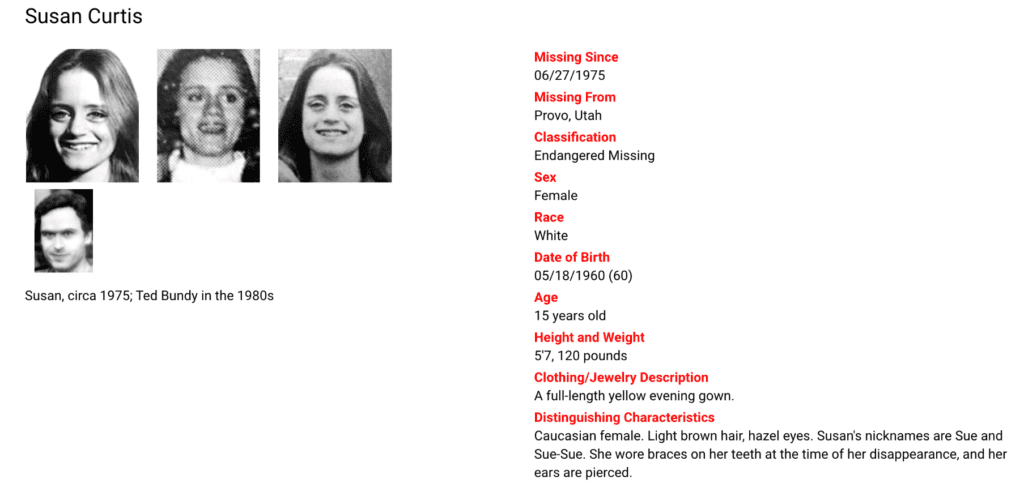
Susan Curtis Missing
Photo Courtesy: The amazing Charley Project

The year after Ted Bundy’s confession, my father and I searched for one of his victims near my hometown, this was where Bundy had stated he buried Sue Curtis. At the time of her disappearance, Sue had been attending a youth conference at Brigham Young University in Provo. According to reports, she had ridden her cycle 50 miles to attend the two-day conference. She was never seen after Day One, when she attended a banquet with some friends and told them she’d be back after brushing her teeth. She had new braces and wanted to clean them. It was less than half a mile from the banquet hall to the dorm they were staying at. Authorities believe Sue never got to the dormitory; her toothbrush was dry.

I began my search journey young but was not much younger than Sue was when she went missing when I began searching for her remains. Even though I had watched my loved ones on these searches for most of my life, it wasn’t until that moment that I realized how important SAR/Recovery was to the families of the missing and to the community at large.

Sue’s body was never found. It’s been more than 30 years, but I keep meaning to go back to where Bundy told us to look and look some more. Those memories stayed with me, always in the back of my mind, as I continued my education, completing my MS in Forensic Science at the Henry Lee College of Forensic Science. I wanted to make a difference; live up to a family legacy of service and help other families.

Soon after graduating with my masters, I returned to Utah and began researching opportunities. I joined the oldest and largest SAR team in the state of Utah as a canine handler and immediately found my calling, even as I worked on honing my skills and networking with other searchers and law enforcement.

Out In The Cold: Cases Waiting For Someone To Care

Twelve years after I began my career as a canine handler, two other canine handlers and I began discussing what we believed was a gap in the services we were providing. We were deploying on many searches looking for the lost, the suicidal, the missing, but we weren’t spending any time or resources on cold cases, even though families had come to us asking for help. With finite resources and always short on time, everyone simply prioritized emergent cases over those which had gone cold.

We saw this as an opportunity to make a difference on our own time and dime. We began strategizing on how we could manage a cold case caseload, and those meetings led to what is now Fide Canem Cold Case, Inc. We are the first and only cold case canine recovery team in the state of Utah and one of a mere handful in the nation.

Since the inception of Fide Canem Cold Case, Inc. in 2017, both interest in cold cases and the desire amongst law enforcement to solve them has increased manifold. We have gone on to partner with the Cold Case Foundation and the American Investigative Society of Cold Cases. These partnerships, along with law enforcement collaborations, have allowed us to consult and deploy on multiple cases world-wide.

No two cold cases are ever the same, whether for a missing child in the wilderness, an older adult suffering a medical issue in an urban setting, a suicidal individual, or the victim of a homicide. Each search is as different as the missing person is and requires in-depth case research prior to deployment.

Brett Sayer poses with Halo, his black Labrador Retriever

Boots & Paws Deployment — How This Process Works

Utilizing our skills in lost person behavior, crime scene analysis, psychology, psycholinguistic profiling, criminology, forensics, navigation, digital forensics, victimology, and search and recovery, we complete a deep dive into each case prior to setting boots and paws on the ground.

Completing this allows us not only to prepare for deployment but also determine the probability of finding the missing person, when it’s a possible rescue, not a recovery. We scrutinize every piece of information available including but not limited to case files, prior GPS or search data, digital data, satellite maps of the area, and victimology. Sometimes the smallest piece of information, such as whether the person was left or right-handed, can lead to the recovery of the missing person (left-handed people often make left turns when lost while right-handed people tend to go right).

Once our in-depth consultation is complete, a determination regarding deployment is conducted in conjunction with the investigating law enforcement agency. If a boots and paws deployment is deemed necessary, the next phase begins. Fide Canem Cold Case, Inc. is willing and able to deploy to any location to complete a search and recovery mission. No case is too cold, no location too far.

“What defines Search and Recovery success?”

Recovering the missing person is understandably the outcome any search team is seeking when they deploy. However, there are other types of success which may be less apparent. For example, some cases are too dangerous for human or canine search. These cases also include areas where the probability of detection is minuscule, including places like unstable mine shafts and caves. Determining the probability of detection in these cases can help law enforcement prioritize cases where recovery is possible.

Another unconventional type of success is providing canine assistance simply to clear an area. Clearing an area means utilizing canines to determine the missing person is not within the boundaries of a specific area. This allows law enforcement and the Search and Recovery team to shift focus to other areas of interest where the probability of detection of remains could be greater.

However, the greatest success we experience as a team is simply providing our services to and engaging with families of the missing, whether it be consulting on a case, deploying or ultimately recovering a loved one. Families of long-term (what we call “aged”) missing persons cases often feel no one cares. We want to let them know we do, even when our efforts don’t always give them answers.  

Like in April 2019, when my fellow cold case canine handler and investigator, Bret Sayer, our canines, Halo and Uintah, and I took the red eye from Utah to New Mexico to search for the partial remains of a mother who was tragically murdered in 1986. You want a glimpse of the crazy life of a cold case investigator, this is it. After working full days at our day jobs — Bret works in security while I’m a Fatality Review Specialist for the state — we met at the airport, landed in New Mexico at 2:00am and then drove six hours to the search location to meet with the Cold Case Foundation.  

We had had no sleep and were running on adrenaline. When we got there, we learned the search area was much larger than anticipated and the winds were very strong. We also discovered that the entire center section of the search area had been excavated to provide materials for the construction of a nearby roadway. This required a quick pivot in our search strategy, so Bret and I surveilled the area, quickly redeveloped our search strategy and deployed into the field as quickly as possible.

We searched the area for the remainder of the day and much of the second. While our canines had some alerts in one particular section, nothing materialized. We subsequently learned our canines had found the area where some of her remains had previously been recovered but were unable to recover any additional remains. Before leaving the area though, we met with the daughter of the homicide victim. She had observed the search both days and had provided all the information she had gathered on her mother’s case. Rather than being upset, she told us, “No one has even said my mom’s name for the last 35 years. Now you are all here. You care.” While we may not have been able to recover additional remains, she saw how hard our canines searched and was grateful we were willing to drop everything to assist. Her words moved us, incredibly.
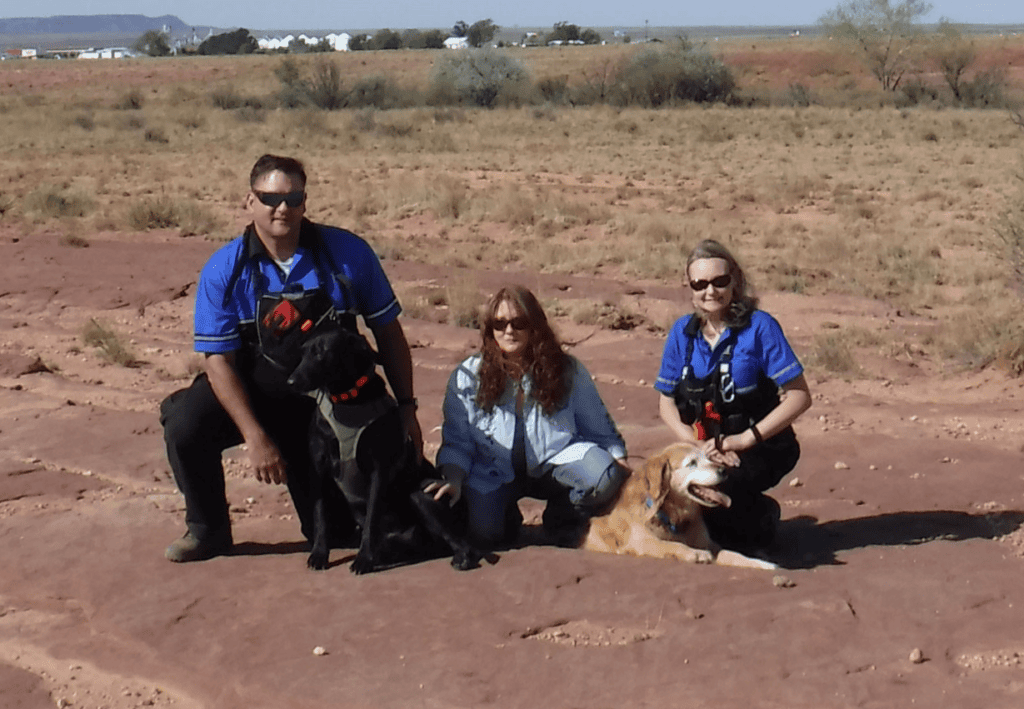
Bret on the left with Halo, and Kacy on the right with Uintah, meet with Sam, the daughter of a woman whose partial remains they were searching for in New Mexico

A Long And Winding Road We’ve Chosen 

When I first started my canine search and rescue career, my mentor said to me, “If searching was easy, everyone would do it.” I’ve worked on innumerable cases, and it’s difficult, complex work but the precious times we can make a difference are worth all the heartbreak and effort. Uintah, my long-term partner who passed away this past May, had three finds in her career, all recoveries, one on land and two in water. A Golden Retriever, she was my whole world and the reason I became a handler. We were partners for over 14 years.

While I can’t discuss other cases because they are still open, I can say pouring over case files, developing search strategies, deploying for days, and still not recovering remains isn’t easy. But however hard it is on us, it’s much harder on the family living a nightmare.

Our canine teams are certified in wilderness rescue/recovery, urban rescue/recovery, disaster rescue/recovery, avalanche rescue/recovery, and evidence detection, location and recovery. We train in real-world scenarios to ensure success. Training to locate human scent in any form allows us to be prepared for all potential rescue and recovery possibilities. Working with minute sources, we are able to search for and recover even the smallest human remains, often as small as one human tooth.

We train for every possible Search and Recovery scenario, urban to wilderness, avalanche to desert, water to what’s buried. Working with AirMed (the University of Utah’s medical helicopter team), we ensure we can reach remote locations, including those requiring advanced technical and rappelling skills to reach. Our human team members have advanced degrees in criminalistics and forensics and are crime scene certified. Our extensive experience with law enforcement and case consultation allows for detailed case review, consultation, and cadaver dog assistance. We are uniquely qualified to assist with cold cases and critical incidents. In our world, no case is too cold, too far, or too difficult.

Fide Canem — Trust the Dog.

Author Bio: Kacy Robinson got her associate of science degree in Criminal Justice at the College of Eastern Utah and followed it up by certifying as a Crime Scene Analyst from the Utah Bureau of Forensic Services Crime Scene Academy. She also has a BA Communications through the University of Utah and an MS in Computer Forensics from the Henry Lee College of Forensic Science at the University of New Haven. While attending, she was the Lead Archivist on the Robert F. Kennedy Assassination Project. spent twelve years with the oldest and largest search and rescue organization in the state of Utah with her two canine partners, the late Uintah and Wahsatch, both Golden Retrievers.

In 2017, Kacy and search partner Bret Sayer established Fide Canem Cold Case, Inc., the first search and recovery team focused exclusively on cold case missing persons and evidence recovery. Bret is a Salt Lake City native who has worked in public safety and security for 20 years. As security manager for a major corporation, he oversees a team of more than 50 officers. Bret attended Weber State University in Ogden, Utah, with a focus on Criminology, Forensics, Chemistry and Laws of Evidence. He is a K9 Human Remains (Cadaver) Handler in tandem with Halo, his 6-year-old Black Labrador Retriever, and has been a search and rescue K9 handler for 8 years. He was assigned to be the callout coordinator and law enforcement liaison in deploying and activating search and rescue teams. Kacy and Bret can be reached here.

New Jersey Hospital Charged With Disability Discrimination

By a Biometrica staffer

Saint Clare’s Health, a division of Prime Healthcare Services that operates hospitals across 14 states in the U.S., was charged with disability discrimination by the U.S. Equal Employment Opportunity Commission (EEOC) on Feb. 8.

The EEOC said in a statement that Saint Clare’s violated federal law when it refused to accommodate a new employee’s sudden disability by delaying her start date, and withdrew her job offer instead.

Taylor McKay, who was pregnant at the time, was hired by Saint Clare’s Health as an EMS dispatcher. She completed a background check, drug test, and health screening and was scheduled to start work. However, McKay was hospitalized and diagnosed with preeclampsia, a pregnancy complication affecting the circulatory system, causing high blood pressure and risk to internal organs.

Five days before her start date – while in the hospital where she was induced into early labor due to her condition and was awaiting the birth of her son – McKay emailed Saint Clare’s human resource department about her diagnosis and induction and asked what steps she needed to take next.

Instead of the next steps, within hours she received a voicemail from Saint Clare’s withdrawing her offer of employment, even though she needed only the minor accommodation of delaying her start date by several weeks.

“The law requires that employers engage with applicants and employees to provide reasonable accommodations for disabilities. Here, the employer’s response was not engagement, but instead revocation of the individual’s job — a clear violation of the ADA,” said Jeffrey Burstein, regional attorney for the EEOC’s New York District Office.

After first attempting to reach a pre-litigation settlement through its conciliation process, the EEOC filed suit in U.S. District Court for the District of New Jersey.

“Such alleged conduct violates the Americans with Disabilities Act (ADA), which requires that employers engage with applicants and employees to provide reasonable accommodations for disabilities and prohibits employers from taking adverse action against qualified applicants and employees based on their disability,” it said in the statement.

A Grant From The Heart, The San Manuel Way

50 Small Businesses Receive $20,000 Grants Each In Partnership With IEEP

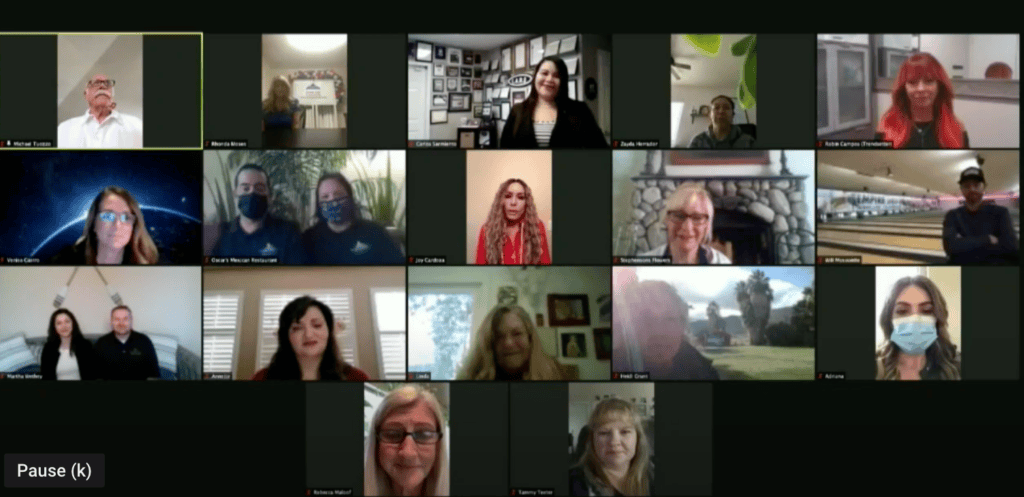
Some of the business owners that were among the 50 chosen for the San Manuel-IEEP grants watch on Zoom while the grants are announced. 

All images in this post are courtesy of the San Manuel Band of Mission Indians, via screen grabs from their YouTube broadcast of the Jan. 29, 2021 ceremony. 

By Michael Johnson

If you happen to glance at the San Manuel Band of Mission Indians’ website, these words greet you: “Since time immemorial, before the arrival of European settlers, the indigenous people of California lived in accordance with the environment, holding sacred everything the land provided.” On Jan. 29, San Manuel Business Committee member, Audrey Martinez, echoed that sentiment while talking about why the Southern California Tribe had decided to partner with the Inland Empire Economic Partnership (IEEP), for the San Manuel Cares $1 Million Small Business Relief Fund.

“It has always been our belief that we are stewards of this land and all its inhabitants. For most of the last century, we had little in the way of resources on our reservation,” said Martinez. “We were fortunate to find kindness and support from the people in San Bernardino County. As we grew and found ways to independently sustain ourselves, we never lost sight of our Yawa, as we found ourselves in a position to be able to bring aid to the community that once helped us.”

And help is what this devastated community of small business owners — restaurateurs and salon owners, mechanics and animal shelters, grocers, delis, wellness centers and therapists, even a bowling alley — needed. The term “Yawa” means “to act on one’s beliefs” in the Serrano language, and that belief was put into action when 50 small businesses received $20,000 each from the fund a few days ago.

With the pandemic in full swing through the majority of 2020 and now 2021, most non-essential small businesses have felt the effects.  Due to stay-at-home orders, business owners had to lay off most of their staff.  Some have even shut their doors forever. Suffice to say, the past year has not been a good one.

San Manuel Tribe Business Committee member, Audrey Martinez, kicks off proceedings on Jan. 29, 2021.

When Help Comes Calling

So, when the San Manuel Band of Mission Indians donated money to local area businesses, those businesses’ owners were appreciative. Business Owner Heidi Grunt of the 29 Palms Inn in Twentynine Palms, California, told Biometrica she was shocked by the phone call she received and was a little taken aback at first. “When somebody calls you and says they’re giving money away, you first think, ‘are you for real’?” Grunt stated.  She added, “it was pretty special,” and we “felt blessed.”

A great little coffee shop was also helped with the grant they received.  Owner Tansu Philip from Viva La Boba said as much to KVCR. “Getting this money was completely unexpected and a huge shock.  Honestly, I knew we were getting something but $20,000 is way beyond anything I could’ve expected or comprehended.  Honestly, I was really emotional when it first happened.  I can’t believe it, honestly.”

The San Manuel Band of Mission Indians Reservation is currently located on 900 sprawling acres of land in Southern California, at the San Bernardino Mountain Region’s foothills, north of the city of Highland and sixty miles from Los Angeles. Each of the 50 recipients had something in common in a community that, according to Paul Granillo, the president and CEO of IEEP, had seen 50% of small businesses negatively impacted by the pandemic. Each one desperately needed help.

“We are moved by their generosity,” he said, speaking of the San Manuel. “Covid-19 has been devastating to small businesses and what San Manuel has done is give cover to these small businesses. Fifty percent of small businesses in the Inland Empire have reported a negative effect from Covid-19. Some sectors have been disproportionately affected, namely, accommodation, food service, healthcare, and the social assistance industry have seen the most job losses and their number of hours of work decreased.”

The owners of Collision Auto Repair in the High Desert, Carlos Sarmiento and Valerie Ruiz, call into the event via Zoom to express their gratitude. 

Community Matters, People Matter

Tribal Chairman Ken Ramirez referenced the spirit of those that came before him in a short ceremony, part live and partly virtual, held to announce the recipients of the award. “This endeavor we are doing today is because of our ancestors. We should not forget that everything we do, the path we are on, has been charted by our ancestors, and so this is in honor of them today.”

The recipients of the grant money were chosen on the basis of two broad criteria. The first was that the business was already part of the San Bernardino County “COVID Compliant Business Partnership Program” and following Covid-19 safe practices. The next level condition was that the business was in a town or city bordering tribal lands, or in the ancestral lands of the mountains and high deserts.

At the center of this giving was the San Manuel Band of Mission Indians’ focus on community. Saying the grant was an extension of their philanthropy efforts, Tribal Secretary Johnny Hernandez Jr. said, “Our grant comes from our heart. We partnered with IEEP and communities across our territory to identify small businesses that could really use our help. An unexpected gift like this could be the difference between keeping the doors open or closing and losing the family business forever.”

Jovanna Rodriguez of Jovi’s Diner said her priorities were clear on what she would do with the money: “Bringing my employees back, putting my team together. One of the things that hurt me the most was that I had to cut my staff. Just bringing them back so they can support their families, and also putting it [the money] back into the business.” Rodriguez, who is born and raised in San Bernardino, said she was very grateful the Tribe was part of the San Bernardino community.

The owners of Collision Auto Repair in the High Desert, Carlos Sarmiento and Valerie Ruiz, agreed. “At the end of the day, it’s about community coming together and we are very, very blessed.”

Tribal Secretary Johnny Hernandez talks about the criteria involved in choosing the businesses.

A Philosophy Of Philanthropy

Through its San Manuel Cares program, the Tribe has supported more than 1,000 organizations since 2003. This includes a February 2020 $9 million gift to the University of Nevada, Las Vegas, to support research and education on tribal gaming operations and law. They have also given $1.3 million to UCLA, $5 million to Arizona State University, $25 million to Loma Linda University, $7.3 million to Mary’s Mercy Center, and $1 million to Indian Country Today.

San Manuel is one of the region’s largest employers, among the top 10 private employers in San Bernardino County.  They employ 4,000 people from the area. And this has much to do with the San Manuel Casino.

Starting in the mid-1980s as a successful bingo operation, the San Manuel developed a card room that also included slot machines in 1994. By 2005, the new San Manuel Casino was built.  The casino has a $550 million expansion project underway, including a 450-room tower hotel, a new event center with 3000 seats, a parking garage, and expanded gaming space. For now, though, as Chairman Ramirez stated, they’re focused on getting the community back on its feet. “We all look forward to the day when you can fully reopen your doors for good and welcome your customers back.  Until then, you have a hand up from San Manuel to cover expenses and keep your employees on the payroll.”

About the writer: Michael P. Johnson is a technology writer from the Greater Memphis Area. Mr. Johnson has almost two decades of experience in the casino industry, utilizing tech daily. You can read more about his work on his website, or reach him at michael@mpjwritesfreelance.com. You can also write to us: marketing@safience.io

‘Kids Are Being Abused, And It’s Our Job To Stop That’

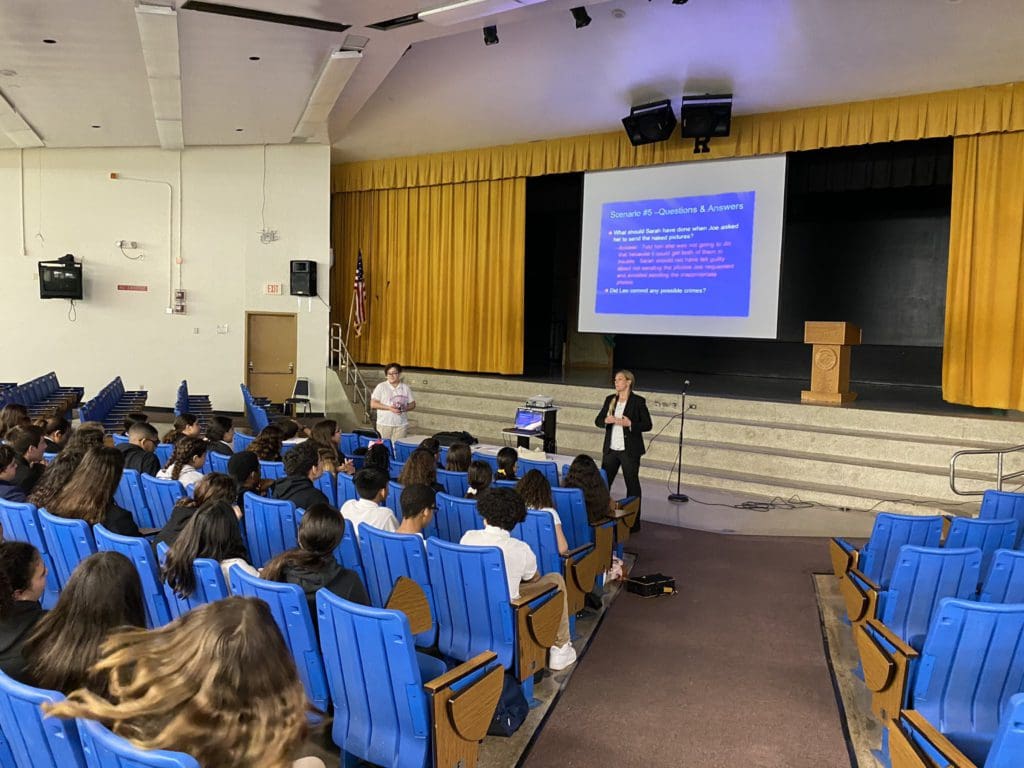
Photo Courtesy: Rockville Middle School, Miami’s, Facebook page showing Agent Laura at the school

By a Biometrica Correspondent

In February 2020, almost exactly one year to the day she was killed in the line of duty, FBI Special Agent Laura Schwartzenberger was doing what she loved — talking to middle-schoolers at Rockway Middle School in Miami, part of their 6th grade legal studies and forensic science class, about practicing online safety. She was fiercely dedicated to her mission and told the students she was there because they mattered. She would always say, “I feel that coming here and talking about the hard stuff means that I won’t see you guys on my end,” the school said in a statement on their Facebook page.  

Special Agent Schwartzenberger, 43, was killed along with her colleague and friend, Special Agent Daniel Alfin, on Tuesday, Feb. 2, while doing what was considered everyday work for the agents of Squad-18, part of the FBI Miami’s Violent Crimes Against Children section — executing a federal court-ordered search warrant in a crimes against children investigation in Sunrise, Florida, a community just northwest of Fort Lauderdale. Special Agent Alfin was 36.

As FBI Director Christopher Wray said at both their memorial services over this weekend, “When new special agents walk across the graduation stage at the FBI Academy in Quantico, they swear an oath confirming who they want to be and the kind of life they want to lead” — they make a promise to put service over self, to protect the American people and uphold the Constitution of the United States.

Special Agents Schwartzenberger and Alfin, both of whom were parents of young children, had committed their careers to something so much harder and more heartbreaking than protecting people at large: Their focus was on protecting the most vulnerable among us, our children, from the vilest of predators, a job that typically is high stress, takes a huge emotional toll, and has a high burnout rate. But they both strode on.

Athletic, Dedicated, Empathetic & Joyful

Special Agent Schwartzenberger joined the Bureau in 2005 and was stationed in Albuquerque, New Mexico for her first assignment. In 2007, she applied and became the first ever—and still the only ever—female FBI SWAT team member in Albuquerque. According to Director Wray, “to qualify, among other things, all potential SWAT team members must do two pull-ups while wearing a 25-pound weighted vest. Laura did five.”

“She was an athlete in body and mind,” he said. “Obstacle course races, CrossFit sessions — Laura was always moving. But she was an athlete in spirit, too. She had a sharp mental focus, stamina, and sense of teamwork and camaraderie that allowed her to keep moving forward, case after case and victim after victim. He said her athleticism and grit were only part of the reason she was picked. “The SWAT team also had to consider her personality. Was this someone they could spent hours, days, or even weeks with, in extremely close contact, during a crisis? Could they count on her in the most dangerous situations with their lives? The answer was a resounding yes.”

Three years on, and now a new parent, Agent Schwartzenberger transferred to Miami and the Violent Crimes Against Children Squad. It was here, the FBI said, that she found her true calling — keeping children safe. 

Brilliant, Funny, Persistent & Dedicated

Special Agent Alfin took a slightly different path to Miami. He entered on duty as an agent in 2009 in the bitter cold of Albany, New York. Agents there remember him as an energetic, incredibly motivated new agent who quickly found his focus — technology and tracking the quickly exploding world of online crime. In 2014, he moved to Linthicum, Maryland, where the FBI’s Crimes Against Children Unit is headquartered, and where he was part of the Violent Crimes Against Children International Task Force, training the FBI’s global partners and coordinating on global cases in a virtual world without borders. 

Shortly after getting there, in August 2014, the team he was on took down Steven Chase, a Florida man who created and built Playpen, what was believed to be the world’s largest child pornography website, with more than 150,000 users around the world at the time of its takedown. Playpen operated on the Tor network, and allowed members to upload and view tens of thousands of postings of young victims, indexed by age, sex, and the type of sexual activity involved. It was the Bureau’s most successful effort against users of Tor’s hidden service sites.

Following Chase and other administrators arrests, the FBI launched Operation Pacifier, on which Special Agent was the primary agent. It is the FBI’s most successful operation conducted on the dark web against online child sex offenders — ever. With the help of international partners, it resulted in 548 international arrests, with 296 sexually abused children identified or rescued internationally, 350 U.S.-based arrests, 25 producers of child pornography prosecuted, 51 hands-on abusers prosecuted, and the rescue or identification of 55 American children.

In 2017, Chase was sentenced to 30 years in prison. Special Agent Alfin’s team won a Director’s Award — the Bureau’s highest possible honor — for Operation Pacifier. He was brilliant and committed, but given his background, this was perhaps not unexpected. David Alfin, Daniel Alfin’s father, told the Washington Post his son was a graduate of Florida State University who came from a “family dedicated to public service.” Special Agent Alfin’s older brother works in law enforcement in South Florida, while his younger brother is a teacher at the U.S. Military Academy.

According to Director Wray, Special Agents Schwartzenberger and Alfin were not just colleagues, they were also “best friends,” who were also on the Miami dive team together, which involved searching for evidence with zero visibility in South Florida’s murkiest swamps and canals. Speaking of their deaths, Director Wray also had this to say: “We lost not one of our own, but two. Two warriors who took on one of the hardest jobs in the FBI, crimes against children. Two best friends who shared the same passion, the same determination, and—in spite of all they had witnessed in their extraordinary careers—the same sense of optimism and hope that comes from work that matters. Two of the very best the FBI had to offer.”

Their lives mattered. What they did mattered. Why did they do it? We’ll leave you with Special Agent Alfin’s own words from 2017. “It’s the same with any criminal violation: As they get smarter, we adapt, we find them. It’s a cat-and-mouse game, except it’s not a game. Kids are being abused, and it’s our job to stop that.”

Data Monday: Marijuana In The States

By Deepti Govind

Virginia may soon become the first of the Southern states to legalize weed in the U.S., and if so, it would also be the 16th state to fully legalize marijuana in the country. The state’s General Assembly voted on Feb. 5 to legalize marijuana in the state, and may just permit simple possession as soon as this summer, according to a Rolling Stone article.

In July 2020, Virginia had decriminalized weed in the state, which changed the way minor marijuana related offenses were viewed in the eye of the law. Offenses involving the personal possession of up to one ounce of marijuana were changed to a civil violation – punishable by a maximum $25 fine, no arrest, and no criminal record – rather than a criminal misdemeanor punishable by up to 30 days in jail, a criminal record, and the possible loss of driving privileges. 

The Virginia General Assembly also has a plan in place to open dispensaries from 2024 onwards. The measure now awaits the signature of Governor Ralph Northam, who has supported marijuana legalization in Virginia in the past. When legal sales begin in 2024, revenues will go toward pre-K and public health programs, addiction treatment and a fund to remedy the effects of the drug’s criminalization.

“If you want to help marginalized communities, here is an opportunity. This is an opportunity to invest in those communities that have been decimated by the so-called war on drugs and to give us an economic leg up. There are more deaths from legal pharmaceuticals … sold at your local CVS and Walgreens that cause way more deaths than anything that marijuana — cannabis — will do,” Del. Don Scott, D-Portsmouth, said prior to the vote, according to Rolling Stone.

Several legislative leaders across the country have been ramping up their calls for enacting marijuana legalization this year, whether it be for adult or medical use, according to a post on Norml.

State-wise Status Check

While 15 states and Washington D.C. have fully legalized marijuana use, several others have mixed laws with legal nuances. For instance, in Nebraska, any kind of marijuana use and possession is illegal but the addressing of offenses related to the use of pot has been decriminalized, which means it is viewed as a civil offense and not a criminal offense.

On the other hand, in Michigan where possession and use of marijuana is fully legal, if you are caught violating rules then you’ve committed a criminal offense in the eye of the law and are liable to be punished accordingly.

Below, we take a look at the laws and tell you what’s legal and what’s not, and whether any offenses are treated as civil violations or criminal violations in each state, sourced from DISA Global Solutions.

Green – Fully legal, no ambiguity in terms of usage regulations
Brown – Fully legal, no ambiguity; punishment not decriminalized
Pink – Legalized but rules either not yet in effect, or still require updates
Purple – Mixed rules (tighter or total restrictions around recreation use, or only certain forms of medical marijuana etc); punishment decriminalized
Gray – Medical use allowed; punishment not decriminalized
Red – Completely banned
Orange – Completely banned but punishment decriminalized
Yellow – Only CBD oil is allowed; punishment not decriminalized

Alabama            

Legal status: Fully illegal

Medicinal: No

Decriminalized: No

Note: Alabama may legalize marijuana soon. Read more here.

Alaska 

Legal status: Fully legal

Medicinal: Yes

Decriminalized: Yes

Arizona

Legal status: Fully legal

Medicinal: Yes

Decriminalized: Yes

Arkansas

Legal status: Mixed

Medicinal: Yes

Decriminalized: No

California          

Legal status: Fully legal

Medicinal: Yes

Decriminalized: Yes

Colorado           

Legal status: Fully legal

Medicinal: Yes

Decriminalized: Yes

Connecticut      

Legal status: Mixed

Medicinal: Yes

Decriminalized: Yes

Delaware          

Legal status: Mixed

Medicinal: Yes

Decriminalized: Yes

District of Columbia      

Legal status: Fully legal

Medicinal: Yes

Decriminalized: Yes

Florida 

Legal status: Mixed

Medicinal: Yes

Decriminalized: No

Georgia

Legal status: Mixed

Medicinal: CBD oil only

Decriminalized: No

Hawaii

Legal status: Mixed

Medicinal: Yes

Decriminalized: Yes

Idaho

Legal status: Fully illegal

Medicinal: No

Decriminalized: No

Read more

Illinois

Legal status: Fully legal

Medicinal: Yes

Decriminalized: Yes

Indiana

Legal status: Mixed

Medicinal: CBD oil only

Decriminalized: No

Iowa    

Legal status: Mixed

Medicinal: CBD oil only

Decriminalized: No

Kansas

Legal status: Fully illegal

Medicinal: No

Decriminalized: No

Kentucky

Legal status: Mixed

Medicinal: CBD oil only

Decriminalized: No

Louisiana

Legal status: Mixed

Medicinal: Yes

Decriminalized: No

Maine  

Legal status: Fully legal

Medicinal: Yes

Decriminalized: Yes

Maryland

Legal status: Mixed

Medicinal: Yes

Decriminalized: Yes

Massachusetts

Legal status: Fully legal

Medicinal: Yes

Decriminalized: Yes

Michigan

Legal status: Fully legal

Medicinal: Yes

Decriminalized: No

Read more

Minnesota

Legal status: Mixed

Medicinal: Yes

Decriminalized: Yes

Mississippi

Legal status: Mixed

Medicinal: Yes

Decriminalized: Yes

Missouri

Legal status: Mixed

Medicinal: Yes

Decriminalized: Yes

Montana

Legal status: Fully legal

Medicinal: Yes

Decriminalized: Yes

Nebraska

Legal status: Fully legal

Medicinal: No

Decriminalized: Yes

Nevada

Legal status: Fully legal

Medicinal: Yes

Decriminalized: Yes

New Hampshire             

Legal status: Mixed

Medicinal: Yes

Decriminalized: Yes

New Jersey

Legal status: Fully legal

Medicinal: Yes

Decriminalized: Yes

Read more

New Mexico

Legal status: Mixed

Medicinal: Yes

Decriminalized: Yes

New York

Legal status: Mixed

Medicinal: Yes

Decriminalized: Yes

North Carolina 

Legal status: Fully illegal

Medicinal: No

Decriminalized: Yes

North Dakota

Legal status: Mixed

Medicinal: Yes

Decriminalized: Yes

Ohio     

Legal status: Mixed

Medicinal: Yes

Decriminalized: Yes

Oklahoma

Legal status: Mixed

Medicinal: Yes

Decriminalized: No

Oregon

Legal status: Fully legal

Medicinal: Yes

Decriminalized: Yes

Pennsylvania    

Legal status: Mixed

Medicinal: Yes

Decriminalized: No

Rhode Island

Legal status: Mixed

Medicinal: Yes

Decriminalized: Yes

South Carolina 

Legal status: Fully illegal

Medicinal: No

Decriminalized: No

South Dakota   

Legal status: Fully legal

Medicinal: Yes

Decriminalized: Yes

Read more

Tennessee

Legal status: Fully illegal

Medicinal: No

Decriminalized: No

Texas

Legal status: Mixed

Medicinal: CBD oil only

Decriminalized: No

Utah

Legal status: Mixed

Medicinal: Yes

Decriminalized: No

Vermont

Legal status: Fully legal

Medicinal: Yes

Decriminalized: Yes

Virginia

Legal status: Mixed

Medicinal: CBD oil only

Decriminalized: Yes

Washington      

Legal status: Fully legal

Medicinal: Yes

Decriminalized: Yes

West Virginia    

Legal status: Mixed

Medicinal: Yes

Decriminalized: No

Wisconsin

Legal status: Mixed

Medicinal: CBD oil only

Decriminalized: No

Wyoming

Legal status: Fully illegal

Medicinal: No

Decriminalized: No

Cannabis, marijuana, hemp – what’s the legal difference?

Cannabis has been used across the world for ages, from the sites where prehistoric hunters and gatherers lived, to ancient China and Viking ships. The use of the plant originated thousands of years ago in Asia, and has since found its way to many regions of the world, eventually spreading to the Americas and the United States, according to an article in Live Science.

But there’s a difference between cannabis, marijuana and hemp. Marijuana and hemp both come from the cannabis plant, which has two familiar subspecies. Cannabis sativa, known as marijuana, has psychoactive properties. The other plant is Cannabis sativa L (The L was included in the name in honor of the botanist Carl Linnaeus), the article said. This subspecies is known as hemp; it is a non-psychoactive form of cannabis, and is used in manufacturing products such as oil, cloth and fuel.

Legally, hemp is defined as the cannabis plant in the Farm Bill of 2018 with one key difference: hemp cannot contain more than 0.3 percent of Tetrahydrocannabinol THC (the compound in the plant most commonly associated with getting a person high). In short, hemp can’t get you high, according to an article on Brookings.

Any cannabis plant that contains more than 0.3 percent THC would be considered non-hemp cannabis—or marijuana—under federal law. Cannabidiol (CBD) is a non-intoxicating compound found in cannabis. The Farm Bill ensures that any cannabinoid—a set of chemical compounds found in the cannabis plant—that is derived from hemp will be legal, if and only if that hemp is produced in a manner consistent with the Farm Bill, associated federal regulations, association state regulations, and by a licensed grower. All other cannabinoids, produced in any other setting, remain a Schedule I substance under federal law.

More Legal Firepower Proposed In Battle Against Child Abuse

By Charlotte Spencer

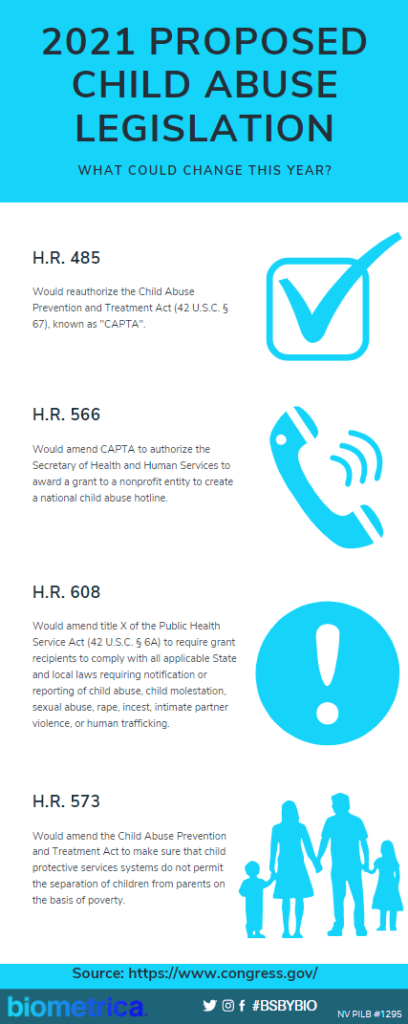
The House of Representatives currently has four pieces of legislation before it aimed at better handling child abuse so far in 2021. Of these, one is a reauthorization of the Child Abuse Prevention and Treatment Act, two are proposed amendments to this act, and one is a proposed amendment to the Public Health Services Act. Here is a brief overview of how these proposed laws could change how we address child abuse in the U.S.

H.R. 485

This would reauthorize the Child Abuse Prevention and Treatment Act (42 U.S.C. § 67). This act covers a lot of subtopics within child welfare including, but not limited to, abuse, neglect, adoption, addiction-related issues, child abandonment, and homelessness. It also includes details on research programs, grants, other government programs, and other miscellaneous items.

For more on this act, known for short as CAPTA, click here. For the full text of CAPTA prior to the proposed amendments mentioned below click here.

For full text of the proposed reauthorization when it becomes available, click here.

H.R. 566

If made law, this would amend the Child Abuse Prevention and Treatment Act to authorize the Secretary of Health and Human Services to award a grant to a nonprofit entity to create a national child abuse hotline.

For full text when it becomes available click here.

H.R. 608

If made law, this would amend title X of the Public Health Service Act (42 U.S.C. § 6A) to require grant recipients to comply with all applicable state and local laws requiring notification or reporting of child abuse, child molestation, sexual abuse, rape, incest, intimate partner violence, or human trafficking. Under the current version of this act, grants can be awarded for addressing health services, preventative health, mental health, substance abuse, and related data infrastructure development.

For full text when it becomes available click here.

H.R. 573

If made law, this would amend the Child Abuse Prevention and Treatment Act to make sure that child protective services systems do not permit the separation of children from parents on the basis of poverty. In other words, those in poverty could still lose custody of their children, but not due to their poverty, only for other reasons.

For full text when it becomes available click here.

Scammers Wasted No Time During Pandemic, FTC data shows

By a Biometrica staffer

If you think scammers also took a break during the Covid-19 pandemic, think again! On Feb. 4, the Federal Trade Commission’s (FTC) said it received more than 2.1 million fraud reports from consumers in 2020. Imposter scams were the most common type of fraud reported.

Online shopping was the second-most common fraud category reported by consumers, propped by a surge of reports in the early days of the COVID-19 pandemic. Internet services; prizes, sweepstakes, and lotteries; and telephone and mobile services were the other fraud categories in the top five.

The scammers wore various hats ranging from that of a government official, to a known business, to a family member or friend, the FTC said in a blog post on the Top Frauds of 2020. Government and business imposter scams were also among the top categories of Covid-19 and stimulus related reports, proving that scammers follow the headlines, the blog added.

Consumers reported losing more than $3.3 billion to fraud last year, up from $1.8 billion in 2019. Nearly $1.2 billion of the losses were due to imposter scams, while online shopping accounted for about $246 million. Just over a third of all consumers who filed a fraud report with the FTC — 34 percent—reported losing money, up from just 23 percent in 2019.

With the pandemic came an increase in online shopping, and then a wave of reports about sellers failing to deliver on promises — or just failing to deliver, period. The FTC got more than 350,000 such reports. The phone is still the top way that scammers are reaching us — both through phone calls and text messages, the data also showed. There was a sharp increase in the number of reports saying scammers contacted them by text message. And, not surprisingly, many of these text messages were related to the pandemic. 

The FTC’s Consumer Sentinel Network is a database that receives reports directly from consumers, as well as from federal, state, and local law enforcement agencies, among other organizations. Sentinel received more than 4.7 million reports in 2020; these include the fraud reports detailed above, as well as identity theft reports and complaints related to other consumer issues, such as problems with credit bureaus and banks and lenders.

In 2020, there were also nearly 1.4 million reports of identity theft, received through the FTC’s IdentityTheft.gov website, about twice as many as in 2019.

Iowa Resident Pled Guilty To Sharing Sensitive Non-public Info

By a Biometrica staffer

Rachel Manna, an Iowa resident, pled guilty to posting the photographs and names of individuals assisting authorities with a narcotics investigation on her Facebook page, the U.S. Department of Justice said in a statement. She got this information from Danielle Taff, who was employed as a contractor paralegal by the U.S. Attorney’s Office for the Southern District of Iowa.

Manna, 33, from West Des Moines, asked Taff to obtain “non-public information” in the spring of 2018. On or about May 16, 2018 used her U.S. Department of Justice computer to access criminal files stored on the district’s shared electronic data storage drive, including reports of law enforcement interviews with at least two individuals who cooperated with the district in a drug-trafficking investigation.

Taff then used her cell phone to take approximately 30 photographs of the sensitive, non-public documents related to the drug-trafficking investigation. This information identified at least two cooperators in the drug-trafficking investigation by name and other personal identifiers.

After photographing the documents, Taff shared them with Manna, who subsequently posted the photographs with several individuals on Facebook. As a result, in October 2018, other individuals shared those photographs to a Facebook group dedicated to outing “snitches,” or law enforcement cooperators, in the Des Moines region.

Taff was assigned to the office’s Civil Division, where she worked exclusively on matters related to civil forfeiture and was neither required nor authorized to access files and information related to the district’s investigation and prosecution of criminal cases. The admissions were made in connection to the guilty plea. Taff pled guilty in November 2020 for her role in the scheme and is scheduled to be sentenced March 9. Sentencing for Manna is scheduled for Jun. 4.

The Department of Justice Office of the Inspector General, Chicago Field Division, is investigating the case. Trial Attorneys Erica O’Brien Waymack and Matthew Palmer-Ball of the Criminal Division’s Public Integrity Section are prosecuting the case.

Black. Child. Missing. Who Knows? And Who Really Cares?

By Gaétane Borders, Ed.S.

If you’re a missing African American child, you’re very likely to get less media coverage, and be an oft forgotten statistic, than a missing white girl. Girl at play photo: © Akesin – Dreamstime.com

African American children make up just 14% of the under-18 U.S. population, but account for almost 40% of all reports on missing children. The search for children of color is complicated by the stark disparity in media coverage, when compared to missing white girls.

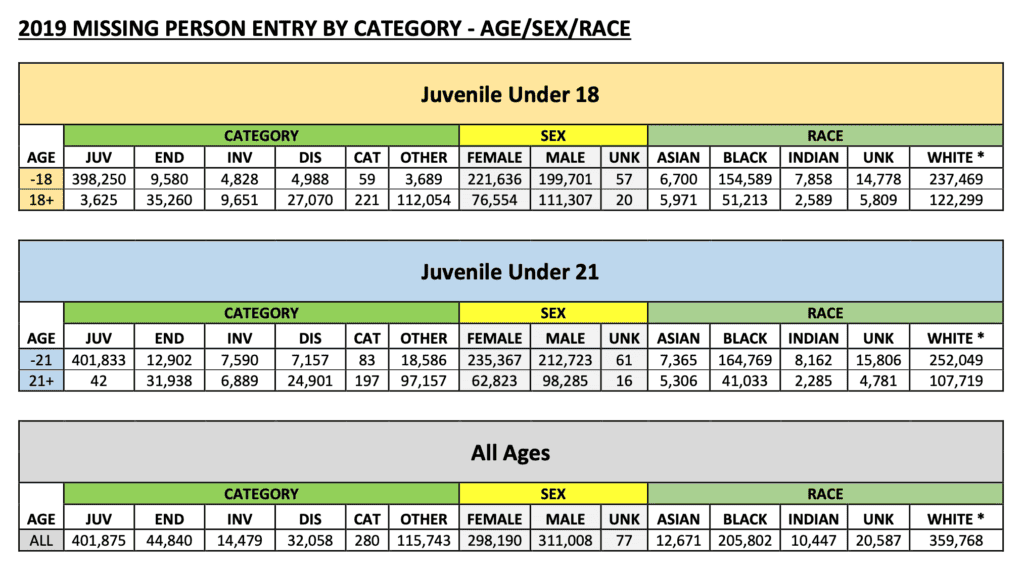
Research has shown that a child is reported missing roughly every 40 seconds, and that hundreds of thousands of children disappear each year. According to the FBI’s National Crime Information Center (NCIC), there were 421,394 entries for children under the age of 18 who were reported missing in the United States in 2019. When the 187,881 entries for missing adults was included, that number of entries for missing Americans jumped to a staggering 609,275.

The crisis of missing persons is not an unknown phenomenon. Holly Bobo, Elizabeth Smart, Natalee Holloway, and Caylee Anthony all became household names, largely due to the heavy media coverage around their disappearances. In contrast, most people are less familiar with names like Tarasha Benjamin, Raymond Green, Jessica Gutierrez, Christopher Dansby and Shane Walker, all of whom were children of color who disappeared without a trace, without the wall-to-wall media coverage that marked some of the other disappearances. 

A False Narrative

This disproportionality in media attention helps create a rather subtle form of misinformation — the implication that children of color are not victimized as often as Caucasian children. However, in actuality, children of color made up more than 40% of all missing person reports in the U.S. in 2019. More specifically, African American children accounted for almost 37% of all reports on missing children under the age of 18. Given that black children make up just 14% of the under-18 U.S. population, that is a horrifying statistic — and a terribly tragic one.

Despite these numbers, the mainstream media has historically lacked diversity in its coverage of missing persons. A 2005 study by the Scripps Howard News Service noted that 162 missing children cases were reported by the Associated Press between Jan. 1, 2000, through Dec. 31, 2004. The findings were that white children accounted for 67% of the Associated Press’s missing children coverage, and 76% of CNN’s. However, white children represented just 53% of the 37,665 cases reported to the National Center for Missing and Exploited Children (NCMEC). Conversely, black children accounted for only 17% of the AP’s coverage on missing children, and 13% of CNN’s, while making up 23% of cases reported to NCMEC.

A 2010 study by Pace University professor, Seong-Jae Min, and Rowan University professor, John C. Feaster, analyzed archived news segments from 2005-2007 for ABC, CBS, NBC, CNN, and Fox News. They concluded that the coverage of missing children cases was disproportionately based on race and gender. The study, “Missing Children in National News Coverage: Racial and Gender Representations of Missing Children Cases,” found that African American missing children were significantly underrepresented in news coverage when compared to national statistics. The study argued that “such things as newsroom diversity, news operation routines, media ownership, and commercial motives of media contribute to the race- and gender-related media bias.”

Source: The NCIC Missing & Unidentified Persons Statistics 2020. Numbers based on 2019 data.

The “Missing White Woman Syndrome”

Dori Maynard, the late president of the Oakland-based Maynard Institute for Journalism Education, an organization with a mission to promote diversity in the news media, also shared her opinion in the report. She is quoted as saying, “Often the assumption is that the white girls are quote-unquote innocent victims, whereas with poor children or children of color, there’s some nefarious activities involved.”

Social scientists have embraced the phrase “Missing White Woman Syndrome,” one ostensibly coined by Gwen Ifill, the late PBS anchor. It essentially refers to the media’s obsession with missing or endangered young, white women, while being far less interested, at least on the surface, in cases involving missing women of color, women from socioeconomically depressed backgrounds and missing men or boys.

The plausible reason why the media discrepancy has been so prevalent is likely due to a combination of factors. What makes it difficult to successfully conclude the cause are variables such as socioeconomic status and access to resources. However, what is absolute is that media coverage helps bring awareness to the missing. It increases the possibility that the case will be solved by a recovery.

One factor that greatly improves the likelihood that a missing child will get media coverage, whether print or tv, is if they are given an AMBER Alert, the early warning system to help find abducted children. However, each state’s AMBER Alert plan includes its own criteria that must be met. The PROTECT Act, passed in 2003, calls for the DOJ to issue minimum standards or guidelines for AMBER Alerts that states can adopt voluntarily. The Department’s Guidance on Criteria for Issuing AMBER Alerts is as follows:

1. There is reasonable belief by law enforcement that an abduction has occurred.

2. The law enforcement agency believes that the child is in imminent danger of serious bodily injury or death.

3. There is enough descriptive information about the victim and the abduction for law enforcement to issue an AMBER Alert to assist in the recovery of the child.

4. The abduction is of a child aged 17 years or younger.

5. The child’s name and other critical data elements, including the Child Abduction flag, have been entered into the National Crime Information Center (NCIC) system.

Amber Isn’t Color-Friendly?

Although the AMBER Alert is a fantastic and much needed tool that helps locate children, its criteria has been criticized as being non-inclusive for children of color. One major problem is that minority children are habitually precluded from the alert because they are often labeled runaways by law enforcement. Take, for example, Jholie Moussa, who was a 16-year-old from Alexandria, Virginia, described as conscientious and a fun-loving teen. Jholie was missing 14 days before her body was found inside Woodlawn Park, Mount Vernon, less than an hour from where she lived. Law Enforcement maintained for quite some time that they did not believe that Jholie was in imminent danger. In fact, she was typified as a “typical runaway” and did not receive an AMBER Alert.  Her ex-boyfriend was later charged and convicted of strangling her to death.

Phylicia Barnes is another of countless examples. She was an overachieving, young, college-bound teen with a straight A average.  She vanished on December 28, 2010, while visiting family members in Baltimore. Although it was frigid the day she disappeared and her coat and boots were found at the residence, police initially labeled her as a runaway. Sadly, her body was found several months later in the Susquehanna River, and her sister’s ex-boyfriend was subsequently accused of her rape and murder.

The RILYA Alert

It is because of these systemic concerns that Peas In Their Pods Inc. (PEAS) was created in 2007. The organization’s mission is to give a voice to the families of missing children of color because they are often unsupported or recognized. Since its inception, PEAS has worked with hundreds of families, and had been a part of countless successful recoveries.

It was just a few years after the formation of Peas In Their Pods Inc. that the staff realized the discrepancy in the dissemination of AMBER Alerts and decided to take action.  Capitalizing on the success and popularity of social media in 2009, the organization focused its efforts in spreading awareness by galvanizing the nation through that modality. It created an alert system called the RILYA Alert, a system that is inclusive and meets the needs of a community that had largely been ignored.

The inspiration for the name was Rilya Wilson, who was a 4-year-old child in Florida’s DCFS custody when she disappeared. She was missing for almost two years before anyone in that organization noticed. The alert is named in her honor because it is PEAS’s fundamental belief that everyone should be made aware when a child is missing, regardless of race, gender, socioeconomic status, or age. Moreover, every child should be considered a national priority once reported or labeled as a missing person.

Although the RILYA Alert gives a voice and needed attention to those who normally go ignored, there are still a few requirements:

• The abduction must be of a child age 17 years old or younger.

• The parent must have contacted law enforcement to report child missing.

• The law-enforcement agency believes the child is in imminent danger of serious bodily injury or death.

A RILYA Alert may also be issued if the child is classified as a runawayby the police. We recognize that at times, not all information is readily available (i.e., license plate numbers, name of abductor, or witness to abduction). In such cases, the available information will be reviewed and verified prior to RILYA Alert.

All children of color meeting the criteria for the AMBER Alert will also receive the RILYA Alert, since it is recognized that a significant disparity exists in how many children of color receive an AMBER Alert despite being in imminent danger. However, no missing child is excluded from receiving the RILYA Alert.

If the criteria are met, alert information is assembled for public distribution. This information may include descriptions and pictures of the missing child, the suspected abductor, and a suspected vehicle along with any other information available and valuable to identifying the child and suspect.

Community Matters, Coverage Matters

While PEAS is working diligently to help level the playing field, there is still so much that needs to be done to improve media coverage of missing minorities. The following are 5 factors that PEAS has identified as critically important in increasing the likelihood of acquiring the media’s attention:

  • Families must feel supported by law enforcement when they are called upon.  The tone of the officers has a great impact on how the case is handled.  Looking at all of the factors before determining that a child was a runaway is paramount, since children labeled as runaways are not typically given an AMBER Alert.  In turn, news outlets will not focus on these cases. 
  • Families must also play an active part by following-up with law enforcement and providing all clues. Families should also not wait for the media, rather they should pursue them relentlessly.  Calling the news desk sometimes works. However, families will have greater success directly contacting reporters.
  • Parents should hold public gatherings where family members, friends, clergy, and supporters are invited. All in attendance should hold signs with pictures of their missing loved one. The local media is often looking for a story, and having events like these helps to give the family exposure.  This local exposure can also lead to national coverage as well. Typically families have no idea what to do when they find themselves in this tragic circumstance. Therefore, having the responding officers or the Detective assigned to the case share these tips with families would increase the likelihood that they will garner media attention.
  • Some families have limited resources (internet, cable, phone) which makes it a definite challenge for them to either contact media, or to be contacted by media. This happens more often than not. These families need an advocate who is able to reach out to television stations and be the point of contact. Communities often have nonprofit groups that would do this at no cost. Peas In Their Pods Inc. is one such organization.  (www.peasintheirpods.org). 
  • No change can be made without discussion. Therefore, one should not shy away from talking about this topic with others. Through this dialogue, you will likely discover that most people are unaware just how many missing children are of color. With this new knowledge, they, too, may begin to question why there is an inherent media bias.  The status quo is more apt to change if more people are actively engaged in making that change a reality.

About the writer: More than 10 years ago, counselor and educator Gaétane Borders began her advocacy for the families of missing children after speaking with a mother whose three children were abducted and ultimately murdered. She heads Peas In Their Pods, Inc. PEAS was founded in 2007 to give a voice to missing children of color and their families, and to fight against child abuse and sexual exploitation. You can reach Ms. Borders on Twitter @parentingpundit. You can also write to us: marketing@safience.io

Merida Group CEO gets 15 years for $150m healthcare fraud

By a Biometrica staffer

The CEO of the Texas-based Merida Group of hospice and home health entities was sentenced to 15 years in prison, on Feb. 3, for falsely telling thousands of patients with long-term incurable diseases they had less than six months to live. The patients were told this in order to enroll them in hospice programs for which they were otherwise unqualified, thereby increasing revenue to the company.

Henry McInnis, 50, of Harlingen, Texas was convicted by a federal jury in Brownsville, Texas, in November 2019 of one count each of conspiracy to commit health care fraud, conspiracy to commit money laundering, obstruction of justice, as well as six counts of health care fraud.

McInnis’s co-conspirator, Rodney Mesquias, 50, the owner of the Merida Group hospice and home health entities, was also convicted following the November 2019 trial. He was sentenced to 20 years in prison in December 2020. The sentence, from a federal judge also included paying $120 million in restitution. Two other co-conspirators have pleaded guilty and are awaiting sentencing.

From 2009 to 2018, McInnis, Mesquias and others orchestrated a scheme that involved the submission of over $150 million in false and fraudulent claims for hospice and other health care services. McInnis served as the top corporate officer and administrator and oversaw the day-to-day operations of the group, a large health care company that operated dozens of locations throughout Texas.

The Merida Group targeted patients with long-term incurable diseases, such as Alzheimer’s and dementia, according to a press release from the Department of Justice. In the course of the trial, investigators revealed that the defendants enrolled patients by falsely telling them they had less
than six months to live and sending chaplains to lie to them and discuss last rites when this was not the case.

McInnis had no medical training and worked previously as an electrician. However, he acted as the de facto director of nursing for the Merida Group. Witnesses at trial testified McInnis directed employees to admit unqualified patients to hospice and home health, keep unqualified patients on services for long periods of time, and fired and reprimanded employees who refused to participate in the scheme.

McInnis also oversaw and enforced a company-wide practice of falsifying medical records to conceal the scheme. Multiple witnesses testified that McInnis ordered employees to alter medical records to make it appear patients were terminally ill. In reality, some were employed or even participating in sporting events. The jury also heard that McInnis explained the purpose of the falsified records was to allow the Merida Group to pass insurance company audits.

As CEO, McInnis also adopted a policy that paid illegal kickbacks. They directed bribes to physicians under the guise of medical director fees to certify unqualified patients for hospice and home health. In some cases, they improperly offered payoffs to marketers in exchange for
recruitment of patients who could be placed on extremely expensive hospice services. 

“McInnis preyed upon some of the most vulnerable members of our society, including many who suffered from diminished mental capacity. Today’s significant sentence demonstrates the department’s continued commitment to pursuing individuals, at all levels of corporate management, who engage in criminal schemes that prioritize profits over patient care,” said General Nicholas L. McQuaid, Acting Attorney of the Justice Department’s Criminal Division.

“Families seek to give comfort and support to their ailing loved ones when all other medical options are gone. It is unconscionable and evil to prey upon the most vulnerable in our community to commit fraud against government-funded programs,” said Christopher Combs, Special Agent in Charge, of the FBI’s San Antonio Field Office.

The investigation that led to the convictions was conducted by the Department of Health and Human Services — Office of Inspector General, the FBI, and the Texas Health and Human Services Commission. The Fraud Section leads the Health Care Fraud Strike Force.

Since its inception in March 2007, the Health Care Fraud Strike Force, which maintains 15 strike forces operating in 24 districts, has charged more than 4,200 defendants who have collectively billed the Medicare program for nearly $19 billion.

The National Health Care Anti-Fraud Association (NHCAA) estimates that the financial losses due to health care fraud are in the tens of billions of dollars each year. A conservative estimate is 3% of total health care expenditures, while some government and law enforcement agencies place the loss as high as 10% of our annual health outlay, which could mean more than $300 billion.